
Direct answer. A pickleball warm up apparel manufacturer needs the wearer and use moment, intended under-layer, half-zip construction, layer ease, court-bottom pairing, team identity, size plan, packing unit and reorder records. Approve lateral movement, overhead reach, hardware, skin contact and the complete player or staff look on samples before production.
A warm-up product occupies the space around play: arrival, pre-session movement, time between matches, coaching, event staffing, travel or departure. It can support one team identity across several wearers, yet those wearers may not need the same fit, pocket or packing route. A player layer worn over a match top is a different product question from a coach top used while carrying balls, notes and a phone.
This guide is for pickleball clubs, brands, team buyers and tournament programmes developing a long-sleeve half-zip layer. It focuses on the product, its relationship to a skirt, skort or short, and the records needed for repeat orders. It does not replace the full player-list workflow in the custom pickleball uniforms guide or the broader assortment decisions in the private-label pickleball apparel guide.
Which role should the pickleball warm-up layer serve?
Name the main use before discussing fabric or price. “Warm-up” may describe a pre-match player layer, a between-match cover, a coach/staff identifier or a travel garment. One design can serve more than one role, but the buyer should rank the roles so the manufacturer can resolve fit and feature trade-offs.
Write a short role statement:
- Wearer: player, substitute, coach, staff or mixed group.
- Moment: arrival, warm-up, between games, sideline/coaching, travel or departure.
- Under-layer: bra, fitted tee, polo, dress bodice or other named garment.
- Movement: court movement, overhead reach, carrying equipment, sitting or repeated removal.
- Identity: club, team, event, sponsor or staff distinction.
- Distribution: individual player bundle, staff kit, retail unit or team bulk.
This role statement keeps the garment from becoming an undefined “long-sleeve shirt.” It also sets a factual boundary. Long sleeves and a half zip do not prove warmth, wind resistance, UV protection, quick-dry performance or another measurable outcome.
How should player, coach, staff and travel roles be compared?
The same colour story may cover several roles while the construction and evidence differ.
| Role | Fit relationship | Feature priorities to discuss | Approval evidence |
|---|---|---|---|
| Player warm-up | Fits over the named court top and may remain on during movement | Layer ease, shoulder rotation, cuff/hem stability, zip opening and removal | Layered movement sample with intended court garment |
| Between-match layer | Repeatedly put on and removed during event flow | Collar/zip handling, skin contact, pocket purpose and packability | Wear/removal sequence and bag/bench packing review |
| Coach or staff top | Visible team role, often worn longer and with carried items | Identifier placement, pocket contents, body/sleeve ease and alternate colour | Role-specific fit sample and equipment-carry review |
| Travel/arrival layer | Coordinates the group off court | Team colour, name/number, bottom pairing and distribution packing | Full-look review plus player/staff bundle check |
Do not assume one base sample proves every role. If players and staff use different silhouettes or pocket loads, identify separate fit and use evidence while preserving a shared identity system.
What must the half-zip construction record contain?
Control the neckline and front opening as a construction, not a styling note. Record collar shape and height, zip length, opening depth, tape colour, teeth/coil direction, slider and puller, top and bottom stops, placket or guard, seam route and reinforcement. Note how the collar should sit with the zip open, partly closed and fully closed.
The live Long-Sleeve Half-Zip Court Pullover & Pleated Skirt Set provides a visible direction with a short centre-front zip, stand-neck shape, long sleeves, contrast bands, a front-pocket direction and a coordinated pleated skirt. Its image does not confirm fibre content, exact pocket construction, inner shorts, warmth or other performance.
The top specification can include:
- front and back body lengths;
- chest, waist and hem measurements;
- shoulder, armhole, bicep and sleeve measurements;
- collar height and opening;
- zipper identity, length, placement and internal finish;
- cuff height and opening;
- hem or band construction;
- pocket type, opening, bag and securement, if selected;
- seam locations and skin-contact finishing;
- artwork, labels and size identification.
A tech pack brings these requirements into one controlled file. Attach the effective version to sample comments and later inspection instructions so the factory is not reconciling an image, email and roster with different revisions.
How much layer ease is needed for pickleball movement?
Layer ease is the room needed over the actual under-garment while preserving the intended silhouette. It is not a standard allowance that can be copied across every fabric, wearer or size.
Send the under-layer or its approved measurements. Review the warm-up sample over that garment through:
- overhead reach and serve-like arm position;
- lateral step and torso rotation;
- bend, split-step and ready position;
- elbow flexion and paddle-side arm movement;
- sitting between games;
- carrying a bag or ball container if relevant;
- opening, closing and removing the layer without catching the garment beneath.
Use measurable comments. “More room at the upper back” should become a named pattern or measurement change, its intended effect and the next sample evidence. The activewear fit-model brief guide helps teams define the wearer, base size, under-layer and review sequence instead of treating one person’s preference as the complete size standard.
Players, coaches and staff may use different ease. If the programme shares one pattern, confirm that the chosen fit works for the priority group. If it uses separate blocks, keep style and size identifiers unambiguous in the order, roster and packing files.
How should the top pair with a skirt, skort or short?
The warm-up top should coordinate with the court bottom without pretending that every bottom has the same construction. A pleated skirt, skort with an inner short, and training short have different waist, pocket, coverage and packing questions.
| Bottom direction | Pairing decisions | Sample relationship | Record to preserve |
|---|---|---|---|
| Pleated skirt | Top length, visible waistband, pleat/trim colour and logo balance | Reach and rotation without unintended bunching or pleat obstruction | Separate skirt measurement and colour/trim approval |
| Skort | Top-to-waist proportion, inner-short route and any ball-pocket location | Lateral movement, bend and access without top interference | Skort construction, pocket side and size pairing |
| Court/training short | Rise, waistband, pocket use, hem line and staff/player role | Movement plus carried-item review if pockets are used | Short specification and wearer-role assignment |
The pickleball skort manufacturer guide covers skort-specific waistband, inner-short, pocket and coverage decisions. This page keeps the focus on how a layer pairs with that approved bottom. Do not infer ball storage, inner shorts or coverage from the warm-up set image.
Decide whether top and bottom are sold or issued together, packed together but sized separately, or managed as independent units. That commercial choice affects SKUs, barcodes, roster columns, carton allocation and reorders.
Which fabric questions are safe to ask before evidence exists?
Describe required handfeel, surface, weight direction, stretch direction, recovery, drape, opacity where relevant, colour, care route and compatibility with the selected zipper, bands, pocket, logo and labels. Ask the supplier to present actual options and identify what remains subject to sample or test review.
Evaluate the sewn garment. Loose fabric cannot demonstrate collar shape, zipper behaviour, cuff recovery, hem balance, pocket drag or layer ease. If the main material changes after fit approval, reopen the measurements and movements affected by its stretch, recovery or bulk.
Avoid converting a use condition into a claim. A programme intended for cooler sessions does not automatically support a warmth statement. An outdoor event does not establish windproof or UV performance. A sport context does not prove quick-dry or moisture-management results. Those claims require a defined material/garment, applicable method, sample scope and evidence.
The buyer can use the custom activewear development route when material, pattern, fit or construction changes. Keep the decision project-specific; availability, MOQ, price and timing depend on the actual material and trim plan.
How should cuff, hem and pocket choices support the role?
Cuffs and hems influence movement and visual balance. Pockets change the front structure and can create different loads for players, coaches and staff.
For cuffs, confirm height, opening, material/finish, sleeve relationship, seam placement and recovery direction. Review whether they remain at the intended wrist position without excessive pressure or movement. For the hem, confirm body length, sweep, band/self-fabric route, side shape and relationship to each approved bottom.
For a pocket, state what it is expected to carry. A player may need no pocket during court movement. A coach may need a secure place for a phone, notes or small accessories. A front pouch, welt, side-seam or zipped pocket has different construction, symmetry and load questions.
Do not label a pocket “ball storage” unless its size, position, retention, access and movement use are actually designed and validated for that purpose. Record opening length, placement, bag depth, closure if any, reinforcement and intended contents, then review the sewn sample under the relevant load.
How can alternate colours distinguish teams and staff?
Build one identity system with controlled variants. The player layer may use the core club colour while coaches or event staff use an alternate body or contrast colour. The relationship should be intentional and documented.
Create a colour hierarchy:
- primary body colour;
- secondary or alternate body colour;
- collar, placket, cuff and hem contrast;
- zipper tape and puller;
- bottom colour and any pleat/side-panel accent;
- crest, wordmark, name, number and sponsor colours;
- label, hangtag, bag sticker and carton identification.
Approve colour on the actual selected materials and trims. Different surfaces may not match visually even when given the same digital value. Record whether the requirement is a match, an approved tonal relationship or a deliberate contrast.
Alternate colours need separate codes in the SKU and roster. “Coach version” in a message is not enough if the purchase order, artwork and packing files use only the player style code.
What team identity belongs in artwork, and what belongs in the roster?
Artwork defines the stable visual instruction: logo file, method under discussion, dimensions, coordinates, colours and placement relationship. The roster supplies variable information such as wearer name, initials, number, role, size combination and bundle code.
Keep a controlled row for each issued or personalised unit:
- roster ID;
- wearer name and role;
- top style, colour and size;
- paired bottom style, colour and size;
- name, number or initials;
- artwork/sponsor version;
- packing unit and distribution code;
- quantity and spare status;
- approval status and revision.
The full uniform roster may include more fields and event-specific relationships. This warm-up record only carries the data needed to make, identify, pack and reorder the layer and its approved pairing. Link it to the uniform master rather than duplicating conflicting files.
The private-label service overview can support logos, labels, hangtags, barcodes and packing. Printing, embroidery or another decoration route should be confirmed for the actual material, placement and artwork; no method or durability result should be assumed from another product.
What should the movement, hardware and wash sample prove?
Build the sample review from the highest-risk questions, not a generic wear note.
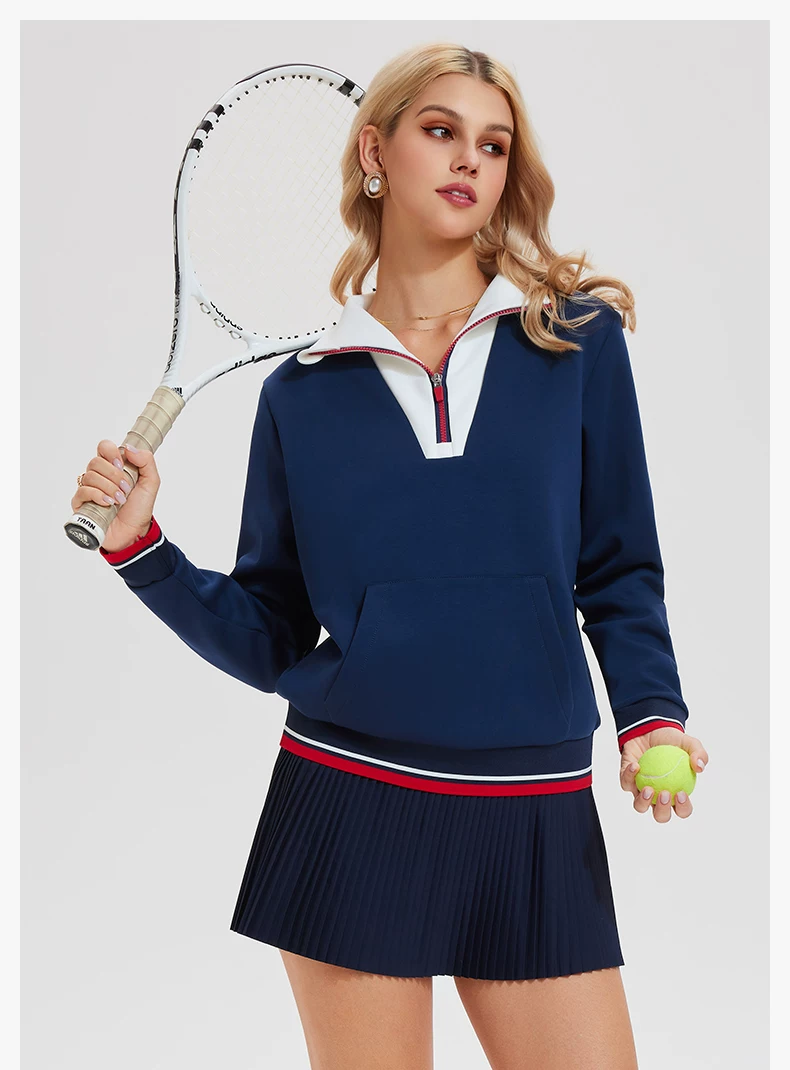
*Visible product direction only. Fabric, pocket, inner-short, performance and wash outcomes require project confirmation.*
Review movement over the named under-layer: overhead reach, lateral step, torso rotation, bend, ready position and removal. Review hardware at every intended zip position for operation, alignment, collar interaction, rough/exposed areas, internal finish and puller direction. Review skin-contact points at the collar, zip end, labels, cuffs, pocket edges and seams.
If wash or care evidence is required, agree the method, number of cycles, drying route, sample identity and observations before testing. Check the questions relevant to the approved garment, such as measurement change, colour appearance, zipper operation, band recovery, seam appearance, logo condition and surface change. Do not promise a result before the actual sample and method are reviewed.
The pickleball training and tournament apparel guide can help separate training, event and competition product roles. Event rules, sponsor permissions and destination requirements still belong to the buyer’s qualified review.
How should the size plan handle different wearer groups?
Use separate assumptions for players, coaches and staff, then decide whether one size chart and block can serve all groups. Record wearer profile, base size, range, points of measure and grading logic.
A point of measure (POM) is the named location and method used to measure a garment consistently. The activewear measurement specification and tolerance guide shows how POM, target, tolerance, method and sample version connect. The top and each paired bottom need their own record.
Do not force same-size top and bottom sets unless the programme has approved that relationship. If separate sizing is allowed, the roster and packing system must carry both sizes. If the buyer uses unisex, women’s, men’s or role-specific blocks, label them clearly so a size code cannot be misread across silhouettes.
A size set is a group of samples used to review the fit and measurement progression across the intended range. Prioritise sizes or wearer groups where layer ease, sleeve length, collar opening, hem position or bottom pairing creates the highest uncertainty.
What should QC inspect before the team order is packed?
Inspection should compare actual garments with released files and approved evidence. Project teams should agree the scope, method, sample basis and acceptance criteria.
Useful warm-up checkpoints include:
- style, revision, wearer-role colour and size;
- body, sleeve, collar, cuff, hem and zipper measurements;
- zipper alignment, operation, puller and internal finish;
- seam appearance, symmetry and visible workmanship;
- pocket type, position, opening, bag and securement;
- approved material and trim identities;
- club logo, name, number, sponsor and role marking;
- label content and placement;
- top-to-bottom colour/trim relationship;
- roster pairing, barcode and bundle code;
- fold, protection, individual packing and carton allocation.
The manufacturing and QC workflow connects brief, sample approval, bulk checkpoints and packing. It does not guarantee a result for a particular order. Preserve inspection observations and disposition decisions with the reorder record so repeated issues are not hidden by a clean new purchase order.
Which packing model works for players, staff and spares?
Choose the issue/distribution unit before generating barcodes or carton maps.
| Packing model | Useful for | Required controls | Reorder effect |
|---|---|---|---|
| Named player bundle | Personalised top plus approved court bottom | Name/number, two sizes, colour, bundle ID and contents check | Replacement may be player-specific |
| Role kit | Coach or staff top with role colour/marking | Role code, wearer size, pocket version and distribution list | Staff additions require the same role/version record |
| Separate garment units | Flexible sizing and independent replenishment | Individual SKU, barcode, size/colour and carton allocation | Top or bottom can be reordered alone |
| Generic team spares | Late joiners or emergency replacement | Unpersonalised status, approved spare sizes and controlled later branding | Personalisation/change must be separately released |
The activewear packaging checklist covers individual bags, identifiers, carton marks and receiving data. Confirm destination-market warnings, labels and import requirements with the buyer’s qualified local team.
Personalised pieces should not be mixed with generic spares without a clear identifier. Decide who owns late names, replacement approval and re-bundling if one component is unavailable.
What reorder record prevents a warm-up product from drifting?
A repeat order should start from a reconciled record, not memory. Preserve:
- effective tech pack and measurement specifications;
- approved pattern/block and size-set comments;
- material, band/rib, zipper, pocket and label identities;
- approved colours and alternate-role colour codes;
- artwork and variable roster versions;
- sample approval identity;
- quantity matrix, top-bottom relationships and packing plan;
- QC observations, accepted changes and unresolved issues;
- supplier/factory route and production notes;
- date and owner of the reorder comparison.
The activewear repeat-order production guide explains how to compare a new order with the previous approved reference. Current material or trim availability still needs confirmation. A saved product photo cannot prove that a zipper tape, knit, colour or label source remains identical.
For teams working across several partner production resources, keep one inPACE project record as the approved handoff. Coordination does not remove the need to identify the actual factory route, material source, sample version and inspection basis for the current order.
How should change control handle late names, colours or construction?
Classify the change before approving it:
- Roster change: name, number, role or wearer assignment.
- Quantity change: size/colour count or spare allocation.
- Artwork change: logo file, sponsor, dimensions or placement.
- Product change: fabric, fit, pattern, zipper, cuff, hem, pocket or bottom construction.
- Packing change: bundle, barcode, bag, sticker or carton allocation.
Record the requested change, affected SKUs/units, owner, date, commercial/schedule review, sample or proof required and approval. A late name may affect only artwork and packing; a new zipper or pocket affects product and sample evidence. Do not treat both as the same administrative update.
Freeze each released file and issue a new revision. If the club overwrites the original roster or tech pack, the factory may not be able to show which instruction governed a unit. Change control protects the buyer as well as the manufacturer.
What should a pickleball warm up apparel manufacturer receive?
Send a complete brief:
- Buyer, club/team/event, channel and owner.
- Player, coach, staff and travel roles with one ranked priority.
- Intended under-layer and paired skirt, skort or short.
- Reference images plus features that are fixed, optional or open.
- Top measurements and layer-ease direction.
- Collar, half-zip, cuff, hem, pocket and seam requirements.
- Material handfeel, surface, weight direction, stretch/recovery and evidence questions.
- Core and alternate colours with trim relationship.
- Logo, names, numbers, sponsors, labels and artwork versions.
- Size range, wearer groups, quantities and top-bottom pairing.
- Sample plan for movement, hardware, skin contact and applicable care review.
- QC plan, roster control, packing model, barcodes and carton allocation.
- Reorder baseline, change owner and open questions.
- Destination, documentation and target schedule for project discussion.
The garment production background associated with Yinshan Garments dates to 1986. That experience helps frame development questions, but it is not evidence of the current garment’s fit, material, performance, colour or wash result. Those decisions still require approved project records and samples.
Which route should the buyer use, and what comes next?
Use an existing-style/private-label route when the accepted silhouette and construction stay stable and the work focuses on approved colour, club branding, labels, roster identification and packing. Use factory-custom development when the material, pattern, fit, half-zip, collar, cuff, hem, pocket or paired bottom changes.
MOQ, price, sample cost and timing are project-dependent. Material and trim availability, colours, customisation, size range, quantity, sampling, evidence, packing, approvals and production planning all affect the discussion.
Before release, confirm:
- [ ] role, wearer and under-layer;
- [ ] effective tech pack and measurement specifications;
- [ ] material, zipper, cuffs/hem, pocket and labels;
- [ ] layered fit and movement evidence;
- [ ] hardware and skin-contact comments;
- [ ] core/alternate colours and bottom pairing;
- [ ] artwork and roster versions;
- [ ] size/quantity matrix and spares;
- [ ] QC checkpoints and packing model;
- [ ] reorder baseline and change-control owner.
Send the warm-up role, team and wearer list, layer reference, fit and hardware questions, colours, branding, packing and reorder needs through the inPACE Sports contact page. The first review should return confirmed assumptions, open evidence, sample priorities and project-dependent commercial inputs.
Product directions
Explore relevant activewear products
Use these product pages as practical references for your brief, then confirm materials, fit, customization, and production details through sampling.
Half-Zip Court Pullover & Pleated Skirt Set
Use this visible set direction to discuss half-zip construction, layer ease, cuff and hem details, court-bottom pairing, team colour and packing.
View product directionCustom Activewear Development
Choose factory-custom development when the warm-up layer needs a new fabric, pattern, fit, half-zip, collar, pocket, cuff, hem or paired bottom.
View product directionPrivate Label Activewear
Use the private-label route to plan team logos, names, role colours, labels, barcodes, player bundles and reorder identification.
View product directionFAQ
Buyer questions
What should a pickleball warm-up apparel manufacturer receive first?
Send the wearer roles, use moments, intended under-layer, reference style, layer-ease direction, half-zip details, paired court bottom, team colours, artwork, size/quantity matrix, sample questions, packing model and reorder requirements.
Can players, coaches and staff use the same warm-up top?
They can share a style only if the approved fit, pocket, movement, identity and packing decisions serve each intended role. If wearer needs differ, keep separate blocks, colours, features or role codes under one controlled team system.
How should a half-zip pickleball layer be sampled?
Sample it over the intended court garment and review overhead reach, lateral steps, torso rotation, bend, ready position, sitting, repeated removal, zipper positions, collar feel, cuffs, hem, pockets and all skin-contact areas.
Should the warm-up top be packed with a skirt, skort or short?
Pack it together when the team distributes a defined bundle and can control both garment sizes. Keep units separate when flexible size pairing or independent replenishment matters. SKUs, barcodes, roster data and carton allocation must match the model.
Does a long-sleeve pickleball shirt guarantee warmth or quick-dry performance?
No. Sleeve length and half-zip construction do not prove warmth, wind resistance, UV protection or quick-dry performance. Any claim requires defined materials, garment construction, an applicable test method, sample scope and supporting evidence.
How should alternate team and staff colours be controlled?
Give every body/contrast colourway and wearer role a clear style or variant code. Approve colours on the actual fabrics, bands, zipper tape, logos and labels, then carry the codes through artwork, roster, purchase order, packing and reorder records.
What records make a pickleball warm-up reorder safer?
Preserve the effective tech pack, measurements, pattern/block, materials, zipper and trims, colour approvals, artwork and roster, sample identity, quantity and packing matrix, QC observations, accepted changes and the new-order reconciliation.
Can MOQ, price and timing be confirmed from this guide?
No. They depend on material and trim availability, colours, product changes, branding, size range, quantities, samples, evidence, packing, approvals and current production planning. The supplier should evaluate the complete project brief.