
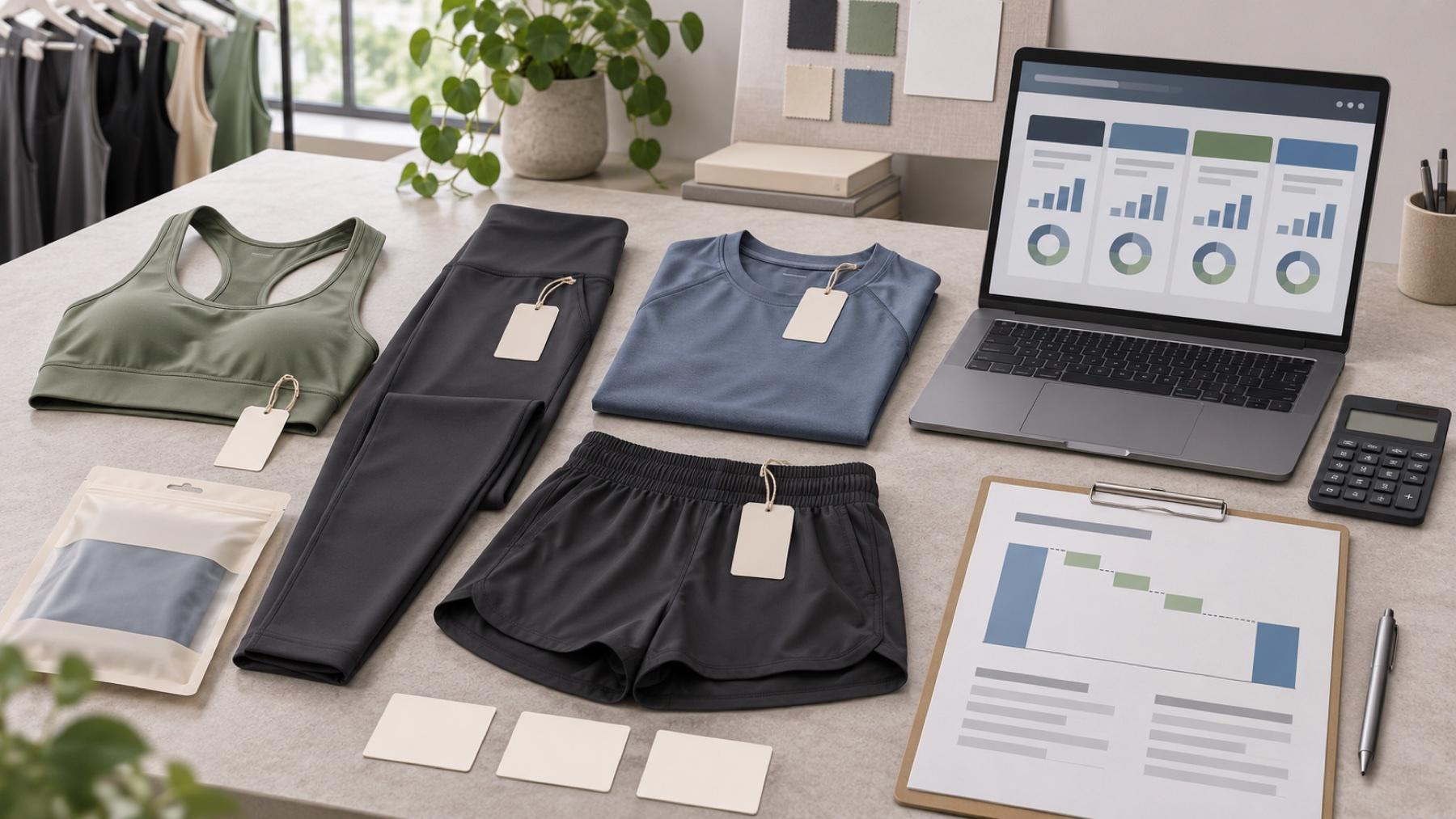
Direct answer. Activewear product profitability for ecommerce should be screened with a SKU-level margin bridge: expected net selling revenue minus landed product cost, channel charges, fulfilment, promotion, returns and avoidable complexity. Model Shopify, Amazon, Shopee and Lazada separately with current seller-account evidence. A channel can change the economics of the same garment, but no platform name proves that a SKU will be profitable.
This guide is for an activewear brand or online retailer deciding which product directions deserve sampling, a limited first order or deeper development. The primary route is small-batch custom: the buyer is testing a defined product and channel hypothesis before committing to a broader range. If an existing product direction already fits, a wholesale or light-custom route may reduce development scope; if fit, fabric, construction or features must change, use factory custom development. The supplier can help clarify product, sample, packing and order scope, but the brand remains responsible for channel fees, retail pricing, marketing, tax and its own profit model.
The goal is not to predict a winner. It is to expose what must be true for one style-colour-size SKU to earn another sample, listing, purchase-order or reorder decision. Start with the landed cost per activewear SKU guide when the receiving-point product cost is still unclear. This article begins after that cost definition and builds the channel contribution screen around it.
How should activewear product profitability for ecommerce be screened?
Use one comparable bridge for every candidate, then change the inputs that genuinely differ by channel. A useful screen starts with the revenue the seller expects to retain from one completed order—not the product page price in isolation—and subtracts the variable costs created by selling and serving that order. Keep fixed business overhead visible in a separate layer so the team does not mistake a positive unit contribution for a profitable company.
The following structure works as a first review:
| Margin bridge line | What the buyer records | Why it can differ by channel |
|---|---|---|
| Gross merchandise revenue | Actual selling-price scenario before deductions | Listed price, currency, tax display and promotion architecture can differ |
| Seller-funded reductions | Voucher, coupon, bundle, markdown or shipping subsidy funded by the seller | Campaign rules and promotional participation differ |
| Net item revenue | Revenue remaining after seller-funded reductions and relevant order adjustments | The calculation basis must follow the seller statement for that market |
| Platform and payment charges | Subscription, referral or commission, transaction, payment and programme charges that apply | Account, category, plan, market and programme participation affect the charge |
| Fulfilment and delivery | Pick-pack, storage, inbound, outbound, packaging, failed-delivery and related service costs | Merchant fulfilment, platform fulfilment and cross-border routes are not equivalent |
| Returns and allowances | Return shipping, processing, inspection, write-down, replacement or customer-service allowance | Apparel return behaviour and platform processes can change the cost path |
| Landed product cost | The approved sellable-unit cost at the brand's defined receiving point | Product, order size, packing, freight allocation and sellable denominator affect it |
| Contribution before fixed overhead | Net item revenue minus the variable lines above | This is a decision input, not a guaranteed profit result |
Do not force every line into a percentage. Some charges are per order, per item, per shipment, per storage period or based on dimensions and weight. Some are optional programme costs. A percentage copied from a blog post can understate the effect of a low selling price, multiple-unit order, dimensional fulfilment charge or return.
Record the source, market and effective date beside every platform assumption. Shopify explains that payment and transaction treatment can depend on the plan, location and payment provider. Amazon states that selling, referral, fulfilment and storage charges can depend on category, price, size, weight, inventory condition and service choice. Lazada's seller resources distinguish commission, payment, logistics and optional campaign or programme charges by market and seller setup. Shopee sellers should use the current fee, programme, fulfilment and statement resources inside the relevant local Seller Centre. These structures can change; the brand's own statement or official calculator is stronger than a generic rate copied into a permanent worksheet.
Why is a product page price not a margin forecast?
A product page price is only the top line of one scenario. It does not show what portion of a promotion is funded by the seller, whether payment charges use the item price or a different order base, whether shipping has been subsidised, or whether a platform programme adds a service charge. It also cannot show the product's received cost, return treatment or inventory ageing.
The same activewear set may appear to have a comfortable gap between retail price and factory quotation while still producing weak contribution after set packing, fulfilment, discounting and returns. The reverse can also occur: a simple product with modest ticket value may be operationally clearer because its pack, fit explanation, size data and reorder path are easier to control. The screen must compare the whole order path, not just the spread between retail and supplier figures.
Use three price scenarios rather than one precise-looking number:
- Base scenario: the ordinary price and promotion plan the brand currently expects.
- Pressure scenario: a deeper seller-funded promotion, a higher return allowance, less efficient fulfilment or a lower sellable yield.
- Recovery scenario: the approved price with fewer deductions or a better verified operating input—not an invented best case.
Each scenario should identify its evidence. If the seller has no history, label the values as assumptions and set an expiry or review date. The activewear startup budget planning guide can help keep cash commitments and operating reserve separate from the unit contribution calculation.
Which product inputs must be stable before comparing channels?
Channel comparisons are misleading when each scenario describes a different garment. Lock the product version, sales unit and packing basis first. A sports bra sold alone is not financially comparable with a coordinated set unless the worksheet explicitly accounts for the different product, pack and fulfilment unit.
For every candidate, record:
- Stable style code and revision.
- Garment or set definition.
- Intended wearer and use context.
- Approved or provisional material direction.
- Size range and size-level identifier.
- Colourways and colour-level identifier.
- Logo, label, hangtag and retail-pack scope.
- Unit dimensions and weight when available from the approved pack.
- Sample status and unresolved product questions.
- Proposed order quantity by style, colour and size.
- Receiving point and sellable-unit cost definition.
When several products are still under consideration, the activewear product-style selection guide helps buyers compare silhouettes and assortment roles before they apply channel economics. A catalogue image is a direction, not evidence of live stock, final specification or cost.
The Activewear Performance Collection can provide existing training-set, bra, one-piece and related directions for a buyer brief. The Yoga Activewear catalog provides a separate studio-oriented set of starting silhouettes when that use case matches the channel plan. A light-custom project can then define logos, labels and packing through the private-label activewear route. If the intended SKU needs a new fit, fabric, waistband, pocket, lining, closure or construction, document that change through custom activewear development before treating the product economics as final.
What changes between Shopify and a marketplace model?
A Shopify store gives the brand control over its storefront and much of the customer journey, but that does not make the transaction cost-free. The seller may have subscription, payment, app, fulfilment, carrier, warehouse, fraud, return, customer-service and marketing costs. The exact payment treatment depends on market, plan and provider. Use the current Shopify admin, pricing information and payout records rather than a universal percentage.
An Amazon, Shopee or Lazada marketplace typically adds a channel-specific statement structure. The seller may see category-based commission or referral charges, transaction or payment charges, fulfilment or logistics fees, storage, return or failed-delivery costs, programme charges and seller-funded campaign deductions. Which lines apply depends on the seller's market, account type, category, service route and campaign choices.
The practical difference is evidence ownership. For a direct store, the brand assembles data from its payment provider, warehouse, carrier, returns process and marketing systems. For a marketplace, part of that evidence is consolidated in platform statements, calculators or seller reports. Neither model eliminates the need to reconcile the order, product and cash records.
Use this channel comparison as a prompt, not a fixed fee table:
| Channel model | Evidence to collect | Frequent modelling mistake | Review question |
|---|---|---|---|
| Shopify or another direct store | Plan and payment-provider terms, payout data, warehouse and carrier quotes, app costs, returns and marketing records | Treating the absence of marketplace commission as zero acquisition or operating cost | What variable cost is created when this exact SKU is sold, fulfilled and returned? |
| Amazon | Current fee schedule or calculator, category assignment, fulfilment method, packaged dimensions, storage and returns data | Applying a headline referral rate while ignoring fulfilment, storage, inbound or return effects | Does the model match the product category, pack and service route actually planned? |
| Shopee | Local Seller Centre fee and programme information, statement fields, logistics route, vouchers and campaign participation | Copying a fee from another country or assuming every promotional tool is platform-funded | Which deductions and subsidies belong to this local account and campaign? |
| Lazada | Local or cross-border seller resources, commission and payment basis, logistics, campaign and programme records | Mixing local and cross-border structures or treating a temporary incentive as a permanent rate | Which market, store type, fulfilment route and programme produce each statement line? |
How should buyers model promotions without inventing demand?
Separate list price, ordinary selling price and campaign price. Then identify who funds each reduction. A platform voucher, seller voucher, bundle, affiliate incentive, free-shipping contribution and paid campaign can affect different statement lines. Do not subtract the same discount twice, and do not assume a platform-funded reduction reduces the seller's proceeds unless the statement rules say so.
Create a promotion approval record with:
- Channel and market.
- Campaign or voucher name.
- Start and end date.
- Eligible SKU versions.
- Displayed price and seller-funded amount.
- Additional programme charge, if applicable.
- Fulfilment or shipping condition.
- Expected contribution under the base and pressure scenarios.
- Owner who approves participation.
- Evidence to review after the event.
A brand with no sales history should not use the promotion to manufacture a positive forecast. Instead, define a maximum seller-funded reduction that keeps the SKU inside the brand's review boundary, then decide whether the commercial goal justifies that contribution. The objective may be customer acquisition, inventory release or learning, but the worksheet should show the cost of that objective.
How do fulfilment and packaging change an activewear SKU screen?
An activewear product's fulfilment cost can depend on the packed unit, not only the garment. A bra, folded legging and coordinated set can create different dimensions, weights, packaging and pick requirements. A padded cup, rigid gift box or multi-piece bundle may change the package enough to affect service costs or receiving work.
Confirm whether the model describes:
- Merchant-fulfilled orders from the brand's warehouse.
- A marketplace fulfilment programme.
- Cross-border direct delivery.
- Local inventory replenished from an import shipment.
- A third-party logistics provider serving several channels.
Then connect the pack data to the same approved product version. The activewear packaging checklist helps define labels, bags, set units, carton marks and receiving information. Do not use an early sample's dimensions as permanent fulfilment data when the approved material, fold, insert or sales unit later changes.
Shared inventory can reduce duplicate stock pools, but it adds allocation and data-control questions. If one warehouse serves Shopify, Amazon, Shopee and Lazada, the model should still attribute the channel-specific pick, shipping, return and programme costs. A shared physical unit does not mean each sale has the same economics.
How should apparel returns enter the decision?
Returns should be modelled as an explicit path, not a percentage hidden inside “miscellaneous.” Identify the reason categories the brand intends to track: fit, size expectation, colour expectation, product fault, changed mind, delivery issue or listing mismatch. These categories lead to different product, content and operational responses.
For a returned unit, record the potential costs of customer return shipping, platform processing, inspection, repacking, cleaning where appropriate, write-down, disposal, replacement and customer support. The actual path depends on the channel and item condition. Do not assume every return is resellable or every returned garment is a total loss.
Before launch, the brand can reduce avoidable uncertainty by improving:
- Garment measurements and measurement method.
- Fit model and sample-size explanation.
- Coverage and construction descriptions.
- Accurate colour and material information.
- Set-versus-single-unit clarity.
- Care information based on the approved garment.
- Product images that show relevant views without overstating performance.
These steps do not guarantee a return rate. They make the listing and product brief more coherent. If the SKU requires a new product, use the activewear sample-cost guide to decide which fit, material, construction and branding questions must be answered before the first order rather than after customer returns.
What does SKU complexity cost before the first sale?
Each style-colour-size combination creates a record that must be sampled or approved, ordered, labelled, photographed, listed, stored, fulfilled, reconciled and potentially reordered. The cost is not only the unit price. A broad launch can create more content work, fragmented purchase quantities, shallow stock, inconsistent size availability and difficult reorder decisions.
Score complexity separately from margin. A candidate may have attractive base contribution but require many variants, a difficult set pairing or a fragile campaign price. Another may show a lower initial contribution but create a clearer product story, more stable pack and easier reorder record. The brand should see both rather than allowing one margin cell to decide everything.
| Complexity area | Low-complexity direction | Higher-complexity direction | Evidence required |
|---|---|---|---|
| Product version | Existing or tightly defined product direction | New fit, material, structure or feature | Current specification and sample plan |
| Variants | Focused colour-size plan | Many colours, sizes or channel-exclusive versions | SKU matrix and rationale |
| Sales unit | One garment | Coordinated set, bundle or channel-specific pack | Pack definition and component identifiers |
| Branding | One approved mark and standard labels | Multiple artwork, placement or packing versions | Artwork and component approval record |
| Channel operation | One clear fulfilment and promotion route | Multiple programmes and campaign conditions | Current channel terms and owner |
| Reorder | Stable code, version and approved substitutions | Unclear version or changing components | Reorder file and change-control record |
For a limited first launch, compare a hero SKU, a compact capsule and a broader range. The activewear capsule collection sourcing guide explains how product roles can work together. The margin screen should then show whether each added style provides a distinct commercial or learning role that justifies its development and operating complexity.
How can a buyer compare a hero SKU, capsule and wider range?
A hero SKU concentrates attention on one product proposition. It still requires a deliberate size and colour plan, but the team can focus its sample, photography, listing and reorder process. A capsule introduces coordinated roles, such as bra, legging and layer, and asks whether customers buy them together or separately. A wider range can serve more use cases but also multiplies product and channel assumptions.
Build three scenarios with the same available cash and channel assumptions:
| Launch scope | Product question | Margin-screen advantage | Main risk to expose |
|---|---|---|---|
| Hero SKU | Can one product direction earn a clear listing and reorder decision? | Fewer product versions and concentrated evidence | Too much dependence on one fit or offer |
| Compact capsule | Do a small number of coordinated products earn separate or combined roles? | Tests cross-sell and assortment logic without a full range | Set pairing, shared colours and stock balance can complicate the order |
| Wider range | Can the brand support several product roles and channels at once? | More assortment breadth and merchandising options | Cash, content, inventory and replenishment complexity can hide weak SKUs |
The activewear manufacturer MOQ guide helps explain why the style, colour, size, fabric, branding and packing plan affects order feasibility. Do not insert an assumed minimum into the margin model. Use the supplier's project-specific response and keep the affected grouping visible.
What should trigger sample, order and reorder approval?
Use gates that correspond to evidence rather than confidence. A product can progress when the unresolved questions are visible and the buyer responsible for the decision accepts the remaining risk.
Sample gate
- Product role and intended channel are defined.
- Existing-style, light-custom or factory-custom route is clear.
- Fit, fabric, construction and branding questions are prioritised.
- The brand knows which margin inputs remain provisional until the product and pack are approved.
First-order gate
- Sample or selected-product evidence matches the intended listing.
- Size-colour matrix and sales unit are approved.
- Supplier quotation scope, packing and receiving point are identified.
- Current channel fee and fulfilment sources are dated.
- Base and pressure contribution scenarios meet the brand's internal review rule.
- Cash and operating reserve remain visible outside the unit contribution.
Reorder gate
- Sales, returns, discounting and statement deductions are reconciled by SKU.
- Product feedback is separated from channel or listing problems.
- Sellable inventory and incoming stock are visible.
- The same product revision can be repeated, or changes have a new sample and cost path.
- Reorder quantity follows verified variant demand rather than a total sales average.
The activewear repeat-order production guide explains how approved records, substitutions and replenishment decisions should carry into another production cycle. A profitable historical SKU is not automatically repeatable if material, fit, branding, packing or channel conditions change.
What should an activewear buyer send the factory?
Send the information that lets the supplier clarify the product and production side of the model. Do not ask a factory to certify the brand's platform margin. A useful brief includes:
- Product reference, sketch, tech pack or approved sample version.
- Intended wearer, use context and product role.
- Fit, size, coverage, structure and feature questions.
- Material direction and any evidence the brand needs.
- Proposed colour and size allocation.
- Logo artwork, placement, labels, hangtags and packing.
- Whether the unit is one garment, a set or a bundle.
- Estimated quantity by variant and the status of that estimate.
- Destination and receiving-point definition.
- Sample questions and approval owners.
- Channel-specific pack or identifier requirements that affect the physical product.
inPACE Sports can discuss product direction, sample scope, fabric and fit questions, branding, packing and the production brief. Sampling support can include printing, embroidery and wash effects when they are relevant to the confirmed project. Planning ranges such as 5–10 days for samples and 25–50 days for production apply only after scope and approvals are confirmed; exact timing, price, route and order conditions require project review. These factory inputs should enter the buyer's worksheet as dated project evidence, not as a promise of retail performance.
How should the profitability worksheet be reviewed?
Use a versioned worksheet with one row per SKU and one evidence register for channel assumptions. Do not overwrite old fee terms, campaign conditions or supplier versions. Preserve the effective date and link each scenario to the product and channel records used.
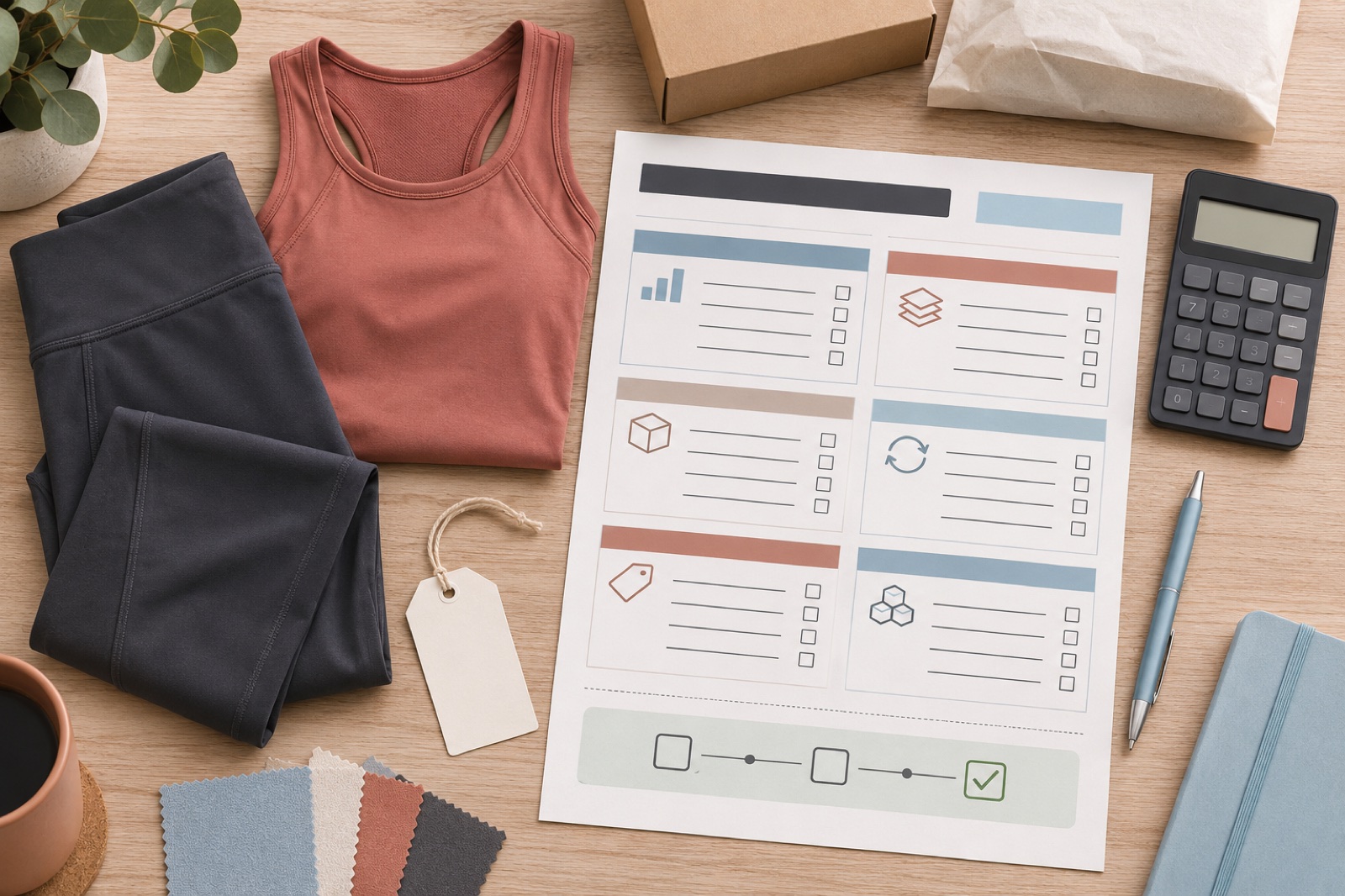
*Editorial planning illustration only. It does not show real platform data, inPACE sales results or a guaranteed margin outcome.*
Before approval, ask the following questions:
- Does every channel scenario describe the same product and sales unit?
- Is landed cost based on the intended receiving point and sellable denominator?
- Are seller-funded promotions separated from platform-funded reductions?
- Are platform, payment, fulfilment, storage and return lines sourced from the current market and account?
- Does the model avoid double-counting shipping, packaging or discounts?
- Are provisional assumptions dated and assigned to an owner?
- Is SKU complexity visible beside the contribution result?
- Does the pressure scenario show what happens when returns, discounting or fulfilment cost worsen?
- Is fixed overhead kept separate from the first unit-contribution screen?
- Are sample, first-order and reorder gates tied to evidence?
The strongest outcome is not the SKU with the highest optimistic margin. It is the candidate whose product, pack, channel and operating assumptions are clear enough to review—and whose pressure scenario still fits the brand's cash and risk boundary.
For a project discussion, share the selected product direction, intended channel and market, size-colour plan, branding and packing scope, sample questions and estimated quantities through the inPACE contact page. inPACE can review the garment-development and production brief. The brand should confirm platform, tax, finance, fulfilment, advertising and profit assumptions with its own current records and qualified advisers.
Product directions
Explore relevant activewear products
Use these product pages as practical references for your brief, then confirm materials, fit, customization, and production details through sampling.
Activewear Performance Collection
Use an existing training product direction to build a channel screen around a named garment, pack and size-colour plan.
View product directionPrivate Label Activewear
Define the logo, labels, identifiers and packing scope that belongs in the SKU and fulfilment assumptions.
View product directionCustom Activewear Development
Use the factory-custom route when fit, fabric, construction or product features must change before the SKU is approved.
View product directionFAQ
Buyer questions
What is activewear product profitability for ecommerce?
It is a SKU-level view of the revenue a seller expects to retain after landed product cost, channel and payment charges, fulfilment, promotion, returns and other variable selling costs. It is a planning result based on stated evidence and assumptions, not a factory guarantee or proof that the item will sell.
Can I use one fee percentage for Shopify, Amazon, Shopee and Lazada?
No. Charges can depend on market, seller plan or account, product category, fulfilment route, programme participation, promotion and effective date. Record each platform assumption from the current official seller resource, calculator or account statement and model the channels separately.
Should the factory quote be used as the product cost?
Only after the buyer confirms what the quotation includes and how it connects to the landed-cost definition. Freight, duties, receiving, packing or other items may sit inside or outside the supplier scope. Use a sellable-unit landed cost at a named receiving point for the channel screen.
How should returns be included for activewear?
Create an explicit return path covering shipping, platform processing, inspection, repacking, write-down, replacement and customer service where relevant. Use the brand's actual channel evidence when available. Do not assume every return is resellable or every return is a complete loss.
Is a hero SKU always safer than a collection?
No. A hero SKU can concentrate development and operating work, but it also concentrates risk in one product. Compare a hero, compact capsule and wider range using the same cash and channel assumptions, then review product-role value, variant complexity and pressure-scenario contribution.
When should a buyer use small-batch custom development?
Use it when a defined product needs physical validation before a broader launch and the buyer wants to learn from a controlled first order. Fit, fabric, construction, branding, packing and sample evidence should be clear. Small-batch does not imply a universal minimum, price or timetable.
What channel evidence should be dated in the worksheet?
Date the official fee or programme source, seller account or plan, market, category, fulfilment route, promotion terms, payment treatment and any relevant statement or calculator output. Assign an owner and review trigger so a changed platform rule does not remain hidden in an old forecast.
What can inPACE review in an ecommerce SKU margin project?
inPACE can review the product direction, customisation route, fit and fabric questions, sample scope, branding, packing, proposed quantities and production brief. The brand remains responsible for platform terms, retail pricing, marketing, tax, fulfilment and its own profit or cash model.