
What should a studio decide before choosing its merchandise?
A studio may want clothing that members can wear during class, an item that marks a shared event, or a branded piece for the journey home. Those purposes lead to different product decisions. A garment that photographs well beside reception might not answer the coverage, movement or size questions members raise when trying it on.
Start with one sentence describing who the range serves and when they would use it. For example, an independent Pilates studio might explore a top for regular attendees and an optional lifestyle item for members who already buy its accessories. This is a planning example, not evidence of demand or an instruction to order those products.
Record the intended sales setting as well. A staffed reception desk can support a sample try-on and explain sizing. A studio website needs reliable measurements and photographs because an instructor is not standing beside the customer. An event handover needs a clear collection list. The same garment can serve these settings, but its supporting information and packing may differ.
Use the yoga and activewear collection to identify product directions after defining that purpose. Avoid treating the whole catalogue as the opening range. Every additional style introduces another set of sample observations, size quantities and replenishment decisions for a team whose main work is running classes.
Choose an owner for the merchandise project. Instructors can contribute useful wear observations, while reception staff may know the questions members ask before buying. One named person should consolidate those observations and approve the supplier brief. Otherwise, a colour request from one instructor can accidentally become a production instruction before the studio owner has agreed.
How should a studio separate member gifts, event apparel, and paid retail?
A studio can use branded clothing in several member programmes, but the commercial and operational records should not be blended. A welcome gift is allocated to an identified group under a studio policy. Event apparel is tied to an occasion, artwork version, handover method, and often a fixed recipient list. Paid retail must give the member enough product, size, and purchasing information to make a decision. None of those uses proves demand for the others.
Define the programme before choosing the garment. If the aim is a member gift, record who is eligible, which approved item they receive, how sizes are collected, and whether the studio or member chooses the variant. If the aim is an event item, record the date or programme reference supplied by the studio, the exact artwork, the allocation list, and what happens to uncollected units. If the aim is paid retail, identify the sales location, selling unit, product description, size guidance, try-on process, approved price owner, and stock record. Pricing and member policies remain the studio's responsibility rather than a factory promise.
| Programme purpose | Product decision | Member-facing information | Record that prevents a misleading reorder |
|---|---|---|---|
| Welcome or programme gift | One approved item or a controlled choice that the studio can allocate accurately | Eligibility, available size or variant choices, collection method, and any studio policy | Gift issue by item and size, kept separate from member purchases |
| Event or community apparel | Garment and artwork linked to the named event or group | Event identity, collection point, recipient information, and approved garment description | Recipient allocation, event artwork version, uncollected quantity, and any transfer |
| Paid reception retail | A garment that staff can identify, explain, and issue in the correct variant | Product role, confirmed garment information, size guidance, selling unit, and studio-approved price or policy | Sales by item and variant, returns or exchanges recorded separately, and remaining stock |
| Online member shop | The exact version shown online, supported by approved product information and images | Product description, measurements or size guidance, available variants, packing unit, and studio-owned fulfilment terms | Order, cancellation, return, and available-stock records owned by the studio |
The same selected style can appear in more than one programme when the version remains suitable, but each allocation needs its own line. Fifty event handovers are not fifty retail sales. Ten staff transfers are not member demand. A reception display that receives compliments is not a purchase record. Keeping the channels separate lets the first-range review distinguish product interest from the way units were distributed.
Use this purpose record to keep the member range separate from the employee-uniform programme described in the gym clothing manufacturer guide. An instructor may wear a sample while teaching, but the staff fit, role wording, and replacement record do not establish that members want to buy the same version.
Which existing styles deserve a place in the first range?
Give each proposed item a job that a member can understand. Two visually similar tops may be unnecessary if both are intended for the same wearer and use. A second product becomes easier to justify when it answers a different question, such as a different coverage preference or a piece intended for arrival and departure rather than class.
Consider the halter-neck yoga top reference as a starting point for neckline, coverage and branding discussions. Its presence in a catalogue does not establish suitability for every member or movement. Review the actual sample and selected size; do not infer support or comfort from a front-view photograph.
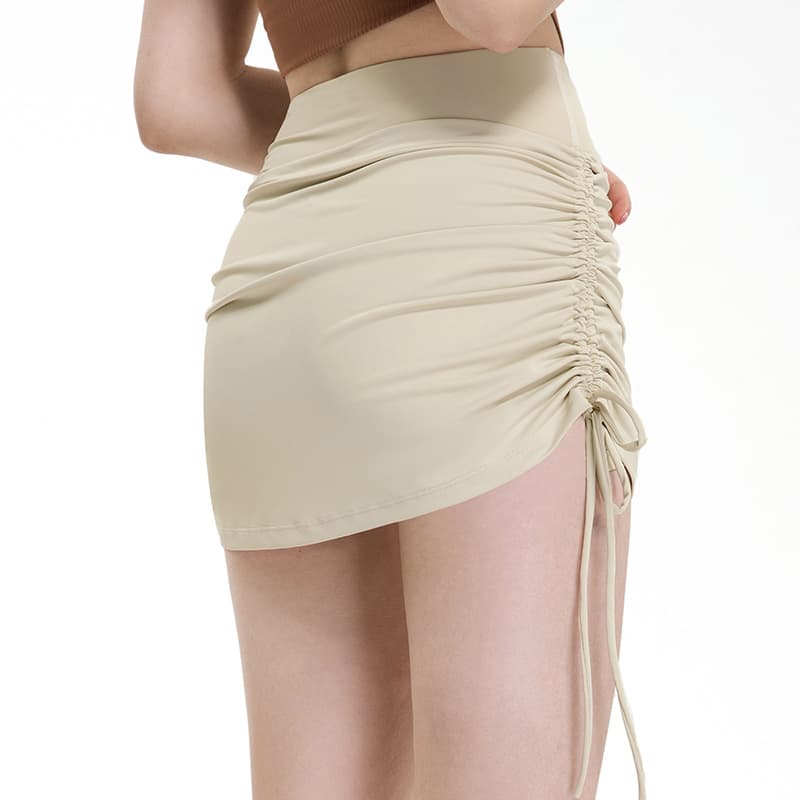
The ruched side-tie skirt reference could instead prompt a studio-lifestyle discussion. Decide whether that role fits the audience before including it. Confirm the garment construction directly, including any features relevant to use, rather than assuming that a skirt shown with activewear includes an inner short or is intended for every class format.
| Possible product role | Question to answer with members and samples | Information the studio should approve | Reason to leave it out for now |
|---|---|---|---|
| Class-use top | Does the selected shape provide the coverage and movement the intended wearer wants? | Exact style, measurements, size guidance and logo position | The sample raises unresolved fit or coverage questions |
| Class-use bottom | Does the waistband, length and movement suit the stated use? | Selected garment, fit observations and separate size quantities | It duplicates another item without meeting a different need |
| Arrival or after-class piece | Would members use it outside the exercise session? | Product role, appearance and member-facing description | The studio cannot explain why its audience would choose it |
| Event or community item | Is there a specific occasion and a clear recipient group? | Artwork version, allocation and collection details | The occasion is uncertain or the recipients are not defined |
This table describes possible roles, not a required four-item assortment. A well-understood single garment can be a more manageable starting point than a matching range with unresolved details. The useful limit is the number of products the team can sample, explain and track properly.
Separate instructor clothing from merchandise even when both use the same base style. Staff may need a distinct logo treatment or colour, and a staff allocation is not evidence that members want that quantity. Maintain separate lines in the order record so staff issue does not appear later as member sell-through.
When does private label stay within light customization?
For this studio route, begin with selected existing styles and discuss the available logo, label and packing options. The garment reference remains identifiable throughout approval. A request for a different fit, material, construction or functional detail can change the work into product development and should be reviewed separately.
The private-label service page is a useful starting point for that branding conversation. Send the actual reference and mark what you want to keep. A photograph annotated with “same shape, studio logo here” is more informative than a request for premium studio wear without a chosen garment.
Do not assume that adding a logo makes every other feature adjustable within the same arrangement. Ask whether the proposed application is suitable for the selected fabric and position, which label changes are available, and how the supplier will identify the final branded version. Confirm quantities and commercial details for that exact scope.
If the studio needs a new neckline, a revised waistband or a different fabric specification, use the custom activewear development route. Keep that request distinct from a straightforward branded existing-style order. Sampling requirements and the supplier's assessment should reflect the actual changes, rather than the project continuing under an inaccurate light-customization label.
Studios planning a broader gym clothing line can also use the gym clothing manufacturer guide to organise development questions. That broader project may be appropriate later. It does not need to be added to a member-merchandise launch simply because the studio has ideas for future products.
How should a studio separate “I like it” from useful purchase-intent evidence?
A positive reaction to a sample can mean several things: the person likes the colour, would enjoy receiving it as a gift, would wear it if the size were different, or would consider buying it under conditions that have not been defined. Those responses are useful only when the studio records what the person saw, tried, and was actually asked.
Use an identified sample version and keep five kinds of information separate:
- Product observation: what happened at a named garment area during the agreed try-on or movement.
- Personal preference: colour, silhouette, handfeel, branding scale, or styling preference stated by the participant.
- Intended use: whether the participant imagines wearing the item in class, before or after class, at an event, or in everyday activity.
- Purchase intention: a non-binding response tied to the displayed product version, proposed selling unit, known size/colour, and any studio-supplied purchase condition.
- Confirmed transaction or allocation: the studio's own record after an order, payment, reservation, gift issue, staff issue, transfer, return, or cancellation actually occurs.
Do not turn “I like it” into a unit forecast. If the studio asks about purchase intention, show the same garment version and provide only information the studio has approved. Mark unknown price, timing, size, colour, or availability rather than inviting the participant to assume them. A response collected before those points are known is not equivalent to a confirmed request.
The feedback form should identify the product reference, sample size and version, participant group, review setting, question asked, response type, specific observation, and any condition attached to the response. Personal identity is usually unnecessary in the supplier handoff. Consolidate anonymised garment observations separately from the studio's commercial planning data.
Sample feedback supports a product decision; it does not prove conversion rate, sell-through, support, comfort, durability, or broad market demand. The studio should decide whether the evidence is enough to keep the existing style, ask a defined supplier question, test another size or variant, choose another reference, or open a separate custom-development brief.
What should a member sample session actually check?
Before asking members to try a sample, decide which questions are still open. Useful observations concern the selected garment: where a seam sits, how a waistband feels during ordinary movement, whether the neckline remains acceptable to the wearer, and whether the available measurements explain the chosen size. General praise is pleasant but difficult to translate into an approval.
Invite observations from people relevant to the intended range, while keeping participation voluntary. A few instructors are convenient reviewers, but their preferences may not represent the members who will buy the merchandise. Note that limitation when interpreting the feedback. A sample session provides practical observations; it is not a formal performance test or proof of broad market demand.
Use the same observation form for each participant. Record the style, sample size, sample version, intended use and specific issue. Ask the wearer to describe what happened rather than simply rating the item as good or bad. “The top moved at this point during a reach” gives the team a question to investigate; “not flattering” needs a more precise explanation before it can guide a supplier.
Only collect the personal information needed to coordinate the session. Supplier feedback usually needs garment observations and measurements, not a member's identity or class attendance history. Anonymised notes can preserve the useful product evidence while keeping the handover focused.
Consolidate the results into one decision: accept the selected style, ask a defined question, or choose a different reference. Do not send several conflicting instructor messages as equal instructions. The sample feedback guide explains how to connect observations to a specific garment and revision so the supplier can respond to the actual issue.
When should the range use a large graphic, a small logo, or quieter everyday branding?
Branding scale should follow the product role and the actual garment, not the size of the studio's wall sign. A small mark may support repeated everyday wear without dominating the silhouette. A larger graphic can suit an event or community item when the audience and artwork purpose are explicit. A label-led or low-visibility treatment may suit a piece intended to work with clothing members already own. These are directions for review, not evidence that a method is suitable for every fabric or position.
| Branding direction | Useful member-range question | Physical sample evidence to review | Version record to keep |
|---|---|---|---|
| Small chest, hem, or back-neck mark | Should the studio identity be visible without making the garment feel like event apparel? | Measured scale and position on the selected size, relationship to seams and stretch, and appearance when worn | Garment version, artwork file, dimensions, colour, reference points, and approved image |
| Large front or back graphic | Is the item meant to carry a specific community, campaign, or event message? | Graphic scale across the garment, contact with seams or panels, appearance during wear, and the proposed application on the actual surface | Named programme, final artwork, garment/colour, application scope, approval owner, and superseded version |
| Role, team, or location wording | Does wording identify an instructor, team, club, or branch rather than a general member product? | Exact spelling, reading distance, placement, variable fields, and the difference between staff/event and member versions | Approved wording list, variable-data owner, allocation, artwork version, and reconciliation check |
| Label-led or quiet branding | Would the member use the garment more often if the external mark were limited? | Main-label, size-label, hangtag, and packaging relationship plus any small external mark | Label text/artwork, garment information, external-mark decision, hangtag, and packing version |
Large and small are not useful specifications on their own. Record dimensions and reference points on an identified sample. Review a worn garment as well as the flat sample, because panel shape, body position, and stretch can change the result. When the garment, size, colour, artwork, position, dimensions, or application changes, decide whether the physical evidence still applies.
Do not infer wear frequency or member preference from branding scale. The studio can ask whether a participant would use the item for class, travel, daily wear, or only the event, but that response remains a stated intention until the programme creates actual distribution or sales evidence. Keep that distinction in the feedback record.
How should the studio approve its logo and visual identity?
A studio logo must work at the proposed size and position on the garment. Fine lettering that looks clear on a wall sign may need review on a small garment application. Supply usable artwork and identify the approved mark, colour reference, dimensions and placement. Keep the artwork file version in the order record.
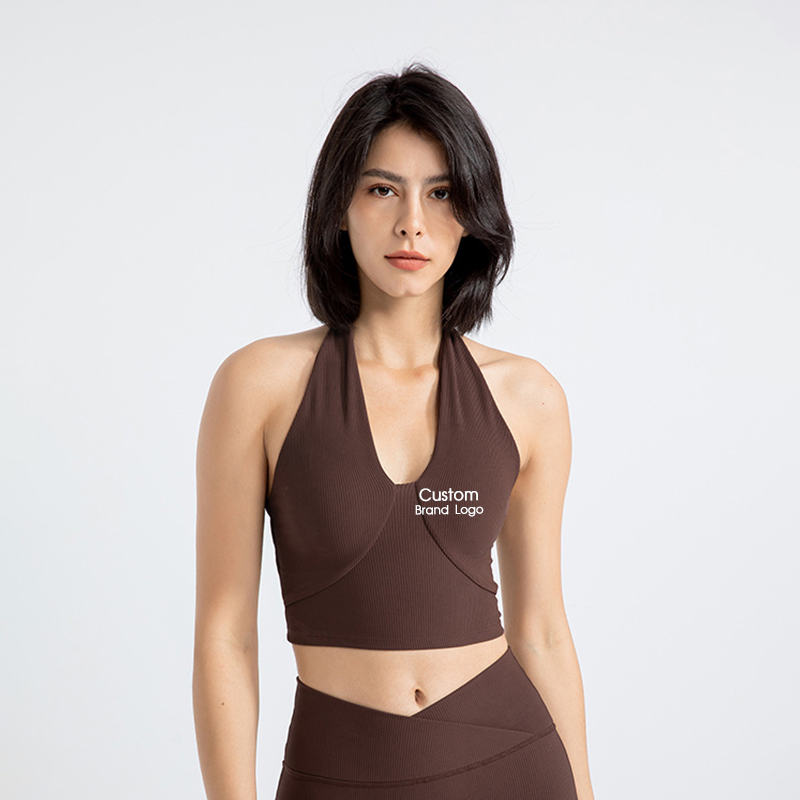
The catalogue image above includes a “Custom Brand Logo” placeholder. It illustrates a branding discussion only; it is not approved studio artwork or evidence of a tested application. The actual studio mark, method, placement and appearance need their own confirmation on the selected garment.
Discuss the intended logo method for stretch activewear with the supplier instead of choosing solely by a mockup. Consider the fabric, the area of stretch, contact with the wearer and the visibility the studio wants. Request confirmation of the relevant sample and review steps for the proposed method. Avoid making durability claims that the available evidence does not support.
Check the branding on a worn sample as well as a flat view. A mark that appears centred when the garment lies on a table may look different when worn. A placement that works on one reference can sit awkwardly on another because seam lines and panel shapes change. Record the approved reference points rather than relying on a screenshot with an unscaled arrow.
Decide whether staff and member products use the same artwork. If instructors need an identifier, give that version a separate code and approval image. Do the same for an event edition. Clear identifiers protect the core member range from acquiring a date, location or instructor-only message by mistake.
Which labels and packing details belong in the supplier brief?
Treat labels as product information as well as branding. Confirm the requested brand label, size identification and other product information with the supplier for the intended destination and sales use. Do not replace accurate care or composition information with a decorative studio message. Any destination-specific requirements should be checked for the actual product and market.
The private label activewear guide can help the team organise the relationship between the selected garment and its branded presentation. Keep the label text, artwork and location attached to that garment record. A generic “use our usual labels” instruction is risky when the studio has previously ordered only towels or accessories.
Define the selling unit. If members can buy a top and bottom separately, each needs its own size and stock identity. If the studio intends to present a combination, explain whether that means coordinated display or a physically packed set. A matching colour does not by itself authorise the supplier to bundle two products together.
| Brief item | Decision required from the studio | Evidence or record to keep | Question to resolve before packing |
|---|---|---|---|
| Brand artwork | Which logo version belongs to each style or allocation? | Approved file and placement reference | Are instructor and member versions clearly separated? |
| Garment information | What confirmed size, care and composition information applies? | Approved text connected to the selected product | Does the information describe the actual garment? |
| Selling unit | Is the item sold singly or in a defined combination? | Product codes and unit description | Can reception identify every packed item without opening it? |
| Size identification | How will staff distinguish sizes and variants? | Confirmed garment and outer identification | Are the written size names consistent across records? |
| Branch allocation | Which destination receives each product and quantity? | Allocation schedule and carton references | Does the total still match the approved order? |
| Presentation | Which agreed bag, tag or insert belongs with the item? | Packing example or approved packing specification | Are extra materials and their scope explicitly confirmed? |
Use the activewear packaging checklist to turn these decisions into a packing instruction. Studio teams often focus on the visible logo while leaving the less visible identification unresolved. Clear size and item labels matter when reception is serving members between classes and cannot inspect every garment to locate the right variant.
How can a studio plan sizes without mistaking interest for demand?
Start from the selected style's size information and the relevant sample observations. Do not transfer a size split from a different garment simply because the studio bought it before. A top and a bottom may serve the same members while requiring different quantity decisions and separate guidance.
Distinguish expressions of interest, confirmed member requests, staff allocations and the studio's discretionary stock. These are different inputs. An informal poll can reveal preferences, but it does not establish that everyone who selected a colour will purchase it. Record the source of each quantity assumption so the studio can reconsider it before confirming the order.
The size, colour and quantity planning guide provides a structure for the variant matrix. Each line should identify the style, colour and size, with any branding version added where relevant. Check the total by style and by destination. A clean total quantity is not enough if the wrong variants make up that total.
Avoid defaulting to equal quantities across all sizes or giving every branch an identical assortment without a reason. A branch that mainly requests one garment should not inherit another branch's mix automatically. Equally, a small feedback group should not be treated as a reliable forecast for the entire membership. Make the assumption visible and keep the opening range within what the studio is prepared to manage.
Ask the supplier to confirm what is available for the exact style, colour, size and customization scope. This guide does not promise standing inventory, a fixed minimum quantity, single-piece fulfilment or automatic replenishment. Those details need a specific response before the studio makes commitments to members.
What should happen when the branded merchandise arrives?
Set aside time and responsibility for receiving the order before it is placed on the reception display. Match the shipment against the approved product and allocation records. Check item identity, quantities, sizes, branding versions and packing information, and record any discrepancies with references that the supplier can follow.
Use the activewear receiving inspection checklist to organise that review. Photographs should show the relevant issue and the affected item or carton identity. A close-up of a logo without a style or version reference may be difficult to connect to the order.
Keep uncertain items separate while the issue is reviewed. Record the count and what needs clarification, then agree the next step with the supplier through the applicable order process. Do not promise members a remedy or replacement date before the studio has confirmed what is actually possible.
Prepare a short reception reference covering the selected style, size guidance, approved description and stock location. Explain which observations support the description and which claims should not be made. Staff should not improvise promises about support, fabric performance or fit for every body simply because an item carries the studio's logo.
For multiple studios or an event allocation, record transfers separately from sales. Moving ten garments from the central store to a branch is an inventory movement, not ten member purchases. That distinction helps the team understand what remains available and prevents a misleading replenishment decision later.
Which launch checklist keeps the order coherent?
Use one final review that brings product, branding and quantities together. This is the point to identify contradictions between a sample approval and the latest packing file. If a decision remains open, name its owner and consequence rather than allowing a vague “to be confirmed” note to travel into production.
- State the intended member group and use for each selected product.
- Record the exact existing-style reference and the features that remain unchanged.
- Separate member merchandise, instructor clothing and event allocations.
- Confirm which sample version supports the product decision.
- Consolidate fit and movement observations into one approved response.
- Attach the final studio artwork and measurable placement instructions.
- Confirm the logo method and the relevant application approval.
- Match brand, size and product-information labels to each garment.
- Check the style, colour, size and branding-version quantity matrix.
- Define selling units, packing identification and branch allocations.
- Name the person responsible for receiving checks and discrepancy records.
- Save the approved files together as the reference for a future repeat order.
Send the supplier a brief change list when revising any of these items. Highlight the affected styles and quantities, identify the superseded file, and request confirmation of the revised scope. This is especially useful when a studio owner approves the artwork while another team member manages the spreadsheet.
Before collecting commitments from members, align the studio's own sales information with the confirmed order arrangements. Product availability, timing and any member-facing policies need their own accurate wording. A supplier discussion or sample approval alone should not be presented as a guarantee that every future member request can be fulfilled.
How should first-range evidence lead to a reorder, revision, replacement, or stop decision?
Review the first range at the level of the actual item and variant. Begin with the approved garment version, quantity received, distribution route, sales or issue record, remaining units, returns or discrepancies, recurring member questions, and specific sample or wear observations. Keep staff issue, gifts, event allocations, branch transfers, and paid purchases separate so one activity does not inflate another.
| Possible next decision | Evidence that can support the discussion | What must be checked before contacting the supplier |
|---|---|---|
| Reorder the approved version | Traceable paid purchases or justified programme allocations, usable remaining-stock record, variant demand, and no unresolved product/version issue | Current garment, colour, size, artwork, labels, packing, destination, quantities, and present feasibility |
| Change the size or colour allocation | Repeated variant requests, stock imbalance with a known cause, returns/exchanges, or new branch/member information | Whether the garment version remains the same and whether the proposed allocation is based on the relevant product rather than another style |
| Revise branding or presentation | Measured placement issue, artwork-reading problem, confusing hangtag/size identification, or reception/online presentation question | Exact affected version, new file or dimension, sample evidence required, superseded file, and revised approval owner |
| Select another existing style | The current reference does not answer the member use, fit, coverage, or product-role question, while the requirement itself remains clear | New reference, what should stay or change, new sample questions, and a fresh size/branding/packing review |
| Begin custom development | The required fit, material, construction, pocket, support, or other functional feature is not part of the selected existing style | Separate development brief, material and fit direction, sample objective, approval sequence, quantities, and unresolved dependencies |
| Pause or stop the item | The purpose remains unclear, feedback cannot be tied to a version, the studio cannot manage the variants, or evidence does not justify another commitment | Remaining obligations, member communication owned by the studio, stock disposition, retained records, and conditions for reopening the decision |
Low remaining stock is not enough by itself. Units may have been gifted, transferred, reserved, issued to staff, returned, or incorrectly recorded. Equally, slow movement does not automatically prove a product problem; the studio may need to review visibility, product information, size availability, or the programme purpose. Record the cause the available evidence supports and label other explanations as open questions.
When a reorder is proposed, reference the approved version and ask the supplier to confirm current feasibility. If the next request changes the product, branding, labels, packing, destination, or quantity structure, treat the affected points as new confirmation items. A repeat-order file is valuable because it makes change visible, not because it guarantees permanent availability or identical commercial conditions.
How should the first range inform the repeat order?
Review the range by actual item and variant. Separate member sales from staff issue, branch transfers and event distribution. Note questions that prevented a purchase, recurring size explanations and specific garment feedback. A low remaining quantity is useful information only when the team knows why those units left stock.
Use the repeat-order production guide to preserve the approved style, artwork, label and packing references. A repeat request should identify the version the studio wants reproduced and ask the supplier to confirm its current feasibility. Reusing an old product name without its approved details can conceal changes in the selected reference or available options.
Decide whether the next action is replenishment, a different size allocation, a revised existing-style selection or a separate development project. Those are different decisions. If members consistently ask for a garment feature the selected style cannot provide, document that requirement before moving into custom development rather than promising an easy alteration.
Share your member audience, selected styles, branding files and first-range plan through the inPACE contact form for a private-label review. Include the programme purpose, size-colour quantities, labels, hangtags, packing, sample questions and the evidence the studio will use for a reorder, revision or stop decision. New fit, material, construction or functional requirements should be identified as a separate development brief.
Product directions
Explore relevant activewear products
Use these product pages as practical references for your brief, then confirm materials, fit, customization, and production details through sampling.
Yoga Activewear Collection
Select existing product directions around the studio audience and the role of each member-merchandise item.
View product directionHalter-Neck Yoga Top Reference
Review neckline, coverage and branding placement on the actual selected garment before approving the studio version.
View product directionRuched Side-Tie Skirt Reference
Discuss an optional studio-lifestyle product role, then confirm the selected style, size range, branding and packing.
View product directionFAQ
Buyer questions
Can a small fitness studio create private label activewear?
A studio can discuss branding selected existing styles with a supplier. Start with the intended member use, exact garment references and requested logo, labels and packing. Ask for the available scope and quantities for that project. Do not assume that a small studio automatically qualifies for a particular minimum order or fulfilment arrangement.
Should instructor uniforms and member merchandise be the same?
They can share a base style if it suits both purposes, but track the allocations separately. Identify any instructor-only artwork or colour and approve it as a distinct version. Staff issue is not member sales data, so keeping separate records makes the later stock and replenishment review more useful.
Does adding a studio logo require a new garment design?
Not necessarily. Branding an existing selected style can stay within light customization when the supplier confirms the requested method and scope. Changes to fit, fabric, construction or functional details need separate review and may require custom development. Define those changes before treating the project as a straightforward branded order.
How many styles should a studio launch with?
There is no universal number. Choose the number of products the team can sample, explain, receive and track properly. Each item should serve a clear member purpose. An additional style should answer a distinct need rather than merely add another colour or silhouette to an already unresolved assortment.
How should a studio choose its size quantities?
Use the selected garment's size information, sample observations and clearly identified demand inputs. Separate confirmed requests from informal interest and staff allocations. Build a style, colour and size matrix, then ask the supplier to confirm feasibility. Avoid treating equal size quantities or an instructor-only sample group as reliable member demand evidence.
Can a studio reorder the same branded garments later?
A repeat order should reference the approved garment, artwork, labels, size information and packing version. Ask the supplier to confirm current availability and the proposed scope. Keeping a complete record supports a clearer discussion, but it does not guarantee permanent stock, unchanged options or an automatic replenishment service.
What should the studio send in its first enquiry?
Send the selected product references, intended member use, logo artwork, requested labels, size and colour plan, packing needs and any separate instructor or branch allocations. Include unresolved sample questions and identify the decision-maker. This lets the supplier assess an existing-style branding project and flag any requirements that need custom development.
How should a studio distinguish member gifts, event apparel, and paid retail?
Give each programme its own purpose, garment version, audience, allocation, and result record. A gift issue or event handover is not a retail sale, and staff or branch transfers are not member demand. Paid retail also needs approved product information, size guidance, selling-unit and stock records. Keeping these routes separate makes the first-range review and any reorder decision more accurate.
Does positive member sample feedback prove that the range will sell?
No. A participant may like a colour, prefer a silhouette, accept a gift, or express conditional purchase interest without making a transaction. Record the exact sample, question, response type, intended use, and any missing price, size, colour, or availability condition. Treat product observations as sample evidence and keep purchase intention separate from confirmed sales or allocations.