
Which North American project are you actually sourcing?
A regional sourcing enquiry becomes useful when it names the channel, product and unresolved work. “Activewear for North America” does not tell a supplier whether the brand wants an existing top with its logo, a new legging fit, or a coordinated range sold through several destinations. Those are different starting points for samples and quotation review.
Consider an illustrative brand planning one core top for its United States direct sales channel and selected studio partners in Canada. The brand wants a common garment appearance, but the two channels may need different product information, size allocations and packing instructions. This example is a planning device, not a reported customer project or a claim about either country's consumers.
The first decision is which garment questions remain open. If the team has only a visual direction and conflicting fit opinions, it needs a way to resolve those opinions. If the garment is already selected and the work concerns branding and destination details, developing a new pattern may add work without answering the current need.
This guide uses the United States and Canada example to explain that division of responsibility. Other North American destinations need their own market records; a regional name is not a substitute for an exact destination. Use the broader local versus China supplier comparison when deciding which activities must stay close to the wearer and which can be coordinated through a documented supplier brief.
Define the intended result before comparing locations: an accepted garment reference, a confirmed customization scope and an order that each channel can identify and receive. Location matters to how the team performs that work, but it does not remove the work or establish the quality of an individual supplier.
When should a brand keep development work close to its customers?
Nearby review can be useful when the most important uncertainty requires repeated access to the intended wearer. Perhaps the team needs to understand neckline coverage during a class, compare two body lengths, or observe how a proposed size guide affects selection. These questions can benefit from direct conversation and a consistent sample session.
The value comes from the specific review arrangement, not from a general assumption that every local supplier is quicker or easier. Confirm who can attend fittings, how comments are recorded, what the local partner will produce, and whether the brand can use the resulting files with another production partner if that is the intended route.
For the example top, the United States team could collect observations from direct-channel customers while the Canadian studio partners use the same observation form with their relevant reviewers. Keep the groups identifiable in the analysis without making either group stand for an entire national population. A difference in feedback may reflect the channel, selected participants, sample size or intended activity.
Local work may also remain appropriate when a product is still changing too fundamentally to brief another supplier coherently. If the neckline, sleeve and body proportions all remain undecided, clarify the priority before multiplying samples. The useful output is a decision and a reproducible garment record, not merely a locally made sample with no transferable measurements.
Ask the local partner to state the deliverables and any limits on their use. If the brand expects patterns, graded measurements or construction notes, include that expectation in the agreed scope. Do not assume that purchasing a sample automatically provides every file or right needed for production elsewhere.
How do the three sourcing routes compare for the same top?
Compare routes using one product brief and one list of open decisions. Otherwise, a local prototype quotation can appear beside a China production quotation even though they cover different work. The brand may then attribute the difference to geography when the underlying scopes are not comparable.
| Route | Work kept near the brand or wearer | Work requested from the production partner | Condition for a useful decision |
|---|---|---|---|
| Local development and production | Product definition, fittings and the agreed manufacturing work | A complete response from the selected local partner | Its scope, product capability and commercial proposal match the project |
| Local review with China development or production | Member observations, channel feedback and final brand decisions | Feasibility, relevant samples, confirmed materials and production coordination | One owner converts local feedback into an agreed supplier instruction |
| China development with remote brand review | Customer research, destination information and written approvals | The agreed garment-development, sampling and manufacturing scope | The brand can review samples and resolve questions clearly at each stage |
None of these routes automatically guarantees a lower total cost, faster launch or better garment. Check the relevant partner's proposal and evidence. A route can be unsuitable for the current stage even if it becomes useful later, after the brand has settled its product requirements.
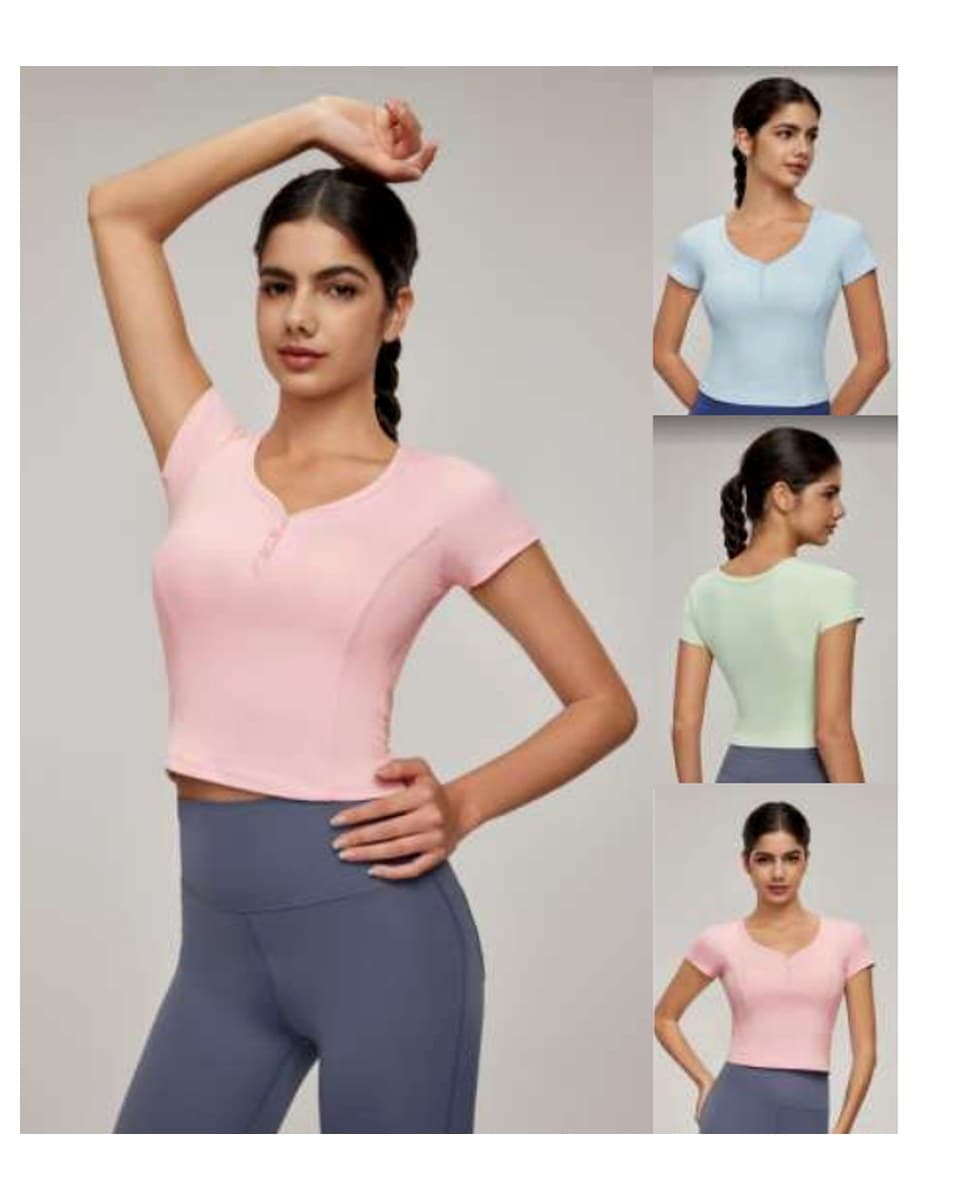
Use the activewear performance collection to identify the core product direction. For an existing reference, the short-sleeve top shown here can support a discussion about neckline, sleeve and body proportions. The image is a visual reference, not proof of a particular fit for North American wearers or evidence supporting a performance claim.
If the selected garment already meets the intended use, discuss the private-label route for the requested branding, labels and packing. If the brand needs new fit, material or construction decisions, describe those through custom activewear development. A regional launch does not by itself decide which of these product routes is appropriate.
How should local feedback become a shared garment specification?
Give every sample an identity before sending it to reviewers. Record the style, size, colour, version and measurement reference. If one group sees an earlier sample while another sees a revised one, their comments cannot be combined as if they evaluated the same garment.
Use questions that produce actionable observations. Ask where a hem sits during the intended movement, whether a seam position creates an issue, and whether the size information helped the reviewer select a sample. Record the observed condition and the requested outcome. Avoid translating “make it more premium” directly into a supplier revision without defining what should change.
The activewear sample feedback guide helps connect those observations to garment details. In the two-channel example, a direct customer might want a different length while a studio reviewer prefers the current version. The brand must decide whether that is a shared requirement, a separate product need or an individual preference that does not justify changing the range.
Create one master garment specification for the features intended to remain common. It should identify the approved measurements, material direction, construction details and appearance references. Use explicit units and measurement methods. A measurement without a defined point or method can create disagreement even when both teams believe they followed the same number.
The tech pack checklist can organise this record. Mark unresolved fields visibly and name the person who will close them. Do not allow a supplier to interpret a blank field as approval to copy a detail from a photograph, or allow a reviewer to assume that an unmarked preference has become part of the specification.
Which decisions should be shared, and which should stay with each destination?
A common garment can reduce duplication in the briefing process, but only if the team knows which details are common. The United States direct channel and Canadian studio partners might share the garment construction while using different information, allocation and packing records. Maintain that distinction in the files and in the final approval.
| Decision | Shared product record | Destination or channel record | Person who closes an open question |
|---|---|---|---|
| Garment shape | Approved measurements, seams and construction version | Any deliberately separate product variant | Brand product owner with supplier input |
| Materials and colour | Confirmed material reference and colour approval | Any documented exception requiring separate review | Product or material decision-maker |
| Brand identity | Approved core artwork and application reference | Channel-specific artwork, if actually required | Brand artwork owner |
| Product information | Verified facts about the actual garment | Approved label text and destination requirements | Named destination-market owner |
| Quantities | Common style and variant identifiers | Size-colour allocation by channel and destination | Brand purchasing owner |
| Packing and receipt | Agreed product identification method | Selling units, carton allocation and receiving details | Receiving or distribution owner |
Use an international manufacturing brief to connect these records without forcing every field into one undifferentiated document. The master garment file should point to the applicable destination schedules. Each schedule needs its own version and approval status so a change in one does not silently rewrite the other.
For example, changing a destination label does not necessarily change the garment fit. Conversely, changing the shared material may require both destination owners to revisit their product information. Describe the dependency explicitly. This prevents the team from treating a local amendment as isolated when it affects a shared product fact.
Why do United States and Canadian label approvals need separate owners?
Do not approve a single label merely because the garments are going to neighbouring markets. inPACE's order resources point buyers toward destination checks. For the United States, review the Federal Trade Commission's official guidance. It describes fibre content, origin and responsible-business identification for most textile and wool products, with separate care-labelling guidance.
For Canada, the Competition Bureau's textile labelling summary identifies dealer and fibre information and explains the English and French requirement for fibre-related text. It also flags additional provincial considerations. These are reasons to assign destination-specific review, not a complete approval checklist for a particular garment.
Ask the relevant market owner to confirm current requirements for the actual product and sales destination, then provide approved text and the information supporting it. The supplier can coordinate the agreed label implementation; that does not replace the brand's destination review or guarantee a compliance result.
The United States sourcing guide can help organise the US launch brief, while the Canadian private-label sourcing guide supports that destination's product and supplier questions. Keep their decisions attached to the correct allocation. A US-facing product page should not accidentally inherit a Canadian channel description simply because both use the same internal style code.
For the example top, retain one verified set of garment facts and two approved destination records. If the garment changes, identify which facts need reconfirmation before labels are produced. This keeps a shared development project manageable without pretending that regional coordination removes local responsibilities.
How should brands compare quotations without losing the local work?
Write the comparison around the work required to reach an accepted product. Identify product development, sample revisions, artwork application, labels, packing, inspection and the agreed delivery scope. Ask each proposed partner to state what is included, what remains with the brand and which assumptions the proposal uses.
A local fitting service plus a China supplier proposal may cover the project, but only if the handover is defined. Check whether the local work produces the files the supplier needs and whether the supplier must repeat part of the development before making its own sample. Do not count a prototype as production-ready evidence simply because another party has already made it.
Separate product cost from the additional work the brand must fund or manage. Sample movement, revisions, destination review, receiving and unresolved packing work can affect the comparison. Use actual written proposals and current professional input for the applicable import and delivery questions. This article does not supply tariff rates or a universal landed-cost estimate.
Keep the basis of the quotation stable while comparing it. A proposal for an unchanged catalogue garment should not be compared directly with one that includes a new fabric and revised fit. If the scope changes during discussion, request a revised comparison rather than keeping the earlier price as if it still describes the project.
Identify the decision that would change the preferred route. If the local partner cannot provide the required production scope, or the brand cannot organise useful remote sample approvals, record that practical limit. The conclusion should follow the project's evidence instead of a rule that local or China sourcing is always the better choice.
What prevents a hybrid project from producing conflicting instructions?
Name one brand owner who can turn comments into supplier instructions. Local reviewers, studio partners and the supplier may all identify valid issues, but they should not independently issue competing approvals. The brand owner should record the question, supporting evidence, decision and affected version.
Use a short change log after each review. For the example top, a neckline amendment might affect coverage, the front panel and logo placement. State whether all those details must be reviewed again. An instruction to “adjust the neckline only” is incomplete if the adjustment changes the area on which the approved logo sits.
Separate a sample receipt from a sample acceptance. Record what the team received, which questions it reviewed, what remains open and which stage the decision authorises. A message saying that the parcel arrived safely should not be interpreted as permission to begin the next production step.
The brand also needs a way to handle a late channel request. If a Canadian partner asks for a different packing unit after the common garment is approved, assess the affected quantities, materials and documents before accepting the change. Keep the shared garment approval intact where it remains valid, while revising the relevant packing schedule explicitly.
Finally, confirm how the supplier will acknowledge the consolidated instruction. The useful response identifies the current files, any questions and the agreed next action. Repeatedly forwarding a long message thread makes it harder to know which of several contradictory attachments is current.
What evidence should connect samples, production and receiving?
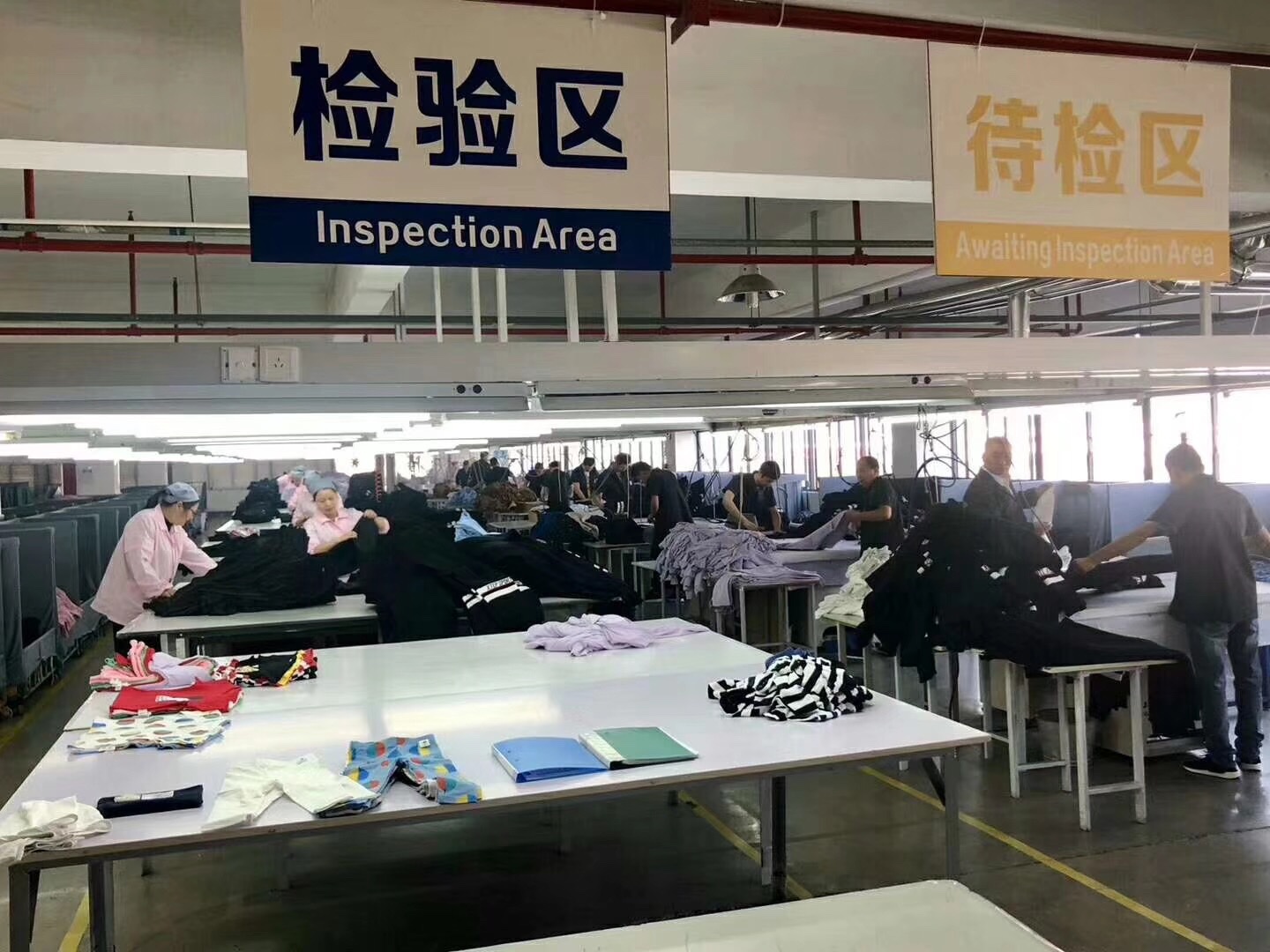
The inspection-area photograph provides process context. It does not establish that the example top has been produced or inspected, and it is not a substitute for order-specific records. Ask which checks and evidence will apply to the actual approved garment and destination allocations.
Connect the inspection reference to the accepted sample and written specification. Relevant questions include measurements, workmanship, logo placement, product information and packing identity. Agree how observations are recorded and how unresolved issues reach the person authorised to decide the next step.
For a shared style with two destinations, receiving teams need enough identification to distinguish the allocations. Use the activewear packaging checklist to specify selling units, variant identifiers and carton records. A carton containing the correct total quantity can still be wrong if its sizes or destination label versions do not match the approved allocation.
Ask each receiving team to record discrepancies against the same item and version references used upstream. That makes the response more useful than separate local descriptions of what appears to be the same issue. Keep the affected counts, photographs and decisions together so the next order can address the actual cause rather than repeating an uncertain assumption.
What should the brand approve before choosing its route?
Use this checklist once the product and partner discussions are concrete. The aim is to identify the work that remains and who can perform it. A route is ready to proceed when the necessary inputs and decisions are clear enough for the agreed next stage.
- Name the actual destination countries and sales channels.
- Identify the core style and each separate colour-size variant.
- State which existing features stay unchanged and which require development.
- Define the local wearer questions and the relevant review participants.
- Record the exact sample versions used by each group.
- Consolidate observations into one shared garment specification.
- Separate common product facts from destination-specific approvals.
- Assign owners for US and Canadian product-information review.
- Compare proposals using the same development and production scope.
- Confirm file deliverables, sample handovers and revision responsibilities.
- Approve quantities, packing identities and receiving allocations together.
- Record the next authorised action and the conditions for proceeding.
After the first order, evaluate the route using the same records. Separate product issues from channel presentation or allocation issues. If one destination needs more of a particular size, that may require a different repeat-order mix rather than a new garment. If both channels identify the same fit problem, revisit the shared product specification before treating it as a local exception.
How can inPACE support the China development part of the project?
inPACE's role in this discussion is product, sample and production coordination for the agreed activewear scope. Its company information provides the published identity and supplier-review starting points. Yinshan Garments' clothing-production experience since 1986 is manufacturing background; it does not establish the outcome, certification or market acceptance of a new project.
Bring the decisions already made locally and identify the questions still open. A selected reference with clear fit observations, artwork and destination schedules gives the supplier a practical basis for feasibility review. A request to make activewear for two countries without those details leaves the central product decisions unresolved.
For a route discussion, send inPACE the North American project brief: the US and Canadian channels involved, core products, local feedback needs, proposed China development work, common garment requirements and separate label or packing approvals. Include the decision-makers and sample evidence available. The next step can then be defined around the work the project actually needs.
Product directions
Explore relevant activewear products
Use these product pages as practical references for your brief, then confirm materials, fit, customization, and production details through sampling.
Activewear Performance Collection
Choose a core product direction before deciding which work stays close to the customer and which work enters supplier development.
View product directionShort-Sleeve Top Reference
Use the neckline, sleeve and body proportions to frame local sample observations without assuming a universal regional fit.
View product directionCustom Activewear Development
Review material, fit and construction requirements with one consolidated brief and named approval owners.
View product directionFAQ
Buyer questions
When is a China activewear manufacturer for North America worth considering?
Consider that route when the brand can define its core products, development scope and approval process clearly enough for a supplier review. Compare the proposal with local and hybrid options using the same requirements. The destination alone does not establish whether China development is suitable or whether a particular supplier can meet the project.
Can a brand keep fittings local while developing garments in China?
Yes, a hybrid arrangement can combine local wearer feedback with supplier development when the handover is agreed. Identify sample versions, measurement methods, file deliverables and one brand owner for consolidated instructions. Local observations become useful to the supplier when they lead to clear decisions rather than several conflicting comment threads.
Can the United States and Canada use the same garment?
They may share a garment if the actual product requirements support that decision. Keep common measurements, materials and construction in a master record, then maintain separate destination and channel schedules. Label text, allocation or packing differences should not be overlooked simply because both orders use the same internal style code.
Is one label approval enough for a US and Canadian launch?
Do not assume so. Assign destination-market owners to review current requirements for the actual product and confirm the relevant text and supporting facts. United States and Canadian guidance address their own requirements. The supplier's implementation of approved labels does not replace that review or guarantee a compliance outcome.
Does a North American project always require custom manufacturing?
No. If a selected existing garment suits the intended use, discuss the available branding, label and packing scope. A new fit, fabric, construction or functional requirement needs separate development review. The product changes, rather than the regional launch name, determine which route should be assessed.
How can brands compare local and China proposals fairly?
Use the same product brief and identify included development, samples, revisions, branding, labels, packing, inspection and delivery scope. Record work that remains with the brand or another partner. Compare current written proposals and resolve missing responsibilities before drawing a conclusion from the quoted product price.
What should a brand send for an initial route review?
Send the actual destination channels, core product references, intended wearer, local feedback questions and proposed China development scope. Include available sample records, artwork, measurements, quantity assumptions and destination approval owners. Separate settled decisions from open questions so the supplier can assess a defined next stage rather than guess the whole project.