
“Private label activewear supplier Canada” is a useful search phrase, but a workable sourcing brief starts with the product route, the sales channel, and the person who will own the market-facing information. An existing yoga, training, or studio style can be a sensible reference when logo, labels, packaging, and an assortment plan are the main changes. A different fit, fabric, coverage level, support direction, panel layout, or feature calls for factory-custom development and a sample that proves the open decisions. A catalogue image alone does not confirm availability, fabric, labels, price, quantity, or Canadian market readiness.
Private label activewear supplier Canada: what should a buyer decide before comparing suppliers?
First identify whether the brand needs a catalogue-informed private-label route or a custom development route. The distinction matters because an existing style can support a conversation about logo placement, a hangtag, packaging, and a size-colour plan, while a new silhouette requires pattern, construction, material, fit, and sampling work. A buyer should not ask a supplier to infer this difference from a mood board or a price-only request.
For a launch, name the core product roles. A studio programme might start with a branded top, legging, light layer, and a member-merchandise item. A fitness retailer may instead need a training top, lower-body option, outer layer, and an approved presentation for each role. The first range does not need a fixed number of styles. It needs a clear purpose for each reference, plus a record of which decisions the first sample must answer.
Use the Yoga Activewear Catalog and Activewear Performance Collection as references for product roles, not as a promise that a future Canadian programme will share the same material, construction, fit, colour, quantity, or availability. When the product itself needs to change, use the custom activewear development route rather than treating a reference image as a production specification.
What belongs in the supplier brief?
| Brief area | What the buyer can provide | What the supplier or manufacturer should review | What remains for approval |
|---|---|---|---|
| Product role | Channel, wearer, use, hero SKU, supporting styles, and intended layering. | Whether the references and route fit an existing-style or custom-development discussion. | The final selected style and project scope. |
| Fit and fabric | Reference sample, measurements, handfeel, stretch, recovery, coverage, support, surface, lining, and movement questions. | Material options, construction implications, pattern questions, and evidence needed from a sample. | Actual fit, coverage, recovery, and care review on the selected garment. |
| Brand presentation | Artwork, logo zone, labels, hangtags, packaging, product photos, and launch context. | Application compatibility, placement, sample proof, and packing sequence. | Final artwork, market-facing wording, and approved files. |
| Assortment and receiving | Size range, colour direction, quantity direction, barcode or carton questions where applicable, and delivery market. | Feasibility assumptions, packing details, sample path, and records needed for handoff. | Commercial terms and receiving requirements after project review. |
The brief should distinguish confirmed inputs from questions still to be tested. The activewear tech pack checklist is useful when a team needs an organised drawing, measurement, construction, and version record. The activewear sample plan can separate material, fit, branding, and approval questions so one early sample is not expected to answer every decision.
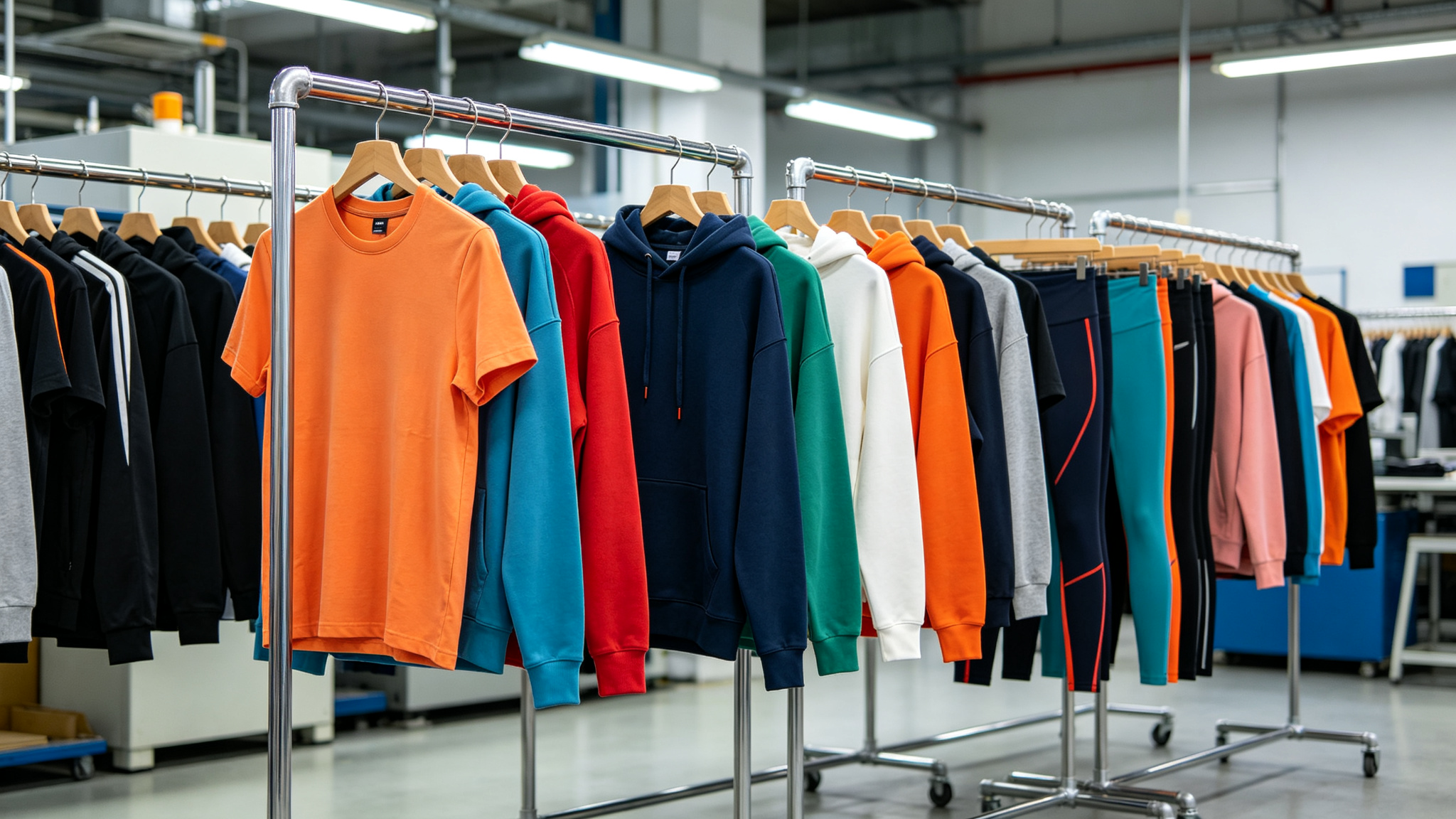
This editorial product-direction image supports the discussion of an assortment, reference ownership, and version control. It does not confirm an inPACE catalogue selection, a material, a label route, a colour, availability, price, quantity, or production condition for a Canadian programme.
Which Canadian market-information questions need an owner?
This guide is a sourcing checklist, not legal advice. The brand should assign a Canadian market-information owner before label artwork, packaging, product pages, advertising, or bulk production are approved. The Competition Bureau’s textile labelling requirements explain that consumer textile labels must be factual, legible, and accessible at purchase; the applicable label route depends on the article. Its detailed guide explains fibre-content and bilingual considerations, dealer identity, and other requirements. It also notes that Quebec can have additional French-language requirements for items marketed there.
The practical sourcing implication is simple. Do not turn a factory conversation into a legal conclusion. Instead, identify who will verify the final fibre statement, generic fibre names and percentages, required language, dealer identity route, origin information where applicable, care wording, packaging statements, product-page claims, and any provincial requirements. A change in material, country of origin, component, product claim, or intended market may require that owner to recheck the final information with appropriate advisers.
If care instructions are included, their accuracy still matters. The Competition Bureau describes care labelling as voluntary federally, while noting that included care information must not be false or misleading and that Quebec can have additional language requirements. Use the official material as a check point, not as a shortcut around a project-specific review.
What should the first sample demonstrate?
The first sample should have a named purpose. For a yoga set, review fit, stretch, coverage in the relevant poses, seam comfort, waistband or neckline stability, and the relationship between the top and bottom. For a training layer, test the intended range of motion, layer relationship, sleeve or hem behaviour, logo zone, and surface response. Record the sample version, material direction, colour, size, reviewers, movements used, observations, decisions, and remaining questions. That record is more useful than a broad instruction to “check quality.”
When printing, embroidery, or wash effects are part of the brief, assess them against the actual fabric, location, artwork, and sample purpose. inPACE can coordinate sampling support that may include these applications where suitable. The planning ranges discussed for samples and production remain conditional on materials, construction, components, revision rounds, quantity direction, partner-factory scheduling, and approvals; they are not a delivery promise.
How should receiving and packing decisions support a Canadian launch?
Packing is not a final factory detail. It connects the approved product to the person who receives, merchandises, and sells it. The brand should state whether cartons go to its own warehouse, a studio, a retailer, a marketplace-preparation partner, or another receiving point. That context affects the packing record without creating a promise about freight, customs clearance, cost, or delivery timing.
Before a handoff, the buyer can list the approved style name or internal SKU, sample version, size-colour assortment, labels, hangtags, polybag direction, barcode data if the receiving channel needs it, folding direction, carton marks, and the person who owns final market-facing information. The factory can then compare those instructions against the selected product, materials, components, artwork, packing format, and production sequence. The activewear packaging checklist and receiving inspection checklist are useful process references; neither substitutes for the actual project files.
The receiving team should be able to trace a carton back to the approved product and sample, rather than treating an unlabelled photo or a general purchase message as the source of truth. If a colour, material, label, care statement, size grade, logo method, or packing component changes, the brand should decide whether that change affects the approval already given. This is particularly important when the person approving Canadian-facing label or packaging information is different from the person reviewing fit or fabric.
How can a supplier comparison remain useful without becoming price-only?
Ask every potential supplier to identify the assumptions behind its response. Useful comparison points include the product route, source of the reference, material direction, sample purpose, construction questions, branding scope, packing assumptions, size-colour plan, available evidence, and open decisions. A lower number cannot be compared fairly with a response based on another fabric, another logo method, fewer colours, a different label route, or incomplete packing information.
For a separate launch-market workflow, the US activewear manufacturer brief shows why brand-owned market information belongs in the project record. Its US guidance does not replace the Canadian textile and language review described here.
The private-label activewear service is the right conversation when an existing product direction and branding details are central. A project that changes the silhouette, material, coverage, construction, or function should move to a custom-development brief. In both routes, the decision owner should keep the response conditional until the selected material, sample, artwork, and market information have been reviewed.
How should a Canadian brand choose between a catalogue route and a custom route?
The choice should be made from the product decision, not from the word “private label.” A catalogue-informed route is worth discussing when a brand can begin with an existing garment direction and its meaningful changes are limited to identity, presentation, and a defined assortment. For example, a team may choose a training layer as a reference, define its logo zone, labels, hangtag, fold, and colour plan, then ask the supplier which of those points can be reviewed together. That still requires confirmation of the actual style, material, colour, quantity, and branding method; it is not a claim of ready inventory.
Factory-custom development is the more honest route when the buyer needs a different garment outcome. That could be a changed rise, inseam, leg opening, neckline, cup construction, pocket position, mesh placement, compression direction, opacity target, or support requirement. A request for “the same, but better” is too vague to quote or sample well. Instead, make the gap between the reference and the intended garment visible. The fabric and trim review is a useful starting point when stretch, recovery, handfeel, coverage, surface, or component compatibility changes the decision. The activewear manufacturing workflow helps a buyer see why approved materials, construction notes, artwork, and packing instructions need to travel together.
Neither route is automatically simpler. A catalogue-informed programme needs discipline around which version is actually being used, what branding is attached, and who approves the presentation. A custom programme needs the same discipline plus an orderly method for testing fit and construction. The useful question for a supplier is: “Which facts do you need from us to decide whether this is an existing-style branding project or a new development project?” A clear answer leaves fewer assumptions hidden in a quotation.
What label, packaging, and product-page questions should be resolved before bulk approval?
The garment, its labels, its packaging, and the product page are related but they are not interchangeable files. The factory needs approved production-facing artwork and placement instructions. The brand needs a process to validate its market-facing statements. The receiver needs a practical way to distinguish an approved carton and SKU from a look-alike item. A Canadian project is easier to manage when those responsibilities are written down before the last approval, rather than being settled from screenshots during packing.
For each style, maintain a controlled version of the fibre statement supplied for review, the size naming and grade, label locations, label materials, logo artwork version, hangtag content, polybag or other pack instruction, and carton-mark direction. Give the market-information owner a chance to compare final wording to the selected material and intended sales regions. If a brand markets into Quebec, that owner should explicitly decide whether the applicable French-language review is complete. The factory can help make the chosen production files visible in the sample and packing workflow, but it should not be positioned as the buyer’s legal adviser.
Product-page claims deserve the same restraint. A comfort, opacity, compression, support, or performance statement should trace back to what the brand has actually decided to substantiate for that product and market. Do not copy generic performance language from a competitor’s listing or a mood-board image. The sample review can identify what a team needs to evaluate, but it does not turn an untested claim into a universal fact. When the brand changes fabric, lining, construction, colour, or intended use, reopen the relevant wording rather than carrying it forward by habit.
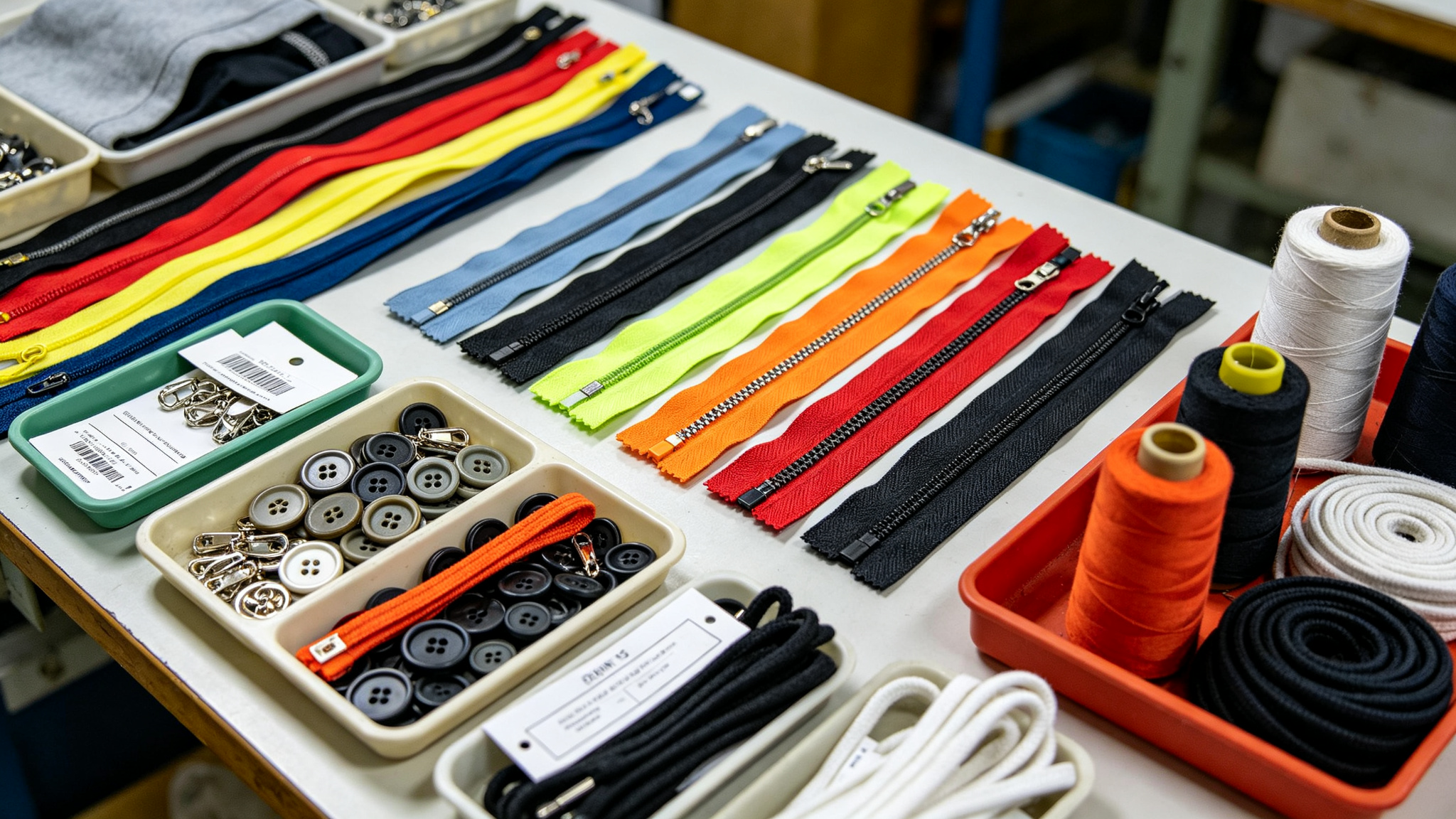
This factory-context image is used to explain component review. It is not evidence that any pictured trim, label component, or application method has been selected for a future private-label activewear order.
This division of work also protects a private-label relationship. The supplier can focus on accurately making the approved garment, applying the approved components, coordinating sample evidence, and preparing agreed packing. The brand retains ownership of its identity, sales copy, and Canadian-market decisions. That creates a useful review trail when a buyer, merchandiser, warehouse partner, and production contact are working in different locations.
Which sample evidence matters before a private-label activewear launch?
“Sample approved” is not enough information for a future repeat or for a person who did not attend the fitting. The record should say which sample was reviewed, what it represented, who reviewed it, which movements or wearing conditions were considered, which details passed, and which details were carried forward as open questions. A buyer may assess a yoga legging in squat and stretch positions, then make a different set of checks for a zip-neck training layer. The garment category changes the evidence that matters.
For fitted bottoms, useful observations can include waist stability, rise, inseam behaviour, coverage in movement, seam comfort, pocket use if present, and recovery after wear. For tops and bras, the reviewer can record neckline position, underband or hem stability, armhole comfort, support direction, layering relationship, and logo-zone behaviour. These are review observations, not guaranteed performance claims. They make it easier to identify whether the next version needs a pattern, material, construction, or branding adjustment.
Use images carefully in the sample record. A photograph can show an approved logo position, hangtag attachment, fold direction, or visible seam location, but it may not show stretch, recovery, coverage, or inside construction well enough to settle the issue. Pair a photo with a written callout, a version identifier, and a decision owner. If a brand sends a physical reference garment, record whether it is a fit reference, construction reference, material-feel reference, or only an aesthetic cue. That distinction avoids copying an unknown specification simply because it was present in a parcel.
inPACE can coordinate sample work across cooperating production factories when a project needs the right material, construction, branding, or finishing discussion. The practical sequence is still project-specific: material availability, component choice, artwork readiness, revision count, quantity direction, and approvals all affect planning. The sample should be used to reduce uncertainty before bulk approval, not to conceal it.
What should a Canada-ready buyer checklist contain before a supplier review?
Use this checklist as a pre-RFQ and pre-bulk-approval handoff. It does not replace legal, customs, freight, or product-testing advice. It ensures the people who own those questions are known before a supplier has to infer the answer.
- Name the sales channel and intended Canadian provinces or regions for each first-launch style.
- Classify each reference as an existing-style branding reference, a fit reference, a material reference, a construction reference, or an aesthetic reference.
- Identify the product role: hero SKU, supporting style, studio uniform, retail assortment, training layer, yoga item, or another defined use.
- Record the intended wearer, size range, fit preference, movement context, coverage and support questions, and any facts still to be tested.
- State the material direction in practical terms: handfeel, stretch, recovery, surface, lining, opacity questions, and component compatibility.
- Supply controlled artwork, the intended logo zone, label placement, hangtag direction, and a named owner for final brand files.
- Assign a Canadian market-information owner to review fibre content, language, dealer identity, care wording when used, product-page copy, packaging statements, and provincial questions.
- Set the sample purpose, review size, reviewer group, movements or wear checks, approval criteria, revision process, and evidence record.
- Make the size-colour plan and quantity direction visible without presenting either as a fixed production promise before the project is reviewed.
- Describe the receiving location, carton or SKU logic, barcode requirements where the receiving channel requires them, fold direction, and the owner of final receiving instructions.
- Keep a change log for any adjustment to fabric, component, grade, label, logo method, packing item, or market-facing statement after sample review.
- Prepare a concise question list for the supplier: which assumptions require confirmation, which sample route fits the brief, and what evidence is needed before production approval?
The how-it-works overview can help a new team map its brief, sample review, approval, and production discussion in sequence. It should be used alongside the project’s own files, not instead of them. A good checklist has the practical effect of making an incomplete answer visible early enough to resolve it.
What should a Canadian fitness brand ask a private label activewear supplier?
Start by asking the supplier to explain what it understands the buyer is trying to make, what the reference does and does not specify, and where the project falls between existing-style branding and custom development. Then ask what it needs in order to review fabric, fit, construction, branding, sample, packing, and delivery-market assumptions. A supplier that answers those questions clearly gives the buyer a better basis for comparison than one that provides a headline number with no assumptions.
Useful questions include: What needs to be confirmed before you can select a sample route? Which details must be supplied in editable artwork rather than in an image? What will the sample be asked to prove? How will we identify the approved version after feedback? Which packing instructions must be final before production? Who should receive the final label and packaging files? What information should remain conditional until the material, sample, and market-facing review are complete? The answers should be logged against the style, not buried in a general email thread.
For a brand starting its first range, the private-label activewear service can anchor a discussion about existing product directions plus logo, labels, hangtags, and packing. For a new fit or construction, the custom activewear development route is the better starting point. In either case, a buyer can share a product brief with inPACE that identifies the intended product, reference source, material and fit questions, branding files, sample purpose, receiving route, and Canadian market-information owner.
Product directions
Explore relevant activewear products
Use these product pages as practical references for your brief, then confirm materials, fit, customization, and production details through sampling.
Yoga Activewear Catalog
Use this catalogue as a product-direction reference for a yoga-led private-label brief, then confirm the actual garment, material, fit, colour, branding, quantity, and market-facing information for the Canadian project.
View product directionActivewear Performance Collection
Use this collection to frame training-product roles, movement needs, layering, and the sample questions that should be resolved before a supplier comparison becomes a production decision.
View product directionCustom Activewear Development
Use the factory-custom route when fit, fabric, coverage, support, construction, colour, or functional detail differs from a reference and needs validation through development and sampling.
View product directionFAQ
Buyer questions
Can a Canadian brand use a catalogue style for private label activewear?
It can begin by using a catalogue style as a product-direction reference when branding and presentation are the main changes. The supplier still needs to confirm the actual style, material, colour, quantity, artwork method, labels, and packing details. If the buyer needs a different fit, fabric, coverage level, construction, or function, the project should move into custom development and sampling.
Does a factory decide Canadian textile-label wording for the brand?
The brand should appoint the person responsible for Canadian market-facing information. A supplier can use approved production files and help keep them linked to the sample and packing workflow, but it should not replace legal or regulatory review. Fibre content, language, dealer identity, care information when used, product claims, and provincial considerations should be checked by the appropriate owner.
What should the first private-label sample prove?
It should prove named questions, such as fit, stretch, coverage, seam comfort, support direction, logo placement, label position, or packing presentation. The right checks depend on the garment category. Record the sample version, materials, review size, reviewers, observations, decisions, and open questions so a later approval is traceable.
Can a reference image be used as a complete production specification?
No. An image can communicate a silhouette or branding direction, but it rarely verifies material, construction, measurements, grade, labels, or packing. Identify what role the reference plays and add written requirements, a tech pack, a physical sample, or a sample-review plan where the garment needs development.
How should a buyer compare private-label activewear supplier responses?
Compare the assumptions before comparing a number. Check whether each response describes the same product route, material direction, sample purpose, branding scope, size-colour plan, packing needs, and open decisions. A response based on a different fabric or incomplete market information is not like-for-like with a more detailed proposal.
Are sample and production timelines fixed for private-label activewear?
No. Planning depends on the selected material, garment construction, components, artwork readiness, revision rounds, quantity direction, schedules across cooperating production factories, and approvals. Discuss the project plan after the relevant inputs are reviewed instead of treating a generic range as a delivery commitment.
What should a Canadian brand send in its first inquiry?
Send the product role, intended route, references with their purpose, fit and material questions, size-colour and quantity direction, branding files or open branding questions, sample purpose, intended receiving route, and the person who owns Canadian market-facing information. That gives the supplier a practical basis for identifying missing information and proposing the next review step.