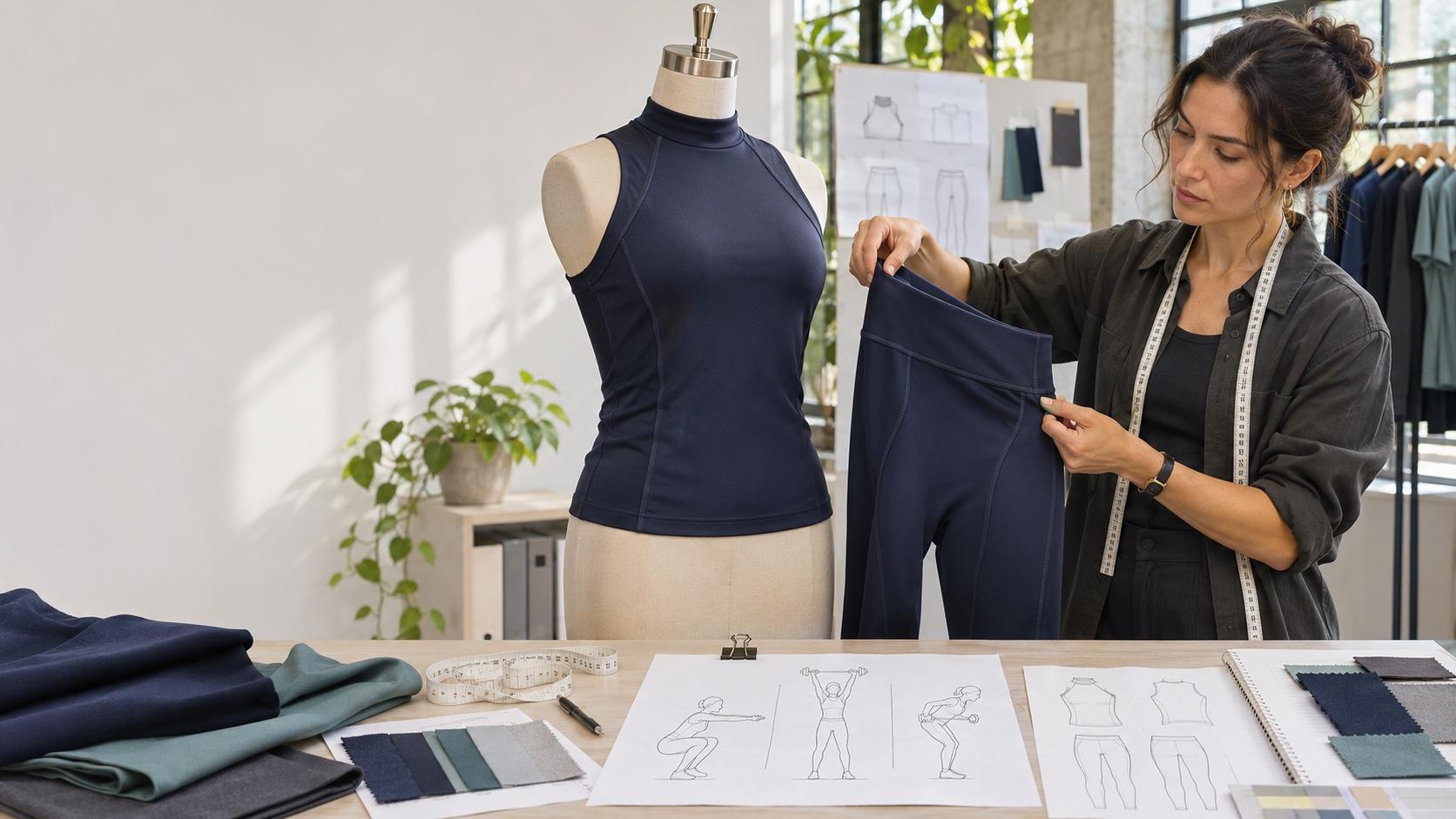
Direct answer. A strength training apparel manufacturer brief should convert the intended exercises into separate fit, coverage, support, construction and sample questions for each garment. Buyers should review tops and bottoms on the intended wearer during controlled squats, hinges, presses, pulls and floor positions. Physical sample evidence—not a fabric name or marketing claim—should decide approval.
This guide is for B2B brands, gym-wear designers and sourcing teams developing apparel for strength sessions. It is deliberately narrower than a general gym clothing guide: the decision is how a garment behaves during loaded or resistance-based movement, not how to plan every workout category.
The commercial route is factory custom manufacturing when the project changes fit, fabric, pattern, construction, coverage or a functional detail. A buyer may begin from an existing product direction, but the intended changes still need a written brief and physical approval. Catalogue images do not prove stock, exact material, movement performance or suitability for a brand's wearer.
The Activewear Performance Collection can help a buyer name a starting silhouette or layer relationship before those project-specific changes are defined. It is a discussion reference, not a statement of live inventory or a finished strength-training specification.
What should a strength training apparel manufacturer brief define first?
Start with the training context, product role and wearer. “Gym wear” is too broad to guide a pattern, sample or approval. A powerlifting-focused legging, a general strength-class top and a warm-up layer can face different movement, coverage and pocket questions even when they share a visual collection.
Define:
- The intended wearer and fit model.
- The session type: free weights, machines, kettlebells, resistance bands, bodyweight strength or mixed use.
- The main movement families.
- Whether the garment is a base layer, support layer, training top, bottom, one-piece or warm-up piece.
- Required coverage in standing, deep flexion, overhead reach and floor positions.
- Expected pairing between top, bra, bottom and outer layer.
- Storage needs and whether a pocket is used during the session.
- Branding zones and areas that bend, stretch or contact equipment.
- Size range and how the brand will review fit across it.
- The sample evidence needed before the product can move forward.
The workout clothing manufacturer guide maps strength, HIIT, group class and warm-up roles across a wider collection. Use this page when the product brief is specifically for strength training and needs a more detailed movement-to-garment review.
Which movements should become sample questions?
Do not ask a supplier to make apparel that is simply “squat proof” or “good for lifting.” State the movement, the garment area to observe and what evidence will be recorded. The same squat can expose waistband movement, back coverage, front-rise tension, gusset placement, seam position and colour show-through; those are different questions.
| Movement family | Garment areas to observe | Buyer questions for the sample | Evidence to record |
|---|---|---|---|
| Squat and lunge | Waistband, rise, seat, gusset, thigh, top hem | Does the bottom stay positioned? Does the top expose more than intended? Is movement restricted or excess fabric created? | Front, side and back views; measurements; wearer comments; issue photos |
| Hip hinge and deadlift setup | Back waist, seat, crotch, hamstring, neckline | Does the back waist gap or roll? Does the neckline or armhole open? Do seams pull across the movement? | Setup and standing views; seam and waistband notes; sample revision |
| Overhead press and reach | Armhole, shoulder, neckline, bust, top length | Does the top lift, twist or expose the underarm? Does a bra or inner layer remain covered as intended? | Standing and overhead views; hem movement; armhole and neckline comments |
| Row and pull | Upper back, shoulder blade, sleeve or armhole, chest | Does the garment allow the intended reach? Do panels or logos distort in the pulled position? | Reach views; panel alignment; logo-placement notes |
| Bench or floor work | Back neckline, shoulder, waistband, pocket and hardware | Does the garment bunch against the bench or floor? Is any component placed at a pressure or contact point? | Contact-area photos; comfort comments; component position |
| Carry and equipment handling | Side seam, pocket, strap area, surface contact zones | Can the wearer access the pocket? Does stored equipment move? Do garment details contact the bar or machine unexpectedly? | Pocket-use sequence; loaded pocket notes; wear-area observation |
The table is an approval prompt, not a universal test standard. The brand should choose movements that match the product's real use and review them consistently. A sample can be suitable for one role and unsuitable for another without either conclusion becoming a claim about all strength training apparel.
How should tops be reviewed for fit and coverage?
Top approval should separate neckline, armhole, bust, shoulder, body length and hem behaviour. A high neckline may support a coverage direction, but the shape can still pull at the front neck, open at the side or interfere with movement if the pattern and material are not balanced.
For sleeveless or short-sleeve tops, check:
- Neckline height and shape while standing, hinging and lying back.
- Armhole depth at rest and during press or pull positions.
- Coverage of the intended bra or inner layer.
- Shoulder and upper-back movement.
- Bust shaping, lining and support relationship.
- Body width and length through the torso.
- Hem position during overhead reach, squat and hinge.
- Side-seam and panel alignment.
- Any zip, binding, elastic or hardware against the body.
- Logo placement before and after movement.
The high-neck zip-front cropped training top can be used as a visual starting direction for neckline, armhole, zip and cropped-length discussion. It is not proof of live inventory or a final strength-training specification. If the project changes the neckline, zip, body length, lining, fit or material, list those changes and review them on the correct sample.
A sports bra, tank and cropped top should not share one generic approval statement. Record the role of each layer. If a top is intended to sit over a bra, the buyer should review the two together in the planned sizes. If it has built-in support or lining, the component, fit and sample questions need their own record.
How should leggings and shorts be reviewed?
Bottom approval should cover the waistband, rise, crotch, gusset, hip, seat, thigh, leg opening and any pocket. A flattering standing image does not show whether the pattern remains controlled through deep flexion or whether the wearer can move without adjusting the garment.
Use the following review order:
- Confirm the exact sample size and wearer measurements.
- Record the garment measurements and measurement method.
- Review standing balance before movement.
- Observe squat, lunge and hinge positions from front, side and back.
- Check waistband movement, back coverage and rise tension.
- Check crotch and gusset position without making a comfort assumption for the wearer.
- Observe seam movement and any visible pulling or twisting.
- Review leg opening or hem position during movement.
- Test pocket access with the intended item when a pocket is included.
- Repeat the movement after adjustments only if the review method requires it.
The Zip-Neck Sculpt Set reference can help a brand discuss a coordinated top-and-bottom direction. The product image does not establish the final waistband, fabric, gusset, pocket, coverage or fit. Those details must be confirmed for the project version.
Shorts require additional questions about inseam, leg opening, inner layer and ride-up. Leggings require questions about full-length or cropped balance, ankle opening and how the material appears through flexion. Neither should be approved from a flat measurement sheet alone.
What does coverage mean in a sample review?
Coverage is not one measurement or a promise attached to a fabric name. It is the relationship between the wearer, pattern, size, material, colour, construction, layer and movement.
Define the coverage question precisely:
- Does the neckline remain within the intended position during hinge and floor work?
- Does the armhole expose the planned inner layer or more than intended?
- Does the top hem remain within the intended overlap with the bottom?
- Does the back waist stay covered during squat and hinge?
- Does the fabric become more revealing under stretch in the selected colour?
- Does a lining, cup or inner short remain positioned?
- Does a seam, pocket or panel create an unintended visible line?
Do not write “full coverage” in the product brief without stating the review condition. A buyer can instead write: “Review back-waist coverage on the approved fit model during the defined squat depth, with the intended top and underlayer, and record front, side and back evidence.” This is more useful to the pattern and sample teams and safer for later product-page language.
Review the actual planned colour when coverage is an approval concern. A dark development sample cannot automatically approve a lighter production colour, and a fabric swatch held by hand is not equivalent to the finished garment stretched across seams, lining and the wearer's body. Record the light source, garment layer, wearer, movement and camera view used for the check. If a later colour changes the visible result, reopen the relevant sample decision instead of carrying forward an observation from a different colour.
The activewear fit model brief helps teams define the wearer, movement set, observation areas and resample triggers. Use the same fit-model identity and measurement method across revisions so that a change in reviewer does not look like a product improvement.
Which fabric questions belong in strength training apparel development?
Start with use, garment role and construction before selecting a fibre story. A fabric can feel firm on a hanger and behave differently once it is stretched across a body, joined to elastic or lining, washed, printed or used in a light colour.
Discuss:
- Intended stretch direction and amount for the pattern.
- Recovery after the defined movement and wear period.
- Surface and handfeel against the body or equipment.
- Weight and thickness in the actual garment construction.
- Appearance under stretch in each planned colour.
- Relationship with lining, cups, elastic and binding.
- Seam and needle compatibility.
- Logo method and placement.
- Care direction and any project-specific validation.
- Lot, colour and substitution controls for production.
The fabric and trim review page provides a starting point for material, elastic, lining, zip and logo-method discussion. A supplier can recommend options after seeing the product brief, but the brand should confirm the selected material and component on the approved project evidence.
Avoid unverified claims such as “four-way stretch guarantees movement,” “compression improves lifting” or “moisture-wicking prevents discomfort.” A material description can guide development, but performance wording should follow the brand's evidence and destination-market review.
How should support and structure be separated from marketing claims?
Support can come from pattern, coverage, material tension, elastic, cup or lining construction and how the garment fits the wearer. It should be reviewed as a product decision, not inferred from a category label.
For a bra or supportive top, record:
- Intended support direction and use context.
- Neckline and armhole coverage.
- Underband width, tension and position.
- Cup, pad or lining construction when included.
- Strap position and adjustability when included.
- Back shape and closure.
- Relationship with an outer top.
- Sample size, wearer and movement set.
- What would trigger a pattern, component or material revision.
For leggings or shorts, distinguish a secure waistband direction from a health, body-shaping or performance claim. Review whether the waistband stays in the intended position and whether its pressure is acceptable to the fit model. Do not turn that observation into a universal statement about all users.
The Light Support Bra Program is a product-direction reference for discussing bra roles within a collection. A strength-training version may require different neckline, underband, lining, strap, cup or fit decisions. Those changes belong in the factory-custom brief and sample record.
Which seams, panels and pockets require movement review?
Construction lines should follow the product purpose and pattern rather than decoration alone. A seam can shape the garment, join materials, create a pocket or support assembly. It can also sit at a bend, equipment-contact or pressure area.
Review:
- Side, inseam, front-rise and back-rise seam position.
- Gusset shape and seam intersections.
- Flat or raised seam profile where it contacts the wearer.
- Panel stretch direction and alignment.
- Pocket opening, depth, bag attachment and access.
- Zip, puller, snap or other hardware position.
- Bar-tack or reinforcement placement when specified.
- Logo placement across seams or high-stretch areas.
- Inside finishing and thread ends.
- How the assembly looks after the defined movement.
If a pocket is planned for a phone, key, card or another item, use that item in the sample review. Record access in standing and movement positions and check whether the stored object changes garment balance. Do not call a pocket “secure” without a defined item and review.
How should a brand build the sample plan?
The sample plan should answer one version of the product at a time. Do not combine several unresolved fits, materials, pockets and branding methods in one vague instruction and then expect the sample to identify the best combination.
| Sample stage question | Minimum input | Human approval evidence | Resample trigger |
|---|---|---|---|
| Is the product role and base pattern direction workable? | Product brief, intended wearer, reference and priority movements | Garment photos, measurements and fit comments | Balance, coverage or movement issue requires pattern change |
| Does the chosen material work with the pattern and construction? | Identified material, colour, lining, elastic and component direction | Swatch/component record and garment observation | Material or component change affects fit, appearance or assembly |
| Are branding and details correctly positioned? | Approved artwork, scale, method and placement | Physical logo/detail sample and location measurement | Artwork, method, colour or location changes |
| Can the approved product move to production handoff? | Closed sample comments, BOM/spec revision, packing and quantity plan | Named approval of the exact version | Any change to product, material, component, branding or pack |
The activewear sample plan helps buyers define sample purpose, review owners and decision gates. Planning ranges such as 5–10 days for samples can be discussed only after the scope, materials, artwork, components and approval sequence are clear. Exact time and cost remain project-specific.
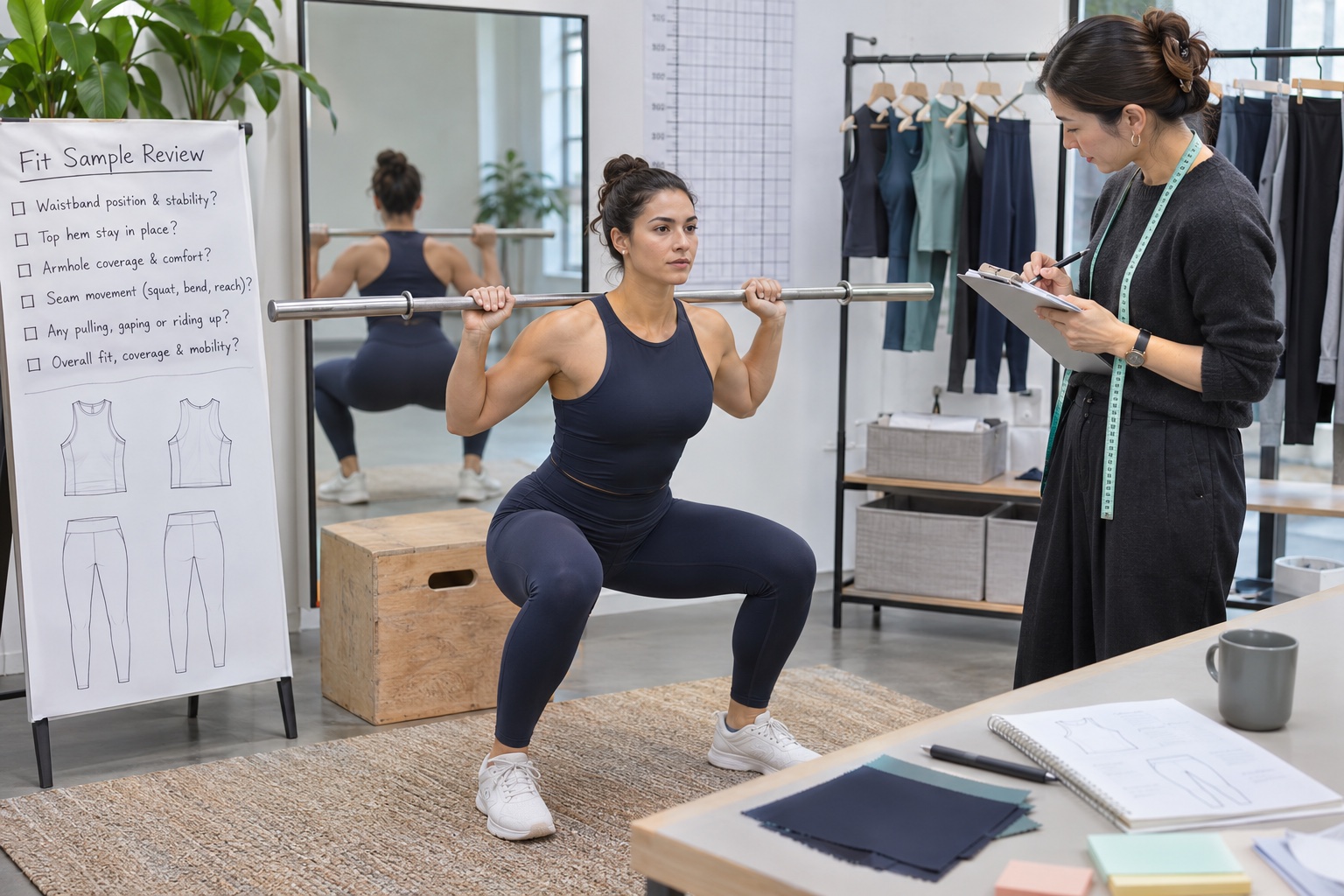
*Editorial sample-review illustration. It does not depict a customer project, a passed performance test or a production approval.*
What should the fit-session record contain?
Use one controlled record for every sample session:
- Style code, product name and sample revision.
- Sample stage and date.
- Fit model identity or controlled code.
- Body measurements and garment size.
- Garment measurements and method.
- Material, colour and component references.
- Planned top, bra, bottom or layer combination.
- Defined movement sequence.
- Observations by garment area.
- Photos linked to the exact sample.
- Requested action and owner for each issue.
- Decision: accept, revise or reject.
- Resample requirement and next-review scope.
Write observations before solutions. “Back waistband drops during the defined squat” describes evidence. “Add more elastic” is a proposed solution that may affect fit and comfort and should be reviewed by the pattern and development team. Keeping those fields separate prevents one comment from becoming an unapproved construction change.
Size approval should also be distinct from grading approval. One fit sample may establish the base-size direction; it does not prove that every size works. The activewear size grading guide explains how base measurements, grade rules, sample evidence and size-level risk should be recorded.
When should a sample be revised rather than approved with comments?
Resample when a change can alter fit, coverage, movement, support, appearance, construction, material behaviour or branding. Typical triggers include:
- Pattern or measurement change.
- New fabric, weight, stretch direction or finish.
- New lining, cup, elastic or binding.
- Changed waistband, gusset, pocket or seam.
- Changed neckline, armhole, shoulder or body length.
- New zip, hardware or closure.
- New logo method, scale or placement.
- Changed colour where appearance under stretch matters.
- Changed size range or base-size approach.
- A comment that cannot be verified on the current physical sample.
An email agreement does not make the change physically visible. If the bulk product will differ from the approved sample, record what changed, who approved the risk and whether a replacement sample or component proof is required.
How should approved strength training apparel move into production?
Production handoff should freeze the exact product version and make approved evidence accessible. The factory needs the current specification, measurement chart, material and component record, artwork, label and packing instructions, quantity breakdown and sample approval history.
The activewear manufacturing workflow connects sample approval to cutting, sewing, branding, inspection and packing. Buyers should define which characteristics will be checked and how an out-of-spec condition is handled. A bulk unit should not be judged against an obsolete sample or a screenshot from an earlier revision.
Use the sample-to-bulk handoff guide to identify stop, review and release gates. The brand should re-open approval when a material, component, construction, artwork, size allocation or pack changes after the sample.
inPACE Sports can discuss design direction, fabric, stretch, coverage, support, construction and fit questions, then coordinate the selected project across suitable cooperating production factories. That coordination draws on more than 30 years of garment-production experience, but it does not replace project-specific approvals. Printing, embroidery and wash-effect sampling can be discussed when relevant to the confirmed design. Production planning ranges such as 25–50 days apply only after scope and approvals are confirmed; exact timing, order quantity and price require review.
What should a buyer send for a strength-training apparel review?
Prepare a brief that lets the development team see the product and the decision:
- Product role and intended strength-training context.
- Reference product, sketch, tech pack or sample.
- Intended fit model and size range.
- Priority movement families.
- Coverage, support and adjustment concerns.
- Top, bra, bottom and layer relationships.
- Fabric and component direction.
- Waistband, gusset, seam, pocket, zip or other construction questions.
- Logo artwork, method and placement.
- Colour and size plan.
- Sample purpose, review owners and resample triggers.
- Estimated quantity by style, colour and size.
- Packing and destination requirements.
- Which details are approved, provisional or open.
For a factory-custom project, use the custom activewear development route to frame the pattern, fabric and construction work. Then send the product roles, movement priorities, coverage concerns, intended changes and sample-review questions through the inPACE contact page. The next useful step is a clearer brief—not a generic claim that the garment is ready for strength training.
Product directions
Explore relevant activewear products
Use these product pages as practical references for your brief, then confirm materials, fit, customization, and production details through sampling.
High-Neck Zip-Front Training Top
Use this existing top direction to discuss neckline, armhole, zip, body length and movement-review questions.
View product directionZip-Neck Sculpt Set
Review a coordinated top-and-bottom direction while defining the project-specific fit, waistband, fabric and sample scope.
View product directionCustom Activewear Development
Use the factory-custom route when strength-training fit, fabric, construction, coverage or features must change.
View product directionFAQ
Buyer questions
What should a strength training apparel manufacturer brief include?
Include the product role, intended wearer, priority strength movements, fit and coverage targets, material and component direction, construction questions, size range, branding, packing, quantities and sample approval method. Mark what is approved, provisional or open so the supplier does not invent missing requirements.
How should leggings be checked for squats and hinges?
Review the exact sample on the intended fit model from front, side and back. Record waistband position, rise and crotch tension, gusset and seam movement, coverage under stretch, leg opening and wearer comments. Use a defined movement depth and repeat the same method across revisions.
How should a strength training top be reviewed?
Check neckline, armhole, shoulder, bust, body width, length and hem position during standing, hinge, overhead press, pull and floor positions relevant to the product. Review the top with its intended bra or inner layer and record any lifting, opening, twisting or exposure.
Does four-way stretch prove a garment is suitable for lifting?
No. A stretch description does not prove fit, recovery, coverage, comfort or construction performance in the final garment. Review the selected fabric with the pattern, colour, lining, elastic, seams and intended wearer on a physical sample.
When does a strength training sample need revision?
Resample when a change may affect fit, coverage, movement, support, appearance, construction or branding. Pattern, material, elastic, lining, waistband, gusset, pocket, neckline, zip, logo and relevant colour changes should be assessed against the project's approval rule.
Can one fit sample approve every size?
No. A base-size sample can establish a fit direction, but the brand still needs controlled grade rules and size-level evidence appropriate to the product and risk. Record the fit model, body measurements, garment measurements and any sizes selected for additional review.
Can strength training apparel use an existing product direction?
Yes, when the existing silhouette is relevant and the buyer clearly identifies what is retained or changed. The team must still confirm the actual product, material, fit, construction, colour, branding and sample route. A catalogue image does not prove stock or final specifications.
What can inPACE review for a strength training apparel project?
inPACE can review product roles, design direction, fabric and component questions, fit, coverage, support, construction, branding, sample scope, packing and production handoff. Exact materials, price, quantity, timing and performance claims remain project-specific and require approval.