
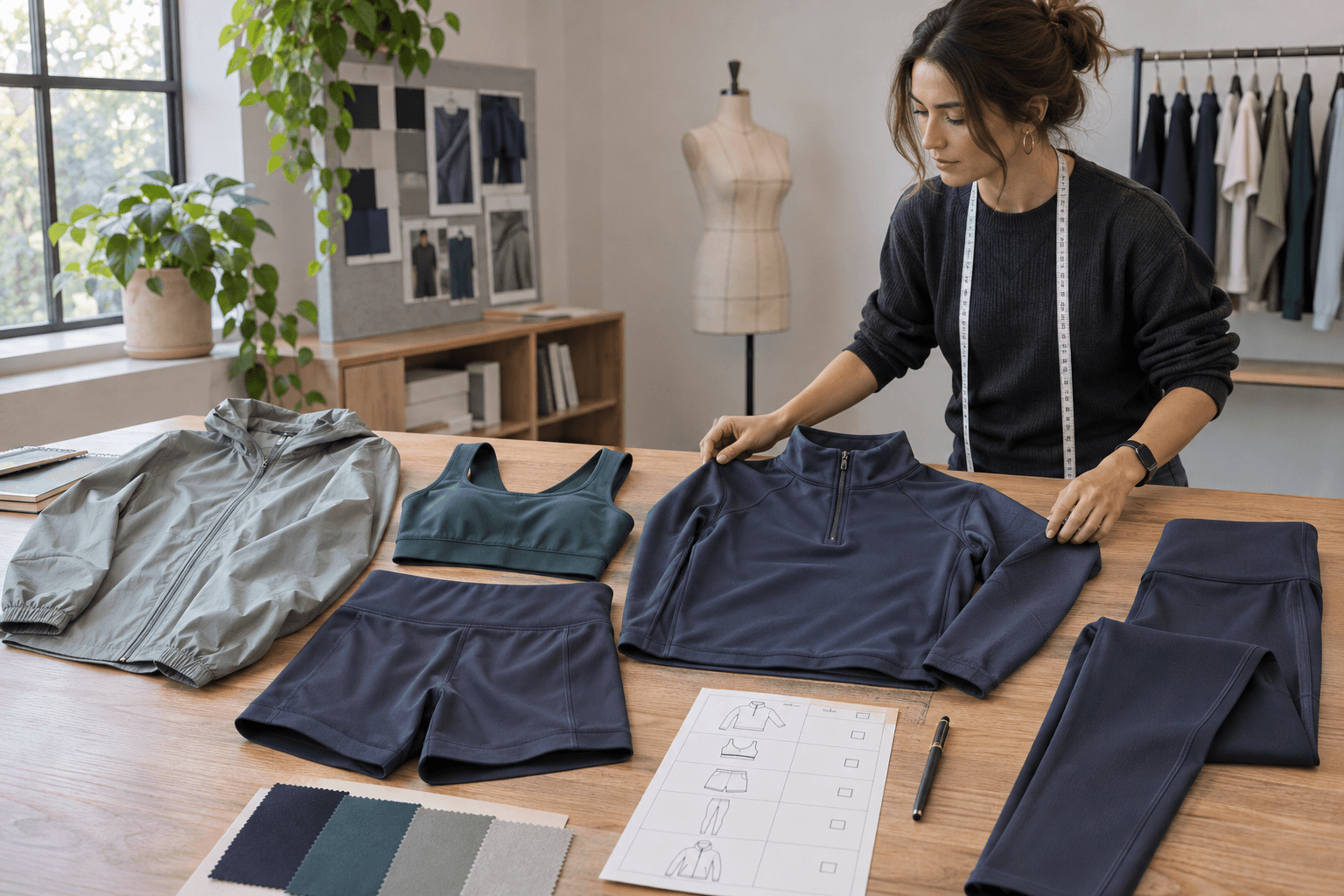
Direct answer. A HIIT training apparel manufacturer brief should turn the planned circuit into product-specific questions about fit, coverage, support, layering, construction and transitions. Review the top, bottom and removable layer on the intended wearer through a repeatable sequence. Approve recorded physical sample evidence—not a fabric label or broad performance promise.
This guide is for B2B activewear brands, studios, gyms and sourcing teams developing clothing for interval and circuit sessions. Its scope is deliberately narrow. It addresses rapid changes between standing, floor, step and recovery positions, plus the way separate garments work as an outfit. It does not replace a general gym-wear collection plan or a strength-specific lifting review.
The commercial route is factory custom manufacturing when the project changes fit, material, pattern, construction, coverage, layering or a functional detail. The Activewear Performance collection can help a buyer name a starting product direction, but an image cannot confirm stock, the exact fabric, movement behaviour or suitability for a brand's wearer. Record retained features and proposed changes before a sample is requested.
What should a HIIT training apparel manufacturer brief define first?
Start with the real class format rather than the word “HIIT.” Two programmes can use the same label while requiring different garments. One may alternate a step, lunge, press and floor position; another may move between a bike, bodyweight station and recovery period. The manufacturer needs the product roles and the transitions that expose garment questions.
Define:
- The intended wearer, fit model and reviewed sample size.
- The session format, station types and typical work-to-recovery pattern.
- The exact movement sequence used for sample review.
- Whether the range needs a bra or base top, training top, short, legging and removable layer.
- The required relationship between neckline, armhole, hem and waistband.
- Coverage expectations during upright, bent, overhead and floor positions.
- The intended pocket item and access point, if storage is required.
- Material, lining, elastic, zip and binding questions.
- Branding zones and areas that repeatedly flex or contact equipment.
- Which observations trigger a revision or a new sample.
The broader workout clothing manufacturer guide helps a buyer structure strength, HIIT, group-class and warm-up roles within one collection. Use this page when HIIT or circuit training is the primary use case and the outfit needs transition and layering evidence.
Which product mix should a first circuit-training range include?
Build the smallest product mix that supports the intended session and sales channel. A clear first range might use one base top, one bottom and one optional layer. A second bottom or bra belongs only when it serves a different wearer, climate, class format, fit need or channel. More SKUs create more size-colour allocations, samples and approval records; they do not automatically make the offer more complete.
Use a role statement for every proposed product:
- Base or support layer: defines the planned neckline, armhole, underband, lining and relationship with an outer top.
- Training top: defines torso coverage, hem overlap and movement around shoulder and upper back.
- Primary bottom: defines waistband, rise, gusset, leg opening and pocket requirements.
- Alternative bottom: serves a documented reason such as length, climate, studio format or customer preference.
- Removable layer: supports arrival, warm-up or recovery and has a clear storage or merchandising purpose.
The gym training set manufacturer guide helps buyers record top-bottom pairing, independent sizing and set approval. The workout shorts manufacturer guide is more useful when inseam, liner, pocket and leg-opening decisions require their own development route.
If existing silhouettes already answer the fit and construction brief, the private label route can frame logo, labels, hangtags and packing after the actual product is reviewed. If the brief changes the pattern, fabric, construction, coverage or feature, use custom activewear development and plan the sample around those changes. The route should follow the product work rather than the buyer's preferred label for the service.
How is a circuit-training brief different from a strength brief?
Strength development often concentrates on loaded squats, hinges, presses, pulls and equipment-contact positions. Circuit training adds a different problem: garments are reviewed through frequent transitions, not only through one controlled movement family. A top can appear balanced in a squat and then move differently during a step-up, overhead reach and quick floor transition.
| Development focus | Strength-led question | HIIT or circuit question | Record separately |
|---|---|---|---|
| Movement order | Does the garment work in a defined loaded position? | Does the outfit remain within the intended fit and coverage range across repeated transitions? | Exercise order, repetition count used for review and observation point |
| Layering | Does one garment interfere with a bench, bar or machine? | Can the outer layer be worn, opened or removed without disrupting the base outfit? | Layer sizes, fastening state and removal sequence |
| Pocket use | Is the item accessible and away from a contact zone? | Does the stored item move or obstruct a transition between stations? | Actual item, pocket side, access position and observed movement |
| Outfit relationship | Does each product support the intended lift? | Do top hem, bra coverage and waistband overlap remain intentional throughout the circuit? | Garment combination, size pairing and coverage views |
These are development prompts, not universal test standards. The brand should choose a representative sequence and hold the wearer, sizes and observation method as consistently as practical across sample revisions.
Which movements should become sample checks?
A useful circuit is short enough to repeat and varied enough to expose the important product interactions. It does not need to recreate an entire class. Select movements because they answer garment questions.
| Circuit transition | Garment areas to observe | Buyer question | Evidence to retain |
|---|---|---|---|
| Step-up to reverse lunge | Waistband, rise, short hem, pocket, top overlap | Does coverage change when the hip moves from high flexion into a long stride? | Front, side and back views; hem and waistband notes |
| Squat to overhead reach | Neckline, armhole, bust, shoulder, top hem | Does the top lift, open, twist or expose more of the inner layer than intended? | Standing, squat and overhead images linked to the sample |
| Plank to standing | Neckline, back hem, waistband, layer front | Does the outfit shift enough to require adjustment between positions? | Floor and standing views; wearer comment; requested action |
| Lateral movement to floor work | Side seam, leg opening, inner short, pocket | Does the short or liner change position, and is the pocket item controlled as intended? | Left/right views, liner observation and pocket-item record |
| Recovery and layer change | Zip, opening, sleeve, hem and underlayer | Can the layer be added or removed while preserving the base outfit's intended position? | Open/closed views, removal sequence and layer-size record |
Avoid turning a brief into claims such as “jump-proof,” “sweat-proof” or “built for every workout.” A buyer can instead write: “Review the named sample on the approved fit model through the documented circuit; record neckline, hem-overlap and waistband position after each transition.” That tells the development team what must be observed.
How should tops be reviewed for fast transitions?
Separate neckline, armhole, bust, shoulder, body length and hem behaviour. A high neckline can support one coverage direction, but its height alone does not show whether the front neck pulls, the armhole opens or the body rides during overhead and floor transitions.
Check the intended top:
- Standing before the circuit, to establish the starting balance.
- During overhead reach, to observe shoulder movement and hem lift.
- In a hinge or plank, to observe neckline and armhole position.
- During a step or lunge, to observe torso twist and side-seam balance.
- After the short sequence, before the wearer readjusts the garment.
- With the planned bra or inner layer in the exact size pairing.
- With the planned outer layer open and closed.
The high-neck zip-front cropped training top is a visual reference for discussing neckline, zip, armhole and cropped-length direction. It is not a finished HIIT specification. If the project changes its length, lining, fit, zip or material, those changes belong in the factory-custom brief and physical sample review.
A zip-front top also needs component questions. Record puller position, zip length, inside finishing and whether the component contacts the wearer or another layer. If the garment is opened during recovery, review the open state as part of the planned outfit instead of approving only the fully closed studio photograph.
How should shorts and leggings be reviewed?
Bottom approval should cover waistband, rise, crotch, gusset, seat, thigh, leg opening and any inner layer or pocket. Review standing balance first, then use the same circuit sequence. The aim is not to promise that a garment never moves; it is to decide whether the observed position and coverage match the product brief.
For shorts, record inseam, outer-leg opening, inner-short length and how both layers relate during step, lunge and floor positions. For leggings, record full-length or cropped balance, knee and ankle position, waistband movement and appearance under stretch in the planned colour. If the colour changes later, reopen any coverage observation that depends on colour or layer.
The Zip-Neck Sculpt Set can help a buyer discuss a coordinated top-and-bottom direction. Its image does not establish the final waistband, gusset, material, lining, pocket or fit. Those details remain project-specific.
Use the actual pocket item in the sample session. A phone-shaped card cannot approve a different phone, and an empty pocket cannot establish how the garment behaves with a stored object. Record item dimensions or identity, pocket side, access position and whether the item changes garment balance through the selected transition.
What does coverage mean in a HIIT sample?
Coverage is the relationship between wearer, pattern, size, material, colour, construction, layer and movement. It cannot be approved by one flat measurement or a general statement about fabric.
Translate the intended result into observable questions:
- Does the neckline remain within the accepted position in hinge, plank and standing transitions?
- Does the armhole show the planned inner layer or more than intended?
- Does the top hem maintain the required overlap with the bottom?
- Does the back waistband remain within the accepted position during flexion?
- Does a lighter colour change the visible result under stretch?
- Does an inner short or lining remain aligned with the outer garment?
- Does adding or removing the layer disturb the base top?
The activewear fit model brief helps teams record the wearer, movement, observation zone and resample trigger. Reuse the same fit-model identity and measurement method across revisions. A different wearer can provide useful feedback, but that feedback should not be mistaken for proof that the garment itself changed.
How should layering pieces be planned?
A HIIT layer needs a defined role. It may be worn during arrival, warm-up, recovery or travel between settings. “Light jacket” is not enough. State what sits underneath it, whether it is worn open or closed, when it is removed and where it is stored.
Review:
- Volume over the chosen top and bra combination.
- Sleeve and armhole movement over the underlayer.
- Opening, zip or fastening operation.
- Hem and pocket position.
- Collar or hood relationship with the base neckline.
- Whether branding remains readable open and closed.
- The removal sequence and any disturbance to the underlayer.
- The packed or carried state if that is part of the product brief.
Do not require every first collection to include a layer. Add it when it has a clear wearer, session and commercial role. A layer with a new sleeve, opening, pocket, hood, fabric or fit is a development product in its own right, not a simple accessory to a set.
Which fabric and construction questions belong in the brief?
Start from garment role and sample question. A swatch can show surface, handfeel, weight direction, stretch direction and colour. It cannot prove finished fit, recovery, coverage, support or suitability after it is joined to seams, elastic, lining, binding and hardware.
Discuss:
- Material identity, composition and structure available for the proposal.
- Stretch direction in relation to the pattern.
- Recovery question after the documented circuit.
- Weight, thickness and appearance in the finished garment.
- Planned colour and appearance under the selected review condition.
- Lining, cup, elastic, binding, zip and drawcord relationships.
- Seam profile at bend and contact areas.
- Logo method and placement on repeated-flex zones.
- Care direction and any project-specific validation.
- Lot, shade and substitution control for production.
The fabrics and trims overview provides a starting point for body fabric, lining, elastic, binding, zip and decoration questions. A supplier can recommend candidates after reviewing the brief, but final language should follow the actual project evidence. Do not infer breathability, abrasion resistance, moisture management or support from a fibre name.
How should support be discussed without making a performance promise?
Support can result from pattern, material tension, coverage, lining, cup, strap and elastic construction, plus how the garment fits the wearer. Record these variables instead of assigning an unsupported “high support” label.
For a bra or support-led top, document the neckline, armhole, underband, strap, back shape, cup or lining and planned outer-top relationship. Review the sample through the intended circuit and record the fit model's observation. A secure feeling on one wearer and size is evidence for that session, not a universal claim.
For a waistband, describe whether it stays within the accepted position and whether the reviewed fit is accepted by the fit model. Do not convert a sample observation into a medical, body-shaping or exercise-performance statement. If support or coverage language will appear in marketing, the brand should decide what substantiation and destination review it requires.
How should the sample plan separate decisions?
One sample should answer named questions. Combining unresolved fit, fabric, pocket, layer, branding and packing decisions in a single vague request makes revision difficult to trace.
| Sample decision | Required input | Approval evidence | Typical resample trigger |
|---|---|---|---|
| Base outfit direction | Intended wearer, top/bottom references and representative circuit | Measurements, starting balance, movement views and fit comments | Pattern, coverage or size-pairing change |
| Material and component direction | Identified fabric, colour, lining, elastic, zip and trim | Material record plus observation on the assembled garment | Material or component changes fit, appearance or assembly |
| Layer relationship | Named underlayer, layer size, open/closed state and removal sequence | Outfit views and layer-change notes | Volume, sleeve, opening, hem or fastening change |
| Branding and production handoff | Approved artwork, placement, labels, packing and closed sample comments | Physical decoration reference and named approval of the exact version | Artwork, method, location, product or pack change |
The activewear sample plan helps buyers assign a purpose, reviewer and decision gate. Exact sample and production timing depends on confirmed styles, materials, colours, components, decoration, quantities, revisions and approval sequence; it should be quoted for the actual project rather than copied from a general guide.
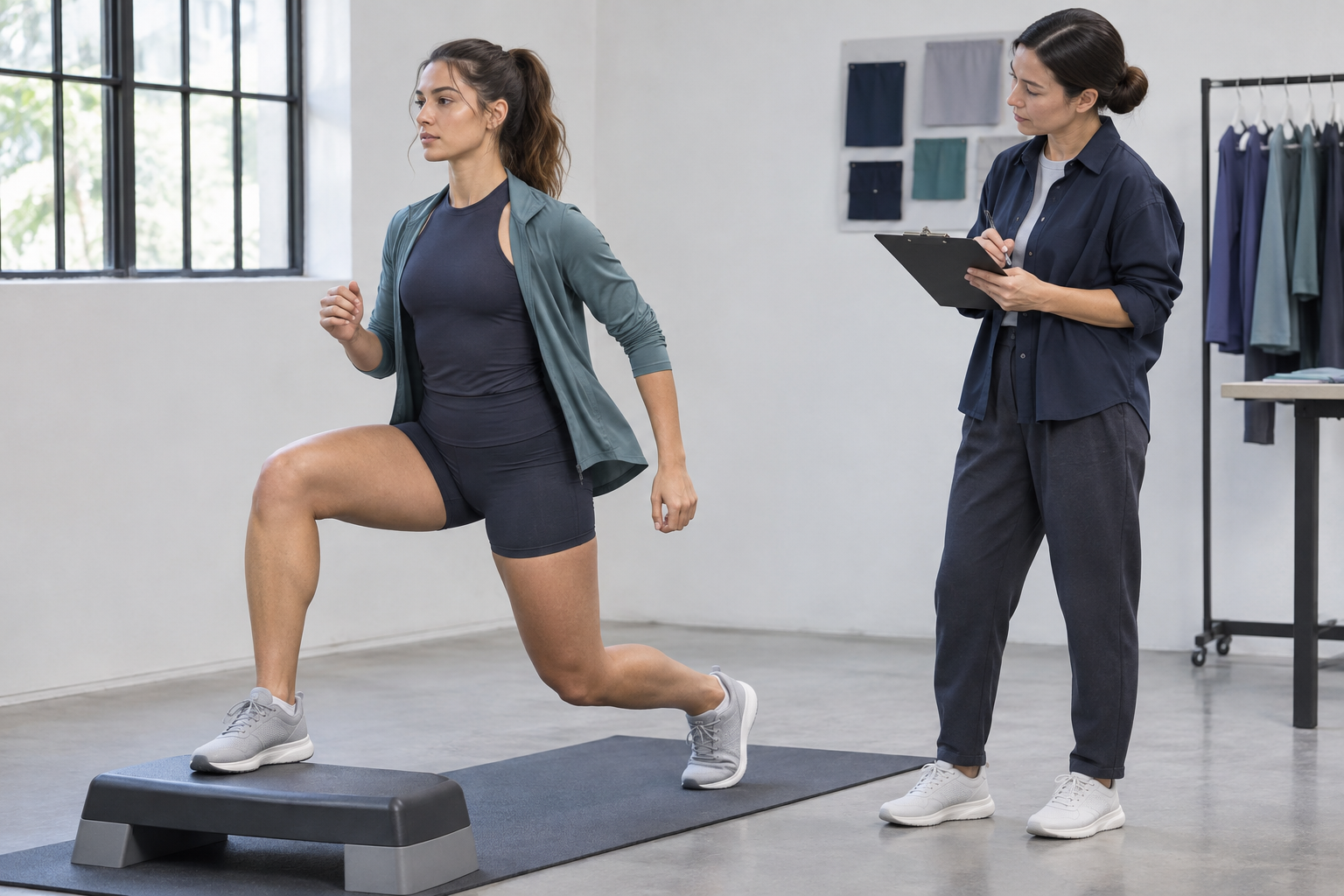
*Editorial sample-review illustration. It does not depict a customer project, a passed performance test or production approval.*
What should the fit-session record contain?
Use one controlled record for each sample session:
- Style code, product name and revision.
- Sample stage, date and review owner.
- Fit-model identity or controlled code, measurements and garment size.
- Garment measurements and measurement method.
- Material, colour, lining and component references.
- The exact top, bottom, bra and layer combination.
- Movement order and observation points.
- Photos linked to the exact sample.
- Wearer comments separated from technical observations.
- Requested action, owner and due decision for every issue.
- Accept, revise or reject status.
- Resample scope and what earlier evidence remains valid.
Write the observation before the proposed fix. “Back waistband moves below the accepted position during the step-to-plank transition” is evidence. “Increase elastic tension” is one proposed response that may affect fit and should be reviewed by the pattern and development team.
When should the brand request another sample?
Request another physical sample when a change can affect fit, coverage, support, movement, appearance, construction, material behaviour or branding. Common triggers include a pattern or measurement change; a different fabric, lining, elastic or binding; a changed neckline, armhole, hem, rise, waistband, gusset, pocket or liner; new hardware; a different logo method or placement; and a colour change where appearance under stretch matters.
An email approval cannot show the result of a physical change. If bulk production would differ from the approved sample, record the change, its affected evidence, the responsible approver and whether a replacement sample or component proof is needed.
The activewear sample-to-bulk guide explains how approved measurements, materials, components, artwork and packing information should move into production. The handoff should identify the exact accepted version rather than asking the factory to combine comments from several sample rounds.
How can a supplier coordinate multiple partner factories?
A circuit-training range may include different product types and processes. One route may be suitable for a close-fit top and bottom, while a layer, special component or decoration may need different production coordination. inPACE can coordinate an appropriate route through multiple partner factories based on the confirmed garment, material, construction, decoration, quantity direction and approval record.
More than 30 years of garment-production experience informs how inPACE organises design discussion, material and fit questions, sampling, production coordination, QC and packing. This does not create a fixed capacity, price, MOQ or timing promise. Factory allocation and commercial conditions must be confirmed for the project.
Printing, embroidery or wash effects should be included in the initial scope when relevant. The artwork, garment zone, material, colour and physical approval method need to be reviewed together. Decoration evidence from one product or fabric should not be carried to another without checking what changed.
The manufacturing overview shows how development, sampling, production coordination, QC and packing connect at a process level. It does not replace the style specification or identify which factory route applies before the product and order scope are confirmed.
What should a buyer send for a HIIT apparel review?
Send:
- The training format, stations and representative movement sequence.
- Product references for each top, bra, short, legging and optional layer.
- Marked images showing retained and changed features.
- Intended wearer, fit direction, sample size and size range.
- Coverage and support questions by garment zone.
- Material, colour, lining, elastic, zip, pocket and trim decisions.
- The intended item for every pocket.
- Planned outfit and size pairing.
- Logo artwork, decoration method questions and placement.
- Labels, hangtags, packing, channel and destination information.
- Preliminary style-colour-size quantities, clearly marked as estimates where necessary.
- The purpose and approval owner for the next sample.
A useful brief does not need every answer to be final. It makes the unknowns visible so a circuit training clothing supplier or manufacturer can recommend a controlled next step. Send inPACE the training format, product references, coverage, layering, branding and sample questions when the range is ready for a factory-custom review.
Product directions
Explore relevant activewear products
Use these product pages as practical references for your brief, then confirm materials, fit, customization, and production details through sampling.
High-Neck Zip-Front Training Top
Use this existing direction to discuss neckline, armhole, zip, body length and transition-review questions.
View product directionZip-Neck Sculpt Set
Review a coordinated top-and-bottom direction while defining the project-specific coverage, waistband, material and layer scope.
View product directionCustom Activewear Development
Use the factory-custom route when HIIT fit, material, construction, coverage, layering or functional details must change.
View product directionFAQ
Buyer questions
What should a HIIT training apparel manufacturer brief include?
Include the class format, representative circuit, intended wearer, garment roles, top-bottom-layer pairing, coverage and support questions, material and component directions, branding, sample purpose and approval owner. Identify which features stay, which change and which observations require another sample.
How is HIIT apparel development different from strength apparel development?
HIIT and circuit development focuses on repeated transitions between upright, flexed, overhead and floor positions, plus layer changes and outfit relationships. Strength development may concentrate more closely on loaded movement families and equipment-contact positions. A brand should use the movement sequence that matches the intended product.
Should a HIIT collection include shorts and leggings?
Only when both products have a defined customer, climate, class, channel or merchandising role. Review each bottom separately for waistband, rise, gusset, hem and pocket questions, then review it with the planned top. Do not add a second bottom only to make the range appear larger.
How should coverage be checked during a circuit?
Use an identified fit model, exact garment sizes and a repeatable short sequence. Record neckline, armhole, top-hem overlap, back-waist position, liner alignment and appearance under stretch from consistent views. Reopen the decision when a change to pattern, material, colour, lining or size pairing affects the evidence.
When does a light layer need its own sample?
A layer needs its own development and sample review when its fit, sleeve, opening, fastening, pocket, material, hood, collar, hem or branding is being created or changed. Review it over the named base outfit, open and closed, and through the intended removal sequence.
Can a fabric name prove breathability or HIIT performance?
No. A fibre or fabric description can guide development, but it does not by itself prove breathability, abrasion resistance, moisture management, recovery, coverage, support or finished fit. Product language should follow identified materials, agreed review methods and project-specific evidence.
When should a HIIT apparel sample be revised?
Revise or resample when a change can affect fit, coverage, support, movement, appearance, construction, material behaviour or branding. This includes pattern, measurement, fabric, colour, lining, elastic, zip, waistband, pocket, liner, neckline, armhole, hem and decoration changes.
What should a buyer send inPACE before requesting a sample?
Send the training format, representative circuit, intended wearer, product references, retained and changed features, coverage and layering questions, material and component directions, pocket item, branding files, labels, packing, preliminary quantities and the decisions the next sample must answer.