
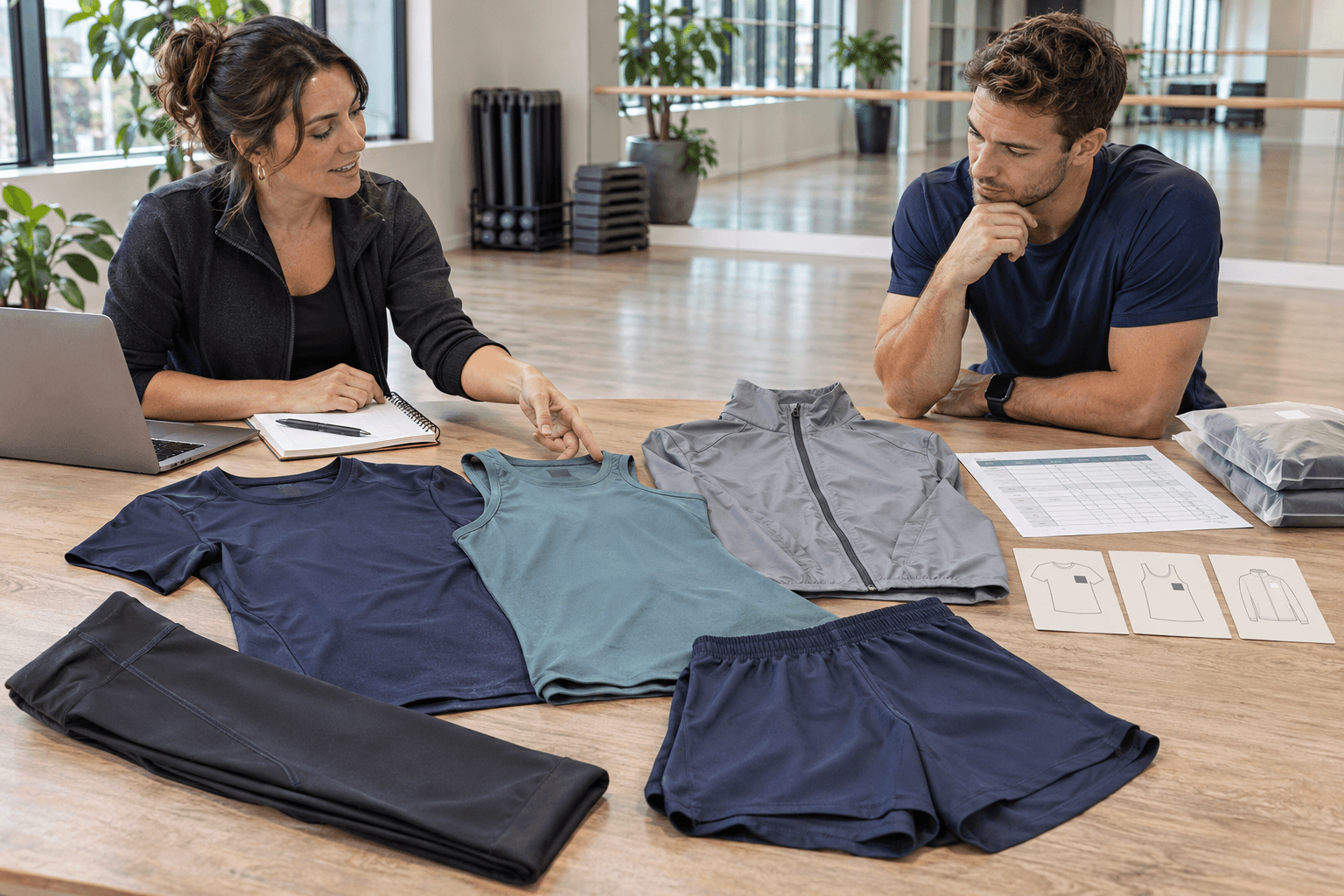
Direct answer. A fitness instructor apparel supplier brief should define staff roles, garment use, logo visibility, fit, sizes, branch allocation, packing and repeat-order controls. Review the actual top, bottom and layer on identified instructors, approve the physical branding, and keep one versioned issue record. Staff sizing is not evidence for member or retail demand.
This guide is for B2B gyms, fitness studios, clubs and multi-location operators planning apparel for personal trainers and group-class instructors. It stays narrower than a general gym clothing programme: the buyer decision is how to identify, fit, issue and replenish instructor garments without mixing them with reception uniforms, member merchandise or a retail collection.
The primary route is wholesale or private label with light customization when an existing product direction already meets the uniform role and the work centres on approved logo application, labels, hangtags, packing and allocation. Move to factory custom manufacturing when fit, material, construction, coverage, pocket, support, layer or another product feature changes. Neither route implies live stock, a fixed MOQ, price or delivery time.
What should a fitness instructor apparel supplier brief define first?
Start with people and duties rather than a product catalogue. A personal trainer demonstrating movements, a cycling instructor, a yoga teacher and a front-of-room group instructor can share a brand identity without wearing one universal outfit.
Define:
- Instructor roles and class formats.
- Whether each garment is staff-only, also offered to members or part of retail.
- Required tops, bottoms and optional layers by role.
- Intended fit, coverage and outfit relationship.
- Movement or teaching positions used during fitting.
- Front, back and side logo-visibility needs.
- Fixed gym logo, role wording and any variable names or branches.
- Staff size information and who approves fit.
- Branch-by-role-by-size allocation.
- Issue quantity and any approved spare or replacement logic.
- Labels, hangtags, folding, bags and grouped packing.
- The approved-version record used for reorders.
The broader gym clothing manufacturer guide separates staff uniforms, member merchandise and retail collections. Use this page when the staff scope is specifically fitness instructors and the operational questions are visibility, size issue and replenishment.
How should instructor apparel be separated from other gym clothing?
One gym identity can cover several programmes, but the order records should remain distinct.
| Programme | Primary wearer and purpose | Useful route | Record that must stay separate |
|---|---|---|---|
| Instructor uniform | Trainers and class leaders during paid duties | Existing product plus approved branding, or custom development when garment features change | Role, outfit, staff fit, logo visibility, branch issue and replacement record |
| Reception or operations uniform | Front-of-house, management, events or operational teams | Existing polo, tee or layer direction with role-specific branding and packing | Shift role, presentation, name/department fields and staff allocation |
| Member merchandise | Members buying or receiving a branded item | Private label around accepted products and member-facing presentation | Audience, assortment, retail presentation, member size demand and campaign purpose |
| Retail activewear | Customers purchasing a coordinated range | Factory custom when fit, material, construction, feature or collection system changes | Target customer, product development, samples, size-colour plan and replenishment data |
Do not use an instructor size list as a retail size curve. The staff list describes today’s employees; a member or retail range needs its own channel and customer assumptions. Likewise, a back print that helps identify an instructor is not automatically the right design for merchandise.
Which instructor roles need different garment decisions?
Use role-based outfit records.
| Instructor role | Product-direction questions | Fitting and movement questions | Visibility and issue questions |
|---|---|---|---|
| Personal trainer | Performance tee, fitted top, tank, short, trouser or layer; pocket and demonstration needs | Reach, squat, hinge and floor demonstrations; top-bottom overlap; stored-item use | Front chest identity, optional back role mark, branch, size and replacement owner |
| Group-class instructor | Top and bottom relationship, class-specific coverage, layer for arrival or recovery | Front-of-room movements, rotation, overhead reach and floor positions relevant to the class | Reading distance from front/back of room, instructor wording, colourway and approved version |
| Cycling instructor | Top length in riding position, neckline, sleeve or armhole, bottom role and optional layer | Seated/standing riding posture, forward torso angle and layer removal | Front/side identity, instructor role text and branch allocation |
| Yoga, Pilates or barre teacher | Top-bottom overlap, floor coverage, support relationship and light layer | Hinge, reach, rotation, kneeling, supine and class-specific positions | Discreet but recognisable mark, studio role, size pairing and replacement record |
The table is a briefing tool, not a statement that one garment performs for every instructor. Select representative movements and review the actual sample on intended wearers.
The Activewear Performance collection can help a buyer name a training silhouette or outfit direction. A catalogue image does not prove stock, exact material, fit or role suitability. If the gym wants a coordinated top-and-bottom reference, the Zip-Neck Sculpt Set can support a pairing discussion while its actual project details remain open.
How should a gym build the instructor outfit?
Define an outfit around the teaching role rather than ordering unrelated garments with the same logo. A practical programme may include:
- One core instructor top.
- One approved bottom by role.
- An alternative top or bottom only when it solves a documented need.
- A removable layer for arrival, recovery or front-of-house time.
- A reception or operations garment kept outside the instructor outfit record.
Record the exact pairing. A cropped top may need a particular waistband height; a loose tee may need a different logo scale from a close-fit top; a light layer may cover a back mark. Review each garment separately, then together.
The high-neck zip-front training top reference can help an instructor programme discuss neckline, opening, armhole, crop length and logo zones. It is a product-direction reference, not a fixed instructor uniform. If those features change, the project moves into a custom-development and sample route.
Where should logos and instructor wording be visible?
Logo visibility is a communication decision and a product decision. The gym should state who must recognise the wearer, from which direction and at what working distance.
Common zones include:
- Small front chest mark for close-range identity.
- Upper or centre back mark for front-of-room visibility.
- Sleeve or side mark for secondary identity.
- Role wording such as Instructor or Trainer.
- Branch or department identifier.
- Individual name only when the gym controls variable data and approval.
Do not assume that “large back logo” is enough. Record artwork, dimensions, placement from a stable seam or edge, garment size used for placement, method, colour and expected reading context. Check the mark while the garment is worn and moving.
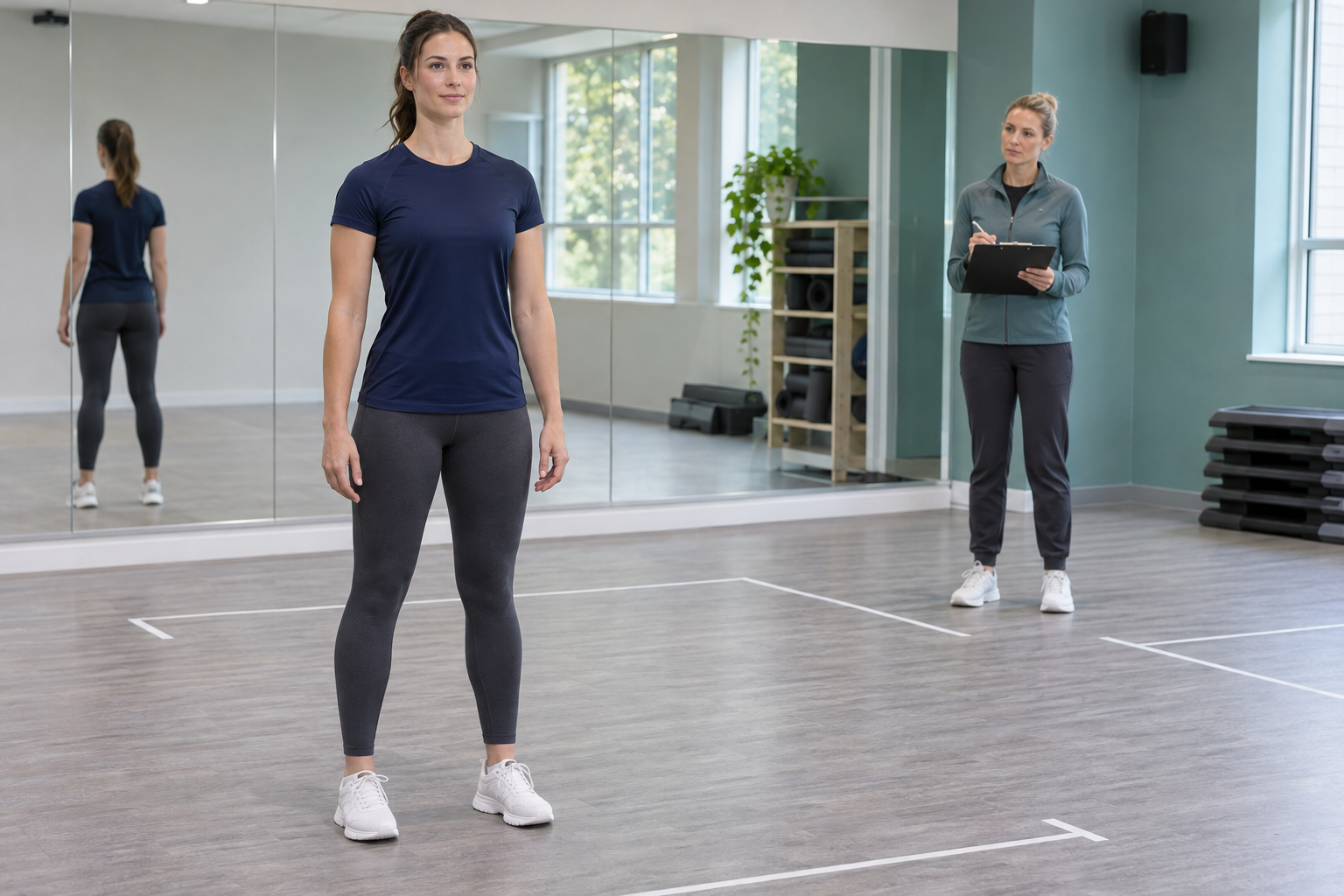
*Editorial visibility-review illustration. It does not depict a customer programme, production approval, class result or verified logo test.*
The logo methods for stretch activewear guide helps buyers connect artwork, application method and placement to a real material and stretch zone. Printing or embroidery can be discussed when relevant, but method, material compatibility and physical result require project confirmation.
How should visibility be reviewed before approval?
Use an identifiable sample and a short observation plan.
| Visibility question | Review condition | Evidence to retain | Resample or reproof trigger |
|---|---|---|---|
| Is the front mark visible at greeting distance? | Worn garment, normal standing and teaching posture | Front views, placement measurement and artwork version | Garment, artwork, method, size or location change |
| Is instructor wording readable from class distance? | Actual studio-like distance and lighting selected by the buyer | Front/back views, measured distance and reviewer decision | Wording, font/artwork, garment colour or placement change |
| Does movement distort or hide the mark? | Representative reach, rotation and floor positions | Before/during/after views and seam/stretch notes | Fit, fabric, panel or application change |
| Does a layer cover the identity? | Core top with layer open and closed | Outfit views and layer-use decision | New layer, mark zone or wearing state |
This is not a standardized visibility test. The gym chooses the conditions relevant to its operation and records who approved the result.
How should staff sizes be collected and approved?
Use measured information and controlled fitting where practical. A staff member’s usual retail size is a starting point, not proof that the selected uniform fits.
The size record should contain:
- Employee or anonymised staff ID.
- Role and branch.
- Garment style and version.
- Body measurements if collected under the gym’s process.
- Sample size tried.
- Relevant fit observations.
- Final issued size.
- Approver and date.
- Open issue or replacement reason.
Keep personal information proportionate and access-controlled. The supplier needs an allocation, not unnecessary employee data. A gym can use controlled IDs and retain the identity mapping internally.
The activewear size and colour quantity guide explains how style, colour, size and quantity decisions should be separated. For an instructor programme, the branch and role fields are equally important.
What should happen during an instructor fitting?
First verify the sample version, material, colour and size. Then review standing balance, teaching posture and representative movements for the role.
Observe:
- Neckline, armhole, sleeve and shoulder position.
- Body length and top-bottom overlap.
- Waistband, rise and leg opening.
- Coverage in overhead, hinge, squat and floor positions as relevant.
- Layer relationship open and closed.
- Pocket access with the intended item.
- Logo position and visibility while worn.
- Label, seam, zip or hardware contact.
- Whether the staff member readjusts the garment during the sequence.
Write observations before solutions. “Back mark folds beneath the layer when closed” describes evidence. “Move the logo lower” is a proposal that can affect appearance and should be reviewed on the next proof or sample.
The activewear fit model brief provides a useful structure for wearer identity, measurements, movement, observation, requested action and resample trigger. A staff fitting does not approve every size; it supports the named wearer and garment version.
How should branches and roles be allocated?
Never order one total quantity without the underlying matrix. Use:
| Branch | Role | Garment/version | Colour | Size | Issue quantity | Approved spare/replacement quantity | Receiving owner |
|---|
Mark forecasts and confirmed numbers separately. The matrix should reconcile to the purchase order and packing plan. If one instructor works at several branches, decide which branch owns the issue and replacement record.
Colour can identify roles or branches, but every extra colour adds allocation, logo and replacement complexity. Use a colour only when it has an operational or brand purpose. Do not assume that a logo method approved on a dark top will look the same on a light top.
What is an approved-version register?
The register connects product, artwork and allocation.
Keep:
- Product name, code and garment revision.
- Approved material and colour references when confirmed.
- Measurement/specification version.
- Logo and role-artwork files.
- Application method and measured placement.
- Labels, hangtags and care information supplied by the buyer.
- Folding, bags, size stickers and grouped packing.
- Sample or physical proof identity.
- Approval owner and date.
- Superseded versions that must not be reused.
An email saying “same as last time” is not enough. The register lets the gym identify exactly what “same” means.
What should be handed over to each studio or branch?
Production approval and local issue are different controls. The central buyer may approve the product, artwork and packing, while a branch manager receives cartons, checks the allocation and hands garments to named instructors. Give the receiving team enough information to complete that second task without asking them to reinterpret the order.
A useful branch handover pack contains:
- Branch name, receiving owner and expected carton or pack identity.
- The approved garment name, code, colour and visible reference image.
- A branch-by-role-by-size issue list using controlled staff IDs.
- The quantity packed, quantity received and any discrepancy field.
- Instructions for sets or outfits that must be issued together.
- The current approved-version identifier.
- A place to record the issue date, recipient and unused balance.
- The replacement-request route and the evidence required.
- A clear rule for obsolete, damaged or returned garments.
Ask the receiving owner to check the outer carton mark, pack label, garment code, colour and size count before distribution. This is not a second product inspection and does not transfer manufacturing approval to the branch. It confirms that the approved allocation reached the intended location and that obvious receiving differences are recorded before garments are mixed into local storage.
If garments are packed by employee, avoid exposing unnecessary personal data on outer cartons. A controlled staff ID or internal code can connect the pack to the gym’s private roster. If garments are packed by role and size, the branch should record the final issue locally so the next replenishment request can distinguish new hires, replacements and unused stock.
For a multi-location programme, compare branch issue records after the first distribution. The comparison can reveal allocation errors, unissued sizes, frequent exchanges or a role whose outfit is being used differently than planned. Treat those observations as programme evidence, not as an automatic instruction to change a pattern or size chart. A product change still needs a defined reason, an affected version and the appropriate proof or sample review.
How should repeat orders be controlled?
A repeat order begins with a change check.
Ask:
- Is the garment version unchanged?
- Is the same material and colour available and approved?
- Is the artwork file unchanged?
- Are role wording and branch names current?
- Is placement unchanged for every garment size?
- Are labels, hangtags and packing unchanged?
- Are destination and receiving details unchanged?
- Does the new size allocation reconcile to current staff?
If any answer changes, identify the affected evidence. A new employee may need only a size allocation against the approved garment. A new fabric lot, colour, logo, role wording, label or pack may require a new proof, sample or confirmation.
The activewear repeat-order guide explains how approved references and changed inputs should be separated before production. The gym should retain issue and replacement history so replenishment is driven by a real staff need rather than an unexplained total.
How should replacements and new hires be recorded?
Use a reason code and current record:
- New hire.
- Role change.
- Branch transfer.
- Size change supported by a fitting decision.
- Normal approved replacement.
- Damage or loss under the gym’s policy.
- Garment revision.
The reason does not automatically determine supplier responsibility or cost. It helps the gym understand what is being ordered and whether the old item should remain in service.
For a new role, check whether the artwork and garment already exist. Do not add variable wording informally after files have been approved. The exact text, spelling, placement and allocation need the same control as the first order.
What labels and packing belong in the programme?
Staff apparel can be packed by branch, role or employee code when the gym needs a controlled handover. Decide whether each item requires:
- Brand or programme label.
- Size identification.
- Care information supplied and approved by the buyer.
- Hangtag or no hangtag.
- Individual bag or grouped pack.
- Outfit grouping.
- Branch, role or employee code.
- Carton mark and receiving list.
The activewear packaging checklist helps buyers connect garment identity, labels, folding, bags, cartons and receiving information. Avoid adding retail packaging automatically to a staff uniform if it serves no operational purpose.
When is private label the right route?
Use the private label activewear route when the selected garment already meets the instructor role and the project focuses on controlled branding, labels, hangtags and packing.
The buyer still needs to approve:
- Exact base product and version.
- Worn fit on intended instructors.
- Logo method, size and placement.
- Role wording and variable fields.
- Labels and packing.
- Branch/role/size allocation.
- Physical proof or sample.
Private label does not mean “no sample decisions.” It means the product itself is not being redesigned beyond the confirmed scope.
When does instructor apparel need factory-custom development?
Use custom activewear development when the brief changes fit, fabric, construction, coverage, pocket, lining, support, layer, colour blocking or another garment feature.
Factory-custom triggers include:
- New pattern or fit block.
- Changed body or sleeve length.
- Changed neckline, armhole or coverage.
- New pocket, key loop or storage requirement.
- New support, lining or inner layer.
- New panel, seam or construction.
- New material or component system.
- Coordinated collection relationships beyond accepted base styles.
inPACE can coordinate an appropriate route through multiple partner factories based on the confirmed product, material, construction, decoration, quantity direction and approval record. More than 30 years of garment-production experience informs how design discussion, sampling, production coordination, QC and packing are organised. This does not create a fixed MOQ, price, capacity or timing promise.
What should the sample plan prove?
Give each sample or proof one purpose.
| Decision | Input | Approval evidence | Reopen when |
|---|---|---|---|
| Is the garment suitable for the instructor role? | Role, reference, wearer, movements and fit questions | Measurements, worn views and fit decision | Garment, fit, material or role changes |
| Is the identity visible and correctly produced? | Artwork, wording, method, size, colour and placement | Physical proof on the actual garment zone | Artwork, method, location, colour or garment changes |
| Is the branch and size allocation correct? | Staff/role matrix and confirmed issue policy | Reconciled quantity table and approval owner | New staff, branch, role, size or issue rule |
| Can the programme move into production? | Closed product comments, branding, labels, packing and PO allocation | Named approval of the exact version | Any product, branding, pack or allocation change |
Exact sample and production timing depends on confirmed garments, materials, colours, components, artwork, quantities, revisions and approval sequence. Discuss planning only after this scope is clear.
What should a buyer send before requesting a programme review?
Send:
- Staff roles and class formats.
- Branch list and receiving owners.
- Garment references for each role.
- Features that stay, change or need supplier advice.
- Intended fit, coverage, layer and pocket questions.
- Instructor fitting or controlled size information.
- Logo artwork, role wording and variable fields.
- Front, back and side visibility requirements.
- Labels, hangtags, folding, bags and grouped packing.
- Preliminary branch-by-role-by-size quantities.
- Issue, spare and replacement logic.
- Sample/proof purpose and approval owner.
- Desired launch date supplied by the buyer, without treating it as a supplier commitment.
The inPACE process overview shows how a brief can move through development, sampling, approval and production coordination. Share staff roles, intended garments, branding requirements, size data, repeat-order process and launch timing with inPACE when the programme is ready for review.
Product directions
Explore relevant activewear products
Use these product pages as practical references for your brief, then confirm materials, fit, customization, and production details through sampling.
Activewear Performance Collection
Use existing training-product directions to identify instructor garment roles before confirming fit, logo visibility and allocation.
View product directionPrivate Label Activewear
Use this route when approved base garments remain unchanged and the programme focuses on logo, labels, hangtags and packing.
View product directionCustom Activewear Development
Use factory-custom development when instructor fit, material, construction, coverage, storage or layering features must change.
View product directionFAQ
Buyer questions
What should a fitness instructor apparel supplier brief include?
Include instructor roles, class formats, garment references, intended fit and coverage, outfit pairings, front/back logo visibility, role wording, staff size information, branch-by-role allocation, labels, packing, replacement logic, sample purpose and approval owner.
Should instructors and reception staff wear the same uniform?
They can share a brand identity, but the garment should follow the actual role. Reception may need a structured tee, polo or layer, while instructors may need garments reviewed through demonstrations and class movements. Record each role, garment, fit, visibility and allocation separately even when colours or logos are shared.
Can staff size data be used for member merchandise?
No. Staff sizing describes the current team and approved uniform. Member merchandise or retail needs its own audience, channel and size-demand assumptions. Keep staff issue records separate from member and retail assortment planning.
Where should an instructor logo be placed?
Placement depends on who must recognise the instructor, viewing direction and garment construction. Review measured front, back or side zones on the worn garment, at relevant studio distance, open and layered as applicable. Confirm artwork, size, method, colour and placement with physical evidence.
How should multi-branch instructor quantities be planned?
Use a branch-by-role-by-garment-by-colour-by-size matrix with issue quantities, approved spares or replacements and a receiving owner. Mark forecasts separately from confirmed quantities and reconcile the matrix to the purchase order and packing plan.
What makes an instructor uniform a repeat order?
A repeat order uses the same approved garment version, material and colour where available, artwork, placement, labels and packing. New staff may require only a size allocation, but changes to product, material, artwork, role wording or packing can require new proof or sample approval.
When is private label suitable for instructor apparel?
Private label can suit an accepted base garment when the work centres on approved logo application, labels, hangtags and packing. The gym still reviews fit, logo visibility, physical branding, size allocation and pack information before production.
When does instructor apparel need factory-custom development?
Use factory-custom development when the brief changes fit, pattern, material, construction, coverage, pocket, lining, support, layer, colour blocking or another garment feature. Those changes need a controlled specification, sample purpose and physical approval.