
Direct answer: direct-to-fabric digital printing is a route question, not a shortcut label
Direct-to-fabric digital printing for activewear means applying a digitally controlled image to fabric before the material is cut and sewn. The phrase does not identify one universal ink, fibre, pretreatment or fixation system. Before comparing a supplier proposal, name the fabric or candidate fibre base, artwork coverage, colourway, garment panels, sample purpose and approval owner. A printed swatch can answer a fabric question; it cannot by itself approve a finished activewear garment.
This guide helps B2B brands decide whether artwork belongs on a fabric-print route, a garment transfer or a local logo application. It does not claim that inPACE owns a digital textile printer or uses a particular ink system. Route suitability and partner scope must be confirmed for the project. If the brief changes fit, fabric, panels, colour or function, use custom activewear development.
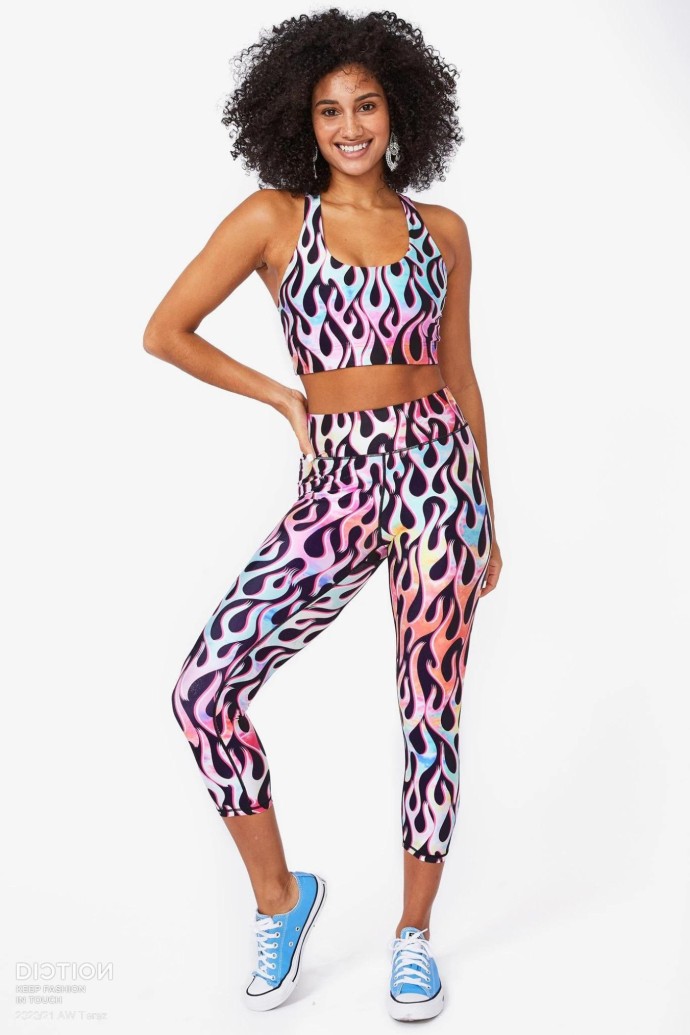
The Jogging & Printed Activewear collection and the YA-13 graphic-set reference shown here can help a buyer identify a product role and visual direction. They are references for the conversation; they do not prove that a particular style uses direct-to-fabric printing, that a fabric is currently available, or that another project can reproduce the same result.
*This product image helps identify a printed-garment direction. It does not identify the print process, fibre content, ink system, sample history or current project availability.*
What does direct-to-fabric digital printing mean in a buyer brief?
In a fabric-print route, the digital image is applied to the textile substrate before garment panels are cut. A supplier may describe the operation as direct-to-textile, direct-to-fabric or roll-to-roll, but terminology can vary by supplier and equipment. Ask what physical surface receives the image, at what stage of garment development the operation happens, and what additional steps follow the print. Those answers identify the process more reliably than a short acronym.
A useful process definition separates the substrate from the chemistry. The substrate is the named fabric or candidate material. The process description identifies how the image reaches that surface, which ink family is being proposed, whether the fabric needs preparation, how colour is fixed or cured, and whether washing or another finish follows. Each part may vary by the selected fibre, construction, finish and equipment. A product page that says “digital print” is not enough to infer all those details.
The routes are different even when their names sound similar. DTF commonly means direct-to-film in garment decoration; DTG applies the image to an assembled garment; transfer sublimation prints to paper before heat transfer; direct sublimation prints to treated polyester fabric before fixation. Manufacturer terminology varies, so compare the process in full. See the activewear printing methods guide, DTF guide, and digital-versus-offset sublimation guide.
| Term in a supplier conversation | Where the image is applied | What to review first | What the term alone does not prove |
|---|---|---|---|
| Direct-to-fabric / direct-to-textile | A fabric surface before cutting, using the named system | Fibre/base fabric, artwork coverage, ink/process description and downstream steps | That one ink chemistry or preparation works across every fibre and finish |
| Roll-to-roll | A continuous fabric feed in the supplier’s described configuration | Actual roll direction, usable width, tracking and print-to-panel plan | A specific fibre, print result, quality level or production capacity |
| Direct-to-film (DTF) | A carrier film first, then a transfer onto a garment or panel | Film, adhesive, garment surface, placement and transfer-sample purpose | A fabric-print route or an all-over fabric process |
| Direct-to-garment (DTG) | An assembled garment | Garment loading, seams, placement, surface and garment sample | That the base fabric was printed before cut-and-sew |
| Sublimation transfer | Transfer paper first, then heat transfer to a suitable substrate | Substrate, paper image, colourway, transfer sample and finished-garment context | The same route as direct printing onto a fabric roll |
| Direct sublimation | Treated fabric first, followed by the system’s fixation step | Polyester base, treatment, fixation and fabric-level evidence | A general name for every direct-to-fabric ink system |
Which fibre and fabric questions come before a print-route choice?
Start with the material, not an assumption that one fibre name determines the answer. Record the candidate fabric identity if it exists: supplier or material code, fibre composition, knit or weave construction, weight or other available specification, finish, ground colour, usable width and intended garment component. If the material has not been selected, say “candidate to be proposed” and ask what information a supplier needs to recommend a route. Do not invent a composition or treat “polyester,” “nylon” or “stretch knit” as a complete specification.
The print system and textile need to be discussed together. Some dye-based systems are designed for particular fibre families; some pigment systems have a different bonding and finishing model; pretreatment and fixation requirements depend on the chosen equipment and materials. Even within a familiar process label, a supplier should identify the actual ink set, compatible base, preparation, fixation and any after-treatment for the proposed job. Vendor examples demonstrate that workflows can differ. They do not give the buyer a universal formula to apply to a different fabric or machine.
Use a material-and-process record that keeps the evidence attached to the exact candidate:
| Record field | What the buyer should capture | Why it changes the next decision |
|---|---|---|
| Fabric identity | Supplier/material code, composition and construction as documented | A category name cannot be tied to a later sample or order |
| Surface and finish | Face, reverse, texture, finish or coating information available | Surface differences may change the visual question or process review |
| Ground and colourway | Base colour reference, colourway name and version | A proof on one ground is not automatically a proof on another |
| Ink/process proposal | Supplier’s full route and named system where disclosed | “Digital” does not name the chemistry or finishing steps |
| Preparation and fixation | What the supplier says is required for that proposed system | Avoid transferring instructions from a different machine or material |
| Fabric width and direction | Confirmed usable width, roll direction and selvage assumptions | Artwork scale and later panel placement depend on physical dimensions |
| Sample question | The single decision that the next sample should answer | Prevents a visual proof from being treated as garment approval |
Do not prescribe a universal pretreatment recipe, temperature, dwell time, pressure, speed or curing setting in the buyer brief. Those are process-specific values for the supplier or qualified process owner to establish. The buyer’s job is to identify the material and the requested decision, then ask which written process information and physical proof will support it.
How do pretreatment, fixation and finishing affect the evidence?
The digital file is only the start of the chain. Depending on the named system, the textile may need a preparation step before ink is deposited. The printed image may then need a route-specific fixation or curing stage. A later wash, clearing or finish may be part of a particular workflow. Some suppliers market a system that combines or removes steps for its stated applications; another process may use a different sequence. The buyer should not assume that a workflow described for one vendor, ink, fabric or end use applies to another.
Ask for a process map at the level needed to understand the sample. It can be a short sequence: candidate fabric received, preparation identified, artwork printed, colour fixed or cured, post-treatment completed if applicable, fabric conditioned, then the agreed sample reviewed. If a step is not applicable to the proposed system, ask the supplier to record that as a process-specific answer. This is a scoping conversation, not a request for confidential machine settings.
A direct-to-fabric route can also be described by vendors as “single step,” “waterless” or “compatible with multiple fabrics.” Treat such phrases as claims about the named supplier’s system, not general facts about digital textile printing. Ask which model, ink set, fabric composition, surface, finishing scope and evidence the statement covers. Do not carry a vendor’s environmental, durability, speed or compatibility statement into an inPACE article or buyer specification as if it had been verified for another project.
For colour, keep three references distinct: the artwork’s screen display, any physical or printed colour reference, and the actual fabric sample. A colour-managed file is still not the same thing as approved fabric. Name the colourway, the ground, the sample version and the reviewer’s decision. If only a visual direction is approved, record that narrow boundary. The production team should not infer a broader colour approval from a digital mock-up or an unlabelled swatch.
How can artwork coverage and fabric width change the layout?
A print that covers a full fabric width, repeats across a roll, or occupies only selected panels requires different artwork instructions. Identify whether the design is all-over, repeating, directional, engineered for a garment zone, or a collection of separate placements. Include a current source file, version date or code, intended physical scale, repeat tile if relevant, orientation arrow, colourway map and any no-print or priority-alignment zones. A screenshot may help start the discussion, but it does not preserve the full production intent.
Usable width should be confirmed for the actual candidate and process. Do not assume that a nominal roll width equals the area available for artwork or pattern layout. Ask the supplier which width should be used in the planning discussion, how the material direction is identified, and whether edge areas or other constraints affect the sample. If the supplier cannot confirm a final pattern layout yet, mark it as preliminary instead of treating a mock-up as a nesting or cutting plan.
An artwork review should also describe what can move. If the scale may differ by size, say so. If the same motif must appear on a waistband, leg, chest or back panel, identify those zones. If a seam may interrupt the graphic, decide whether that is acceptable, should be minimized, or must be evaluated in a sample. A visual designed on a flat rectangle can be cropped when cut into curved panels; garment construction may change how the final composition reads.
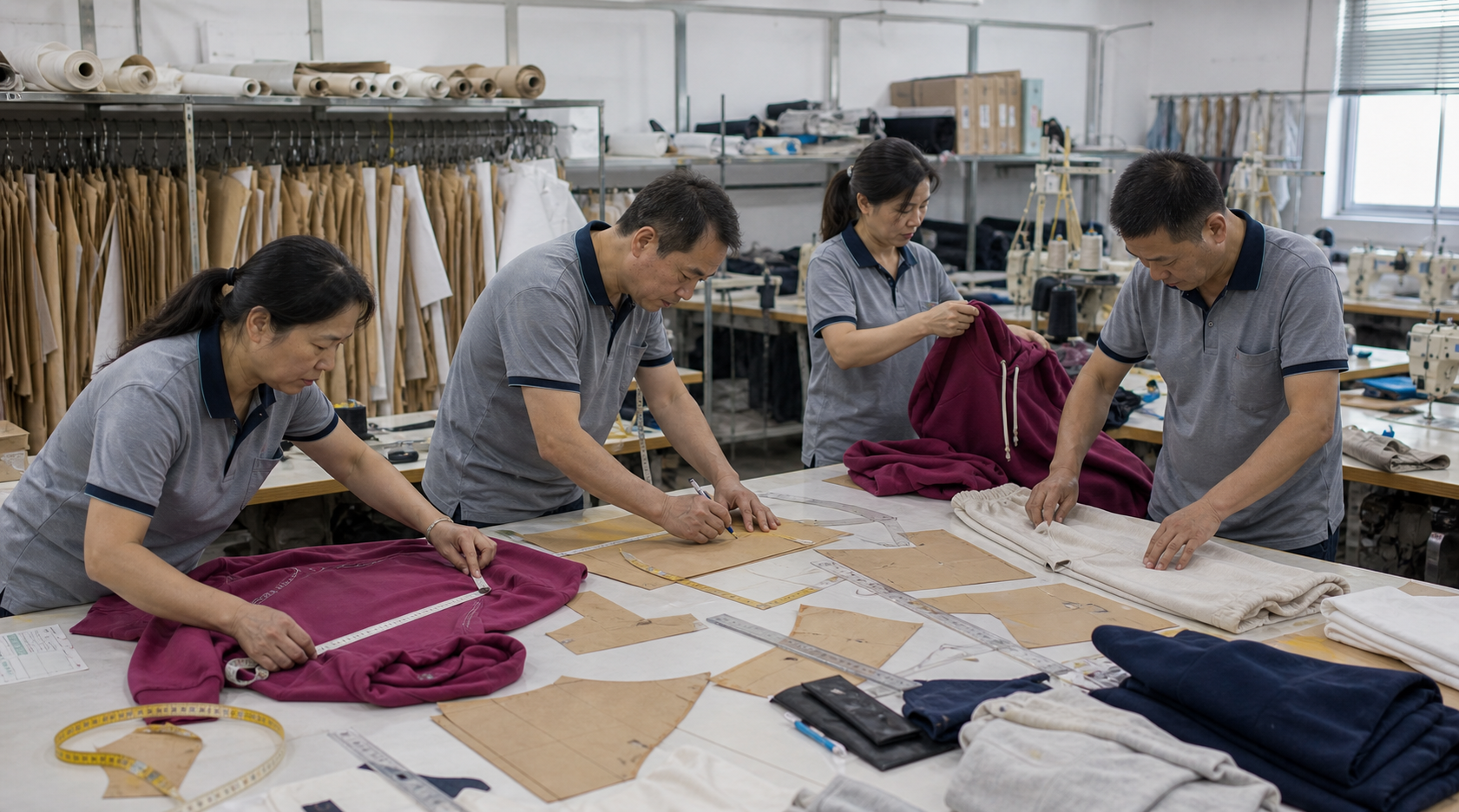
*Pattern-room context helps show why artwork must connect to cut panels. It does not depict direct-to-fabric printing or a confirmed layout for this product reference.*
The activewear print artwork files guide covers source-file naming, dimensions, repeat and version-control questions. For this page, the key addition is the fabric identity and process context. Connect each artwork revision to the material and sample that were reviewed. If the file changes after approval, record what changed and decide whether the earlier fabric or garment evidence still answers the question.
What can a printed-fabric sample prove before the garment is sewn?
A fabric strike-off or printed swatch can answer a fabric-level question within its documented scope. It may let the team review whether a named design is visible on a candidate surface, whether the ground and image interact as expected for a visual decision, or whether a repeat and direction can be understood. It cannot by itself confirm how pattern pieces will be cut, how a seam will divide the design, how a waistband or gusset will interact with the graphic, or what the finished garment will look like when worn.
Before requesting a sample, state its purpose in one sentence. Examples include: “Review the face and reverse appearance of Artwork V04 on Candidate Fabric A after the supplier’s proposed finish,” or “Check whether the scale and direction remain legible on the agreed panel map.” Avoid a vague request such as “send a print sample.” The supplier needs to know what the buyer intends to decide after seeing it.
Use a sample chain with clear limits:
- Artwork preflight: Confirm the file, current revision, intended scale, coverage and any repeats.
- Material identity: Name the candidate, source and available composition or construction information.
- Process proposal: Ask the supplier to identify the proposed print, preparation, fixation and finishing route.
- Fabric evidence: Label the swatch with its fabric, artwork version, colourway, process scope and sample date.
- Cut-and-sew review: Connect the fabric proof to the panel map, pattern version, size range and intended garment.
- Constructed sample: Review the assembled style for placement, seams, curved zones, body proportions and the buyer’s stated use context.
- Written approval: Record what was accepted, what remains open, who decided and which version the decision covers.
The sample feedback guide helps turn observations into revision requests. If the program later moves to bulk, the sample-to-bulk handoff guide provides a broader record of how an approved reference and remaining changes should be carried forward. Neither guide turns an early swatch into an automatic production release.
What garment issues should the first sewn sample make visible?
A fabric print may appear consistent on a roll but look different once garment panels are placed and assembled. The sample question can include how a repeat lands at an outer-leg seam, whether a center motif remains intentionally aligned, how the print meets a waistband, whether a gusset interrupts a visual, or how directional artwork sits on front and back pieces. These are layout and construction observations tied to a named pattern, fabric and artwork version.
Stretch activewear adds another layer. Ask which areas are expected to stretch in wear and whether the sample should be reviewed flat, on a form, on a wearer or through a named movement. An observation on a relaxed sample cannot settle a question about a stretched panel. Likewise, one garment size cannot automatically represent every size if artwork scale, placement or panel proportions change across a graded range. State what the sample covers and what has not yet been reviewed.
Do not describe an image as proof of colourfastness, no cracking, wash durability, stretch recovery, opacity or abrasion resistance. Those claims require evidence appropriate to the property and the agreed method. The garment sample may reveal a visual or handling question that the buyer should record; it does not replace a test report or an agreed acceptance method. A photo helps identify the observation, but it cannot show every condition under which the garment was assessed.
A sewn sample should carry the identity of each part that could change the interpretation: garment style, size, base fabric, fabric colour, print artwork revision, process notes that the supplier shares, finishing status, pattern/panel version and sample date. If the sample contains an alternative material or artwork, label each version. The reviewer can then distinguish “this image is not aligned with the seam” from “the print route is unsuitable,” which are different conclusions and may lead to different next steps.
If the print question exposes a change in fit, fabric, panel architecture, garment colour or construction, re-scope the project instead of keeping the request inside an artwork-only conversation. That distinction matters for the production plan and quotation: a new garment specification changes more than the image file. The buyer should ask which earlier approvals remain valid, who needs to review the new sample, and whether the same route question still applies.
How should brands compare supplier replies without inventing a process standard?
Use a comparison table with a row for the proposed substrate, named process, ink or transfer system where disclosed, preparation/fixation/finish description, artwork coverage, fabric-width basis, sample type, unresolved inputs, quotation assumptions and the person who can approve the evidence. Do not rank suppliers by a claimed speed, colour gamut, durability or environmental advantage unless the statement is documented for the exact proposed system and relevant application. A supplier’s marketing material is not an independent test of the buyer’s garment.
Keep the following fields side by side for each candidate supplier:
| Comparison field | Supplier A | Supplier B | Buyer action |
|---|---|---|---|
| Process described in full | Record exact wording and application stage | Record exact wording and application stage | Clarify any abbreviation or missing stage |
| Fabric/material basis | Named code or open item | Named code or open item | Supply a specification or request a candidate proposal |
| Preparation and finish | Record disclosed steps and unknowns | Record disclosed steps and unknowns | Ask how the sample will be labelled and reviewed |
| Coverage and width | Capture repeat/zone and usable-width assumptions | Capture repeat/zone and usable-width assumptions | Match the panel map and artwork scale |
| Sample offered | Fabric proof, strike-off, transfer or garment sample | Fabric proof, strike-off, transfer or garment sample | Decide which question the sample must answer |
| Quotation basis | Scope, assumptions and exclusions | Scope, assumptions and exclusions | Reconcile differences before comparing amounts |
| Approval boundary | Reviewer, version and covered colourway/size | Reviewer, version and covered colourway/size | Keep unreviewed versions visible |
What should a direct-to-fabric RFQ include?
Send the current artwork package and note its version, physical scale, direction, repeat, colourways and priority zones. Include the candidate material reference or the fibre and construction requirement if a material has not yet been selected. Provide an available fabric specification, sample or supplier sheet, and clearly mark what is missing. If there is already a garment sample, identify its style, size and revision; if it is only a visual reference, say so.
Ask for the supplier’s process explanation: where the image is applied, the process name in full, the proposed ink or transfer family where it can be disclosed, the preparation/fixation/finishing steps relevant to the sample, and any input that prevents a comparable review. You do not need confidential machine settings to define the buyer’s decision. You do need the supplier to state its assumptions and identify the next evidence stage.
A buyer-preparation checklist can be short and useful:
- [ ] Garment role, style reference and route boundary;
- [ ] Current artwork file, version owner, scale, direction and coverage;
- [ ] Candidate fabric identity, composition and available specifications;
- [ ] Ground colour, colourway list and any physical colour reference;
- [ ] Fabric face/reverse, usable-width question and panel map;
- [ ] Seams, stretch zones, openings, pockets, gusset or waistband priorities;
- [ ] Exact sample purpose: fabric visual, process proof, panel layout or sewn garment;
- [ ] Requested process description and any preparation/fixation/finish notes to record;
- [ ] Size range, quantity direction and packaging or market details relevant to the same order;
- [ ] Named reviewers, approval owner, open questions and change-control contact.
Ask the supplier to return the proposal with its assumptions, exclusions, missing inputs, sample identity and decision requested. The buyer can then decide whether to proceed with a fabric proof, compare another process, request a constructed sample or revisit the garment brief. A preliminary reply should remain preliminary until the relevant evidence and approval are recorded.
When should a brand move from a print discussion to custom development?
The boundary should be clear in the first supplier message. A product catalogue can establish an example of a garment role. It cannot confirm that another buyer’s requested base, print technique, colourway or construction is available. If the selected YA-13 or another jogging direction is only a visual starting point, say which features are references and which are required changes. For a new garment, use custom activewear development.
inPACE can review the buyer’s product direction, artwork coverage, material information, colourways, sample purpose and production handoff needs within a confirmed project scope. A useful output from that conversation is a short, versioned record: process question, selected fabric or open material brief, artwork ID, sample evidence requested, reviewer, unresolved details and next approval point. It gives the buyer a basis to decide whether to continue, revise or compare another route. It is not a claim that a named printer or ink system is owned by inPACE.
Share the fibre or base-fabric direction, artwork coverage, surface target, colourways and finished-garment plan through contact inPACE for a project-specific review. Include any print vendor proposal or existing sample record if available. The first useful step is to define what the next proof must show; the route and any production assumptions can then be confirmed against the real garment and material.
Technical references
The links below explain particular manufacturer-described systems; they are not universal process standards or evidence of inPACE equipment or capability.
Product directions
Explore relevant activewear products
Use these product pages as practical references for your brief, then confirm materials, fit, customization, and production details through sampling.
Jogging & Printed Activewear Direction
Identify a garment and panel context before confirming the fabric, digital print route and sample scope for a project.
View product directionYA-13 Fluid Graphic Set Reference
Use this graphic garment direction to frame coverage and panel questions; verify the actual material and print process separately.
View product directionCustom Activewear Development
Use the custom route when the project also changes the fabric, fit, panels, construction, colour programme or sample plan.
View product directionFAQ
Buyer questions
Is direct-to-fabric digital printing the same as DTF?
No. In garment-decoration discussions, DTF commonly means direct-to-film: the image is first printed on a film and then transferred to the garment. Direct-to-fabric describes applying an image to textile before the garment is cut and sewn. Ask a supplier to spell out the process it proposes, because abbreviations and marketing terms can vary.
Is direct sublimation the same as every direct-to-fabric process?
No. Direct sublimation is a specific route described for treated polyester fabric followed by heat fixation. Direct-to-fabric is a broader description of where an image is applied. The ink system, preparation, fixation and compatible material must be confirmed for the named equipment and project.
Can a digital file confirm how the print will look on stretch activewear?
No. A file shows artwork intent, not the physical result on a particular fabric, colourway, seam or stretched garment zone. Review a labelled fabric sample and, when the question requires it, an assembled sample under the intended review conditions.
Does direct-to-fabric printing always require pretreatment and washing?
There is no one answer for every system. Preparation, fixation and after-treatment vary by ink, fibre, finish and equipment. Ask the supplier to describe the proposed workflow for the named candidate fabric and sample rather than copying a recipe from another printer or material.
What should the first sample be expected to prove?
Name one decision, such as a visual on a candidate fabric, repeat scale, reverse appearance or panel placement. A fabric proof cannot automatically prove garment construction, fit, wash performance, colourfastness or every size and colourway. Those need their own scope and evidence.
Can one approved fabric swatch approve every size and garment colour?
Not automatically. Size grading, panel proportions, ground colour, finish and artwork scale may change what the final garment shows. Record which fabric, artwork, colourway, sample stage and size the approval covers, then identify any variants that still require review.
What should a buyer send before requesting a route review?
Send the garment reference, current artwork revision, proposed coverage, fibre or fabric information, colourways, panel map, sample question, quantity direction and approval owner. Mark unknowns clearly. The supplier can then identify assumptions and the next evidence needed for a project-specific decision.