
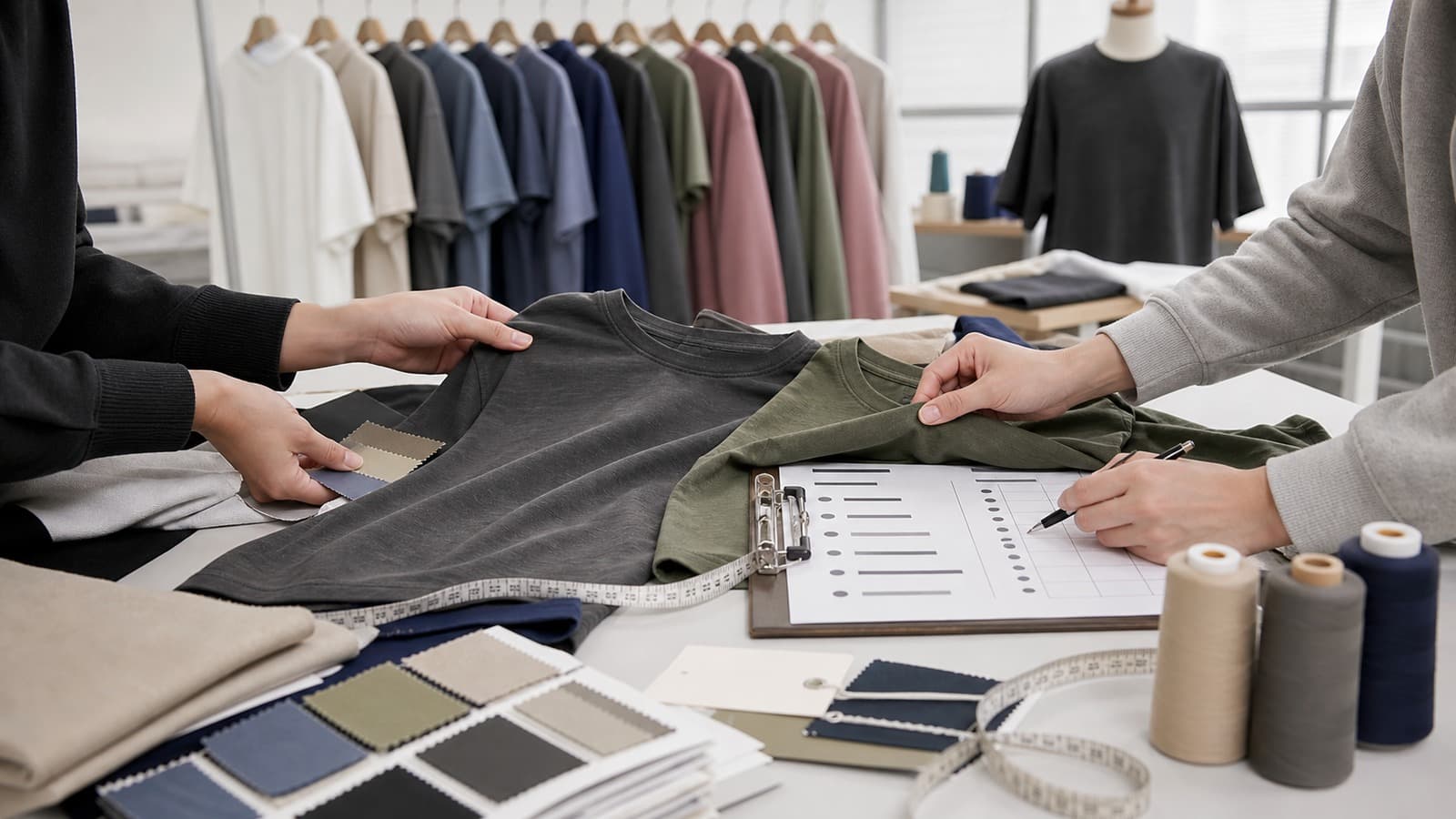
The sourcing decision
What does a custom sportswear manufacturer do?
A custom sportswear manufacturer is more than a place that puts a logo on an existing garment. For a B2B buyer, the manufacturer is part of the development path from an early idea to a repeatable production standard. That can begin with a tech pack, physical sample, sketch, reference image, or an existing catalog style. The factory then helps assess whether the requested product, fabric, construction, branding, and quantity can work together in production.
In activewear, the details are unusually connected. Fabric stretch affects fit; fit affects support and comfort; seam placement affects movement; and a logo or label method can affect handfeel, durability, cost, and production timing. A useful manufacturing conversation therefore covers the complete product plan, not only the garment's visual appearance. The work may include material direction, patterns and samples, logo application, labels and hangtags, packing, inspection, and preparation for the buyer's shipping route.
Prepare before you source
Start with the product brief, not the factory list
Buyers often begin by collecting factory names and requesting a price immediately. That can produce fast replies, but not always comparable or actionable ones. A factory can only quote responsibly when it understands what is being made and which details are important to the brand. A clear brief makes the first conversation more realistic and helps prevent a low initial quote from changing once the missing details appear.
- Product category and intended activity or use case.
- Reference image, physical sample, sketch, or tech pack.
- Fabric direction: stretch, handfeel, compression, weight, opacity, and finish.
- Colorways, size range, and sizing or grading expectations.
- Logo method, artwork, placement, labels, and trims.
- Hangtags, bags, barcode stickers, carton marks, and packing instructions.
- Target quantity, delivery market, target launch date, and cost direction.
- Any non-negotiable performance or presentation requirements.
Missing information does not mean a project cannot begin. It means the buyer and factory should be explicit about assumptions. Fabric availability, dyeing, color count, logo technique, and packaging can all change the product route. Recording the assumptions early gives both sides a better basis for sampling and quotation.
Product and material knowledge
Evaluate activewear fit, construction, and fabric expertise
An activewear supplier should be able to discuss the garment as it will be worn, not only as it will look on a table. For leggings, that may mean waistband stability, gusset shape, seam placement, recovery, and opacity in motion. For sports bras, the discussion may include support level, lining, elastic, straps, cup options, and the relationship between fabric and construction. Training tops, yoga sets, teamwear, and outer layers each bring their own balance of comfort, durability, presentation, and cost.
Fabric selection should be treated as a product decision rather than a catalog checkbox. Buyers can ask how a fabric recovers after stretch, whether it is appropriate for the intended use, how it behaves in a lighter colorway, and whether it is available for the proposed production route. The right fabric is not necessarily the softest or the most technical-sounding one. It is the option that suits the garment function, target customer, price direction, and available manufacturing plan.
Yoga and studio
Soft handfeel and flexible stretch may be priorities, alongside confidence in movement and color presentation.
Gym and training
Durable compression, recovery, construction, and repeat wear can become more important for the intended activity.
Team and program orders
Color consistency, logo placement, size planning, and repeat-order records may be especially relevant.
Choose the right development route
Decide between catalog-based styles and fully custom development
Buyers do not always need to begin with a completely new product. A catalog-based style can be a practical route when the silhouette and construction are already close to the brand direction. It can help a buyer focus the first discussion on fabric availability, colors, logo treatment, labels, packing, and size planning. For a new brand or a time-sensitive collection, this route may make it easier to learn the factory's sampling and communication process before moving to more complex development.
Fully custom development is more suitable when the product needs a distinct fit, construction, panel design, pocket placement, support level, fabric development, or performance feature that an existing style cannot reasonably provide. It gives a brand more control, but it also asks for more complete inputs and a more deliberate sample route. The buyer should expect a discussion of which parts of the concept are essential, which materials are available, and which changes could affect cost, timing, or minimum order planning.
For a catalog-informed starting point, buyers can compare one coordinated training-set reference to define the intended silhouette and product role before the factory reviews fabric, fit, colors, branding, and construction changes.
Neither route is automatically better. The useful question is whether the route supports the commercial objective of the collection. A focused catalog-informed launch can establish core styles and repeat-order records. A custom program can create stronger product differentiation when the buyer is ready to manage the additional development decisions. In both cases, a manufacturer should explain the production implications plainly rather than promising that every idea can be executed with the same MOQ, cost, or lead time.
Catalog-based starting point
Useful when a buyer wants an existing style direction and needs to clarify fabric, colors, private-label details, order quantity, and production suitability.
Fully custom development
Useful when the brand needs new fit, construction, materials, support, or product features that require a dedicated development and sample route.
Sampling protects the project
Review the sampling process before placing a bulk order
Sampling gives a buyer a physical way to assess the decisions that cannot be settled by a photograph or a digital mockup. It is where fabric, fit, support, construction, logo placement, labels, and presentation become a real product. A disciplined sample process also gives the factory a clear production reference once comments have been resolved.
1. Feasibility review
Review the brief, product category, material direction, customization scope, quantity, and target market.
2. Development or fit sample
Make the first physical sample around the agreed direction, noting any material or construction assumptions.
3. Buyer feedback
Review measurements, fit, support, workmanship, logo placement, labels, and any changes needed.
4. Approved standard
Confirm the version that represents the intended production result before bulk materials and production are scheduled.
Sample cost and timing depend on the style complexity, material availability, trims, logo technique, and revision route. The practical question is not simply how fast a sample can be made. It is whether both sides understand what the sample is intended to confirm, how feedback is documented, and which changes may affect the later production plan.
Product references
Explore product directions before choosing a development route
Use these product pages to establish the silhouette and commercial direction of your brief before confirming custom fabric, fit, colors, branding, labels, and production details.
Commercial planning
Understand MOQ, cost, and lead-time variables
There is no responsible one-size-fits-all MOQ or lead-time answer for custom activewear. A quoted route changes with the product plan. Stock fabric and an existing catalog-based style may offer a different entry point from a new style with a custom color, special finish, unique trim, and full private-label package. The same is true of cost: a lower unit price may exclude an element that another quote already includes.
Buyers should ask suppliers to identify the assumptions behind their figures. Relevant variables include fabric availability, number of colorways, dyeing requirements, fabric consumption, construction complexity, logo method, branded components, packaging, order quantity, and the factory's schedule. A comparable quote is one built from the same brief. This is more useful than comparing a single unit price that may be based on different materials or services.
For early-stage brands, a sensible approach can be to discuss which elements are flexible and which are essential. A buyer may decide to begin with an available fabric, a more focused color range, or a catalog-informed silhouette while keeping the key brand details that make the collection distinctive. That is not a compromise in quality by default; it is a way to make the first production plan clearer and more practical.
Private-label readiness
Check branding and packaging details early
A garment becomes retail-ready through a group of small but connected branding choices. Buyers may need to discuss printed or heat-transfer logos, embroidery where appropriate, woven labels, care labels, size labels, hangtags, barcode stickers, bags, folding instructions, carton marks, and warehouse requirements. These details should be included in the production conversation early, because they can affect material sourcing, placement, sample approval, packing, and inspection.
The best logo technique depends on the fabric, artwork, placement, wash expectations, desired feel, and order plan. The factory should be able to explain practical trade-offs, but the buyer should approve a physical representation of the final approach. A digital artwork file is necessary, yet it cannot fully show how a mark will sit on a stretch fabric or how it will feel once the garment is worn.
Explore private-label activewear detailsQuality and communication
Assess quality control and communication as a process
Quality control should not begin only when finished cartons are ready to ship. A stronger process starts with an approved sample and clear product information, then continues through material review, cutting and sewing checks, logo and label verification, packing review, and final inspection. This is especially important for activewear because fit, measurements, stretch, workmanship, and presentation can all affect the buyer's end customer experience.
Communication is inseparable from quality. Buyers should understand who owns the project, how sample feedback is confirmed, where product changes are recorded, and how potential issues are raised before shipment. Fast messages are useful, but written clarity matters more when a product has multiple colors, sizes, labels, logo placements, and packing instructions. Good documentation lets a brand repeat an order with more consistency as the program grows.
Review the manufacturing workflowSupplier comparison
Compare manufacturers with a buyer scorecard
A supplier comparison should make it easier to decide, not create a longer list of vague impressions. Use one brief when speaking to several manufacturers and compare their answers against the same criteria. This makes differences in scope visible and helps the buyer see where a factory is responding with assumptions rather than confirmed details.
| Criterion | What a buyer should look for |
|---|---|
| Product focus | Evidence of relevant activewear categories and construction knowledge. |
| Sample process | Clear stages, feedback handling, and a defined approval standard. |
| Fabric guidance | A practical discussion of performance, availability, and trade-offs. |
| Customization | Ability to discuss logos, labels, packaging, and colorways in context. |
| MOQ and quotation | Transparent assumptions based on the actual product brief. |
| Quality process | Defined checks from sample approval through packing. |
| Communication | Clear ownership, written confirmations, and realistic updates. |
| Export readiness | Packing and documentation planning that suits the shipping route. |
A factory visit or a focused video call can be useful when a buyer needs to examine the areas involved in sample development, sewing, quality checks, packing, or repeat-order preparation. The purpose is not simply to see a production room. It is to ask practical questions about how the buyer's product will move through the process.
A practical B2B partner
Working with inPACE Sports for custom activewear
inPACE Sports supports B2B custom activewear programs for brands, online stores, wholesalers, studios, clubs, teams, and startup designers. The business works with Ningbo Yinshan Garments Factory in Ningbo, Zhejiang, China, and its product discussion can cover yoga wear, gym wear, sports bras, leggings, teamwear, private-label details, sampling, quality-control planning, packing, and export preparation.
Review the Custom Activewear route to see how a product direction can be adapted around fabric, branding, size range, and the production plan.
A buyer can begin with a complete tech pack or with an earlier-stage input such as a reference image, sample, sketch, or catalog style. From there, the useful next step is to clarify the product goal, fabric direction, customization scope, size range, colorways, and quantity. MOQ, cost, sampling, and production timing are reviewed project by project because they depend on material availability, color requirements, logo method, packaging, style complexity, and the order plan.
For buyers comparing potential partners, the right starting point is a clear brief and a candid feasibility discussion. That makes it possible to identify a sensible sample route, decide which details need physical approval, and plan a bulk order around documented expectations rather than assumptions.
Send a product briefBuyer questions
FAQ: Custom sportswear manufacturing
What is a custom sportswear manufacturer?
A custom sportswear manufacturer is a B2B production partner that develops or adapts activewear around a buyer's product brief. The work can include fabric selection, patterns, samples, logos, labels, packing, bulk production, quality control, and shipment preparation. This is different from simply buying ready-made retail stock.
Can I develop activewear from a reference image or sample?
Yes. A reference image, physical sample, sketch, or tech pack can start a development discussion. The manufacturer still needs to review the intended fabric, construction, measurements, size range, branding, and target quantity. A reference is useful direction, but sampling is what confirms whether the chosen result is workable.
What should I include in a custom sportswear RFQ?
Include the product category, use case, reference material, target quantity, colorways, size range, fabric direction, logo and label needs, packaging requirements, destination market, target launch date, and target price direction. The more specific the brief, the more useful the factory's feasibility review and quotation will be.
What affects MOQ for custom activewear?
MOQ depends on the product, fabric availability, colorways, dyeing, logo technique, labels, packaging, and order plan. Catalog-based styles using available materials may offer a different starting route from a fully custom product with special fabric, custom colors, or extensive branding details.
How long does sportswear sampling take?
Sample timing varies by style complexity, available materials, trims, logo method, and the number of fit or design revisions. Buyers should ask what is included in the sample stage, which materials are being used, how feedback will be recorded, and what must be approved before bulk production is scheduled.
Can a manufacturer add private-label logos, labels, and packaging?
Many activewear manufacturers can discuss logo application, woven labels, care labels, hangtags, barcode stickers, poly bags, and carton marks. The right method depends on the fabric, artwork, placement, wash requirements, desired handfeel, and packaging route. An approved physical sample is more reliable than a digital mockup alone.
How should I compare sportswear manufacturers in China?
Compare suppliers on a like-for-like brief. Look at relevant product knowledge, sample quality, fabric advice, customization clarity, quality-control discipline, communication, quotation assumptions, and export planning. A lower unit price is not a useful comparison if the fabric, logo, packaging, inspection scope, or delivery assumptions differ.
What should I approve before bulk production begins?
Before bulk production, buyers should approve the sample or pre-production reference, key measurements, construction details, fabric and color direction, logo placement, labels, packaging, and any special packing instructions. Written confirmation reduces the risk of different expectations between development, production, and final inspection.
Delivery preparation
Plan packing and shipment information before the final inspection
Export planning is easiest when the buyer's packing requirements are visible before the order reaches the end of production. Depending on the route, the factory may need confirmed folding instructions, poly-bag requirements, size stickers, barcode labels, assortment ratios, carton marks, carton limitations, shipping marks, and delivery contact details. A wholesale customer, a direct-to-consumer fulfillment partner, and a retail distribution center may each require different presentation and carton information.
This does not mean every buyer needs to manage logistics alone. It means the requirements should be clear enough for the production and packing teams to prepare the goods correctly. Before shipment, buyers should also confirm which final inspection records, packing-list information, and shipping documents are required by their chosen freight route. Clear export preparation protects the work already invested in product development and helps the goods arrive in a form that can be received, counted, and sold without unnecessary rework.
Next step
Build a more reliable supplier relationship
Successful activewear sourcing is rarely the result of finding a factory from a single product image. It comes from a complete brief, realistic material choices, purposeful sampling, approved product details, disciplined quality control, and communication that stays clear from development through delivery. When those foundations are in place, a buyer is better positioned to compare suppliers fairly and build a program that can be repeated with confidence.
What should a buyer test when choosing a custom sportswear manufacturer?
A custom sportswear manufacturer should be evaluated on how it turns one defined product question into a reviewable sample and a controlled production handover. That is different from a broad supplier shortlist, an RFQ price comparison, or a company-history page. The useful question is: can the manufacturer identify what the reference proves, what it does not prove, which development decisions are open, and what the next physical sample is meant to answer?
For a brand developing leggings, sports bras, training tops, teamwear, or coordinated sets, the first input might be a reference image, a physical garment, a sketch, a catalogue style, or a tech pack. None of those inputs is automatically a production specification. A credible development conversation separates the visible inspiration from the requested fit, construction, fabric, logo, colour, size, packaging, quantity, and approval decisions. The manufacturer can then explain dependencies without quietly substituting an easier garment for the requested one.
This guide is for B2B teams assessing product-development fit. Use the activewear supplier checklist to compare a broader supplier shortlist, and use the custom activewear RFQ guide to make quotation scope comparable. Here, the focus stays on the product route between a reference and an approved sample.
Begin with a reference-intake record, not a collection of images
Send every reference with a short instruction. For each image, sample, sketch, or product link, identify its file name or date and label the intended use: keep, change, review, or ignore. A buyer might keep the longline proportion of a bra, ask to review the back-strap construction, and ignore the logo visible on a reference. That gives the development team a practical starting point.
A physical garment can be valuable because it shows a real object, but it still needs interpretation. Its fabric, base size, pattern, seam allowance, elastic, lining, cup option, decoration, and prior wear condition may not be appropriate for the new programme. The same applies to a catalogue reference. It can help establish a silhouette or product role, but it does not promise that a particular fabric, component, colour, or construction is available for another project.
Before feasibility review, a buyer should record five inputs:
- The garment role, wearer, activity, channel, and any non-negotiable use question.
- The references being used, their versions, and the parts each reference is meant to show.
- The required changes and the decisions that are still open.
- The first sample purpose: for example, fit, material, construction, branding placement, or a named combination of those questions.
- The product owner, factory contact, and the person who can approve or defer a decision.
This record is deliberately smaller than a full tech pack. It gives a manufacturer enough context to assess a development route. Where measurements, seams, components, artwork, or grading need more detail, the buyer can connect the record to an activewear tech-pack checklist rather than leaving technical instructions in scattered emails.
How should a manufacturer respond to an incomplete reference?
An incomplete reference should produce a structured response, not an invented specification. The manufacturer can say what it understands, name the missing information, describe the decision that the next sample can test, and flag any dependency that could change the route. A response that sounds certain while material identity, base measurements, component choice, or logo method is still unknown may be less useful than one that makes its assumptions visible.
| Development checkpoint | Buyer input | What a useful manufacturer response makes visible | Decision before the next sample |
|---|---|---|---|
| Product purpose | Garment type, intended activity, wearer, sales channel, and essential features | Whether the request fits an existing-style adaptation or needs a custom development route | Which features are non-negotiable and which can be assessed as alternatives |
| Reference interpretation | Marked images, sample, sketch, product link, or tech pack | What the reference shows, what remains unknown, and which files govern when they conflict | Keep/change/review instructions tied to a current version |
| Material and construction | Handfeel, stretch, coverage, support, weight, surface, lining, trim, or component direction | Candidate questions and the physical evidence needed; not a universal performance claim | Which material and construction questions the sample must answer |
| Fit and sizing | Intended wearer, base size, range, chart, movement, or comfort concern | Measurements, grading, support, coverage, or movement questions that need review | The base size and observation points for the first sample |
| Brand components | Artwork version, provisional placement, labels, hangtags, and packing needs | Which branding elements can be reviewed now and which require a proof or material-specific sample | Current artwork, placement, component, and approval owner |
| Sample and commercial scope | Quantity direction, target market, next decision date, and sample purpose | Assumptions, exclusions, inputs needed, and the difference between development review and a confirmed production scope | A named sample purpose and an updated brief or quotation version |
The table is a planning tool, not evidence of a specific customer project. It is particularly helpful when a buyer is deciding between an adapted catalogue direction and a garment that needs new fit, construction, panel arrangement, pocket placement, support, or fabric development. The custom activewear development route is relevant when the garment itself—not only its logo or labels—needs controlled development.
Match the development route to the garment change
An existing product direction can be a practical starting point when the buyer is primarily checking an established silhouette while considering colour, branding, label, packing, or limited material questions. For example, a buyer can use a Zip-Neck Sculpt Set as a reference to explain a close-fit training direction, then mark which neckline, fabric, logo, pocket, colour, or size decisions remain open. The buyer and manufacturer still need to confirm whether the changes stay within that product direction.
A factory-custom route is usually more appropriate when the requested result changes the pattern, intended fit, construction, panels, support level, pocket function, fabric, or other product-defining feature. It should not be presented as inherently better. It simply requires a more deliberate sequence of brief review, material and construction decisions, sample evidence, revision records, and approval. A brand can also begin with a limited sample scope rather than treating every future size, colourway, component, or packaging detail as approved on the first sample.
The distinction protects both sides. A catalogue-informed discussion can stay focused on what is actually being adapted. A custom discussion can state where new development work begins. Neither route confirms MOQ, price, production time, availability, or performance results until the project scope, materials, components, quantity direction, and approvals are confirmed.
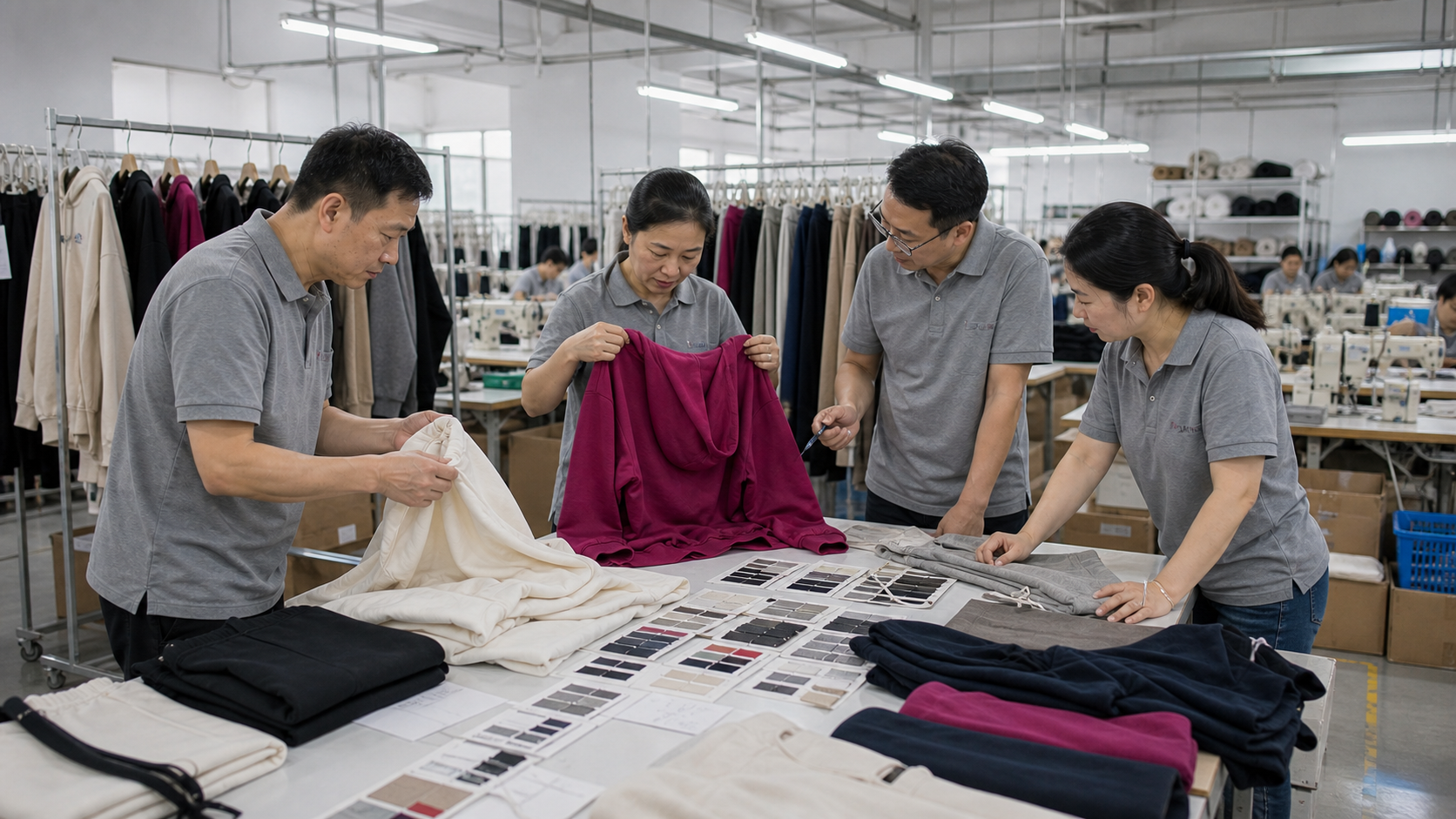
This image shows a sample-review context. It does not identify a customer project, prove a fabric or fit result, or show an approved production version for another buyer.
Give the first sample one job
The most productive sample is not necessarily the one that tries to answer every question at once. It has a named purpose. A first development sample might assess a base fit and waistband construction. A material sample might compare handfeel, stretch direction, coverage questions, or colour presentation on an identified garment. A branding sample might assess a current artwork version, placement, handfeel, and the relationship with the selected surface. A pre-production reference has a different role again: it connects approved details to production and QC instructions.
Write the sample purpose before development begins. Then list what the sample does not approve. A fit sample may not approve final packing or a later colour range. A material observation may not establish universal wear or wash performance. A logo proof may not settle a changed fabric, placement, or artwork version. This prevents the team from turning a single physical object into evidence for decisions it never addressed.
When reviewing an activewear sample, organise comments by garment location and decision type. Rather than writing “fit is not right,” record the size and version, location, observed condition, requested outcome, evidence, owner, and next review method. For instance, a buyer can note that a waistband on sample version 01 needs a review at the specified base size during the named movement context. The factory response can state whether the next step is a pattern, material, elastic, construction, or measurement review. That is clearer than claiming a correction has been made before the next version exists.
Keep buyer and manufacturer responsibilities visible
Custom development requires shared information, but not shared ambiguity. The buyer owns the product purpose, brand priorities, references, decision authority, and final acceptance of the intended result. The manufacturer's development contact reviews feasibility, identifies pattern, material, construction, component, and sampling dependencies, and explains what evidence is needed next. A commercial or sourcing owner should keep quotation assumptions aligned with the active product version. Production and QC should receive only the versions and instructions that are actually approved for handover.
Use a simple status for each open item: open, answered for review, accepted for next sample, approved, or superseded. Add the date, owner, source file, and the version affected. A change to a fabric can reopen colour, logo application, handfeel, measurement, quote assumptions, and QC questions. A changed logo may reopen placement, technique, artwork proof, and packing inserts. The record should make that connection visible instead of relying on memory.
Illustrative workflow only—not a customer case
Imagine a fictional brand with a high-waist training legging reference. The buyer marks the overall silhouette as a direction, asks to review the waistband height and pocket placement, describes a soft-but-supportive material direction, and supplies provisional tonal artwork. The brand has not finalised a size range or quantity split.
The manufacturer replies that the reference is enough to discuss a custom development route, but not enough to confirm a final specification. It requests a base size and notes that material, pocket construction, final artwork, colour reference, size range, and quantity structure remain open. The proposed first sample purpose is to review the base fit, waistband, pocket position, and material direction. The buyer then records which questions that sample should answer and which ones remain for a later version.
This example is fictional. It does not describe an inPACE order, an approved style, a quote, or a test result. Its value is the decision sequence: a visible reference becomes a named sample question, the response records assumptions, and the next revision can be checked against the item that prompted it.
Turn sample feedback into a revision record
| Record field | What to write | Why it matters |
|---|---|---|
| Sample ID and date | A version name, date, base size, and the files or photos reviewed | Stops a later comment from being attached to the wrong sample |
| Location and observation | The garment area, measurement point, component, or visible condition observed | Makes feedback actionable instead of subjective |
| Requested outcome | What the buyer wants reviewed, changed, retained, or compared | Separates an observation from a proposed solution |
| Manufacturer response | Pattern, material, construction, component, branding, or information dependency to review | Shows what the next version is expected to address |
| Owner and status | Named role, due point, and open/review/approved/superseded status | Keeps responsibility visible across buyer and factory teams |
| Evidence and next check | Annotated photo, measurement, swatch ID, artwork version, or sample observation | Connects a requested change to an identifiable next decision |
Keep the original file and version trail. Do not allow an earlier sample photo, an old artwork export, or a verbal decision to silently replace a later approved record. Before production handover, list the current brief, measurements, materials, colours, construction details, artwork, labels, components, packing requirements, quality attention points, and the approvals each team is expected to use. The sample-to-bulk manufacturing guide explains how that handover can remain distinct from an early development sample.
What should be approved before production handover?
Production handover is not just an instruction to start sewing. It is the point at which the buyer and manufacturer identify the active product version and the unresolved items that cannot be treated as approved. Depending on the project, the handover can include the approved sample or reference, measurement and grading direction, material and colour records, construction notes, artwork and placement, labels, components, packing, quality attention points, and a clear owner for any item that must still be closed.
The manufacturer can coordinate this review through appropriate partner factories when the confirmed project requires it. inPACE's role is to help structure the B2B development discussion around the garment, materials, sample evidence, production coordination, QC, packing, and the buyer's documented scope. More than 30 years of garment-production experience provides relevant context for that process; it is not a promise of a fixed MOQ, price, lead time, capacity, certification, or outcome. Printing, embroidery, washing, and similar operations should be discussed only where the actual brief makes them relevant and the sample or production implication can be reviewed.
Prepare a development brief a manufacturer can act on
Before contacting a custom sportswear manufacturer, organise the current reference versions, product purpose, keep/change instructions, intended use, material and fit questions, base size, branding files, quantity direction, destination context, sample purpose, and decision owner. Mark the unknowns rather than presenting them as facts. Ask the manufacturer to reply with the development route understood, assumptions, dependencies, first-sample question, and the next file or approval needed.
When ready, share a custom activewear product brief with the reference versions and one defined sample question. A transparent brief and revision record give the buyer a better way to assess development fit than a generic factory promise or a product image alone.