

A reliable activewear supplier should understand stretch fabrics, fit, sample comments, logo techniques, private-label details, quality control, packing standards, order timelines, and export documentation.
What to review
Questions designers, buyers, and brands should answer
Buyers and sourcing teams comparing custom activewear manufacturers before requesting samples or placing a first order.
Review relevant product experience, sample quality, and fabric knowledge before comparing unit prices.
Clarify MOQ, development timing, logo methods, labels, packing, and quality checkpoints in writing.
Assess communication quality with a real product brief, not a generic supplier questionnaire.
Practical next step
Turn the research into a clearer product brief
Send the same product information to shortlisted suppliers and compare their feedback, assumptions, and sample route.
View the order processProduct directions
Explore relevant activewear products
Use these product pages as practical references for your brief, then confirm materials, fit, customization, and production details through sampling.
Activewear Performance Collection
Compare existing training sets, sports bras, and performance silhouettes before defining fabric, branding, and order requirements.
View product directionCustom Activewear Development
Use the custom route when supplier evaluation needs to cover a new fit, material, construction, or performance feature.
View product directionPrivate Label Activewear
Compare how suppliers review logos, labels, hangtags, packaging, and receiving requirements alongside the garment.
View product directionLong-form buyer framework
How can a buyer turn this research into a production-ready decision?
The central task in choosing an activewear supplier for a B2B brand programme is deciding which shortlisted supplier can support the intended product and explain what remains unconfirmed. That decision cannot be made from a headline price, a product photo, or a general statement about customization. It needs a record that connects the commercial goal to the garment, material, fit, construction, branding, quantity, quality checks, packing, and destination. When those elements are visible together, a buyer can ask more precise questions and a factory can explain the route without pretending that open details are already confirmed.
The purpose of the framework below is not to turn a brand founder or buyer into a garment technician. It is to make responsibility and evidence clear. The buyer defines the customer and business need, shares what is known, and identifies the decisions that matter. The factory should connect product review, sampling, approvals, QC, packing, and repeat-order records. Both sides then record what was reviewed, what remains conditional, what must be approved physically, and what information will guide production or a later repeat order.
Test category relevance before discussing price
A supplier should understand the movement, fit, material, construction, and customer expectations behind the buyer's yoga, gym, training, teamwear, or athleisure product.
Judge the questions in the first response
A useful response identifies missing fabric, size, colour, logo, packing, quantity, and destination details rather than replying to an incomplete brief with false precision.
Compare samples with a written purpose
Buyers should define whether a sample is confirming silhouette, measurements, support, opacity, recovery, seam comfort, logo behaviour, labels, or packing presentation.
Ask how material choices are confirmed
A fabric name alone does not explain weight, stretch direction, recovery, surface, colour route, availability, or suitability for the intended garment.
Make MOQ, cost, and timing assumptions visible
Order variables depend on style complexity, fabric availability, colourways, branding, packaging, quantity, and factory planning, so early figures need a recorded scope.
Review the QC and approval handover
The supplier should explain how approved measurements, materials, workmanship, artwork, labels, and packing details become checkpoints during production and before shipment.
Include communication and repeatability
Clear revision records, decision owners, file versions, packing instructions, and repeat-order references are part of supplier capability, not administrative extras.
Buyer scenarios
How does the decision change in common sourcing situations?
Real projects rarely arrive with every detail complete. The useful question is not whether the brief is perfect; it is whether the missing information is visible and whether the next step will produce evidence. These scenarios show how a buyer can keep choosing an activewear supplier for a B2B brand programme practical without converting early assumptions into promises.
The buyer has a direction but incomplete technical files
Start with the product role, target customer, intended use, reference material, and the decisions already made. Mark missing measurements, fabric, artwork, or packing details as open questions. The supplier response should show what can be reviewed immediately, what needs a sample, and what information is required before the route becomes more specific.
A catalogue reference is close but not exact
List the features that already work and separate brand presentation from garment changes. A logo, label, hangtag, or bag may stay within a catalogue-informed route, while a new fit, material, pattern, construction, or performance feature may require custom development. The decision should be based on the requested change, not a category label.
The order contains several colours, sizes, and brand components
Create one assortment record by style, colour, and size, then connect every logo, label, barcode, bag, and carton instruction to the correct SKU. Ask which choices affect material planning, application methods, packing ratios, or quotation assumptions. This is where a simple-looking collection can become operationally complex.
The programme is expected to repeat
Decide which approved records will be retained after shipment and which changes should trigger a new sample. Product specifications, material and colour references, artwork, placement, labels, packing, QC notes, and prior order data make later replenishment more controlled. A reorder should not depend on memory or an old message thread.
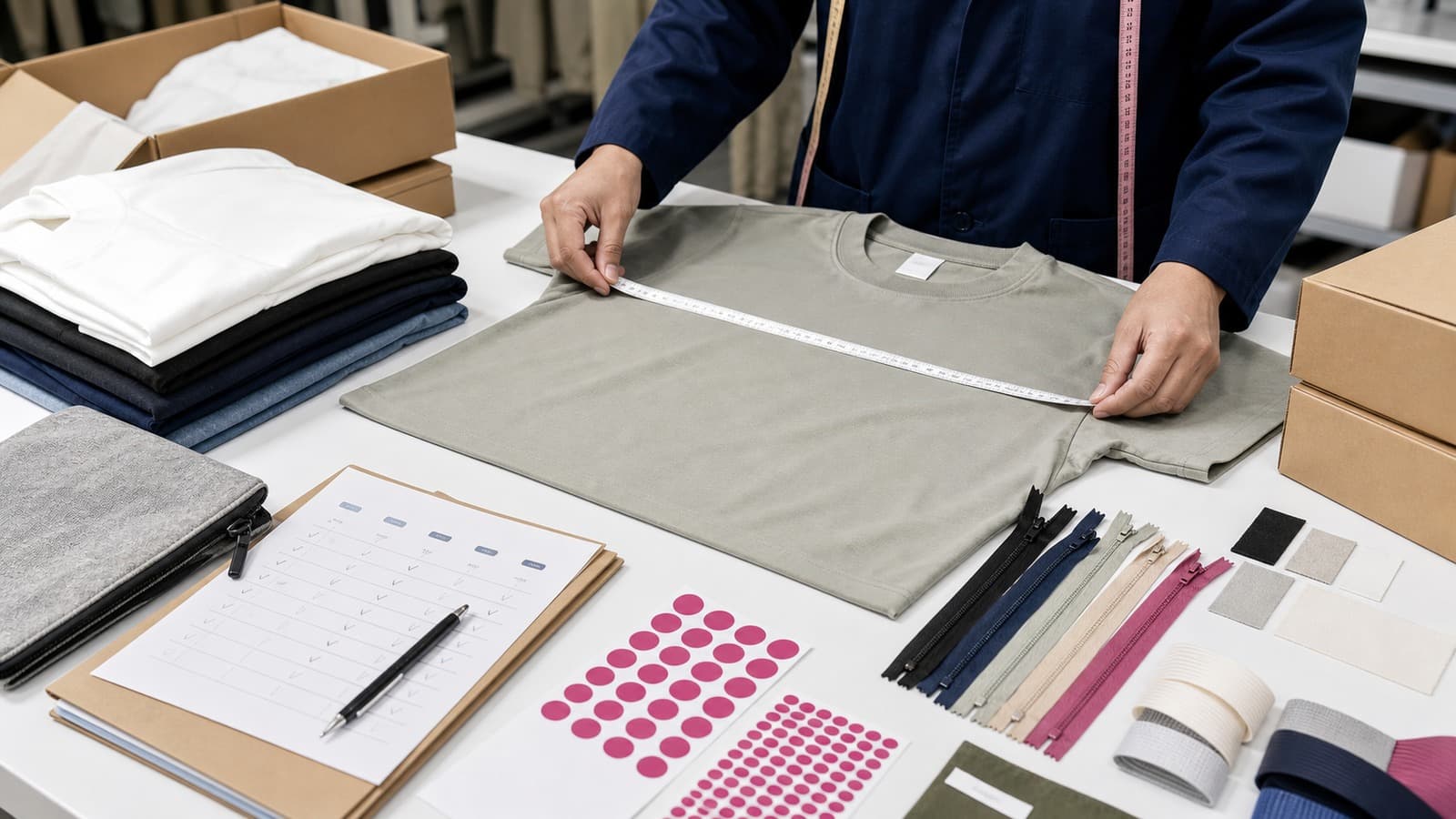
Factory execution framework
What should happen between the first brief and a repeatable order?
A B2B article is useful only when it helps the reader understand execution. For choosing an activewear supplier for a B2B brand programme, the following stages provide a practical route from early direction to recorded approval. They are not fixed promises or a universal schedule. Product complexity, material availability, colours, branding, packaging, quantity, sample feedback, and factory planning can change how the stages are organised.
Stage 1
Product and use-case definition
Name the garment, intended activity, customer, selling channel, coverage, support, layering role, and non-negotiable requirements. This prevents a familiar product name from hiding different expectations.
Stage 2
Reference and specification review
Explain what each photo, physical sample, catalogue style, sketch, size chart, or tech pack is meant to communicate. Mark what should stay, change, or remain open for advice.
Stage 3
Material and trim confirmation
Connect stretch, recovery, opacity, compression, weight, surface, handfeel, colour, elastic, zipper, label, and logo requirements to the actual product instead of approving isolated components.
Stage 4
Sample purpose and comments
Decide what the sample must prove, then record observations by issue, location, measurement, requested change, reference, owner, and approval status. A sample is evidence, not an informal promise.
Stage 5
Branding and packing approval
Review logo artwork and placement, labels, hangtags, barcode data, bags, folding, assortment, carton marks, and receiving instructions early enough to influence the order and QC plan.
Stage 6
Production and quality handover
Confirm which measurements, materials, colours, construction points, artwork, components, packing details, and approved samples are available to production and inspection teams.
Stage 7
Shipment and repeat-order record
Retain the final product files, changes, QC disposition, packing instructions, colour and component references, and prior order information for replenishment or range extension.
Decision record
How can a buyer compare supplier evidence fairly?
Send the same product brief to each shortlisted supplier. Use this blank matrix to separate a documented response from an open question or a mismatch; it is a buyer worksheet, not a record of inPACE supplier tests or a comparison of named factories.
| Review area | Question for each supplier | Evidence to record | Status and next action |
|---|---|---|---|
| Product and route fit | Which garment, use case, and requested changes are included? Is the route based on an existing style, branding, or new fit/material/construction development? | Written scope tied to the buyer's references; relevant sample or catalogue reference where available; limitations and changes called out. | Mark evidence-supported, awaiting evidence, or does not meet the stated requirement. Confirm scope or revise the brief before comparing price. |
| First response and open inputs | Which details are confirmed, assumed, missing, or needed before a reliable sample plan or quotation? | Supplier response names the missing fields, dependencies, owner, and next decision rather than filling gaps with unstated assumptions. | Mark evidence-supported, awaiting evidence, or does not meet the stated requirement. Supply missing inputs or keep the item open with an owner and due point. |
| Material and components | What is the proposed fabric or component identity, construction, colour, and role in the garment? Which specifications or availability details remain provisional? | Identified swatch/specification version and component mapping; mark unavailable or unprovided values as unknown. Do not infer a BOM from a photograph. | Mark evidence-supported, awaiting evidence, or does not meet the stated requirement. Request the material record or a project sample before approving a material claim. |
| Sample purpose and revision control | What question should the first sample answer, and how will comments, revisions, and approval be linked to its version? | Sample or version identifier, agreed review points, dated observations, requested change, decision owner, and approval state. | Mark evidence-supported, awaiting evidence, or does not meet the stated requirement. Keep sample approval open until the agreed review questions are answered. |
| Quotation assumptions | Does the response identify styles, colours, size range, quantity, material, branding, packing, destination, currency, validity, inclusions, and exclusions? | A written quote or response tied to the same scope, with assumptions and project-dependent items separated from confirmed terms. | Mark evidence-supported, awaiting evidence, or does not meet the stated requirement. Normalize the brief or request a revised response; do not rank unlike scopes by unit price. |
| QC and production handover | Which approved references and project requirements will production and inspection use, and what inspection scope or standard version has actually been agreed? | Named sample/specification version, measured points or workmanship criteria, agreed inspection scope, and disposition owner. No universal AQL or zero-defect outcome is implied. | Mark evidence-supported, awaiting evidence, or does not meet the stated requirement. Write the project-specific criteria and version into the order plan before release. |
| Branding, packing, and destination | Who approves artwork, labels, hangtags, barcodes, bags, folding, carton marks, and destination instructions? | Current file/proof version, responsible approver, applicable SKU/component, and any open receiving or export-preparation instruction. | Mark evidence-supported, awaiting evidence, or does not meet the stated requirement. Assign missing approvals and keep them open before bulk packing instructions are finalized. |
| Communication and change handling | Who owns each response and how will a change to fabric, fit, artwork, quantity, or packing affect earlier approvals? | Named contact or role, dated revision trail, changed file/sample reference, affected decisions, and next response point. | Mark evidence-supported, awaiting evidence, or does not meet the stated requirement. Reopen the connected review when a change affects the approved product. |
| Published lists and supplier claims | Is a public comparison, list, or supplier page independent evidence, a retailer offer, an editorial source, or the supplier's own marketing? Which underlying record can the buyer inspect? | Publisher, date, stated relationship, named source material, and the specific claim being checked. A list or marketing page may help discover a supplier or clarify an offer type, but it does not replace a project response, sample, quote, or approval record. | Mark evidence-supported, awaiting evidence, or does not meet the stated requirement. Keep the page as a discovery reference, then ask the shortlisted supplier for project-specific evidence against the same brief. |
When should a buyer pause the decision?
- Hold a comparison when suppliers are responding to different product, quantity, branding, packing, or destination scopes; first align the brief.
- Hold material or sample approval when the proposed item cannot be tied to an identified version or the agreed review question has not been answered.
- Hold a production decision when an unresolved requirement is a buyer non-negotiable, a quotation exclusion is unclear, or approval responsibility is unassigned.
- A missing document is an open item, not automatically proof of poor capability. Ask what alternative evidence is available and record the answer without converting it into a pass.
Separate product fit from evidence quality
A supplier may appear suitable for the product category while still leaving important project questions unanswered. Keep those judgments in separate columns. Product fit asks whether the proposed route addresses the garment, activity, and requested changes. Evidence quality asks whether the response is tied to a reference, sample version, written scope, or other traceable record. A confident explanation without a project reference can be useful discussion, but it should not be recorded as a confirmed material, fit, or QC approval. Likewise, an unanswered question does not establish that the factory lacks a capability; it establishes that the buyer needs another answer or a review step before relying on it. Separating fit, evidence, and open questions helps the team choose a sensible next action without turning one incomplete response into a broad pass or fail.
Set priorities before assigning scores
There is no universal score that makes one activewear supplier right for every brand. Before scoring responses, identify the requirements that would stop the project from moving forward, such as a specific garment route, a material constraint, a branding method, a receiving instruction, or a review responsibility. Then mark which criteria are important but negotiable and which can be resolved during sampling. If a numerical score helps a team organize discussion, define the scale and evidence threshold first, and keep the underlying notes beside the result. A high total should not cancel a failed non-negotiable, and two buyers should not compare numbers if they used different definitions of a pass. When useful evidence is still being requested, label the score provisional and state what would change it.
Test communication with the same follow-up
The first reply is only one observation. Send each shortlisted supplier the same short follow-up about one unresolved item and retain the answer with its date and reference. Check whether the response addresses the question, identifies a dependency, asks for a missing input, and names the next decision or owner. For example, a material question should distinguish an identified swatch or specification from a suggested option; a sample question should say what the next sample is intended to verify. Buyers should also record when an answer changes an earlier assumption. This creates a more comparable view of communication than judging speed or friendliness alone. It does not guarantee how a future order will be managed, so keep it as one project signal alongside product review, samples, quotation scope, and the agreed handover.
Choose the next supported decision, not a premature winner
The comparison may support different next steps for different suppliers. One response may justify a sample request while another needs a revised quotation or a clearer material reference. A buyer can keep more than one route open when the evidence does not yet answer the same question, provided the brief and next action remain explicit. Before moving from evaluation to a commercial commitment, check that the product scope, key assumptions, sample status, quote inclusions and exclusions, branding approvals, quality criteria, packing instructions, and responsible contacts have been reviewed at the level the project requires. This is a decision checkpoint, not a promise that every detail must be final before discussion can begin. Record what is approved, what remains conditional, and which change would require another review so later decisions do not rely on an outdated comparison.
Read published supplier comparisons as a classification prompt
A public supplier list can be useful when it makes a buyer notice that a finished-goods brand, a retailer, a distributor, and a contract manufacturer are not offering the same thing. That distinction should be captured before a buyer compares price, because an offer for a branded finished product cannot answer the same questions as a project that needs a specified garment, branding, sample route, quality handover, packing, or export preparation. The page itself is not a substitute for due diligence: first identify who published it, whether the publisher has a commercial relationship with any supplier, when the information was written, and which statements point to underlying evidence. Then transfer only the buyer's relevant questions into the common brief. Do not copy a page's claimed minimums, timing, capacity, quality level, customer list, testing, or certifications into a supplier scorecard unless the shortlisted supplier provides current, project-specific support for that claim.
Buyer checklist
What should be ready before the next factory conversation?
A buyer can begin even when some boxes remain open. Label them clearly and ask what evidence would close them. That approach is more useful than hiding uncertainty or waiting for an impossible level of perfection. It also makes a supplier's reasoning easier to evaluate: the response should identify connected decisions and explain why a sample, component approval, revised brief, or packing record is needed.
Continue the buyer journey
Keep the next step tied to the product decision
Continue with prepare a custom activewear RFQ when that question is adjacent to the current decision. If the project is ready for factory review, send the product type, reference, material and fit priorities, branding scope, estimated quantity, packing needs, and destination market. inPACE Sports can then discuss whether the next step is product selection, private-label review, custom development, sampling, or a more complete quotation brief.
State what is confirmed, flexible, and still open for factory guidance.
Ask how decisions move into sampling, production, QC, and packing.
Retain the approval and receiving records needed for shipment and reorders.
FAQ
Buyer questions
What should a buyer prepare when choosing an activewear supplier for a B2B brand programme?
Prepare the intended product or collection direction, customer and use case, reference styles or samples, fabric and fit priorities, colours and sizes, branding and packing needs, estimated quantity, destination market, and launch context. Mark open questions clearly. This gives the supplier a basis to review which shortlisted supplier can support the intended product and explain what remains unconfirmed without treating assumptions as confirmed specifications.
Can a buyer start without a complete tech pack?
Yes. A catalogue product, physical sample, reference image, sketch, measurement chart, mood board, or written brief can start the discussion. Explain what should be retained, changed, or reviewed, then use sampling and written comments to build a supplier comparison that records evidence, status, owner, and next action. A reference is direction; it is not automatically a production-ready specification.
How should MOQ, cost, and timing be discussed?
MOQ, cost, and timing depend on the actual product route, fabric availability, colourways, construction, logo method, labels, packaging, quantity, and factory planning. Ask the supplier to state what an early figure includes and assumes. Do not compare numbers until the participating suppliers are responding to the same garment, material, branding, packing, and delivery scope.
Which details should be approved through a physical sample?
Use a sample to review the details that cannot be confirmed reliably from a description alone: fit, measurements, support, movement, fabric behaviour, opacity where relevant, construction, logo appearance, label placement, handfeel, and product presentation. Record the observations and requested changes so the approved result can guide production and QC.
What should the buyer retain for production and repeat orders?
Keep approved measurements, material and colour references, artwork, placement, label files, component details, packing instructions, sample comments, QC decisions, quotation assumptions, and change history together. The result should support connect product review, sampling, approvals, QC, packing, and repeat-order records and give both sides a reliable reference when the product is inspected, replenished, or extended.