
Direct answer. AI activewear sourcing can organize research, compare RFQs, identify missing fields and draft buyer questions. It cannot verify a factory, approve fabric or fit, inspect workmanship, confirm legal compliance or authorize bulk production. Treat every output as a traceable draft: retain its sources, protect confidential inputs, test the physical garment and assign each approval to a qualified person.
This guide is for B2B buyers, designers and sourcing teams deciding where generative AI can reduce administrative work without weakening product control. The primary commercial route is factory custom manufacturing because a new fit, fabric, construction or feature requires physical development and approval. AI may also support an existing-product or private-label project, but it does not turn a catalogue image into stock proof, a final specification or an approved order.
The useful question is not “Can AI source activewear?” It is “Which part of this decision is document work, which part requires current external evidence, and which part can only be approved on the real garment?” Once that boundary is explicit, the team can use AI as a research and comparison assistant while keeping supplier accountability, intellectual property, sample decisions and production authorization under human control.
What is AI activewear sourcing useful for?
AI is most useful where the task is repetitive, text-heavy and reversible. It can convert an agreed template into a first draft, compare two versions, group a long list of questions or point to fields that appear inconsistent. A buyer can then check the result against the original files.
| Sourcing task | Appropriate AI assistance | Evidence the buyer must retain | Human decision |
|---|---|---|---|
| Market and product research | Group public information, summarize recurring themes, create questions for further research | Original URLs, publication dates, screenshots or downloaded source documents | Decide whether the evidence is current, relevant and credible |
| Supplier discovery | Normalize public company descriptions and build a preliminary question list | Supplier website, registration information, direct replies and dated records | Decide whether the supplier identity and capability are verified |
| RFQ preparation | Draft fields, identify missing garment details and rewrite questions clearly | Buyer-approved product brief, artwork, tech pack and version register | Approve what is sent and what remains provisional |
| Quote comparison | Align named line items, units, assumptions and exclusions | Original quotations and supplier clarifications | Decide whether offers are truly comparable |
| BOM review | Compare component names, colours, suppliers, units and substitution notes | Controlled BOM versions and approved component evidence | Approve a component or substitution |
| Sample comments | Organize observations by garment area and revision | Photos, measurements, wearer feedback and sample version | Accept, revise or reject the physical sample |
| Production handoff | Draft a checklist from already approved records | Signed or otherwise authorized specifications, PO and approval history | Release the order and approve any change |
The boundary is simple: AI can help prepare and compare the record; it cannot create the underlying evidence. If a response says a supplier has a capability, a fabric has a performance property or a product complies with a rule, the buyer still needs a current primary source and project-specific proof.
For supplier discovery, start with the questions in the activewear supplier audit checklist. Use AI to organize the questions by owner or evidence type, not to replace identity checks, document review, calls, samples or an audit when those controls are required.
Which activewear decisions must remain human and physical?
Fit, handfeel, stretch response, opacity, support, coverage, seam comfort, pocket use and closure behaviour are experienced on a material or garment. A language model can describe possible concerns, but it cannot feel the fabric, wear the product, observe movement or inspect the actual production unit.
Keep the following decisions outside automatic approval:
- Supplier identity, manufacturing role and authorized subcontracting route.
- Product scope, target wearer, intended use and commercial positioning.
- Fabric selection, colour, handfeel, stretch, recovery and coverage.
- Pattern, measurements, fit block and grading direction.
- Support, lining, cup, waistband, gusset, pocket and closure construction.
- Logo artwork, ownership, placement, method and colour.
- Sample acceptance, revision or rejection.
- Claims, labels, care information and destination-market review.
- Purchase order release, bulk change approval and shipment decision.
- Quality disposition when goods or records do not match the approved version.
An AI-produced checklist can remind the team to review a waistband or logo. It cannot decide that the waistband is secure, the logo is durable or the garment is suitable for a particular movement. Those conclusions require the defined sample, review method, responsible people and evidence.
The custom activewear development route is appropriate when fit, fabric, construction or product features must change. Buyers looking for an existing training direction can first review the Activewear Performance Collection; studio-focused teams can use the Yoga Activewear catalog. These pages are product-direction references. They do not replace a current brief, approved sample or supplier confirmation.
How should a buyer set the data boundary before using an AI tool?
Do not begin with a prompt. Begin with the organization's data classification, approved tool list and access rules. Identify what is public, internal, confidential, personal, contract-restricted or owned by another party. Then decide which fields may enter which approved system.
Current official provider documents illustrate why the exact product and plan matter. OpenAI states on its business data privacy page that business inputs and outputs are not used for model training by default. Microsoft explains on its Copilot privacy and protections page how enterprise data protection, logging and plan-specific controls apply. Google explains that Workspace administrators and content owners can restrict Gemini access to Workspace data. These are provider statements, not a substitute for the buyer's contract, configuration or legal review.
Before use, record:
- Tool name, workspace or plan, and account owner.
- Approved use cases and prohibited data.
- Retention, sharing, connector and training settings relevant to that account.
- Who can access prompts, files, outputs and conversation history.
- Whether third-party integrations or agents receive the data.
- Whether the source file owner permits the intended processing.
- Required deletion, export, audit or incident process.
- A review date, because provider features and terms can change.
Use the minimum necessary input. A request such as “compare these two anonymous BOM structures for missing units” may not require customer names, target prices, unpublished artwork or supplier identities. Replace sensitive identifiers with controlled project codes where possible. Do not upload a full data room when a redacted extract answers the question.
How can AI support research without becoming the source?
Research output should point the buyer back to inspectable material. Ask for claims, dates, source links and unresolved contradictions in separate fields. Then open the source and confirm what it actually says. If the tool cannot provide a traceable source, treat the statement as a lead for further research, not a fact for an RFQ or product claim.
A practical research register can include:
| Field | What to record | Approval rule |
|---|---|---|
| Research question | One precise sourcing or product question | The buyer owns the question |
| AI-assisted finding | Short draft summary | Never treated as evidence by itself |
| Source | Primary URL, document name or direct supplier reply | Must be accessible to the reviewer |
| Source date | Published, effective or received date | Current enough for the decision |
| Extract | The relevant sentence, table or field | Must support the summary |
| Limitation | Market, product, account, test or scope boundary | Must remain visible in downstream use |
| Reviewer | Named person with the right role | Accepts, revises or rejects the finding |
| Recheck trigger | Date or project change that invalidates the record | Prevents stale information from surviving |
This matters when reviewing trend reports, customer comments, destination-market rules or platform requirements. AI can group hundreds of public comments into possible themes, but it cannot prove demand, forecast sales or confirm that the sample solves those themes. It may overgeneralize, omit minority problems or misread sarcasm and context. The team should preserve a representative source sample and keep the research conclusion proportional to the evidence.
How can AI help compare suppliers without inventing a score?
Supplier comparison becomes safer when every candidate answers the same dated questions and the evidence is stored beside the score. AI can normalize response wording, flag blanks and identify where one quotation uses a different unit or scope. It should not assign capability from marketing language or turn missing evidence into a positive rating.
Use the activewear supplier scorecard after basic supplier identity and pre-engagement checks are complete. Define each criterion before reading the responses. For example, “sample communication” might be judged from response completeness, version control and whether questions are closed—not from fluent English or a polished AI-written email.
Protect against three common errors:
- False equivalence: two suppliers use the same term but include different fabric, testing, branding or packing scope.
- False precision: a generated score looks objective even though evidence is missing or criteria are subjective.
- Automation bias: reviewers accept the AI recommendation without opening the supplier's original documents.
Keep original replies unchanged. Create a separate comparison layer that cites the source file and paragraph. If the AI flags a risk, the next action is usually a supplier question or evidence request, not an automatic rejection. If it praises a capability, the next action is verification, not automatic approval.
How can AI improve an RFQ while preserving buyer intent?
An RFQ needs enough detail for a supplier to understand the product and identify assumptions. AI can turn a rough note into structured questions, check whether sections are missing and compare the draft against an approved template. The buyer must verify every field before sending it.
The custom activewear RFQ guide explains the product, fabric, fit, size, colour, branding, packing, quantity and destination inputs a factory needs. AI can help with wording, but it should not fill unknowns with plausible values. Use labels such as “buyer to confirm,” “supplier to advise” and “provisional for sample discussion” rather than generated certainty.
For private-label work, the private-label activewear route helps define logo, label, hangtag and packing scope around an identified product. If only those branding elements change, the brief should not imply a new fit or fabric. If the physical garment changes, move the project into factory custom development and define a sample approval path.
A useful prompt asks the tool to:
- List missing fields without guessing their values.
- Separate buyer requirements from supplier questions.
- Preserve product codes, units and revision identifiers exactly.
- Mark every assumption and its owner.
- Identify conflicts between the brief, artwork and packing instructions.
- Produce a change log rather than silently rewriting approved text.
The human approver should compare the output with the original brief, not only with the previous AI output.
How should AI compare quotations and BOM versions?
Quotations and bills of materials often look comparable while using different bases. One quote may include labels and individual packing; another may exclude them. One BOM may specify a component by supplier code; another may use a generic description. AI can surface these differences if the input documents are clean and the comparison instructions are explicit.
Use the activewear bill of materials guide to define materials, trims, units, colours, supplier references, approved alternatives and version control. Then ask the tool to compare named fields only. Do not ask it to decide that two fabrics or trims are equivalent based on similar wording.
For every difference, keep:
- Source document and revision.
- Original value and proposed value.
- Unit of measure.
- Product, colour and size scope.
- Reason for the difference.
- Cost, fit, appearance, performance, timing or compliance question raised.
- Supplier response.
- Sample or document evidence required.
- Named approver and date.
The fabric and trim review page provides context for stretch, handfeel, coverage, component and logo discussions. A generated comparison can direct attention to a missing fabric weight, finish or colour reference. It cannot approve the material. Approval belongs to the agreed swatch, lab dip, component, test record or garment sample, depending on the project.
How should confidential designs and intellectual property be handled?
Treat unpublished artwork, tech packs, patterns, customer names, target costs and supplier terms according to their owner and contract. An AI tool does not create permission to upload, transform or share someone else's content. The buyer should know who owns each input, what the service terms allow and where the resulting output may be used.
Create a pre-upload check:
- Is the tool approved for this data class?
- Does the user have rights and permission to process the file?
- Can customer and supplier identities be removed?
- Can the task use an extract instead of the complete document?
- Are connectors, shared links, agents or plug-ins enabled?
- Is the output allowed to leave the approved workspace?
- Will generated wording, artwork or code receive an originality and rights review?
- Is a human required to approve external use?
Do not ask a public AI tool to reproduce a competitor's garment, logo or copyrighted artwork as a production instruction. A reference image can help communicate direction, but it is not a production-ready specification and may carry ownership restrictions. Translate the legitimate design intent into measurable product decisions: silhouette, coverage, construction, material direction, placement and sample questions.
How should AI notes connect to physical sample approval?
AI can sort sample comments by body area, issue type and owner. It can compare the comments against the previous revision and draft a closure list. The reviewer still needs to identify the correct sample, observe it on the intended wearer or fit model, perform the agreed movements and confirm the physical change.
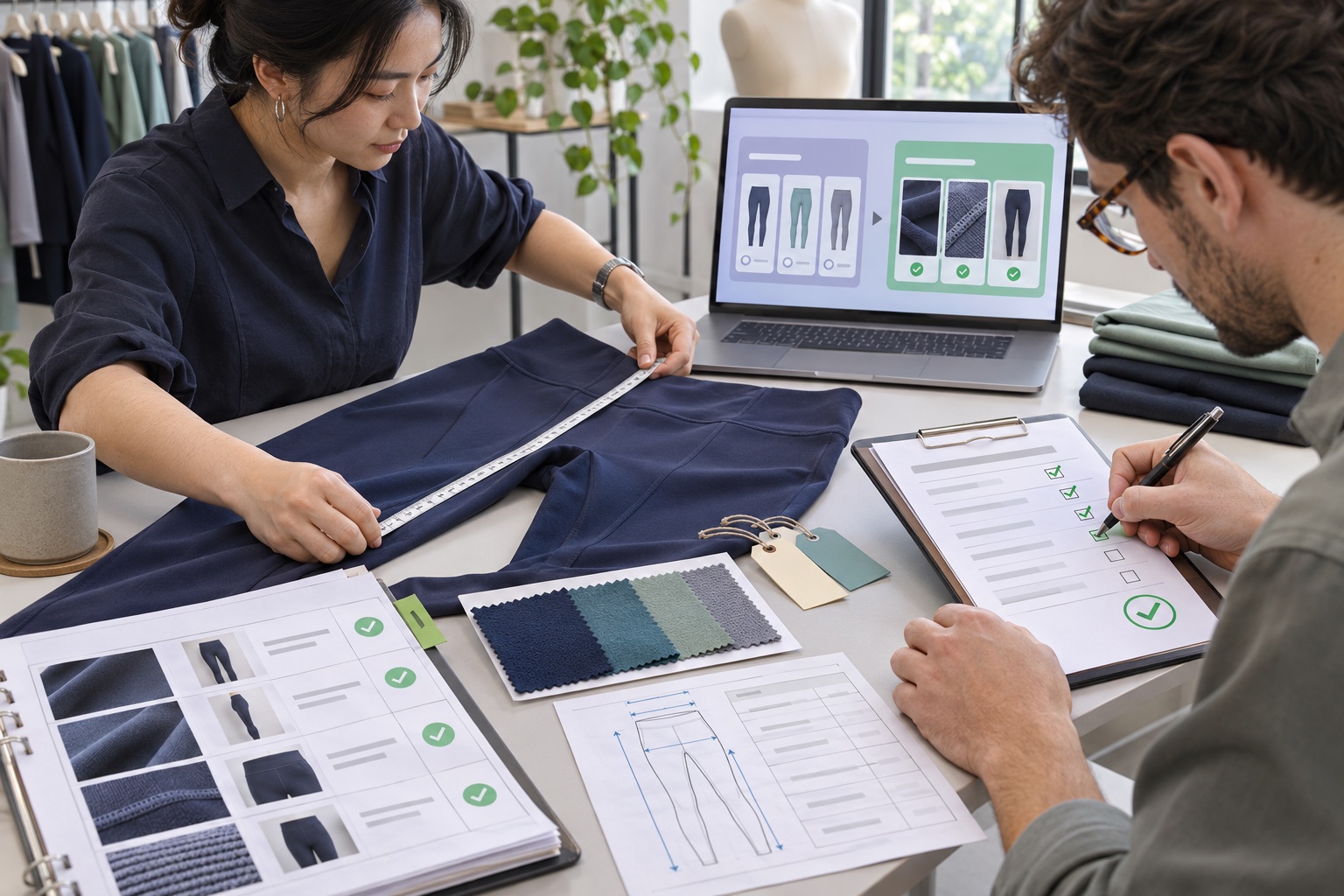
*Editorial planning illustration. It does not depict a customer project, an AI-approved garment, a test result or a production authorization.*
Use a sample record with:
- Style code, sample stage and revision.
- Date received and reviewer.
- Material, colour and component references.
- Measurement method and result.
- Fit, movement, coverage and support observations.
- Construction, seam, pocket, closure and branding observations.
- Photos linked to the exact sample.
- Each issue, requested action and owner.
- Resample trigger.
- Final human disposition: accept, revise or reject.
The tool may draft a clearer comment such as “review waistband movement during squat and seated flexion.” It cannot observe the waistband. It may group three notes under “coverage,” but the reviewer must confirm whether those notes describe the same problem and whether the next sample resolves it.
Can AI approve quality control or compliance?
No. AI can help prepare a QC checklist from approved specifications, compare inspection text with the PO or group defect descriptions. It cannot inspect the goods it has not physically observed, authenticate a test report or decide legal compliance for a destination market.
The activewear purchase order checklist helps lock product version, quantity, branding, packing and approvals before production. The activewear manufacturing workflow explains how approved records connect to production, QC and packing. Use AI to make missing links visible; do not let it rewrite the approved specification during inspection.
If a tool reads photographs, remember that image interpretation has limits. Lighting, scale, compression, hidden seams and incomplete views can change what appears visible. A photo may support communication, but it does not replace the defined inspection method, measurement tool, physical sample or authorized report.
For compliance topics, record the destination, product, applicable requirement, primary source, effective date and qualified reviewer. A general AI response is not a legal opinion, laboratory result or certificate. If a claim appears on the product page, label or packaging, the brand should retain the evidence and approval behind that exact wording.
Where should the human approval gates sit?
Build the workflow around decisions that cannot advance without a named owner. The table below keeps AI assistance visible without confusing it with approval.
| Gate | AI may assist with | Required evidence | Human owner |
|---|---|---|---|
| Research accepted | Summaries, source grouping, contradiction list | Opened sources and dated research register | Buyer or category lead |
| Supplier shortlisted | Response normalization and missing-field flags | Identity, capability, quotation and direct communication records | Sourcing lead |
| RFQ released | Structure, wording and completeness check | Buyer-approved brief and attachments | Product or sourcing owner |
| Material direction approved | Comparison of descriptions and open questions | Physical swatch, component or agreed project evidence | Designer and product team |
| Fit sample approved | Comment organization and version comparison | Correct sample, measurements and movement review | Fit and product approvers |
| BOM or substitution approved | Field-level difference report | Controlled BOM and relevant material/component evidence | Product and sourcing owners |
| PO released | Checklist and inconsistency scan | Approved product, quote, quantities, terms and packing scope | Authorized buyer |
| Bulk or shipment decision | Inspection summary and issue grouping | Defined QC evidence and authorized disposition | Quality and commercial owners |
AI should not be the owner in any row. It has no contractual authority, product accountability or ability to accept commercial risk.
What workflow can a brand adopt now?
Use a small, controlled pilot before expanding AI across the sourcing process.
- Choose one reversible task. Start with a missing-field check or source register, not supplier approval or PO release.
- Define the accepted inputs. Use redacted, versioned documents and keep the originals.
- Write the output format. Require source references, assumptions, differences and unresolved questions.
- Assign a reviewer. Name the person who compares the output with the evidence.
- Test failure cases. Include inconsistent units, outdated revisions and missing attachments to see whether the tool flags or invents them.
- Measure usefulness. Record corrections, missed issues and time spent reviewing—not only time spent generating.
- Set an expiry. Recheck provider settings, tool behaviour and the prompt when the process or source documents change.
- Expand only with controls. Add another use case when the first has a clear owner, audit trail and acceptable error response.
The inPACE how-it-works process can help a buyer map its brief, sample, approval and production handoff. AI belongs around those records as an assistant; it does not remove the steps.
What should a buyer send inPACE for an AI-assisted sourcing brief?
Send the approved product evidence rather than an AI conclusion alone:
- Product role, intended wearer and use context.
- Existing product reference, sketch, tech pack or sample version.
- Fit, movement, coverage, support and structure questions.
- Material and component direction.
- Size range, colour plan and proposed quantity by variant.
- Logo artwork, labels, hangtags and packing requirements.
- Supplier questions or comparison fields already approved by the buyer.
- Which fields were AI-assisted and which sources were used.
- Human approval owners and unresolved questions.
- Destination and any physical, label or packing requirements the brand needs reviewed.
inPACE Sports can discuss product direction, fabric and fit questions, sample scope, branding, packing and the production handoff. The team can coordinate suitable work across multiple cooperating production factories and draw on more than 30 years of garment-production experience when reviewing a project route. Printing, embroidery and wash-effect sampling can be discussed when relevant to the confirmed design. Exact scope, price, order quantity and timing remain project-specific and require approval.
For a structured review, send the product evidence, supplier questions, RFQ fields and human-approval points through the inPACE contact page. Do not send unnecessary confidential data. Mark provisional fields clearly, identify the approved AI environment used and keep the human decision owner visible.
Product directions
Explore relevant activewear products
Use these product pages as practical references for your brief, then confirm materials, fit, customization, and production details through sampling.
Activewear Performance Collection
Use a named training-product direction when testing AI-assisted brief checks against real garment and sample evidence.
View product directionPrivate Label Activewear
Define the logo, labels, hangtags and packing scope that remains under buyer and supplier approval.
View product directionCustom Activewear Development
Use the factory-custom route when fit, fabric, construction or product features require physical development and approval.
View product directionFAQ
Buyer questions
What is AI activewear sourcing?
AI activewear sourcing is the controlled use of AI tools to organize research, compare documents, draft questions and flag missing fields during apparel sourcing. The output remains a draft. Supplier verification, product decisions, sample approval, compliance review, purchase authorization and quality disposition stay with qualified people.
Can AI choose an activewear supplier?
AI can normalize supplier responses and identify gaps, but it cannot verify identity, capability, authorization, working conditions, quality or reliability from marketing text alone. Buyers should retain original evidence, ask consistent questions and assign the shortlist decision to a named sourcing owner.
Can AI approve fabric, fit or a garment sample?
No. Fabric handfeel, stretch response, opacity, fit, coverage, support, seam comfort and movement behaviour require the defined physical material or sample and an agreed review method. AI may organize observations, but a human reviewer must accept, revise or reject the sample.
Is business data automatically safe in every AI tool?
No. Data handling depends on the provider, product, plan, configuration, connectors and contract. Check current official documentation and your organization's policy before use. Minimize inputs, remove unnecessary identifiers and do not upload confidential files to an unapproved environment.
How can AI help with an activewear RFQ?
It can structure product, fabric, fit, size, colour, branding, packing, quantity and destination fields; identify blanks; separate buyer requirements from supplier questions; and draft a change log. It should mark unknowns rather than invent values, and the buyer must approve the final RFQ.
Can AI compare activewear quotations and BOMs?
It can compare named fields, units, assumptions, exclusions and revision differences when the source documents are controlled. It cannot decide that two materials or components are equivalent or that one quotation is commercially acceptable. Preserve originals and route each difference to a human owner.
Can AI approve activewear quality control or compliance?
No. It can prepare checklists or summarize inspection records, but it cannot inspect unseen goods, authenticate test reports or provide project-specific legal approval. Use physical inspection evidence, current primary requirements and qualified reviewers for quality and compliance decisions.
What can inPACE review in an AI-assisted sourcing project?
inPACE can review the product direction, fabric and fit questions, sample scope, branding, packing, proposed quantities and production handoff. Buyers should disclose which records were AI-assisted, retain the underlying sources and keep platform governance, legal review and final approvals within their organization.