

Direct answer. An activewear purchase order is ready for production review when the buyer and supplier can identify the exact styles and versions, approved sample, colour and size quantities, materials and substitutions, artwork, labels, packaging, delivery scope, commercial references, and authorized decision owners. Put unresolved items in a dated open-decision list. A PO records agreed scope; it does not replace technical approvals or guarantee an outcome.
A purchase order (PO) is the buyer’s instruction for a defined commercial order. In activewear, the PO should connect the style, quantity plan, approvals and packing scope to the technical records used by the people preparing and making the garments. The purpose of a pre-production checklist is to expose gaps while there is still time to resolve them, not to create a paper form that appears complete while teams are using different references.
This guide covers the handoff from an agreed product direction to production review. For pricing inputs, use an activewear RFQ. The sample-to-bulk review covers that separate transition.
What should an activewear purchase order checklist confirm?
A useful checklist connects every commercial line to an identifiable product and the correct approval record. At minimum, a buyer should be able to answer: what is being ordered, which revision is the reference, how is the quantity distributed, what has been approved, what remains open, what will be packed, and who can authorize a change? If those answers live in conflicting spreadsheets or email threads, consolidate or reference the controlling record before release.
The checklist is not a universal legal form. A business may have its own purchase terms, finance rules, supplier onboarding steps, import requirements and approval workflow. Use the responsible commercial and compliance teams for those matters. The product checklist here helps keep garment-specific instructions and handoff evidence visible alongside the buyer’s own documents.
| Checkpoint | What to identify | Useful evidence or reference | Common gap to resolve |
|---|---|---|---|
| Order identity | PO number, buyer, supplier, issue date, requested milestone | Buyer PO and accepted order confirmation | Two files use the same number for different revisions |
| Product scope | Style code, description, colourway, collection or programme | Line-item schedule linked to the technical pack | Marketing name is present but style code is missing |
| Approved reference | Sample name, version, date and approval status | Dated sample record, photos or signed review | “Approved sample” is mentioned but cannot be identified |
| Quantity plan | Total and split by style, colour and size | Reconciled matrix with units and total | Totals do not match the PO line quantity |
| Materials and branding | Confirmed fabrics, trims, artwork, labels and permitted alternatives | BOM, artwork files and approval records | A proposal is mistaken for a production approval |
| Packing and shipment scope | Folding, bagging, carton or assortment requirements as agreed | Packing instruction and shipping handoff reference | Carton or individual-unit scope is unspecified |
| Decisions and owners | Open questions, due stage and authorized approver | Dated issue log or approval register | A verbal comment has no owner or disposition |
1. Identify the order and product scope
Start with administrative identifiers that let both organizations locate the same order. Record the buyer’s PO number, supplier reference if one is used, issue date, buyer entity, supplier entity, currency or commercial reference where appropriate, and the contact responsible for questions. If the PO changes, retain its previous revision or clearly mark the superseded copy so that an older attachment cannot be mistaken for the current instruction.
Then define each garment line in a way that survives forwarding. Include a stable style code, a plain-language product description, colourway identifier and any collection or season reference needed by the project. A name such as “Core Legging” may be meaningful internally but can be reused across collections. Pair it with a code and a linked technical record. Do not rely on a photograph alone to identify the product.
Separate styles when their construction, material, fit, branding or packing changes the instructions. State whether colours appear as separate PO lines or as one line with a matrix, and use that structure consistently.
2. Link the PO to the approved sample and current technical version
An order can only be reviewed against references that are named clearly. Identify the sample or sample stage that the buyer approved, its date or version label, and where its record can be found. A short reference such as “fit sample v2 approved for fit review only” is more useful than “sample approved,” because approval may cover one purpose without settling colour, artwork, material or production details.
Where the project uses several sample stages, do not collapse them into one generic approval. A development sample may demonstrate construction direction; a fit sample may support silhouette and measurement review; a sales sample may reflect a later commercial presentation. The records and names differ by project. State exactly which sample informs the order and what the approval covers.
List the current technical package or tech pack revision, the BOM revision, measurement sheet and approved artwork references when applicable. Use filenames, dates or revision IDs that distinguish current files from earlier ones. If a drawing, measurement or material changed after a sample was reviewed, flag the change and state whether it was approved for the order. A file attached to an email is not automatically the controlling revision.
Reconcile technical conflicts before release. If a PO colour code conflicts with artwork or a sample differs from the current tech pack, identify the controlling reference and record the decision, evidence and effective revision.
3. Reconcile the size, colour and quantity matrix
The quantity matrix is one of the most useful checks before release because it translates the PO total into the planned assortment. For each style and colour, list every requested size and its unit count, then show a subtotal. The sum of those subtotals should equal the quantity on the PO. If a product has more than one length, cup option, inseam or fit variant, include that distinction rather than hiding it inside the size name.
Use the sizing convention agreed for the project. A label such as “M” can differ by brand, category or market, so link the matrix to the current size specification or measurement chart. If the order includes alpha sizes and numerical sizes, state their mapping only when the buyer has confirmed it. The PO should not ask a supplier to infer the intended size run from a previous order when the current matrix is available for confirmation.
| Style | Colour reference | Size | Units | Line subtotal | Notes |
|---|---|---|---|---|---|
| Example only: L-01 legging | C-01 / approved swatch reference | XS | 12 | — | Hypothetical example; replace with approved project values |
| Example only: L-01 legging | C-01 / approved swatch reference | S | 24 | — | Hypothetical example; size ratio is not a recommendation |
| Example only: L-01 legging | C-01 / approved swatch reference | M | 24 | — | Confirm the actual size system and quantities |
| Example only: L-01 legging | C-01 / approved swatch reference | L | 12 | 72 | Illustration only; subtotal is not a commercial offer |
The table above is deliberately hypothetical and does not recommend a quantity or assortment. In a live order, replace each placeholder with a buyer-confirmed value and reconcile it with the order line. Where the project has a permitted tolerance, pack split, or quantity adjustment rule, refer to the agreed commercial document and have the responsible commercial owners confirm its meaning. Do not introduce a tolerance by copying a generic checklist.
Keep colour identifiers stable across the PO, artwork, BOM and sample record. A colour name such as “sage” may describe a visual direction but may not uniquely identify a lab dip, print file or supplier reference. Link the approved swatch, colour standard or project colour ID, and say whether approval applies to a specific fabric base and finish. If the same name covers multiple materials, keep those references separate.
Before release, recalculate totals rather than assuming a spreadsheet formula was copied correctly. Check the style total, colour total, size totals and overall order total. Confirm that the matrix has no blank row, duplicate size label or stale colourway. If the buyer changes a line after approval, update the matrix revision and send the new version to each party who uses it.
4. Confirm materials, substitutions and component approvals
Reference the materials and components that the order depends on: shell fabric, lining, pocketing, elastic, thread, closures, labels, transfers, trims and any other style-specific item. Use the identifiers and approval states in the current bill of materials. A component described as “similar to sample” is difficult to verify unless the sample itself and its relevant feature are named.
Separate confirmed selections from proposals and open items. A supplier may suggest a substitute because of availability, performance, colour match, construction or another project reason. That suggestion is not the same as buyer approval. Record the original item, proposed alternative, reason, affected colourways or sizes, evidence required and approver. If the change could alter hand feel, stretch, recovery, coverage, fit, durability, print appearance or another relevant property, specify the review needed before the alternative is used.
Do not claim a material meets a test, certification or regulatory requirement without applicable evidence and authorized review. Link the evidence and its scope, or mark the question pending.
For usage or consumption values, name the unit and basis. A number without a unit can be interpreted differently by teams. If the figure is an estimate, identify the source and assumptions and do not present it as a final charge or manufacturing instruction. The BOM guide explains how to structure component references, versions and substitution decisions; the PO should point to its applicable approved revision rather than duplicate a second uncontrolled material list.
5. Freeze artwork, branding and label instructions
Artwork can appear in several places: screen or digital print, heat transfer, embroidery, silicone badge, woven label, hangtag, carton marking or packaging insert. List each artwork asset that applies, its file name or revision, placement, scale or other approved reference, and the garment colours or sizes it covers. If the buyer has approved a visual mock-up but not a production file, say so. This prevents a review image from being treated as final artwork.
Identify logo placement for each style and state how artwork colours map to garment colourways. If grading changes placement or proportions, link the approved rule or request review; resolve conflicting files before release.
Brand labels and care labels require controlled content and placement. Link approved artwork or text, label type if decided, position and attachment method where those choices are in scope. For care, origin, fibre content or other regulated wording, use the buyer’s approved copy and compliance workflow. This article is not a substitute for legal review of label requirements in a destination market.
Reference the agreed branding scope and identify any included component still awaiting artwork or text approval. If the final file is missing, assign an owner and needed stage instead of writing “logo as usual.”
6. Specify packing and assortment instructions
Packing requirements affect how products are prepared and handed over. State the agreed unit-level presentation, such as folding, individual bagging, size stickers, hangtags, inserts or other components, only when those details are confirmed for the order. Then define the carton or assortment level if relevant: whether colours or sizes are mixed, how carton contents are identified, and which marks or labels have been approved.
Use a separate packing instruction when a single PO covers several styles or the instructions need diagrams and examples. Reference its revision and identify the products it covers. This keeps detailed pack diagrams manageable while preserving a clear link from each PO line to the right instruction. The activewear packaging checklist covers the broader preparation of these details.
Avoid “standard packing” unless both parties share that definition. Assign an owner to each unresolved packing choice, and have the commercial owner confirm any request outside agreed scope.
Align size and colour identifiers across the garment, individual pack, carton, PO and matrix. Confirm the revision and intended use of separate packaging artwork; do not invent carton dimensions or ratios.
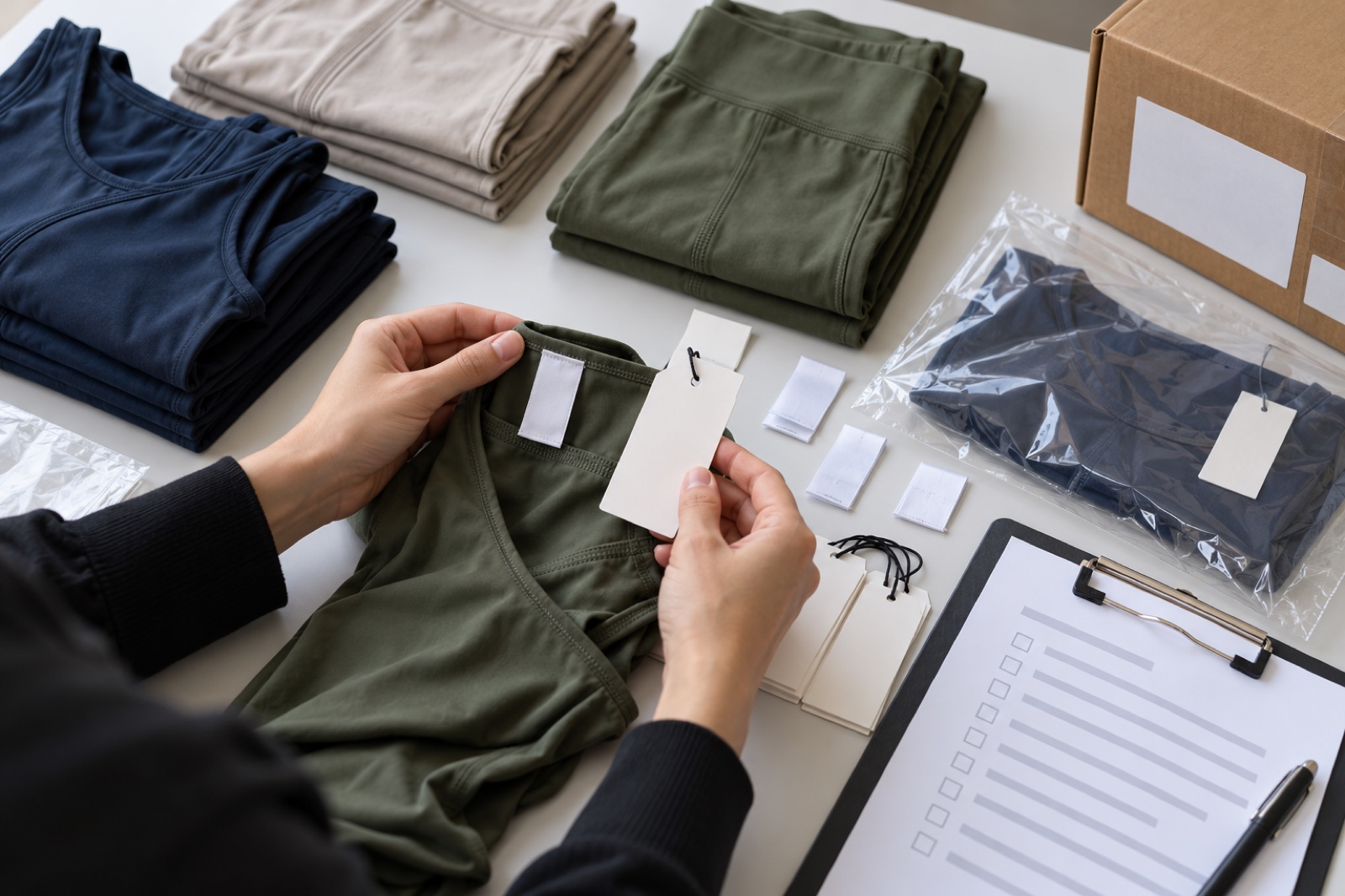
*Illustrative AI-generated packing review; it does not show an inPACE order, customer, approval or production site.*
7. State commercial and delivery references without creating new terms
The PO should refer to the commercial arrangement the parties actually accepted. Depending on the buyer’s process, this might include a quotation identifier, order confirmation, currency, payment reference, delivery destination or requested milestone. Use the responsible commercial team’s approved documents for terms and interpretation. A checklist cannot create or amend payment terms, cancellation rights, liability, delivery commitments or other contractual provisions.
Give each date a defined milestone, such as sample review or shipment handoff, and mark it requested or confirmed. Ask the supplier to confirm feasibility through the agreed channel; a requested date is not an unconditional promise.
For a factory-custom project, identify which product-development decisions are completed and which remain subject to sample review. For a wholesale or light-customization order, identify the existing product direction and the approved branding or packing options. These paths have different scope. An order that changes fit, fabric, construction or core product features may need a further development or sampling step before it is ready for bulk release.
8. Use a decision register for what is still open
A complete-looking PO can still contain unresolved decisions. Maintain a short register with the question, current status, owner, needed-by stage, evidence or reference, and decision date. Use status words that distinguish proposal, under review, approved for sample, approved for production, rejected and superseded. The exact labels can be adapted to the buyer’s workflow, but each status should have one shared meaning.
Do not hide an open issue in a long email chain. Summarize the decision in the controlling record and link to the discussion if context is needed. When a question is answered, record the decision and update the affected PO, matrix, BOM, tech pack, artwork or packing instruction. Notify the people who rely on the change. An approval in one file does not automatically update all related records.
Make issue statements specific: “Confirm whether colour C-03 uses artwork revision B or C for style L-01; buyer brand owner to approve before artwork release.” Name the competing references, decision and owner instead of writing “check colour.”
9. Clarify approval roles and change control
Name who approves product, artwork, materials, quantities and commercial terms; these may be different people. Follow the buyer’s authorization process instead of assuming any email participant can approve every change.
Record each change with its date, affected style and colour, old and proposed references, reason, evidence, owner, decision and new revision. Have the appropriate owners confirm any effect on price, timing, packing or other scope.
10. Run a pre-release review before production starts
Review the PO beside current technical and commercial records. Confirm the style, approved sample, quantity matrix, materials, artwork, labels, packing, shipment references and open issues. Ask the supplier to check completeness and raise feasibility questions through the agreed channel.
Distinguish acknowledgement from approval: receipt of a file does not mean the contents were approved. State whether the supplier should check completeness, confirm a reference, review artwork or prepare for release, and keep the dated response.
If records conflict, pause the affected decision, resolve the source of truth, issue a corrected revision and notify its users. Route changes to agreed scope through the commercial process.
Buyer preparation checklist
Use the list below as a working review. Mark items as confirmed, pending, not applicable or requiring a separate commercial confirmation; do not mark a box complete just because a file exists.
- [ ] PO number, buyer and supplier references, issue date and current revision are clear.
- [ ] Each line identifies style code, product, colourway and applicable collection or programme.
- [ ] The approved sample or sample stage, date and approval scope are named.
- [ ] Current tech pack, BOM, measurement sheet, artwork and packing references are linked where applicable.
- [ ] The size-colour matrix is complete, uses the agreed size system and reconciles to the PO total.
- [ ] Materials, trims, labels and substitutes show their current approval state and evidence.
- [ ] Artwork files, placements, colours and affected products are identified by revision.
- [ ] Label wording and placement follow the buyer’s approved review process.
- [ ] Individual presentation, assortment, carton and marking instructions are stated or referenced where in scope.
- [ ] Delivery milestones and logistics details are labeled as requested or confirmed and linked to the agreed terms.
- [ ] Open decisions have a precise question, owner, due stage and release impact.
- [ ] Approval roles are clear for product, artwork, materials, quantity and commercial changes.
- [ ] The supplier has reviewed the current file set and flagged contradictions or missing information.
- [ ] Superseded versions are marked and the current version is easy to identify.
- [ ] The buyer records who authorized the release and what exact revision they authorized.
How can buyers prepare a concise production handoff?
Send the PO with a short handoff note that names the current revision and lists the controlling references. Include the approved sample record, style and colour matrix, current technical package, BOM, artwork, label copy and packing instruction where they apply. Link to files with stable names or a shared location rather than relying on a mixed set of attachments with ambiguous filenames.
In the note, distinguish decisions already approved from items awaiting review. State the requested next action: confirm completeness, confirm feasibility, review an artwork file, or prepare for a release review. If there is an open issue, say whether it blocks the requested next stage. A supplier can respond more precisely when the request is specific and attached to the correct product version.
For a new fit, fabric, construction or feature, a PO may not be the only document needed to move work forward. Discuss the custom activewear development route and the project’s sample plan before treating a bulk instruction as complete. For an existing product direction that needs labels, branding or packing, review the private-label activewear route. The manufacturing overview explains the broader factory-custom path, and buyers can contact inPACE with the product scope, current references, quantity matrix, artwork, labels, packing and open decisions for a production-release review.
What a purchase order checklist can and cannot do
A disciplined PO checklist helps teams find missing references and conflicting decisions before the handoff reaches production. It connects the commercial order to the style, sample, quantities, materials, artwork and packing instructions that define what the buyer expects. It also gives each unresolved question an owner and a place in the project record.
Treat the PO as a controlled index to the agreed order scope. Keep it concise enough to review, link it to detailed technical files, and revise it when the approved scope changes. The best release handoff is clear about what is confirmed, what is still a proposal, who decides next and which version everyone should use.
*Illustrative images in this article are AI-generated and show a generic review setting. They do not depict an actual inPACE order, approval record, customer or production facility.*
Product directions
Explore relevant activewear products
Use these product pages as practical references for your brief, then confirm materials, fit, customization, and production details through sampling.
Custom Activewear Development
Review the development path when an order introduces a new fit, fabric, construction or other product decision.
View product directionPrivate Label Activewear
Connect an existing product direction to approved labels, branding and packing scope.
View product directionActivewear Manufacturing
Discuss the production handoff and project scope with the factory team.
View product directionFAQ
Buyer questions
What should be included in an activewear purchase order?
Identify the PO and supplier references, style lines, colourways, size and quantity matrix, approved sample, current technical and material revisions, artwork, labels, packing scope and relevant commercial references. Include approval owners and an open-decision list. Use the buyer’s own commercial terms and approval workflow for legal, payment and delivery matters.
Is an approved sample enough to release bulk production?
Not by itself. An approved sample is one reference and its approval may cover only a specific stage or feature. The team should also reconcile the current technical package, material and artwork references, quantity matrix, packing instructions and any open decisions. State what the sample approval covers and resolve conflicts before release.
How do I check that a size and colour matrix matches the PO?
For each style and colour, list every requested size and its unit count, calculate subtotals and compare the grand total with the PO. Confirm the size convention and link to the current measurement or size specification. Recheck the matrix after a change and issue a new revision if quantities or identifiers move.
Can a supplier substitute a fabric or trim after the PO is issued?
A proposed substitute should be recorded with its reason, affected styles or colourways, evidence needed and authorized approver. Do not treat a proposal as approved because it appears similar or is available. Review any effect on relevant product features and update the BOM and related records after a decision.
Should packaging be described in the PO or a separate document?
Either method can work if the PO clearly identifies the applicable instruction and revision. A separate packing document is useful when requirements include diagrams, multiple styles or detailed carton assortments. Confirm which details are in scope and keep product, individual-pack and carton instructions aligned.
Does a PO guarantee a delivery or production date?
A date on a PO may be requested or confirmed, and the document should say which. It does not by itself establish feasibility or guarantee a milestone. Define what the date means, such as sample review or shipment handoff, and use the parties’ agreed commercial process to confirm timing.
What is the difference between a PO and an RFQ?
An RFQ organizes the product and commercial inputs needed to request or discuss a quotation. A PO records an order instruction against the scope the parties have agreed. The RFQ supports evaluation; the PO should connect the accepted order to the correct product references, quantities and approval records.
Who should approve a production PO?
The buyer should follow its authorization process and identify the people responsible for product, artwork, materials, quantities and commercial terms. One person may not own every decision. The supplier should confirm receipt and raise feasibility or documentation questions through the agreed channel, while the buyer records who authorized the specific release revision.