

Direct answer. Activewear cost engineering is a controlled design-to-cost process. A brand protects the product’s non-negotiable fit, coverage, support, material and QC requirements, then compares specific specification changes by cost direction, product risk and evidence needed. The chosen option is re-quoted and, where necessary, sampled and tested before it replaces the approved baseline.
A supplier quotation can exceed the target for many reasons: the product may contain more material or operations than the target assumed, colours and quantities may be fragmented, branding may require several processes, or the quote may include evidence and packing work that was absent from the buyer’s early estimate. The answer is not an unexplained demand for a lower unit price. It is a joint review of what the product must do, which details may change and what proof is required before a lower-cost version is approved.
This guide is for B2B design, procurement and merchandising teams working on activewear, gym clothing, yoga wear and workout apparel. It treats cost reduction as a product decision with named owners. It does not publish a universal price, promise that a change will save a fixed amount or suggest removing sampling and quality control.
What does activewear cost engineering change?
Activewear cost engineering changes a controlled product specification, not simply the number on a quotation. The team starts with the version the supplier priced and asks which design, material, process, colour, component, branding or packing choices are responsible for the gap. It then creates alternatives that still meet the approved product role.
The original specification remains the baseline. Every proposal should show:
- The exact feature being changed.
- Why it may change the cost direction.
- Which buyer requirement it must preserve.
- What new risk it introduces.
- Which sample, observation, test or document can resolve that risk.
- Who recommends, reviews and approves the option.
- Whether the supplier must issue a revised quotation.
This is different from a buyer’s internal activewear should-cost model. A should-cost model maps the cost drivers implied by the current product. Cost engineering uses that map after a gap appears and tests alternative specifications. It is also different from comparing suppliers: the activewear manufacturer quotation guide helps align proposals from different sources, while this guide keeps one product and its approved trade-offs under control.
Why should the original product baseline be locked first?
Without a locked baseline, a cheaper quote may describe a different garment. A sports bra with revised lining, elastic and cup construction cannot be compared fairly with the original version if the quotation still carries the same short product name. A legging with a simpler waistband or removed pocket may cost less, but the team must see the feature change rather than recording an unexplained price reduction.
Create a baseline pack with:
- Style ID, revision and date.
- Product role, target wearer and channel.
- Approved reference, sketch, sample or tech pack.
- Base size and intended size range.
- Fit, coverage, support and movement requirements.
- Main material, lining, elastic and component direction.
- Panel, seam, pocket, opening and edge construction.
- Colourways and style-colour-size quantity matrix.
- Artwork, logo locations, labels and hangtags.
- Folding, unit packing, carton and destination requirements.
- Sample status, open tests and QC focus.
- Quotation version, currency, basis, exclusions and validity.
The baseline should distinguish confirmed, proposed and unresolved details. A reference image can show silhouette and visible features, but it does not prove the pattern, material, seam construction, grading, consumption or production route. A physical garment can provide stronger construction clues, yet its fibre, finish, care result and origin still require records where those facts matter.
The activewear bill of materials guide is useful for connecting material and component decisions to the correct product version. Keep the original BOM and quotation unchanged; issue a separate option record instead of overwriting the evidence used for the first decision.
Which requirements should be non-negotiable?
Non-negotiables are the reasons the product deserves to exist in the range. They should be written as product outcomes and approval boundaries, not broad slogans such as “premium quality.”
For example:
| Product area | Possible non-negotiable | Evidence before approval | What should not be assumed |
|---|---|---|---|
| Fit | Approved base-size silhouette, key measurements and garment balance | Named fit sample, measurement record and reviewer comments | That a fabric or seam change will preserve the same fit |
| Coverage | Required body coverage and opacity direction in stated wear conditions | Sample in the intended colour/material and defined observation | That higher fabric weight alone proves coverage |
| Support | Product-specific hold, strap, band, lining or cup relationship | Wear review and construction record for the actual version | That one fabric composition guarantees support |
| Stretch and recovery | Movement range and return expected for the product role | Material and garment sample observations; testing if specified | That nominal elastane content predicts finished performance |
| Surface and handfeel | Approved look and feel for the channel | Confirmed material swatch or garment sample | That a similar composition feels or behaves the same |
| Durability and QC | Named seams, components, artwork and inspection points | Agreed sample, test, inspection or approval evidence | That removing QC work makes the product less expensive without risk |
Some details can be flexible even when the product outcome is fixed. A buyer may accept a different seam route if it preserves comfort, stretch and appearance. A logo method may change if the new proposal remains suitable for the confirmed material and placement. A packing item may be simplified if the channel, labelling and protection requirements remain satisfied.
Write both lists before asking the supplier for alternatives. It prevents the team from accepting a lower quotation and discovering later that the changed version no longer fits the product promise.
How should buyers find the real cost drivers?
Review the specification by driver rather than asking the supplier for a general discount. The fabrics and trims resource can help the team name main fabric, lining, elastic, binding, thread, zips and other components before discussing alternatives.
Use a driver matrix:
| Driver | Baseline question | Possible adjustable variable | Risk to review | Likely evidence |
|---|---|---|---|---|
| Main material | What exact material, weight, usable width, colour and finish were priced? | Confirmed alternative construction, finish, width or source | Drape, coverage, recovery, shade, handfeel and care | Swatch, lab dip where relevant, material record and garment sample |
| Pattern and consumption | Which revision, size mix and marker assumptions apply? | Panel geometry, length or feature placement | Fit, appearance, grading and usable yield | Updated pattern/consumption response and fit sample |
| Construction | Which seams, layers, bindings, pockets and openings are included? | Simpler assembly route or combined operation | Comfort, stretch, strength, appearance and serviceability | Construction sample and named QC points |
| Components | Which elastics, cups, zips, drawcords or hardware are included? | Approved standardised component or changed specification | Support, safety, function, colour and durability | Component approval and garment sample |
| Colour plan | How many materials and components are colour-specific? | Fewer launch colours or shared components | Range appeal, shade relationship and inventory concentration | Revised colour map and quantity matrix |
| Branding | Which methods, sizes, colours and placements were quoted? | Fewer placements, revised scale or suitable alternative method | Appearance, stretch-zone behaviour and care | Artwork proof, strike-off or branded sample as applicable |
| Labels and packing | Which labels, hangtags, bags, stickers and cartons are included? | Consolidated presentation or channel-appropriate simplification | Legal/channel information, protection and receiving | Approved pack standard and pack sample where required |
Cost direction should be recorded qualitatively until the supplier provides a project-specific re-quotation. “Potential reduction,” “neutral,” “possible increase” and “unknown pending supplier review” are safer than inventing a saving percentage. The same change can behave differently by fabric, colour, quantity, factory route and order timing.
Can material cost be reduced without weakening the product?
Sometimes, but “use a cheaper fabric” is not a complete engineering instruction. A material proposal must be compared against the function the original fabric performs: stretch direction, recovery, weight, coverage, handfeel, surface, drape, colour, print or logo compatibility, seam handling and care direction.
Useful questions include:
- Is the original material over-specified for the intended product role, or does it solve a real fit or coverage need?
- Can one approved material serve several styles without changing the product outcome?
- Does a usable-width or pattern relationship change the consumption scenario?
- Can an unavailable or highly fragmented colour plan be consolidated?
- Does an alternative finish remove an unnecessary process while preserving the approved surface?
- Which lining, mesh, elastic and binding relationships must be sampled with the main material?
Composition alone is not enough. Two fabrics with the same fibre percentages may differ in knit construction, weight, width, finish, stretch, recovery, surface and dye behaviour. The supplier should identify the proposed material; the buyer should state what must remain true; and the physical sample should show the actual garment relationship.
Use the custom activewear development route when material, fit, construction, colour or performance direction must change. An accepted existing product with only branding and presentation changes may suit the private-label activewear route. Mixing those routes can hide development work inside what appears to be a simple material substitution.
Which construction changes need the most caution?
Construction changes can remove material, components or operations, but they can also move stress, change fit or alter the product’s visual identity. Map the garment zone before proposing an alternative.
For a sports bra, review neckline, straps, armholes, lining, cup structure, underband, elastic, bindings and back construction together. For leggings, review rise, waistband layers, gusset, pockets, panel intersections, inseam and hem. For tops, consider shoulder, sleeve, armhole, neckline, body length and opening. A one-piece garment connects upper-body fit, torso length, waist, hip, crotch, leg opening and closure decisions; simplifying one area may affect several others.
The Long Sleeve Seamless Romper is a useful visual direction for this discussion. Its one-piece silhouette prompts questions about torso balance, sleeve, neckline, contour lines, crotch and short-leg coverage. The image does not establish the final material, pattern, construction, measurements or cost for a new programme.
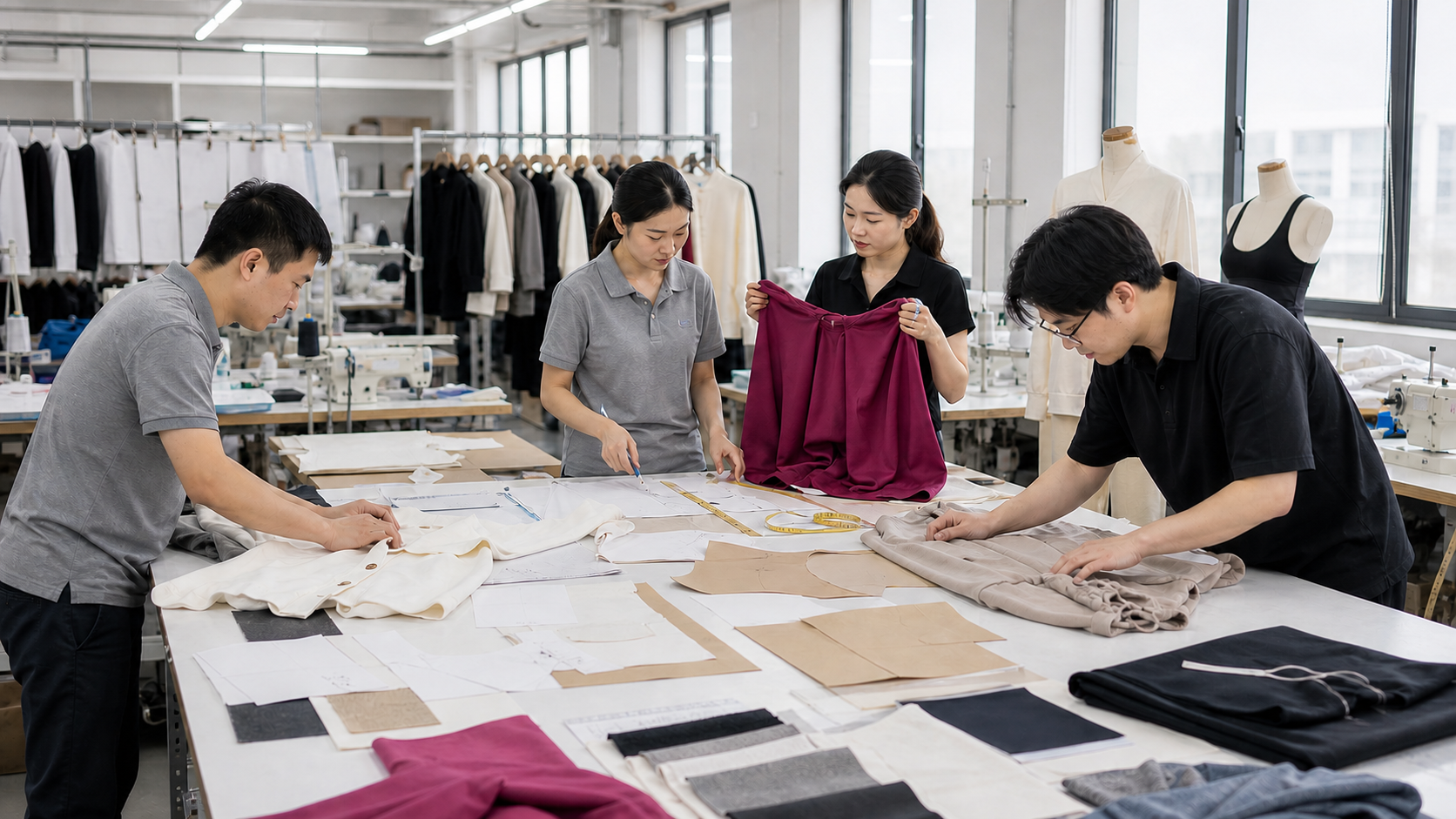
*Real inPACE manufacturing-context image showing why pattern, material and sample evidence should be reviewed together. It is not a quotation, customer order, test result or production approval.*
An alternative construction proposal should identify:
- The baseline seam, layer, component or operation.
- The proposed route and why it may simplify the product.
- The product outcome that must remain.
- The affected measurements or garment zones.
- The sample and QC evidence needed.
- The supplier’s revised quotation and version date.
Never approve a construction change only because it looks similar in a flat image.
How can colours and quantities support activewear cost reduction?
Colour and quantity planning can create complexity without changing the garment drawing. A programme total may look substantial while each style-colour-size combination remains small. Separate the matrix by style, colour and size so the buyer can see fragmentation.
Possible planning options include launching fewer colours, concentrating volume in a core colour, sharing confirmed components across compatible colours, moving an accent colour to a later repeat or combining the same approved material across related styles. None of these is automatically right. Merchandising must judge the customer and channel impact, while the supplier confirms whether the revised matrix changes material purchasing, setup, partner-process or production assumptions.
Do not call demand risk a factory inefficiency. A wide colour range may be a deliberate merchandising choice. The cost-engineering record should make the choice visible: retain the range and accept the commercial consequence, or narrow the range and record the sales assumption being changed.
How should branding, printing and embroidery be reviewed?
Branding can involve artwork preparation, colour, placement, size, method, proofing, sample work and partner-process coordination. Printing, embroidery and wash effects should only enter the cost-engineering plan when they are part of the confirmed brief and the responsible production route has reviewed feasibility.
Ask whether:
- Every placement is necessary to the range identity.
- The artwork size and colour count are controlled.
- One method is suitable for the material, stretch zone and care expectation.
- A placement can move away from a difficult seam or high-stretch zone without weakening the design.
- Several colourways can use the same approved artwork geometry.
- The proposed method needs a swatch, strike-off, panel or garment sample.
- A change affects labels, packing, QC or the quotation basis.
Do not replace one decoration method with another based on a generic cost ranking. The actual material, artwork, placement, colour, equipment, order and evidence route determine whether an option is feasible and useful.
Can labels and packing be simplified safely?
Yes, where the commercial channel and required information allow it. Start with the receiving and customer experience: brand label, care and fibre information, size identification, hangtag, barcode, unit protection, folding, SKU sticker, carton assortment and carton marks.
Possible adjustments include removing a redundant presentation item, consolidating hangtag information, standardising a pack component across compatible styles or changing a decorative packaging feature. However, the buyer must confirm applicable market, channel and warehouse requirements. This article does not provide legal or compliance advice.
Keep protection and traceability separate from decoration. A simpler bag or tag presentation should not make the product harder to identify, receive or protect. The supplier should re-quote the approved pack standard rather than assuming that “basic packing” means the same thing to every party.
How should Option A, B and C be compared?
Do not send the team a list of unrelated ideas. Build complete options against the same baseline:
| Decision field | Option A: protect almost all baseline details | Option B: controlled specification change | Option C: broader range reset |
|---|---|---|---|
| Product role | Unchanged | Unchanged | Must be reconfirmed |
| Typical scope | Commercial clarification, quantity concentration or minor presentation edit | Approved material, construction, component or branding change | Several connected product and merchandising changes |
| Cost direction | Smaller or uncertain until re-quoted | Potential reduction subject to evidence | Potentially larger change, but not comparable until redefined |
| Main risk | Gap may remain | Fit, feel, appearance or function may move | Product identity, channel and demand assumptions may change |
| Evidence | Revised quotation and controlled documents | Updated specification plus relevant sample/test/QC evidence | New brief, development plan, samples and commercial review |
| Approval | Procurement with affected owner confirmation | Design, merchandising, procurement and supplier | Senior product/merchandising decision with new baseline |
Each option needs one owner, one version and one decision date. Avoid combining the lowest-cost line from several incompatible options. A material alternative tested with one seam route does not prove another construction. A branding sample on one colour does not approve every colour. Evidence belongs to the version that produced it.
When must the product be re-sampled or tested?
Resample when the change may affect fit, coverage, support, movement, appearance, material behaviour, construction, component function, artwork, care or packing presentation. The exact sample type depends on the decision.
The activewear sample plan can help assign a purpose, inputs, reviewer and exit condition. A material swatch may answer handfeel and colour direction but not garment fit. A fit sample may answer balance and measurements but not approve later artwork. A branded sample may verify placement and surface interaction but not replace final packing review.
Testing should be tied to a stated product or market requirement and the actual version. Do not claim that every option needs the same test, or that a visual review proves technical performance. Where formal testing, buyer observation or supplier documentation is required, record the method, version, owner and acceptance condition before release.
Sampling and QC are not waste to remove from the plan. They are the evidence that makes a cost-engineered alternative comparable with the baseline.
Who approves an activewear value-engineering change?
Use named roles:
- Design protects visual identity, proportion, surface and approved design details.
- Product development controls the specification, pattern, material, construction and sample version.
- Merchandising evaluates range, colour, channel and customer consequences.
- Procurement aligns quotation scope, supplier response, quantity and commercial records.
- Quality defines evidence, inspection points and unresolved risks.
- Supplier or manufacturing partner confirms feasibility, production route, dependencies and revised quotation.
- Final business owner accepts the combined product and commercial trade-off.
One role may cover several jobs in a small brand, but the approvals should still be explicit. A supplier can propose an alternative; it should not silently redefine the buyer’s non-negotiables. Procurement can validate commercial scope; it should not approve a changed fit without the responsible product owner.
What should the activewear cost-engineering worksheet contain?
Use one controlled register:
- Baseline style, revision, quote and target gap.
- Product role and non-negotiable outcomes.
- Driver by material, pattern, construction, component, colour, branding and packing.
- Proposed option and reason.
- Qualitative cost direction.
- Fit, performance, appearance, compliance and delivery risks.
- Required sample, test, document or quotation.
- Owner, reviewer and approval status.
- Revised specification and quotation version.
- Decision date, conditions and rejected alternatives.
Keep the original quote attached. If the supplier response changes because the quantity, colour, delivery basis or specification changed, record that reason. “Requoted lower” is incomplete; “Option B, revision 3, two launch colours, approved component X and updated packing scope” gives the team something it can audit later.
Buyer checklist before approving a lower-cost version
- Confirm the quotation gap is measured against the same currency, delivery basis, quantity matrix and product revision.
- Freeze the original specification and quotation as the baseline.
- Write the product role and non-negotiable fit, coverage, support, surface and QC outcomes.
- Mark every adjustable design, material, colour, component, branding and packing detail.
- Ask the supplier to explain the cost direction and dependencies of each proposal.
- Record risks instead of calling an alternative “equivalent” without evidence.
- Build complete Option A/B/C packages.
- Assign design, product, merchandising, procurement, quality and supplier owners.
- Update the specification before requesting a revised quotation.
- Resample or test when fit, material, construction, component, artwork or presentation may change.
- Confirm that labels and packing still meet the stated market, channel and receiving needs.
- Keep QC points and approval records connected to the chosen version.
- Reject any saving that depends on an undisclosed product change.
- Do not release production until the approved specification, evidence and quotation agree.
How can inPACE support activewear cost engineering?
inPACE can review the current brief, sample, specification, BOM, quotation basis and target gap; discuss material, stretch, coverage, support, structure and fit priorities; and help turn flexible details into reviewable options. Where the confirmed scope makes it appropriate, inPACE can coordinate suitable work across multiple partner factories and connect the selected option to sample validation, production planning, QC and packing.
That support is informed by more than 30 years of garment-production experience. It is not a claim that every project uses one factory, that every alternative will lower cost or that price, timing, capacity, certification or performance is guaranteed. The actual result depends on the product version, materials, colours, processes, quantities, evidence and agreed commercial scope.
Use the manufacturing and QC overview to connect the chosen specification with production records and inspection points. When the team is ready, share the target product role, non-negotiable fit and material requirements, quotation gap and flexible details for a value-engineering review.
Product directions
Explore relevant activewear products
Use these product pages as practical references for your brief, then confirm materials, fit, customization, and production details through sampling.
Activewear Performance Collection
Use real product directions to identify which fit, material, construction and range details are fixed before comparing cost-engineering options.
View product directionLong Sleeve Seamless Romper
Use this one-piece reference to map connected torso, sleeve, neckline, contour, crotch and coverage decisions before proposing a construction change.
View product directionCustom Activewear Development
Use factory-custom development when cost engineering changes material, fit, construction, components, colour or the required sample evidence.
View product directionFAQ
Buyer questions
What is activewear cost engineering?
It is a controlled design-to-cost process. The team protects non-negotiable product outcomes, identifies adjustable specification drivers, compares complete alternatives and approves a new version only after the required quotation, sample, test and QC evidence are aligned.
Is activewear cost engineering the same as asking for a discount?
No. A discount changes the commercial number without necessarily changing the product scope. Cost engineering identifies which product or programme decisions may change the cost direction and records their risks, evidence and approvals.
Can a brand reduce material cost without lowering quality?
Sometimes, but the alternative must be compared against the original material’s role in fit, coverage, support, recovery, handfeel, surface, colour, construction and care. Fibre composition or a visual match alone does not prove equivalent product behaviour.
Which activewear requirements should remain non-negotiable?
Keep the outcomes that define the product role: approved fit and key measurements, required coverage and support, essential material and surface direction, functional components, brand identity, market or channel needs, and the evidence and QC needed to approve them.
When does a cost-engineered activewear option need a new sample?
Resample when the change may affect fit, coverage, support, movement, appearance, material behaviour, construction, component function, artwork, care or packing presentation. Give each sample a stated purpose, reviewer and acceptance condition.
Should QC be reduced to meet an activewear target cost?
No. QC points and approval evidence protect the comparison between the baseline and the alternative. The team can remove redundant work only when it has shown that the product and risk boundary remain controlled; it should not hide a saving by skipping required verification.
Who should approve an activewear value-engineering change?
Design, product development, merchandising, procurement and quality should approve the areas they own, while the supplier confirms feasibility and the revised quotation. A final business owner accepts the combined product and commercial trade-off.
What should a brand send inPACE for a cost-engineering review?
Send the current product specification, reference or sample, BOM, colour-size quantity matrix, branding and packing files, quotation basis, target gap, non-negotiable product outcomes and the details that may be flexible. Mark open questions and the evidence already available.