
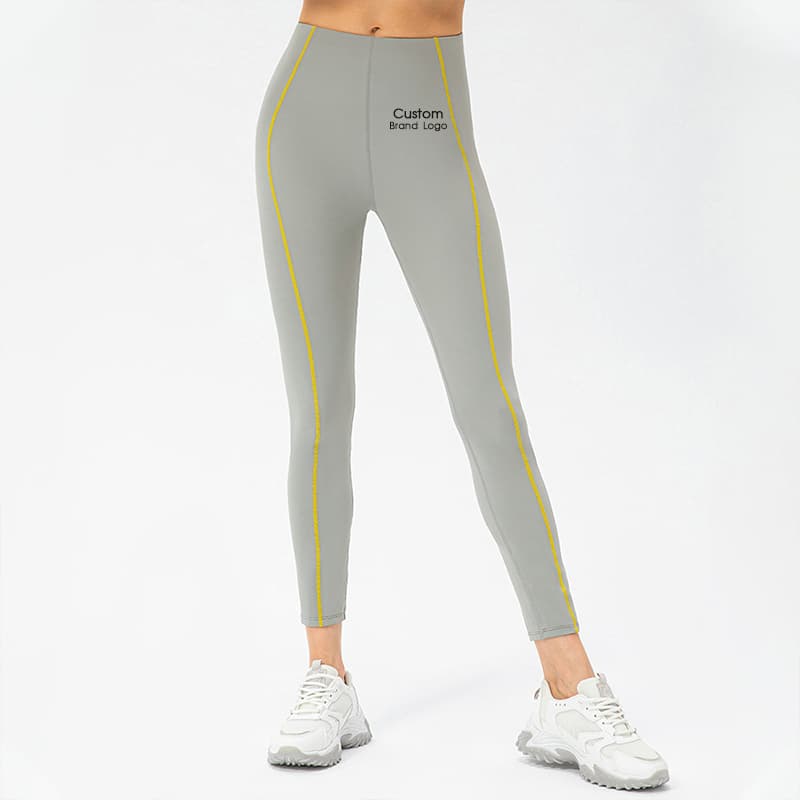
A buyer can choose a legging photograph quickly and still leave several different supply requests hidden in one message. “High waist, mixed sizes, our logo” does not identify the accepted garment measurements, the number of pieces in a pack or the location the artwork must occupy. Each unresolved detail can create a different interpretation of the same order.
The activewear wholesale supplier route starts with confirmed existing styles and reviewed branding options. This guide narrows that process to workout leggings: choosing the waist and leg direction, assessing existing pockets, keeping logos clear of garment details and translating an assortment into quantities that can be produced and received.
What should a workout leggings wholesale supplier identify before quoting?
Give the supplier an exact product code or link and the reference image you used. Add the intended role of the legging in the range and identify which existing features matter. A legging chosen for a visible contrast line needs a different branding discussion from a plain-looking reference, even if both are described as high waist.
Use the performance activewear collection to organise training-range directions and the yoga activewear catalogue to compare additional garment references. The aim is a short, identifiable selection. A collection page helps discovery, while the order needs the exact style and the current options the supplier has confirmed.
State whether the request accepts the existing garment or proposes changes. Selecting a confirmed colour and adding an approved logo is different from asking for a new waistband, shorter inseam or relocated pocket. The fact that a catalogue garment inspired the enquiry does not make every requested variation an existing option.
Ask the supplier to confirm current material, size, colour and quantity conditions for that selection. The word wholesale does not establish ready stock or a universal pack size. Keep any quotation assumptions attached to the actual brief so later decisions can be compared against the same product scope.
How do you distinguish a fitted legging from other pant directions?
The contrast-piping training legging reference shows a close-fitting leg, a broad waist direction and a narrow contrasting line. Those visible details give the buyer concrete questions about fit, length, colour coordination and logo placement. They do not establish a measured performance result or current availability.
The hero image shows grey leggings with yellow piping. Its Custom Brand Logo text is a placeholder indicating a possible branding area, not a real customer's artwork or proof that an application method has been approved. The order still needs its own artwork and placement decision.
Some nearby catalogue pants have a different lower-leg shape. DWL115027 is a flared pant reference, and DWL115096 is a micro-flare direction. They can be useful comparisons when deciding the assortment role, but they should not be described as identical to a close-fitting workout legging.
Keep a separate reason for retaining each silhouette. If the brief specifically requires a close ankle, a wider opening may answer a different range question rather than serve as an interchangeable substitute. Confirm the accepted product on the sample and carry that identity into the size list, images and packing records.
Use this worksheet to turn broad preferences into selection questions. It is a buyer planning tool, not a completed product assessment.
| Selection detail | Question for an existing style | Record needed for the order | When to review a different route |
|---|---|---|---|
| Waist direction | Does the existing height and shape suit the brief? | Accepted sample and relevant measurements | A new waistband or rise is requested |
| Leg length | Which confirmed length meets the intended use? | Style, size and accepted length identity | A new inseam or hem treatment is required |
| Pocket arrangement | Does an existing pocket meet the stated purpose? | Confirmed location, construction and reviewed use | A pocket must be added, moved or redesigned |
| Contrast detail | Is the existing line or panel part of the selected appearance? | Main and contrast colour references | The position or construction must change |
| Branding area | Can the proposed logo be reviewed at the intended location? | Artwork, dimensions, method and placement | The garment itself must change to create the area |
Which waistband questions belong in an existing-style review?
Identify where the waist is intended to sit and what the buyer needs to observe during use. High waist is a starting description, not a complete fit specification. The actual sample, its size and the wearer's proportions affect how the top edge and rise appear and feel.
Ask for the relevant measurements using the supplier's agreed method. Keep body guidance separate from finished-garment dimensions, and label any relaxed or stretched measurement clearly. A buyer comparing different charts should first establish that the reference points and methods are comparable rather than assuming that similar numbers describe the same thing.
Review the waist during the intended movements and wearing combination. Record whether a concern involves position, coverage, folding or comfort, with enough context for the supplier to understand it. “Waistband rolls while seated in this sample size” is a more usable observation than “make it more supportive.” It identifies a question without inventing its cause.
Do not solve every selection concern by requesting a construction change. Another existing size or style may be the appropriate option, subject to review. If the required waist cannot be found within the confirmed selection, define the change through custom activewear development. Keep that scope separate from the original wholesale quotation.
How do you confirm length and pocket requirements together?
Record the actual leg length and the accepted appearance on the intended reviewer. A catalogue model's ankle position is not a universal size guide. Height, proportions, footwear and pose can affect what the photograph suggests. Identify the garment measurement and the wearing context before accepting a length description for the range.
A cropped, ankle or longer direction should map to a confirmed style or option. If the buyer uses a marketing label for the length, connect it to the relevant product record. Do not let two different lengths share one order line simply because the brand wants a single consumer-facing style name.
For pockets, state what must be carried and when. Confirm whether the selected garment actually includes the relevant pocket and how it is constructed. A seam line or panel visible in an image does not prove the presence of an opening, its dimensions or its ability to retain the intended item.
Where a pocket exists, review access and the effect of the intended contents on the sample. Use the actual item or an agreed reference and identify the movement context. That review can support a selection decision, but it should not be turned into a universal capacity or retention guarantee.
If the buyer requires an added pocket, a new position or a different opening, treat it as garment development. The request can affect more than the appearance: it changes the specification that the supplier must review. Keeping it explicit helps the team avoid quoting an existing style while expecting a different product to arrive.
What can a colour comparison tell you, and what remains open?
A colour comparison can help a buyer decide how the range should look. It cannot, by itself, establish material identity, coverage under movement or the approved appearance of a future order. Link the proposed colour to an identified reference and agree what sample or evidence will settle the outstanding questions.
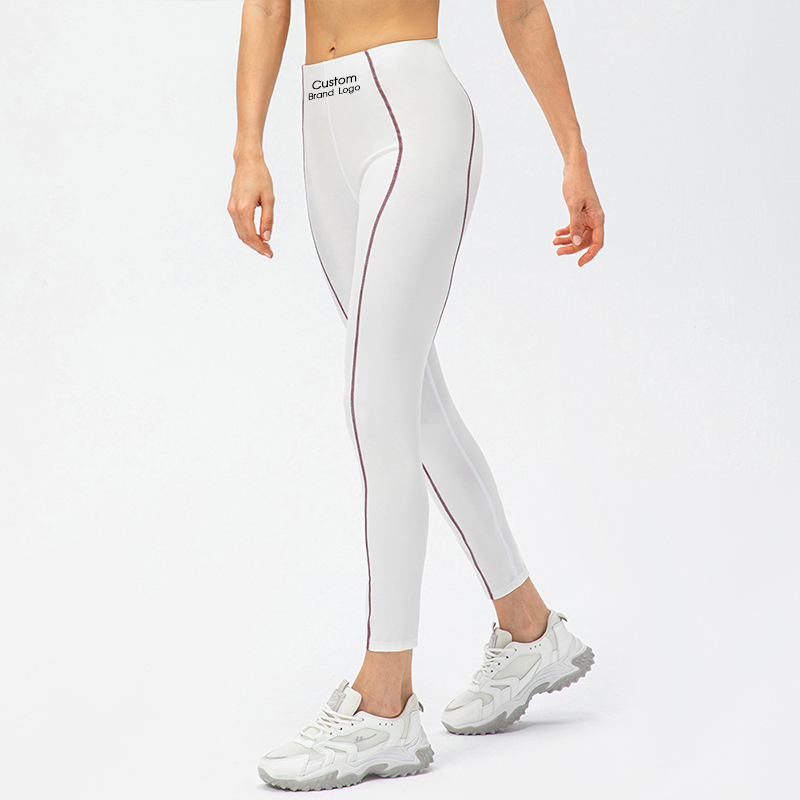
This second catalogue view shows a white and dark-red direction. The visible logo text remains a placeholder. The image is not an opacity test, a confirmed stock option or an approved branded order.
When a style contains contrast piping or panels, keep the main colour and contrast colour connected in the record. “White leggings” may be insufficient if more than one contrast combination is being discussed. Give the full proposed combination a clear identity, then confirm the available option with the supplier.
Review any coordinated top separately. A colour name repeated across two garments does not establish a visual match, particularly when the materials or surface structures differ. If matching is important, state that requirement and review the intended combination through the agreed process.
Keep the approved product images aligned with the actual order identity. Do not use a grey reference to imply that a white version has passed the same coverage or appearance review. An unresolved question can remain open in the buying record while the team requests the evidence needed for a decision.
How should the logo relate to seams, piping and the waistband?
Start with the actual artwork and the proposed garment location. A logo may sit near a waistband edge, beside a contrast line or on another agreed area. Define its dimensions, orientation and position from identifiable reference points so the proof can be checked against the selected style.
The private-label activewear service connects that artwork with labels, hangtags and packing. On a fitted legging, keep the appearance at the proposed location and the relevant application questions visible. A flat digital mock-up and a physical application sample can answer different questions; agree which evidence is needed rather than treating them as interchangeable.
Use the logo methods for stretch activewear guide to discuss the method against the real material and artwork. Do not assume that a decoration accepted on another garment will behave the same way on the legging's waist or side area. Any requested appearance, stretch or care review needs an identified sample and scope.
If piping or a seam is part of the chosen design, confirm the intended relationship between that detail and the artwork. A logo that appears centred in a general image may not be positioned as the brand expects relative to the actual panel. Retain the accepted placement instruction rather than asking production to estimate from a mood-board image.
Where a different size needs a placement review, make that part of the approval plan. Do not silently scale artwork or move it to avoid a detail without agreement. The record should identify which sizes, colours and garment versions the accepted proof covers.
How do you convert a size pack into individual legging quantities?
A size pack is a defined grouping of sizes, not a universal industry quantity. State its contents before using the pack as an order unit. The supplier and receiver need to know how many individual leggings each pack contains and which style, colour and length those pieces represent.
The size and colour quantity planning guide helps structure this information. Keep both the pack count and the resulting piece count visible. Otherwise, a request for ten packs can be misread as ten garments, or a total piece quantity can be divided using a ratio the buyer never approved.
Consider this arithmetic example only: one pack contains one S, two M and one L, for four leggings. Three black packs contain twelve pieces; two navy packs contain eight. Together, those five packs contain twenty individual leggings. These invented quantities demonstrate the calculation. They are not a suggested size ratio, a demand forecast, a minimum order or a statement of inPACE's available colours.
| Example colour | Packs | S pieces | M pieces | L pieces | Total pieces |
|---|---|---|---|---|---|
| Black | 3 | 3 | 6 | 3 | 12 |
| Navy | 2 | 2 | 4 | 2 | 8 |
| Combined | 5 | 5 | 10 | 5 | 20 |
If the buyer changes the contents of a pack, recalculate every affected line. Changing one M to one L leaves the pack's total unchanged but changes the size allocation. A correct overall total therefore does not prove that the assortment is correct. Both the size totals and the colour totals need to match the accepted request.
Specify whether the grouping is only a way to calculate quantities or whether the garments must physically arrive together in a labelled pack. Those are separate requirements. A supplier can understand the numerical ratio while still needing instructions about bags, bundling and carton allocation.
How do you choose size and colour quantities for a trial order?
Base the proposed size distribution on information relevant to the actual product and audience. Previous sales may help, but a new fit, length or channel can change what the buyer needs to learn. Keep the source of the allocation visible instead of presenting a familiar ratio as a universal answer.
Where the order is exploratory, identify the assumption and the observation it is meant to support. The buyer might be comparing two accepted length directions or assessing whether a particular colour belongs in the range. Keep those questions distinct from whether the sample itself was approved. Product acceptance and market demand are different decisions.
Do not let a coordinated top dictate the legging size automatically. If the range includes outfit sales, keep the individual garment quantities and any mixed-size pairing instructions explicit. The consumer-facing outfit can have its own commercial arrangement while the supplier's production record still needs the correct count of leggings.
After the supplier confirms which combinations can be quoted, reconcile the proposed matrix with the current commercial scope. Removing a style, length or colour should update all related pack calculations. Retain one approved version so artwork, packing and receiving teams are working from the same assortment.
Which labels and packing identifiers prevent receiving mistakes?
Give each included variant a clear identity using the selected style, colour, size and any confirmed length distinction. Connect the garment label, outer identifier and receiving list to that identity. A short internal code can be useful, but the buyer and supplier must share the same mapping.
Approve the actual brand and garment information for the selected product. Composition and care text should come from verified information, with destination-specific requirements confirmed by the responsible buyer. Do not carry a label over from a visually similar legging without checking the material and product record it belongs to.
The activewear packaging checklist helps organise individual bags, barcodes where required, carton marks and receiving information. For size packs, confirm whether the outside of the pack states its contents and how the individual items are identified. Keep the pack identifier separate from any identifier used for one sellable garment.
If folding or logo presentation matters, include a suitable reference. The receiving team may need to locate sizes quickly, while the retail team may care about how the product appears when unpacked. Explain both requirements so the approved packing arrangement answers the actual handling needs.
How should a quotation and receiving check use the same brief?
Ask the proposal to identify the selected product and the current quantity matrix, including the agreed unit. Confirm which branding, labels, packing and other work are included, and which questions remain unresolved. A quotation for undecorated pieces cannot be compared directly with one covering an approved logo and a defined assortment pack.
At receiving, use the same product identity and allocation record. Check the actual individual quantities against the accepted lines and the agreed packing format. Where a discrepancy appears, record whether it concerns the garment, the label, the pack contents or the paperwork. Those distinctions make follow-up more precise.
Retain the accepted sample and relevant proof as references for the review points agreed with the supplier. Do not invent a universal inspection threshold or treat a casual visual glance as a completed performance test. The order record should identify what was meant to be checked and the evidence used to report the result.
What should remain unchanged, or be reapproved, on a reorder?
A repeat request needs the exact accepted garment identity, not merely the phrase “same leggings.” Retain the style, material reference, waist and length information, pocket arrangement, main and contrast colours, size allocation, artwork and packing record. Together, these describe what the buyer intends to repeat.
Use the activewear repeat-order guide to separate a true repeat from a revised request. Changing the colour combination or the pack ratio may leave the garment construction unchanged while altering the order. A new waist, pocket or material can require a different product review. Identify each change rather than replacing the previous brief with an unexplained file.
Use actual receiving and customer observations to inform the decision. Keep a comment about a particular length attached to its style and size. Compare colour sales with their original allocations before drawing a demand conclusion. A small allocation selling out first does not, by itself, establish the best ratio for a larger order.
Reconfirm the current supply and commercial conditions. A previous order is evidence of what was agreed and delivered at that time; it does not reserve future stock or automatically approve a substitute. If an alternative is proposed, review the relevant differences before treating it as the same product.
How can inPACE help clarify an existing-legging order?
inPACE can help connect a selected catalogue direction with the product, branding and packing questions needed for an order discussion. Specific references and a readable size-colour list make that review more useful than a broad request for high-waist gym leggings in assorted sizes.
The programme draws on Yinshan Garments' production experience dating to 1986. This is manufacturing background rather than an inPACE brand-age claim. For an existing-style enquiry, the relevant contribution is recognising which details can be confirmed within the selection and which requests need garment development or additional sample work.
Discuss the production route against the actual material, decoration, quantity direction and order scope. The agreed sample and written records remain the basis for the order; catalogue photographs and general capability statements help start the conversation without replacing those decisions.
What should you send for a workout leggings wholesale review?
Prepare one current brief containing the following information. Leave unresolved items as explicit questions rather than letting a supplier infer the answer from a photograph.
- Exact product links, style codes and reference images.
- Intended use and the role of the legging in the assortment.
- The accepted waist direction and relevant measurement information.
- Confirmed length options and the intended wearing context.
- Existing pocket requirements and the item to be carried where relevant.
- Main and contrast colour references for each proposed combination.
- Size information and any mapping to the brand's own labels.
- Quantities in individual pieces, with every pack ratio fully defined.
- Logo artwork, dimensions, position and application-review questions.
- Brand labels, verified garment information and packing requirements.
- Receiving identifiers and any requirement to keep packs physically together.
- Sample identity, approval owner, destination and delivery target for discussion.
Send your legging references and size-pack plan to inPACE. Include the waist, length, pocket and logo questions alongside the individual quantity totals so the review can address one clearly defined existing-style order.
Product directions
Explore relevant activewear products
Use these product pages as practical references for your brief, then confirm materials, fit, customization, and production details through sampling.
Close-Fitting Training Legging Reference
Identify the waist, leg length and contrast piping direction, then confirm the existing options and proposed logo position.
View product directionFlared Pant Comparison
Compare a wider lower-leg direction as a separate assortment role instead of treating it as the same fitted legging.
View product directionMicro-Flare Pant Comparison
Keep this distinct silhouette and its accepted size and length information separate in the quantity plan.
View product directionFAQ
Buyer questions
Does a workout leggings wholesale supplier use a standard size pack?
There is no universal pack definition. Ask the supplier to confirm the proposed grouping and state the quantity of every size in each pack. Convert pack counts into individual garment totals before approving the assortment and its packing requirements.
Are flared yoga pants interchangeable with fitted workout leggings?
No. They represent different lower-leg silhouettes and may serve different assortment roles. Review the actual sample and measurements for each reference. Keep the product identity, accepted length and quantity allocation separate instead of using one style as an unapproved substitute for another.
Can a photograph confirm that a legging has a useful phone pocket?
A photograph may show a seam or visible opening, but it does not establish the full construction or suitability for the intended item. Confirm the actual pocket and review access and use on the sample. Adding or redesigning a pocket should be treated as garment development.
Is the Custom Brand Logo text in the images an approved customer logo?
No. It is placeholder text on the catalogue reference. A buyer's order needs its own artwork, dimensions, placement and application review tied to the actual garment. The image does not show an approved application for a specific customer order.
How should main and contrast colours be recorded?
Identify the complete proposed combination, including the main fabric and any piping or panel colour, using the agreed references. Confirm current options and the relevant sample approval. A general colour name alone may be ambiguous when several combinations are under discussion.
Must a numerical size pack also be a physical package?
Not necessarily. A pack can be a quantity-planning unit or an actual bundled receiving or selling unit. State which meaning applies and agree the contents, individual identifiers, outer label and carton arrangement before production or packing is confirmed.
What information makes a legging reorder unambiguous?
Retain the accepted style and sample, waist and length records, material and pocket details, colour combination, size allocation, artwork and packing instructions. Identify any requested changes and reconfirm current conditions before treating the order as an unchanged repeat.