
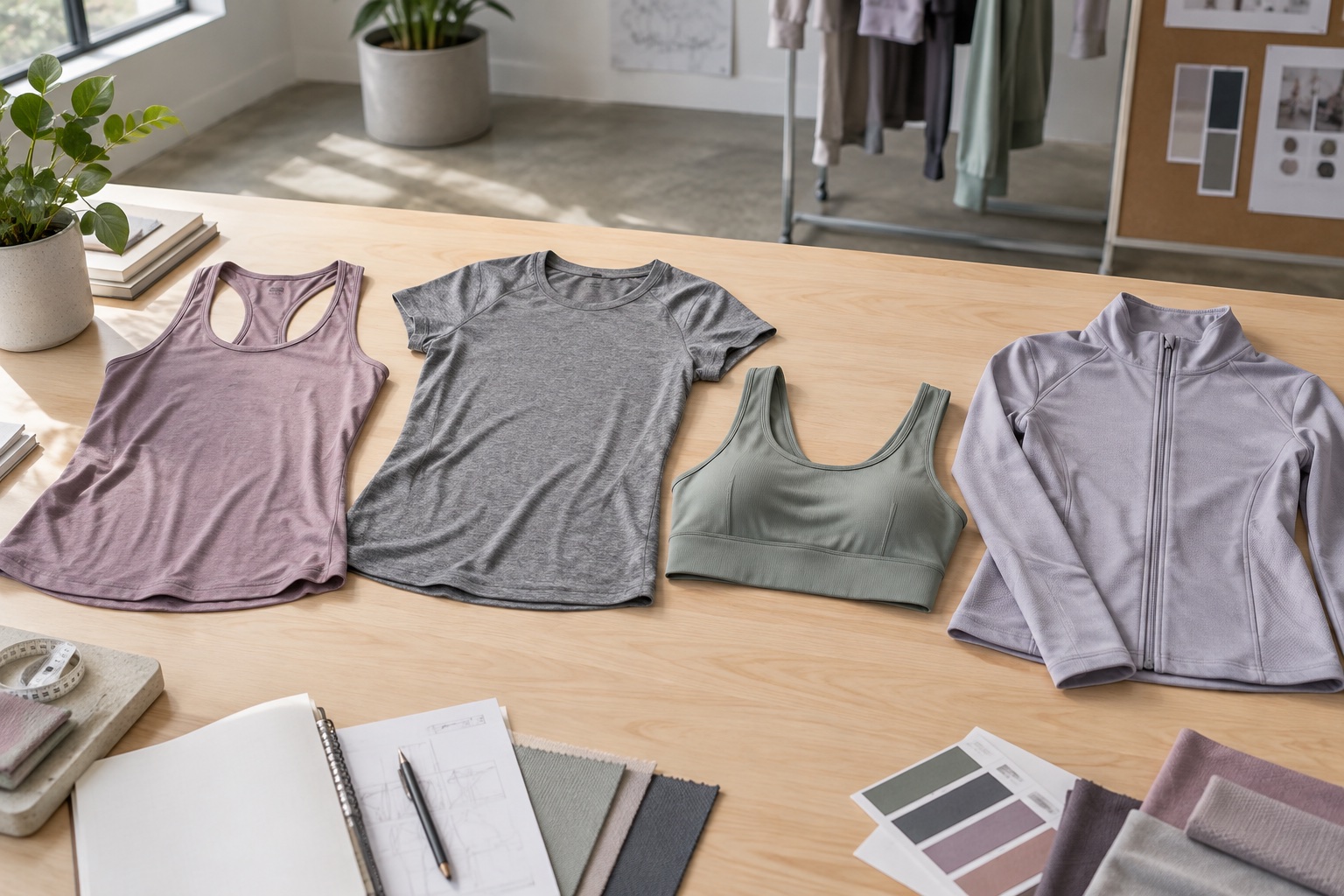
Direct answer: plan workout tops by product role, range and brand scope
A women’s workout tops wholesale supplier can help a brand organise an assortment of tanks, tees, light-support top directions and zip layers when the buyer identifies the intended wearer, sales channel, size-colour mix, product references, branding files and packing brief. A clear matrix shows what belongs in the first order and what remains open. Confirm current product options, materials, samples and commercial terms for the specific programme.
This guide covers wholesale and light customization around existing top directions: selecting product roles, planning size and colour combinations, adding agreed branding, and documenting packing and repeat-order details. It does not imply that any named style is in stock or immediately available. New fit, fabric, support construction, performance features or other garment changes belong on the custom activewear development route, where a project brief and sample plan can assess the change.
What does a women’s workout tops wholesale supplier help a buyer decide?
A useful supplier discussion starts with a product brief rather than a broad request for “women’s gym tops.” That phrase could describe a racerback tank, a cropped training top, a short-sleeve tee, a light-support direction, a long-sleeve layer or a zip-front piece. Each one has a different role in a range, may have different fabric or construction questions, and may need a different size and colour plan.
A wholesale or light-custom request generally begins from product directions the supplier can identify and review. The buyer selects the styles or references, defines how each item fits the intended assortment, and then confirms branding, labels, packing, samples and quantities. The product page can help name a silhouette; it does not by itself confirm current materials, colours, sizes, inventory, minimums or production terms.
The assortment should fit a channel and customer plan. A studio may want a small capsule that pairs a tank with a layer. A retailer may need a clearer role for a tee beside leggings or shorts. A club or fitness programme may prioritise consistent logo placement and participant size collection. A wholesale distributor may need packing and barcode details prepared for its own system. These are examples of buyer briefs, not guarantees about what a factory or catalogue can supply.
Before requesting a quote, the buyer should decide whether they need a current product direction with approved branding or a new garment specification. A logo, label or hangtag can fit a light-custom conversation when the base product remains within the confirmed route. A new neckline, support architecture, body length, fabric composition, fit block or construction feature changes the product and needs custom development.
The activewear wholesale supplier solution explains the existing-product route at a broader level. This page focuses on tops: how to assemble the range, clarify size-colour quantities, approve brand elements and protect the item record for a repeat.
How can tanks, tees, light-support tops and zip layers play different roles?
A top range becomes easier to assess when each item has a clear purpose. A tank may provide a sleeveless option or work under a layer. A tee may cover more of the upper arm and torso. A light-support direction may serve a specific styling or studio role, but the product name does not prove a performance level. A zip layer may be worn over another piece and introduce a closure, trim and logo-placement discussion. The buyer should explain the role in their assortment without assuming a technical claim.
The terms “light support,” “training tee” and “zip layer” are useful shorthand for a product direction, not universal specifications. If the range depends on support, coverage, opacity, compression, moisture management or another performance feature, the brand should define the actual requirement and ask what material or garment evidence would address it. Do not infer these properties from a category name or catalogue photograph.
| Top direction | Buyer role question | Details to compare | Brand and sample questions |
|---|---|---|---|
| Tank or sleeveless top | What coverage, layering and movement role does it serve? | Body length, neckline, armhole, hem and intended companion bottom | Where can a logo sit, and which garment sample shows the placement? |
| Short-sleeve tee | Is it a base layer, stand-alone top or coordinated set piece? | Sleeve shape, body length, side seam, neckline and layering space | Does artwork or embroidery placement need a full-garment reference? |
| Light-support direction | What intended wearer and styling role are in scope? | Coverage, strap arrangement, lining or construction only when verified | What evidence would support any buyer-defined support requirement? |
| Zip layer | When is the layer worn and what is underneath it? | Closure, collar, cuff, hem, pockets and panel relationships | How should the logo, label, zip pull or other trim be reviewed? |
The table helps the team decide which product direction belongs in the range. It does not define a universal fit, support level or available specification. Buyers should use product references and samples for the decisions that matter to their channel.
A buyer can begin with the Yoga Activewear catalog to identify product roles and related silhouettes. A specific style reference such as a racerback cropped yoga tank can make a discussion more concrete, but the buyer must still confirm exact product details, colour options and project terms.
Which coverage, length and layering questions should be answered first?
Coverage is a product decision, not a marketing adjective. The buyer can identify the intended neckline, shoulder and arm coverage, torso length, hem position and whether the top is meant to sit alone or over another garment. A fit photo or sample can help communicate proportion, but it does not replace a size specification or confirm that the same fit applies across every size.
Length and layering also affect which styles belong together. A cropped tank and a longer tee may share a colour but serve different customer preferences. A zip layer could be intended to open over a fitted top or close over a tee. These relationships affect merchandising, branding zones, garment measurements and the sample views a buyer needs. Describe how each item works with the intended bottom or layer so the assortment is not selected solely by product name.
If the buyer wants two tops to coordinate, list the shared and distinct requirements. Shared items may include a colour direction, logo artwork or packaging instruction. Distinct items may include neckline, sleeve, body length, fabric, label placement or size coverage. A shared brand brief should not hide the product-specific details that a supplier needs to confirm.
Sample views should answer the coverage and layering question. A hanger image can show the silhouette but may not show how the garment sits when worn. A close-up can show a seam or logo but not the total proportion. If the buyer’s decision depends on an outfit, request a paired view or fit sample that names the sizes and references under review. Any fit model, measurement or performance evaluation should follow the project’s agreed method.
| Comparison point | Tank | Tee | Zip layer | What the buyer should record |
|---|---|---|---|---|
| Upper-body coverage | Sleeveless direction | Sleeve and torso coverage | Layering coverage over another piece | Target neckline, sleeve and body length |
| Outfit relationship | Worn alone or under a layer | Stand-alone or base-layer role | Worn open or closed over a top | Intended companion products and use context |
| Branding zone | Front, back, strap or hem options to review | Chest, sleeve or back options to review | Chest, sleeve, collar or zip-side options to review | Artwork revision, dimensions and landmark |
| Construction detail | Neckline and armhole shape | Sleeve join and body construction | Closure, collar, cuff and pocket details | Which details are existing references or requested changes |
How should a first size-colour assortment be planned?
A size-colour matrix converts an assortment idea into a request a supplier can review. Each row should identify the product style, garment colour, size and planned quantity. If artwork colourways differ from garment colours, represent them separately. If quantities are still forecasts, label them as a planning scenario rather than an approved order. The supplier can then confirm which assumptions apply to a quote or sourcing response.
Do not collapse several styles into one total. A collection with two tank references, one tee and a zip layer may have a different style-colour-size distribution from a uniform order of one top. The table should show whether the brand expects all styles in every colour, a selected colour per style, or a smaller launch set. If the buyer has a target assortment ratio, write the ratio and ask the supplier which input needs confirmation.
Colour planning should identify a named direction or reference when available. A digital inspiration image can communicate mood but may not identify a reproducible shade. Ask whether the buyer is choosing from product-specific options, requesting a new colour development or using a confirmed physical reference. Colour, material and availability should be verified for each product direction rather than inferred from a webpage or a previous season’s photo.
Size planning needs the intended market and customer data source. The buyer should identify the size range, size chart reference, expected distribution and any size-specific differences that affect the product. If the brand has not validated the range, it can keep the matrix provisional and request a sample or size review. Do not claim that one size sample proves fit across the full range.
Use a simple matrix with clear status fields: requested, under review, sample needed, approved for the named scope, or not selected. Keep the supplier’s response beside the buyer’s quantities. This prevents an unconfirmed colour or product from quietly appearing as a production assumption.
What must a logo, label and packing sample confirm?
A branding brief should identify the brand asset, version, location, size, colour, method if known and the product area where it will appear. A logo file alone does not indicate its intended dimensions or exact position. Provide a placement map with a garment landmark such as neckline, side seam, centre front or hem. If several top styles use different positions, show each one separately.
A product proof and a garment sample answer different questions. A digital placement image can review rough location. A physical decoration sample can show a specific application on an identified material. An assembled garment can help the buyer discuss location in context. The approver should record which item they reviewed and whether their decision covers one style, one colourway, a size range or a larger scope. A sample for one top does not automatically approve the same mark on a zip layer or a different fabric.
Labels, hangtags and packaging also need their own files and owners. Record care and brand label content supplied by the responsible brand owner, label dimensions, attachment position, hangtag artwork, barcode data if used, bag or wrap instructions, fold direction and carton marks. The supplier should confirm which of these elements it can coordinate for the project and which files or compliance statements must come from the buyer. Do not assume one packaging sample represents every product or destination.
Keep a single revision record that links the style, size-colourway, logo file, label content, hangtag, packing brief, sample ID, comments and approval owner. If the brand changes artwork, placement or packaging after a sample, log the change and decide whether a new proof or sample is needed. A clear revision record is more useful than emailing a file called “final-final” with no approval context.

*Illustrative brand-planning scene only. Blank tags and planning materials are not inPACE customer records or an approved product/packing sample.*
How should a buyer approve samples before a wholesale order?
A sample plan should list the item to be reviewed, the question, the approver and the next decision. For a tops range, that may include silhouette, coverage, length, fabric direction, colour, logo placement, label position, pairing with another item or packing presentation. The sample request should identify the style, colourway, size, fabric reference if available and artwork or label revision. Missing details should be marked as open.
Separate visual feedback from a specification change. A comment such as “move the chest mark slightly higher” should identify the measured or visual reference and approval owner. A request to change neckline, body length, fabric, support construction or sleeve changes the garment scope. The supplier should confirm whether the change belongs in a new sample round and how it affects the existing quote or timing.
The sample decision should state what it approves and what remains unreviewed. For example, the buyer may approve the logo artwork and colour on a tank sample while leaving the tee and zip-layer placements open. They may approve the visual direction on one size while requesting another size or fit review. A purchase order should use the current approved reference and should not assume that a sample has silently approved every product in the collection.
If the programme includes multiple styles, define whether the buyer wants a separate sample for each product or a staged review. The supplier can then discuss a feasible plan based on actual materials, artwork and project requirements. The usual inPACE planning range for sample development is 5–10 days after the scope is confirmed; exact timing, cost and conditions must be confirmed for each project and approval sequence. This is planning context, not a guaranteed date for every top or branding method.
For a broader sample handoff, the activewear sample-to-bulk guide helps buyers keep approval records connected to the bulk brief. Keep each top direction in its own scope rather than treating all tops as one technical specification.
How can a brand protect a repeat order?
A repeat order should begin from the approved product record, not just the last invoice or product name. Keep the style reference, current product specification, fabric or material direction, size-colour matrix, logo placement, artwork version, label and packing files, sample approval and open-item record together. The buyer should be able to identify which version a supplier is being asked to repeat.
If the brand changes the colour, artwork, size range, label, packaging or product construction, record the change and ask whether the existing approval still covers it. A new garment base may require a new branding sample. A new hangtag or barcode file may change packing work even if the garment stays the same. A substitute material or product reference should be confirmed before the buyer assumes the earlier price or sample record still applies.
Keep the quantity matrix for each order revision. The first order may use one style-colour distribution and the reorder another. The supplier should confirm which quote scenario applies. Avoid assuming that a past MOQ, price, lead time, stock position or refund condition remains valid without a current project response.
A repeat-order file can be compact: approved source versions, supplier-confirmed reference, quantity matrix, sample scope, packaging files, authorised comments, order number and date. Add a change log when an item moves from the previous release. This helps a new buyer or production coordinator understand what was repeated and what changed without relying on memory.
The workout tank top manufacturer guide and gym T-shirt manufacturer guide cover distinct sleeveless and tee briefs. The workout long-sleeve manufacturer guide addresses a separate long-sleeve product brief. If the requested top needs new fit, fabric, support, construction or performance development, route it through custom activewear development rather than extending a wholesale reference beyond its confirmed scope.
What should a buyer include in a workout-top wholesale request?
A good first message explains the assortment decision and gives the supplier enough detail to identify the product directions. It does not need to pretend every input is final. List the intended wearer, channel, product roles, selected references, size-colour scenario, branding and packing brief, sample questions and decision owner. Mark estimates, undecided colours and product changes as provisional.
- Select the tank, tee, light-support and/or zip-layer roles needed in the range.
- Name each product reference or attach a clear silhouette image with its source.
- State the wearer, sales channel, intended use and how the tops pair with other items.
- Share the target size range, size chart or customer data basis and provisional quantity distribution.
- Separate garment colourways from logo colours and artwork revisions.
- Send logo artwork, placement map, label content, hangtag files and packaging instructions.
- Identify which features are existing references and which would change fit, material or construction.
- Name sample questions, sample sizes, approval owners and required sample views.
- Mark confirmed inputs, assumptions and details the supplier must verify.
- Ask for written confirmation of current options, quote scope, availability and commercial terms.
- Record the approved reference and quantity matrix for future replenishment.
How inPACE can support a tops assortment review
inPACE works with B2B activewear brands, wholesalers, studios, clubs and online retailers on product direction, private-label branding and custom development. A useful tops request gives the team product references, intended range roles, size-colour quantities, logo files, labels, packing and sample questions. The team can identify which details are clear and which require a project-specific check.
The Private Label Activewear page is relevant when the buyer is selecting an existing product direction and discussing approved branding, labels, hangtags or packing. A new fit, fabric, support construction or garment feature belongs in custom development. Exact product options, material, samples, order quantities, price and timing must be confirmed for the project; catalogue pages are references, not inventory or availability promises.
Send the top references, intended wearer and channel, size-colour mix, logo files, label content, packing brief and sample requirements through inPACE’s contact page. If a requested top needs product development, explain the desired change separately from the wholesale assortment. That lets the supplier review the current product direction and the custom request as distinct decisions.
Product directions
Explore relevant activewear products
Use these product pages as practical references for your brief, then confirm materials, fit, customization, and production details through sampling.
Yoga Activewear Catalogue
Review the catalogue as a starting point for identifying product directions, then confirm the selected style, options, and project scope.
View product directionRacerback Cropped Yoga Tank
Use this product reference to name a sleeveless silhouette for an assortment discussion; current materials, colours, and availability require confirmation.
View product directionPrivate Label Activewear
Use this route to discuss approved branding, labels, hangtags, and packing for an identified existing product direction.
View product directionFAQ
Buyer questions
What should I send a women’s workout tops wholesale supplier?
Send the selected top references, intended wearer and channel, product roles, size-colour quantities, logo files, label and hangtag content, packing brief, sample questions and decision owner. Mark estimates and unconfirmed options clearly.
Can I mix tanks, tees and zip layers in one wholesale assortment?
A buyer can propose a multi-style assortment for review. Identify each product reference, role, colourway, size distribution, branding scope and packing need so the supplier can confirm which options and terms apply to the specific programme.
Does a catalog page mean a workout top is in stock?
No. A catalog page is a product reference and does not establish live stock, current materials, colours, sizes, minimums, price or production availability. Ask the supplier to confirm the details for the styles and quantities in your request.
How should I plan the size-colour mix for workout tops?
Use a matrix that lists each style, garment colour, size and planned quantity. Separate estimates from approved quantities and label artwork colourways separately from garment colours. The supplier should confirm which assumptions the response uses.
What does light customization include for workout tops?
It can refer to branding or packing around an identified product direction, such as a logo, label, hangtag or agreed packaging detail. Confirm the actual scope, files, sample and supplier responsibilities. Changes to fit, fabric or construction require a custom-development review.
Should I approve branding on every top style?
Record which style, material, colourway, logo revision, placement and sample stage the approval covers. A sample on one tank does not automatically approve the same application on a tee or zip layer. Identify any styles or sizes still needing review.
When should I move from wholesale tops to custom development?
Move to custom development when the request changes fit, fabric, support construction, coverage, pattern, seam, performance feature or other garment specification. Keep the requested change separate from branding and packing on an existing product direction.