
When is a private label yoga wear manufacturer the right route?
Private label yoga wear is a practical starting route when a studio or brand has found a yoga silhouette that already serves the intended customer and does not need to be rebuilt from the pattern outward. The buyer is not ordering retail units or relying on an assumed ready-to-ship stock position. Instead, the team starts with a catalogue-informed product direction and makes the brand presentation, product selection, and order assumptions visible before a quotation or sample discussion.
That distinction matters because the phrase private label can hide two very different projects. A studio may need a sports bra, legging, layer, or coordinated set whose fundamental fit and construction are already close to its purpose. The useful questions are then which product reference to use, how the logo should sit on the actual garment, which labels and hangtags are needed, how the pieces will be packed, and what size, colour, and quantity direction the project has. That is a Wholesale and light-customization conversation.
A different project needs a factory-custom route. Move there when the brief calls for a new silhouette, a different fabric character, a particular underband or waistband construction, revised strap geometry, added pockets, a new print system, a functional feature, or another change that affects how the garment must be developed and sampled. Calling that work private label without naming the deeper product change can create the wrong expectation before the first review.
For a studio collection, write down the product decision first: what members will wear in class, what staff may wear, what will be sold as a coordinated set, and which pieces need a branded presentation. The Yoga Activewear Catalog is a useful place to choose a reference direction. It does not replace a project review of the actual fabric, colour, components, branding, availability, and production assumptions.
What should a studio decide before choosing yoga styles?
A studio collection becomes easier to review when each style has a job. A foundational legging or bra may be the repeatable core piece. A short-sleeve top, long-sleeve layer, or cover-up can give members an option before and after class. A small capsule for instructors may need a different balance of coverage, movement, colour, and visible branding from a retail-facing set. These are merchandising choices, not universal rules; they need to be stated so the product discussion has a clear purpose.
Begin with the wearer and the class environment. Describe whether the collection is intended for yoga, Pilates, low-impact studio classes, commute-to-class layering, or a broader athleisure offer. Note the desired coverage, how pieces are intended to coordinate, and whether the studio wants calm, neutral presentation or a more visible colour story. A supplier cannot responsibly infer those choices from a logo file alone.
Then identify which parts of the product are non-negotiable and which remain open. A buyer might care most about a square neckline, a cross-back arrangement, a high-rise legging, or the way a layer is used over a set. Another brand may be flexible about the exact starting style but clear about the logo, label system, and retail presentation. The Square Neck Cross-Back Sports Bra can be used as a concrete reference while the buyer records those distinctions; it is not a promise that every detail is available unchanged.
Avoid mixing a broad mood board with an unexamined buying plan. A photograph may show colour and proportion, but it does not establish the garment's measurements, fabric composition, fit across sizes, construction, logo compatibility, or packing requirements. Mark each reference as a visual direction, a construction instruction, a brand-presentation idea, or an item to investigate. This lets the factory ask focused questions rather than guessing which details must be reproduced.
Which catalogue choices should be documented for each product?
The easiest way to compare a studio range is to keep one row for each candidate style. A concise product matrix stops the brand, merchandiser, and factory from holding different versions of the same decision. It also makes it clear whether a piece remains within a catalogue-informed private-label path or has become a custom-development request.
| Product decision | What the buyer should state | Why it changes the review |
|---|---|---|
| Product reference | Catalogue URL, product code, front and back view, and the intended role in the collection | It identifies the starting silhouette instead of leaving the factory to interpret a general yoga image. |
| Wearer and use | Class setting, movement context, desired coverage, and whether the piece is member, instructor, or retail facing | It gives context for fit, support, layer, and presentation questions without claiming one style suits every wearer. |
| Colour direction | Proposed colour names or references, contrast requirements, and which colours must coordinate | It separates a colour idea from a final material and production confirmation. |
| Branding | Current logo file, intended placement, size, colour, and any areas the logo must avoid | It starts a product-specific compatibility discussion rather than assuming one method works on every fabric. |
| Labels and hangtags | Brand name, size label, care or composition information supplied by the buyer, hangtag fields, and barcode needs | It links retail presentation to the information that has to be checked before packing. |
| Packaging | Fold direction, individual bag request, sticker or barcode position, set grouping, and carton-mark needs | It gives the factory a usable receiving and packing brief rather than a late-stage instruction. |
| Size and quantity direction | Intended size range, colour split, estimated units by style, and destination market | It provides the variables needed to review feasibility without inventing a universal MOQ or price. |
| Open decisions | What the buyer still needs to see, test, or approve | It prevents a visual preference from being mistaken for a signed-off production detail. |
The matrix should use the same name for a style wherever it appears: in the product reference, logo artwork file, label proof, colour conversation, sample comment, and packing information. If the studio changes from a catalogue bra to a newly designed one, record that as a new development decision rather than silently continuing with the old reference code.
How can bras, tops, and leggings form a coordinated studio range?
A coordinated range does not require every garment to use the same fabric, logo size, or level of support. It requires the buyer to say what each piece contributes and which decisions must remain consistent. A teaching uniform, a member retail item, and a broader brand collection may share a colour family and identity while answering different coverage, movement, repeat-wear, and presentation questions.
Start with the audience rather than the number of products. An instructor-facing bra or top may need a coverage and layer relationship that works through repeated class demonstrations. A member-retail set may be judged partly on how clearly the pieces coordinate on a rail, product page, or studio display. A studio's wider brand collection may add a cover-up or layer whose job is to connect the class outfit with arrival, departure, or front-desk use. These are planning roles, not performance guarantees.
| Studio product role | Useful starting piece | Questions to record before selection | Brand decisions that should coordinate |
|---|---|---|---|
| Instructor or coach wear | Bra or fitted top, legging, and optional layer | Intended classes, desired coverage, movement areas to observe, layer relationship, and who will join the sample review | Studio identity, colour relationship, visible-versus-discreet logo direction, and approved label system |
| Member retail core | One top or bra plus one bottom | Intended customer, size direction, whether pieces may be bought separately, price-positioning input supplied by the buyer, and retail presentation | Set naming, colour pairing, hangtag fields, size identification, barcode needs, and pack format |
| Event, welcome, or team item | Top, tee, or layer selected for the named occasion | Wear context, expected styling, distribution method, garment reference, and whether the item is sold or supplied to a group | Front/back artwork hierarchy, event wording, studio mark, individual packing, and quantity allocation |
| Broader brand capsule | Core set plus one complementary layer or alternate top | Which product is the anchor, what the additional style adds, and which differences are intentional | Shared palette, artwork version, label family, photography/product-page naming, and approval owner |
The bra, top, and legging should still be reviewed as separate garments. A bra can have a different lining, underband, strap layout, or contact area from a top. A legging brings a waistband, rise, gusset, inseam, and larger stretch zones into the decision. The studio should not assume that a logo size, material response, label position, or fit comment approved on one piece automatically transfers to another.
When a collection is sold as a set, record whether the top and bottom must also work as individual SKUs. If customers can choose different top and bottom sizes, the order, barcode, packing, and replenishment files should preserve that choice. If pieces are always packed as a fixed set, identify the approved pairing and how the outer label communicates it. The correct route depends on the studio's sales and receiving plan; it should not be guessed from a styled photograph.
How should stretch, coverage, skin feel, and sweat context enter the material brief?
A request such as soft yoga fabric or breathable studio wear is a starting preference, not a complete material instruction. The buyer should connect the preference to a garment area, wearer, movement, and observation. That lets the supplier discuss suitable options without turning an adjective into an unsupported fibre, weight, stretch, moisture, or comfort claim.
| Material question | Put it in the brief this way | What a physical review may observe | What the record must not claim without evidence |
|---|---|---|---|
| Stretch and recovery | Name the garment zone and the movements that matter for the intended class | Whether the selected sample returns acceptably after the named movement and whether the logo area changes visibly | A universal recovery percentage, permanent shape retention, or suitability for every body and activity |
| Coverage | Name the pose, lighting context, colour, lining decision, and reviewer group | What the reviewers observe on that specific sample in the defined conditions | “Squat-proof,” opaque in every condition, or equivalent consumer claims based on an image or one reviewer |
| Skin feel and contact | Identify underband, strap, armhole, waist, gusset, seam, label, or logo areas that touch the wearer | Whether the selected construction, edge, label, and application feel acceptable to the named reviewers | Chafe-free, irritation-free, or comfort for all wearers |
| Sweat and repeated studio use | Describe class type, expected wear context, colour concerns, and which areas the buyer wants to examine | Appearance, hand, cling, placement, or drying observations made on the identified sample under the agreed review | Moisture-management performance, odour control, colourfastness, or a wash-life result that was not tested and recorded |
| Surface for branding | Identify fabric face, texture, rib, mesh, seam proximity, stretch direction, and proposed mark | Edge definition, hand, distortion, colour relationship, and behaviour on the actual application sample | That one method will behave identically on every colour, fabric lot, placement, or garment |
The studio can use a short material-and-wear note for each product: selected reference, material identity if confirmed, product area, named movement, desired observation, reviewer, and open question. If the material changes, reopen the affected fit, coverage, logo, label, colour, and care-information decisions. A revised fabric can preserve the general silhouette while changing the evidence needed for approval.
This is also where a studio should separate wearer feedback from market wording. A teacher may describe how a sample feels during a class, and a member-review group may notice a different preference. Those observations can guide a revision. They do not automatically become a product-page claim, laboratory result, or promise that every customer will have the same experience.
How should a studio review logo position and size on each garment?
Logo review is more useful when the buyer names a garment landmark instead of saying small on the back or large on the leg. The working file should identify the exact style, colour, artwork version, proposed dimensions, relationship to a seam or edge, and whether the placement is intended to be discreet, instructional, retail-facing, or visible in studio photographs. Measurements remain proposals until the relevant sample is approved.
| Garment zone | Position and size questions | Yoga-specific review points | Separate evidence to keep |
|---|---|---|---|
| Bra underband or front | Distance from centre, neckline, band edge, and seam; available flat area; intended visual weight | Band stretch, lining relationship, skin contact, curvature, and whether the mark competes with the product shape | Artwork file, measured placement sheet, application sample, colourway, and approval image |
| Bra or top back | Relationship to straps, back opening, binding, neckline, and centre line | Movement across the shoulder blades, strap movement, seam proximity, and visibility when layered | Front/back mock-up, physical garment view, measured landmark, reviewer note, and approved version |
| Top chest or hem | Distance from centre front, armhole, side seam, hem, or opening | Drape, fold, layer interaction, surface texture, and how the area changes when worn | Position diagram, intended size, fabric identity, selected method, and physical sample decision |
| Legging waistband | Relationship to centre back, side seam, waistband depth, and any pocket or panel | Waistband extension, body curve, contact, seam construction, and visibility beneath a top | Flat and worn views, placement measurement, logo sample, colour reference, and decision owner |
| Legging side or lower leg | Start and end points relative to hip, knee, ankle, seam, or panel | Stretch direction, movement, scale along the leg, seam crossing, and balance with the top | Artwork scale, left/right instruction, garment size used, material/colour, and approved photograph |
The activewear logo application guide explains how material, artwork, placement, and physical evidence shape the method discussion. It should be used as a technical review companion, not as a menu that lets the buyer select printing, transfer, or embroidery from a name alone. The suitable route remains conditional on the identified garment, fabric, construction, artwork, size, colour, quantity direction, and approved sample.
Keep large and small versions as separate artwork or application decisions. A small identity mark on a waistband may use a different scale, line detail, and viewing distance from a larger back graphic or team message. If the buyer changes size, location, substrate, colour, or artwork detail after reviewing the first sample, record whether a new application sample or garment review is required rather than assuming the earlier approval still applies.
What should the physical yoga sample record before logo approval?
A digital mock-up answers whether the proposed mark looks directionally suitable on a picture. A physical sample answers narrower questions about the actual garment and application submitted for review. The sample record should never be a blank approval box. It should identify what was reviewed, under which practical conditions, what the reviewers observed, and which decision follows.
| Sample record field | What to enter | Why it matters |
|---|---|---|
| Garment identity | Style or product reference, version, size, colour, material identity if confirmed, and construction notes relevant to the logo zone | It prevents observations from one garment or material from being copied to another. |
| Branding identity | Artwork filename and date, logo dimensions, colour, candidate method, measured location, and mock-up version | It connects the physical mark to the file the brand intended to review. |
| Review condition | Flat view, worn view, named yoga movements, layer relationship, lighting used for coverage observation, and any agreed wash review | It keeps the observation tied to a repeatable context instead of an unqualified claim. |
| Observation | Touch at the logo edge, visible distortion, placement balance, interaction with seams or folds, colour relationship, and any before/after appearance actually seen | It captures evidence without inventing a numerical performance result. |
| Decision | Accept, revise, reject, or hold pending information; name the decision owner and date | It distinguishes a comment from an instruction that may move forward. |
| Recheck trigger | Changed artwork, size, placement, method, garment, material, colour, construction, wash condition, or reviewer requirement | It shows when the earlier evidence no longer describes the requested product. |
If a wash observation is needed, define it before the review: which exact garment and application, who owns the wash method, what condition will be recorded, which areas will be photographed or described, and what decision the observation supports. Do not insert an unverified cycle count or durability conclusion. If no actual wash record exists, list wash appearance as an open approval question.
The same discipline applies to touch and deformation. Record what a named reviewer observed on the identified sample, including whether the logo edge, garment surface, or stretch area raised a concern. Avoid turning one sample comment into a universal comfort statement. The useful output is a clear next action: retain the proposal, adjust size or location, consider another candidate method, review a changed garment, or obtain more evidence.
Which colour, logo, and label decisions need separate approval?
A coordinated studio set can share one visual identity without sharing one approval. The top and bottom may use different fabrics, trims, seam maps, surface textures, or logo zones. A colour reference can also appear differently on distinct materials. Approve the brand system as a family, but keep enough product-level detail to stop one accepted sample from silently authorizing another.
| Approval item | Bra or top record | Legging or bottom record | Collection-level record |
|---|---|---|---|
| Colour | Material or garment reference, approved colour evidence, contrast binding or trim, and logo colour | Material or garment reference, waistband/body relationship, panel or pocket colour, and logo colour | Intended pairing, acceptable relationship, alternate combinations, and owner |
| Logo | Artwork version, dimensions, measured placement, method candidate, and physical sample decision | Artwork version, dimensions, left/right or front/back instruction, placement, and physical sample decision | Which marks must match, which sizes intentionally differ, and hierarchy across the range |
| Main and size labels | Label file, fold or edge direction, contact area, position, and sample decision | Label file, waistband relationship, position, and sample decision | Shared naming, size convention supplied by the buyer, approved supplier file, and version date |
| Care/composition information | Buyer-approved wording for the actual product and destination, linked to the confirmed material record | Buyer-approved wording for the actual product and destination, linked to the confirmed material record | Responsible market-information owner and rule for keeping distinct products separate |
| Hangtag, barcode, and packing | SKU fields, attachment point, fold, bag, and whether it is sold alone or in a set | SKU fields, attachment point, fold, bag, and whether it is sold alone or in a set | Pairing table, retail name, receiving logic, carton information, and release owner |
A practical approval pack can therefore contain one collection cover sheet and separate product records. The cover sheet names the range, audience, visual hierarchy, colour relationships, and responsible reviewers. Each product record keeps its own garment reference, material, colour, logo, labels, sample observations, size direction, quantity estimate, and packing instruction. That structure helps the studio preserve a consistent identity without erasing the technical differences between garments.
How should branding work with yoga fabrics and garment zones?
Branding begins with the garment, not a generic list of logo methods. A mark that looks clear on a flat artwork file may sit across stretch, a seam, a curve, a lining edge, or a high-contact zone when placed on an actual bra, legging, or layer. The discussion should name the selected product, exact placement, intended size, artwork version, colour relationship, and what evidence the buyer needs before approval.
For a yoga bra, note the neckline, strap layout, underband, lining relationship, and areas where movement or skin contact may matter. For leggings, identify the waistband, side seam, pocket area if relevant, back panel, ankle, and any contrast panel. For tops and layers, identify the chest, back, sleeve, neck, hem, zipper, or pocket areas that make sense for the selected silhouette. These descriptions do not determine a logo technique; they make a project-specific review possible.
The private-label activewear service is the right product path for discussing logo, labels, hangtags, and packaging as a coordinated presentation. A buyer should supply the current artwork file and clearly mark draft artwork as draft. The factory and buyer can then review the proposed branding direction in the context of fabric, stretch, garment construction, colour, sampling, and the approved reference. Do not treat a digital mock-up as final proof of how a mark will look on the finished garment.
A studio brand should also separate consumer-facing branding from required product information. Size labels, care or composition information, hangtags, barcodes, stickers, poly bags, and carton marks have different jobs. The first supports the identity of the collection; the others support handling, selling, warehouse receiving, or market-specific preparation. The buyer should provide the confirmed text and identifiers that belong to its own brand and destination market rather than asking the factory to invent them.

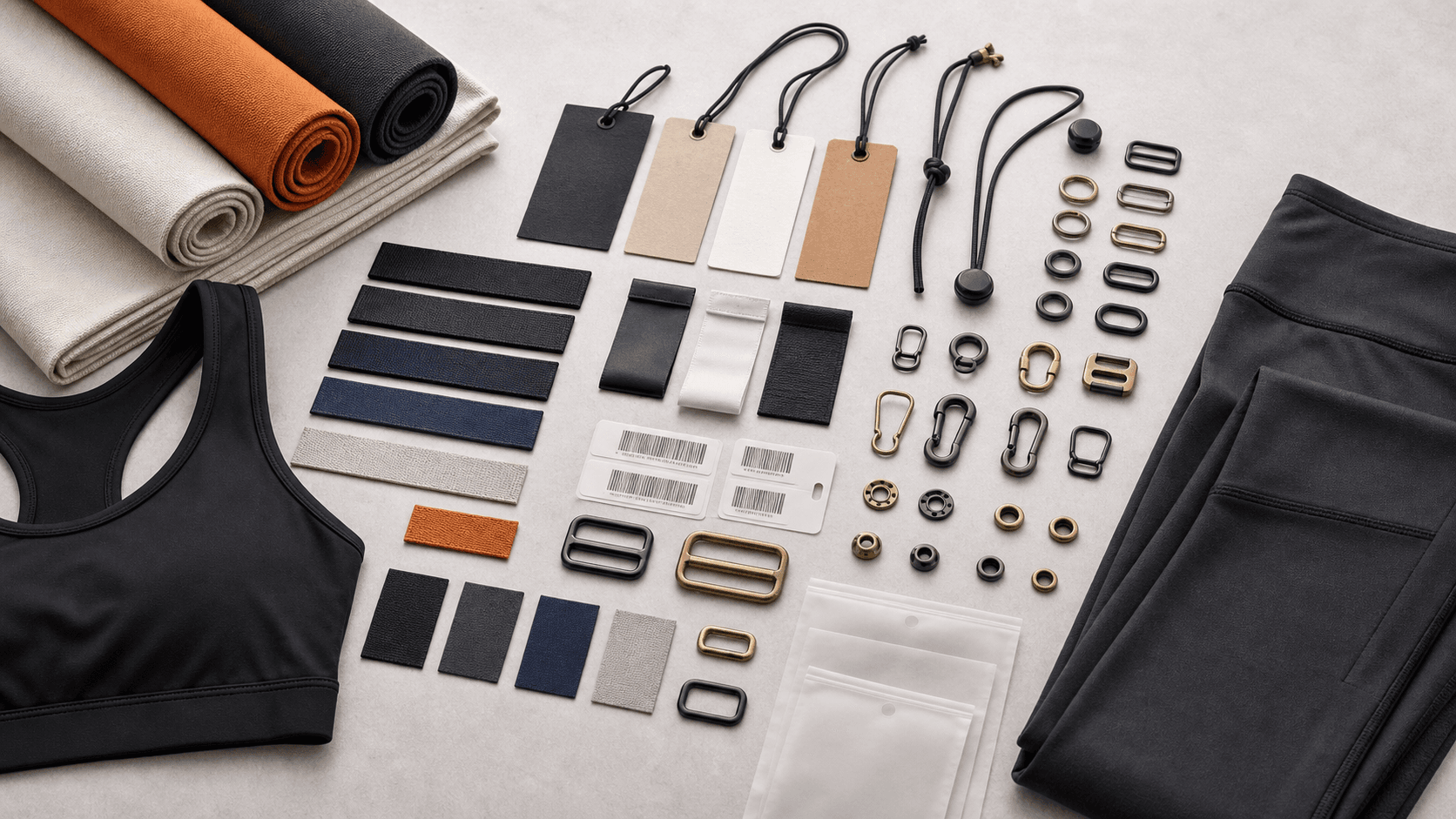
The execution image above illustrates why packing should be part of the same working file as the product and brand details. Folding, individual packing, size identification, set grouping, and carton information should be checked against the latest style-and-brand record. A studio may simplify this for a small first collection or add more receiving detail for a retail or distribution plan; the correct level depends on the project and destination.
How do colour, sizes, and quantities affect a studio collection?
Colour, size, and quantity are operational decisions, not a decorative appendix to a product selection. One studio may prefer a small, tightly coordinated colour offer so members can build sets. Another may have a broader membership, seasonal calendar, or online channel that needs more variation. Neither route automatically determines an order plan. The factory needs the buyer's estimate by style, colour, and size alongside the product, brand, and packing requirements.
Use a matrix instead of a total-only quantity statement. List the selected style, colour, size range, expected units, and whether the product is a core repeat item, a test item, an instructor piece, or a seasonal layer. Then show what is provisional. This reveals whether a very small colour split, a wide size range, a special component, a distinct fabric, or an individualized packaging request should be discussed before a quote is compared.
The same caution applies to colour. A studio can communicate a visual direction with a swatch, image, or named reference, but the final appearance can depend on the material, product component, finish, logo colour, and sample. Identify which colours must coordinate across a bra and legging, which contrast elements are optional, and which brand elements must remain legible. Final decisions should be confirmed against the relevant project evidence rather than a screen image alone.
When a buyer wants to test a collection, state the test question. It may be whether members prefer a silhouette, whether a colour grouping fits the studio identity, whether a branded layer is useful at the desk, or whether the label-and-packing system works for the intended channel. That gives the small-batch or first-order discussion a reasoned basis. It does not imply a fixed small quantity, price, lead time, or capacity.
How should a studio keep product and brand approvals connected?
A private-label program often loses clarity when product, artwork, label, packing, and order information live in separate conversations. The studio may approve a garment image in one thread, send a newer logo in another, and decide on a barcode or fold direction only after the colour plan has changed. None of those events is unusual. The risk comes when an older file or product reference is treated as if it describes the current collection.
Use a short versioned approval record for every chosen style. At minimum, it should name the catalogue reference, its product role, colour direction, artwork file and date, proposed placement, label and hangtag files, packing instruction, size-and-quantity matrix, buyer owner, factory question, and next approval point. When a decision changes, record what changed and which other items must be rechecked. A new logo placement, for example, may affect the selected garment zone, colour contrast, sample evidence, and packing photograph. A new barcode field may affect the label or bag instruction and warehouse record.
Do not convert open questions into approval labels simply because a visual looks close. It is more useful to mark a point as proposed, under review, approved for sample, approved for production, or awaiting buyer information. Those labels make it possible to distinguish a direction that still needs evidence from an instruction that can be carried forward. They also help a studio protect continuity when a collection has several people reviewing marketing, product, operations, and retail details.
The physical sample or relevant approval evidence should be tied back to the same record. If the buyer comments on a bra's strap area, a legging's waistband, a label position, a logo contrast, or a pack presentation, capture the exact style, colour, version, observation, requested action, and decision owner. A statement such as make it more premium is not a usable production note. A product-specific note such as review the label edge against the selected fabric, confirm the revised artwork file, and retain the agreed placement reference gives the next discussion an auditable starting point.
This record also improves repeat-order planning. A studio can compare a future request against the prior approved style, colour, brand components, and packing information, then name the changes rather than rebuilding the brief from memory. It does not freeze the product forever. It gives the buyer and factory a disciplined way to identify what may need a new review when the collection, channel, materials, labels, or product route changes.
What should happen before the buyer asks for a quotation?
A useful enquiry lets the factory understand both the selected catalogue route and the limitations of the current brief. Assemble a concise working pack before asking for pricing or production advice. It can begin simple, but it should be specific enough that assumptions are visible and the factory can say what still needs confirmation.
- Name the studio, selling channel, destination market, and the collection's intended use.
- Link every chosen catalogue style and describe its role: core set, instructor item, retail layer, or test direction.
- Attach current logo artwork and identify the draft version, intended locations, size, and colour.
- List labels, hangtags, care or composition text supplied by the buyer, barcode fields, bagging, folding, and carton-mark requirements.
- Provide the planned colour and size range plus a quantity direction by style, colour, and size; flag estimates clearly.
- State which product details are confirmed and which need a sample, feasibility review, or buyer decision.
- Include packaging and receiving needs early when the studio sells through a shop, ships to a warehouse, or groups sets.
- Share the target launch context or delivery window as a planning input, not as an assumed factory commitment.
The activewear sampling process explains the broader path from a usable brief through review, confirmation, and production preparation. The information does not need to be perfect before a first conversation. It should be organized enough for the buyer and factory to distinguish a missing input from an approved choice, and for a quotation to record its assumptions where information is incomplete.
A price-only request makes comparison harder because two factories may be interpreting different products, materials, logo applications, packaging systems, or quantity allocations. Ask the factory to identify what has been assumed. If a buyer later changes a style, fabric, colour plan, label system, logo placement, or quantity split, revisit the affected assumptions rather than treating the original quotation as a permanent description of a different project.
When should a catalogue private-label project move to custom development?
Move beyond a catalogue-informed route when the selected reference no longer carries the central product requirement. A new neckline, revised length, different support structure, new waistband, fabric change, feature detail, panel architecture, engineered print, or altered fit may require pattern, material, construction, and sample work that a light-customization discussion cannot responsibly cover. The boundary protects both the studio's design intent and the accuracy of the production review.
The decision is not a judgement that a studio collection must be fully custom to be credible. A well-chosen catalogue product plus clear brand presentation can be the right commercial route. Equally, a collection that needs new product development should be named as such early. The custom activewear development route is for buyers who need the factory to examine a new fit, fabric, construction, colour, feature, or sample plan rather than only a brand treatment on an established direction.
A useful adjacent guide is Wholesale Activewear With Custom Logo, which explains what brands can prepare when the main question is an existing product direction plus branding. For a supplier-comparison decision that goes deeper into yoga product development, review how to choose a yoga wear manufacturer. Together, these articles help a buyer separate product selection, brand presentation, and factory development instead of forcing all three into one vague request.
How can inPACE Sports support a branded studio collection?
inPACE Sports can use a chosen catalogue direction as the start of a B2B private-label conversation for brands and studios. The practical work is to review the selected product reference, brand artwork, labels, hangtags, packaging, size-and-colour direction, and the questions that remain open. Where the project requires a new fit, fabric, construction, colour, feature, or deeper product change, the route should move into custom activewear development and sampling rather than be described as catalogue branding.
For Ningbo Yinshan Garments Factory, the useful factory-side record is not only a picture of the preferred garment. It is the current product reference, the brand details that belong on it, the required buyer-supplied information, the sample or approval questions, and the packing instructions that must carry through to order preparation. That process can include material and trim discussion, sample coordination, production communication, QC planning, and export-packing preparation when relevant to the project. Each item remains subject to the actual brief and confirmation.
What should a studio send next?
Send a private-label yoga brief with the selected catalogue links, intended studio audience, product roles, colour direction, current logo files, labels and hangtag content, packing needs, style-colour-size quantity matrix, destination market, and the decisions you still need to review. That gives the team a focused basis to discuss the right product route, branding plan, and next approval step without inventing an MOQ, price, lead time, or availability.
Use the contact team to share your yoga styles, studio logo, wearing requirements, and size-colour plan for a branded sample review. If the collection needs a new product solution rather than branding on a selected catalogue direction, state that clearly in the enquiry so the custom-development and sampling questions can be reviewed from the start.
Product directions
Explore relevant activewear products
Use these product pages as practical references for your brief, then confirm materials, fit, customization, and production details through sampling.
Yoga Activewear Catalog
Start with the studio-ready silhouettes, then record the colour, product role, logo, label, packing, and quantity questions that still need confirmation.
View product directionSquare Neck Cross-Back Sports Bra
Use this yoga catalog reference when a studio collection needs to discuss neckline, strap layout, colour direction, branded details, and sample confirmation.
View product directionPrivate Label Activewear
Use the private-label route when the selected yoga direction needs logo, labels, hangtags, packaging, and a buyer-ready approval record.
View product directionFAQ
Buyer questions
What does a private label yoga wear manufacturer do for a studio collection?
For a studio collection, a private label yoga wear manufacturer can begin with an appropriate catalogue-informed product direction and then review the buyer's logo, labels, hangtags, packaging, colour direction, size range, quantity plan, and delivery-market requirements. If the brief changes the core fit, fabric, construction, colour system, or function, it should move into custom product development and sampling.
Can a studio add its logo to a catalogue yoga style?
A studio can discuss logo application on a selected catalogue yoga style, but the exact placement, size, artwork version, colour, fabric, garment zone, stretch, and sample evidence should be reviewed for that product. A digital mock-up alone does not confirm how a logo will appear or behave on the finished garment.
Where can a studio place a custom logo on yoga bras, tops, or leggings?
Possible zones include a bra underband or back, a top chest, back, sleeve, or hem, and a legging waistband, side, or lower leg. The suitable position and size depend on the selected garment, material, seams, lining, stretch direction, skin-contact area, artwork, colour, and intended visibility. Record measured landmarks and approve the proposal on the relevant physical sample instead of treating a generic mock-up as final.
How should a studio review logo stretch, touch, and wash appearance?
Identify the exact garment, material, colour, artwork, dimensions, placement, candidate method, review movements, and any agreed wash condition. Record only what reviewers observe on that sample, who made the decision, and what change would require another review. Without a real record, keep stretch, touch, deformation, and wash appearance as open questions rather than writing a durability or comfort claim.
What should a studio provide before asking for a private-label quote?
Provide the selected style links, product roles, intended wearer and class context, colour direction, current logo files, label and hangtag content, packing requirements, destination market, and a style-colour-size quantity direction. Mark estimates and open questions clearly so quotation assumptions can be reviewed rather than guessed.
Is there a fixed MOQ for private label yoga wear?
No universal MOQ should be assumed. The workable order plan can depend on the selected style, materials, colours, size split, logo method, labels, packaging, quantity allocation, sampling needs, and factory planning. Discuss the actual project with the product and quantity matrix instead of relying on a generic number.
Do catalogue private-label yoga styles still need a sample review?
The suitable review route depends on the product, branding, material, colour, and approval questions. A buyer should discuss what evidence is needed to confirm the chosen product direction and brand details rather than assuming that an image or catalogue reference is sufficient for every decision.
How should yoga labels, hangtags, and packaging be planned?
Plan labels, hangtags, barcodes, individual packing, fold direction, set grouping, carton marks, and receiving needs with the selected product and sales channel in mind. The buyer should provide its confirmed brand and market information, while the factory can review how those instructions fit the product and packing workflow.
When should a studio use a custom activewear manufacturer instead?
Use a custom activewear manufacturing route when the studio needs a new silhouette, fit, fabric, construction, colour, functional detail, or sample-development plan that an established catalogue direction cannot carry. Naming that requirement early helps the factory review the right materials, pattern, sample, production, QC, and packing questions.