
A buyer can receive three swatches described as lightweight, stretchy and quick drying and still have no reliable basis for selecting one. The descriptions may refer to different properties, different tests or simply a supplier's preferred language. Even when the swatches feel similar, the proposed garments may use different cuts, linings, seams and branding areas.
The practical question is therefore specific: what must this fabric do in this garment, and what evidence will support that decision? This guide provides a comparison method for adult court-apparel projects. It does not report an inPACE material trial or rank untested fabrics. Use custom activewear development when the project changes the material, fit or construction, and identify the sample decisions needed before production.
Which use conditions should shape the fabric brief?
Describe the actual setting before selecting a material direction. Record whether the garment is intended for indoor practice, outdoor sessions, tournament use, travel or a combination. State the expected layering and the buyer's priorities for feel, movement, coverage and care. Avoid treating every outdoor location as one climate or assuming that an indoor venue removes all comfort questions.
A training top might prioritise a particular next-to-skin feel and movement at the shoulder. An outer short might need a different drape and surface appearance. A skort liner has its own fit and coverage role beneath another layer. These are different starting briefs even if the collection shares one colour palette and brand mark.
Use the training and tournament apparel guide to settle the garment roles first. Then select the material questions for each role. This prevents a fabric chosen for a top from becoming the default for every component merely because the buyer wants the range to coordinate.
Rank the priorities. Mark the requirements that would stop approval, the features that can be compared during sampling and the preferences that remain flexible. A list in which every property is described as essential gives the supplier little guidance when the proposed options involve different appearance, feel or construction choices.
Why is fibre composition only one part of the comparison?
Ask for an identified fabric, not only a fibre percentage. The record should distinguish composition, yarn or surface description where relevant, knit or woven construction, nominal weight, finish, colour and supplier reference. Attach the swatch version used in the conversation. If some information is still provisional, mark it that way rather than filling a blank with a familiar catalogue specification.
Two materials carrying the same broad fibre description need not be interchangeable for the buyer's garment. AATCC's public summary of TM195 for liquid moisture management explicitly relates the measurement to fabric structure as well as fibre and yarn characteristics. That is one reason to connect a performance discussion to the actual material, rather than using composition as the result.
The fabrics and trims page is a useful starting point for a material enquiry. Send a physical handfeel reference where possible and explain which feature matters: a smoother face, a particular drape, a softer contact surface or a more structured outer appearance. “Like this fabric” becomes more useful when the buyer identifies the quality they want to retain.
How should polyester, nylon and stretch-woven directions be discussed?
Treat these as material directions to investigate, not a league table. If the supplier proposes a polyester-based stretch knit for a top, ask which identified option meets the desired surface, drape, movement and evidence requirements. If a nylon-based stretch knit is proposed for another component, review it against that component's brief rather than assuming the fibre name settles the choice.
A stretch-woven outer short is a separate construction proposal from a fitted knit liner. Ask how the candidate behaves in the intended pattern, where movement is required and which seams or openings need review. The same collection may use different constructions to serve different garment roles. Coordination can come from colour and design without forcing every piece into one fabric.
Do not specify a blend ratio merely because it appears on an unrelated reference. Ask what the proposed material is, why it is being offered and how the sample will resolve the buyer's questions. If the supplier offers alternatives, record the differences so the quotation and approval do not collapse several materials into one generic description.
Retain an accepted fallback only after it has been reviewed. A second fabric should not be described as equivalent simply because its composition and colour name resemble the first. Identify what has actually been compared and which decisions would need reopening if the order switches to it.
What does each garment role ask of the material?
Build a small role matrix before ordering a large swatch selection. This keeps the comparison connected to the range the buyer actually intends to make. The table below is a planning framework, not a list of tested properties or recommended specifications for every player.
| Garment or component | Priority to define | Evidence or sample question |
|---|---|---|
| Training top | Contact feel, shoulder movement and desired surface | Does the proposed material work in the intended fit and seams? |
| Team or match top | Coordinated appearance and branding area | Does the actual colour and application sample match the agreed direction? |
| Outer short | Drape, movement clearance and surface appearance | How does the material behave in the accepted outer pattern? |
| Skort outer layer | Silhouette, hem movement and coverage preference | Does the chosen fabric create the agreed outer appearance? |
| Skort or short liner | Body contact, fit, coverage and pocket interaction | Does the assembled layer remain suitable in the defined review? |
| Optional warm-up layer | Intended layering, feel and care priorities | Is the fit and material combination appropriate over the planned outfit? |
Use existing products to make the discussion concrete. The DWD115066 A-Line Tennis Skirt can establish an outer-skirt direction. The YA-03 Run Training Short Set can help identify a top-and-short reference. Neither product name is a substitute for approval of a changed material or evidence for a new performance claim.
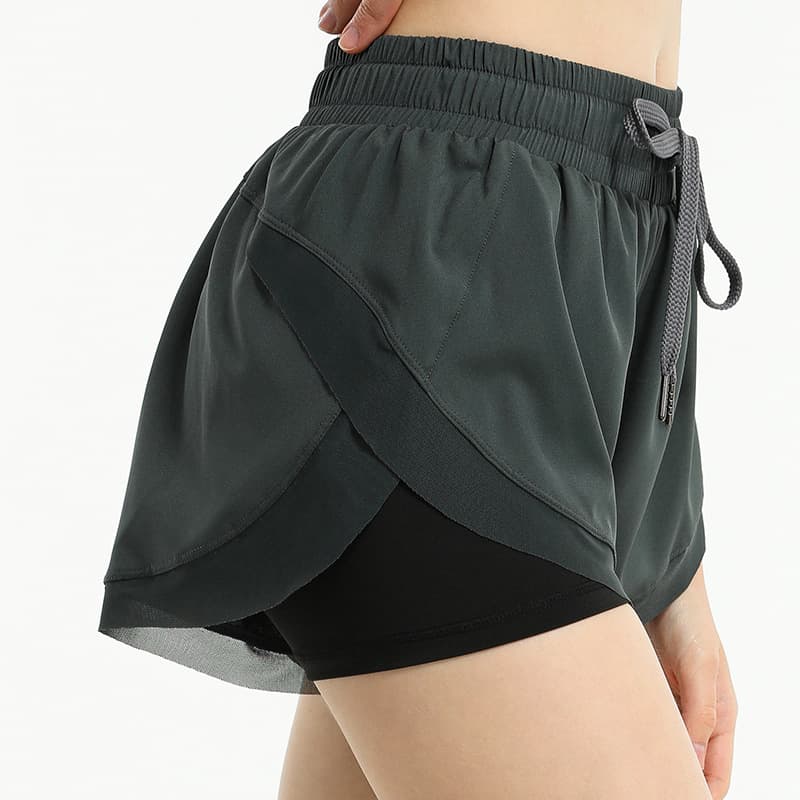
The main photograph shows an outer short with an inner layer. It illustrates that separate components can have separate material roles. It does not identify their composition or prove their suitability for a particular pickleball order. Assign a fabric reference to each component in the actual brief.
How should stretch and recovery be reviewed?
State where the garment needs movement and how the pattern will use the material. Record the sample size, intended fit and the directions in which the material is being assessed. A hand-pulled swatch may be useful for an early conversation, but it is not a controlled comparison unless the method and conditions are defined.
Separate extension from what happens afterwards. Ask how the proposed fabric will be assessed for returning toward its original condition after the agreed extension or use. Do not treat “four-way stretch” as a complete report on fit, recovery or garment life. If a measured requirement matters to the project, agree an appropriate method and acceptance criterion with the supplier or laboratory.
Review the seams and openings in the assembled sample. A fabric can feel accommodating in a loose swatch while the garment's seam, waistband or logo area becomes the limiting feature. Record where the wearer experiences restriction or where appearance changes, so the next discussion can consider construction as well as material.
Use consistent observations when comparing revisions. Keep the same relevant movement, sample setup and review notes wherever practical, and identify anything that changed. The aim is to distinguish an improvement associated with a new material from one caused by a different size or altered pattern.
How are moisture management and drying different questions?
Ask the supplier what the proposed evidence actually measures. Liquid movement within a textile and the rate at which a wet specimen dries are related to the buyer's use case, but they are not the same question. A report should identify the property assessed rather than placing several different benefits under one “wicking” label.
AATCC's public description of TM201, the heated-plate drying method, concerns drying after a prescribed quantity of water is applied under specified heated-plate conditions. TM195, cited earlier, addresses liquid moisture management. These are examples of different measurement scopes, not mandatory pickleball tests or evidence that a particular inPACE fabric has passed them.
For a comparison, retain the report's specimen identity, method and version, preparation and relevant conditions. Ask whether the colour, finish and material reference match the fabric proposed for the order. If the evidence comes from a different material, record that limitation before using it to approve a claim for the selected one.
Also separate laboratory results from a wearer's impression during a trial. A sample wearer can report that a top felt damp in a stated session; that observation helps frame the next question. It does not produce a drying-rate measurement or establish the same experience for every wearer and setting.

This surface reference shows visible openings and folds. A photograph cannot establish air permeability, liquid transport, drying rate or the composition of the material proposed for an order. Use the image to communicate a visual direction, then ask for the relevant swatch and evidence.
What should “breathable” mean in this enquiry?
Ask the buyer to describe the concern behind the word. They may want an open-looking surface, a less enclosed feel in a particular area, or evidence about air passing through the fabric. Those requests are not interchangeable. Identify the desired outcome before asking the supplier to select a mesh, perforated panel or other direction.
Where air permeability is a measured requirement, ask the laboratory or supplier to agree a suitable method, specimen and acceptance criterion. Keep that result distinct from drying and moisture-management evidence. A perforated appearance can help communicate a design preference, but it should not be presented as a complete comfort assessment.
Review panel placement in the actual garment. Consider the buyer's coverage preference, seam contact, branding area and the other layers worn with it. An open panel that looks appropriate on a flat sketch still needs to be reviewed where it sits on the body. Document the intended appearance and the questions for sampling without promising a cooling effect from an untested construction.
How should colour, stretch and coverage be assessed together?
Use the proposed colour and the intended garment fit. Record the lighting and movement used for the buyer's coverage review, including any agreed conditions involving damp material. A colour name in a swatch book does not capture the full appearance of a stretched or assembled garment. Retain the actual sample reference used for approval.
For a skort or layered short, identify which layer is expected to provide coverage and what liner visibility is acceptable. Review the outer and inner materials together. If the buyer changes the outer colour, confirm whether the appearance of the liner, seam allowances or pocket outline needs another check. An approval recorded for one combination should not silently extend to every variant.
Keep subjective appearance comments precise. “The pocket outline is more visible than the agreed reference in this setup” is an actionable observation. “This fabric is transparent” may omit the colour, fit, lighting or garment area that caused concern. A clear record lets the supplier discuss a material or construction revision against the same target.
Colour coordination across different fabrics also needs its own approval. Put the top, bottom, liner edge and trim references together under the agreed viewing conditions. A shared colour name is useful for organising the range, but the buyer should approve the actual relationship they want to see between those components.
Why should branding and construction be included before material approval closes?
Record the planned branding area early. The application will be assessed on a specific material, colour, surface and garment location. A logo proof on paper can establish artwork, but it does not show how the selected method appears and feels on the proposed textile. Use the logo-methods guide for stretch activewear to frame that discussion.
Ask for the application sample to identify the fabric and artwork versions. Review appearance at rest and during the agreed garment movement, and include relevant care questions. If the material or finish changes later, ask whether the earlier branding approval still applies. Do not assume a mark reviewed on one swatch is automatically accepted on another because both use the same fibre name.
Construction details should be reviewed with similar precision. Note the proposed seam, binding, elastic, pocket attachment and joining area where these affect the buyer's requirements. The purpose is to find the source of a sample issue, not to attribute every restriction or surface change to the fabric. The final garment brings those choices together.
What evidence is useful for wash performance?
Start by naming the question: dimensions, overall appearance, seam appearance, colour or a particular applied detail. “Wash tested” is incomplete without the sample identity, procedure and result. Use the activewear wash-sample brief to record the proposed care review and the observations required before approval.
AATCC's public summary of TM135-2025 concerns fabric length and width changes after specified home-laundering procedures. It also explains that standard procedures support comparison but cannot reproduce every household practice. Its laundering training overview distinguishes fabric dimensional assessment from garment dimensional assessment under TM150 and from other appearance evaluations.
For the buyer, that distinction helps define what evidence is still needed. A fabric report may answer a material question while an assembled garment review examines the chosen seams, layers and branding. Ask which specimen was assessed and whether the result applies to the specific sample version under discussion. Keep a report and an informal care observation labelled as different kinds of evidence.
Record what changed and what did not meet the agreed target. A measurement sheet should state its points and conditions; photographs should make the compared area identifiable. Avoid translating one successful review into a promise about unlimited washes or every washing routine. Any broader claim needs evidence appropriate to its wording and scope.
How can a buyer compare candidate fabrics without inventing a score?
Give each candidate a stable identifier and use the same decision headings. Enter available evidence, missing information and the next action. A blank cell should mean “not yet assessed,” not zero performance. This is particularly important when one supplier provides a report and another provides only a descriptive name.
| Buyer question | Useful evidence to request | What that evidence does not settle alone |
|---|---|---|
| Is this the proposed material? | Identified swatch and specification version | Approval of every later batch or substitution |
| Does it suit the intended movement? | Agreed material assessment and assembled fit review | Universal comfort for every wearer |
| How is liquid moisture managed? | Applicable method, specimen and reported result | Drying rate or a complete garment comfort claim |
| How is drying being compared? | Defined drying method and comparable conditions | Performance in every venue or climate |
| Is coverage acceptable? | Actual colour and garment review in the agreed setup | All colours, fits and lighting conditions |
| What changes after care? | Defined fabric or garment procedure and observations | Every household routine or unlimited durability |
| Does branding work on it? | Actual application sample and relevant review record | Approval after an unreviewed material change |
Agree acceptance criteria before deciding which candidate is preferred. Some criteria may be visual references; others may require measured evidence. Name the person responsible for the decision and mark any conditional approval. Do not average unlike results into an impressive-looking score that conceals an unresolved requirement.
Consolidate comments using the sample-feedback guide. An illustrative entry could say: “Candidate B remains open because the supplied drying report does not identify the proposed finish.” That is a sample record format, not a finding about a real supplier. It makes the next request clear without inventing a result.
What must carry forward from fabric selection to production?
Keep the accepted swatch, fabric reference, colour standard and sample version connected to the order. State whether approval covers the material alone or the finished garment as reviewed. If a supplier proposes a substitution, compare the relevant evidence and identify which approvals must be reopened before agreeing to it.
The sample-to-bulk production guide helps connect these records. For a layered short or skort, identify outer fabric, liner, waistband and relevant trims separately. For a coordinated outfit, retain the accepted relationship between the materials and colours of each piece. One general fabric description can hide several distinct decisions.
Discuss the production and inspection records through the manufacturing review. Ask how the approved references and agreed requirements will be used for the actual order. A development sample is useful evidence for a decision, but it does not certify an unmade production lot. Keep the later inspection scope and any required testing visible in the order plan.
How can inPACE support a pickleball fabric and sample decision?
A pickleball brand may have several material descriptions but still be unsure which one belongs in a match top, skirt shell, inner short, pocket or club uniform. inPACE Sports is the B2B activewear brand within the Yinshan and Ever-Echo network. For a project, the team can review the garment and intended play context, identify which component decisions need separate material records, and discuss what the first sample should prove. Candidate availability, test scope and commercial terms remain specific to the confirmed brief.
A useful handoff includes the identified supplier and material code, composition and construction as supplied, body/liner/mesh/waistband/pocket map, target colour, branding, sample version, movement or wash question, evidence owner and approval point. This gives the buyer a comparison record and a clear reason to retain, change or request evidence for each component, rather than asking one broad “performance fabric” question. The approved sample and specification can then carry the relevant decisions into production discussion.
For a moisture-related question, see the activewear moisture-management guide; for stretch by garment component, use the elastane-free stretch guide; for panel coverage and seams, see the mesh-panel guide. The fabric and trim review and order workflow provide broader context. Send the garment type, use conditions, candidate records, branding scope and sample priorities through inPACE’s contact page.
Product directions
Explore relevant activewear products
Use these product pages as practical references for your brief, then confirm materials, fit, customization, and production details through sampling.
Court Skirt Material Reference
Separate outer drape, liner coverage and the assembled appearance when reviewing a new material direction.
View product directionTraining Top and Short Reference
Identify the material roles of the top, outer short and any inner layer before comparing swatches.
View product directionCustom Activewear Development
Connect the material specification and performance questions with an identified garment sample and approval record.
View product directionFAQ
Buyer questions
What is the best fabric for pickleball apparel?
There is no single material choice for every garment and use. Define the role of the top, outer short, skirt, liner or layer, then compare identified candidates against the buyer's movement, feel, coverage, appearance and care requirements. Review the actual garment and relevant evidence before approving the proposed material.
Is polyester always better than nylon for a pickleball top?
A fibre name alone is not a sufficient basis for choosing the finished fabric. Compare the proposed material's construction, weight, finish, feel and relevant evidence in the intended garment. Ask why each option is being proposed and what the sample will resolve. Do not assume two materials are equivalent from composition alone.
Are moisture wicking and quick drying the same claim?
They should be treated as separate questions with clearly identified evidence. Liquid moisture-management assessment and drying-rate assessment have different scopes. Ask what the supplied result measures, which specimen was used and under what conditions. Neither a descriptive label nor an unrelated report establishes all of the garment's proposed performance benefits.
Does a mesh-looking fabric prove that the garment is breathable?
Its appearance can communicate a surface or panel direction, but it does not provide a measured air-permeability result or a complete comfort assessment. Define what the buyer means by breathable, agree any evidence required and review the panel in the assembled garment, including coverage and the other layers involved.
Can the outer short and liner use different fabrics?
Yes, they can be proposed with separate materials to serve their different roles. Identify each fabric and review the combination for fit, coverage, appearance, joining details and care. Approval of the outer swatch should not be treated as approval of an unspecified liner or an unreviewed assembled sample.
Is a fabric wash report enough to approve the finished outfit?
It may answer the stated fabric question, but the buyer should identify what remains to be reviewed in the garment. Seams, layers, trims, branding and finished measurements need attention within the agreed approval scope. Keep the tested specimen and procedure clear, and do not extend a result to conditions it did not assess.
What happens if a fabric changes before a repeat order?
Identify the replacement and compare it with the accepted reference. Review the material, colour relationship, relevant evidence and any effects on fit, branding or care. Record which approvals need reopening and obtain an explicit decision. A shared style name or similar composition does not, on its own, confirm an equivalent replacement.
What should a pickleball skort fabric comparison record?
Record each fabric code and supplier, the component it serves, supplied composition and construction, any GSM method, the sample version and size, review conditions, observations, unresolved questions and decision owner. Mark information not supplied or not tested; do not infer performance from a product image or fibre name.