
Elastane-free stretch fabric is a possible route for selected activewear components, not a universal substitute. Stretch may come from fabric geometry, stretch yarn or another polymer, and these routes can differ in recovery, fit and care behaviour. Compare a named candidate with your current garment in the intended component before making a sourcing or product claim.
What does elastane-free stretch fabric mean?
A useful comparison begins with a current reference garment and one clearly identified candidate. Define the fit, activity and garment component, then compare extension and recovery under the same stated conditions. Review the assembled sample for movement, bagging, seam stability and post-wash appearance. For a close compression style, support garment or waistband, the recovery requirement may be demanding. A relaxed shell or a component with less negative ease can be a more sensible first investigation, depending on the actual construction.
The supplier example in this article is SINGTEX STRETCH PLUS SCK-4711, which SINGTEX describes as a TPEE and recycled polyester blend in its award material context. It is a sourcing reference only, not an inPACE catalogue confirmation, current availability statement, lab result or proof that a finished garment meets a particular claim. See the supplier’s stretch series and its SCK-4711A award note. Confirm code variant and specification directly before sampling.
How can a fabric stretch without elastane?
Stretch may be engineered into the geometry of a knit or woven construction. Loops in a knit can open and recover within a certain range; a woven structure can allow movement through yarn arrangement and mechanical crimp. These materials may have a different extension profile or recovery from a fabric that includes elastic yarn. The buyer should not confuse the amount a swatch can be pulled with how quickly or consistently it returns after the intended use.
A second route uses yarn or polymers with elastic behaviour other than elastane. TPEE, for example, is a thermoplastic elastomer. A specific supplier’s blend or structure may be designed to stretch and recover, but the product name does not guarantee that it suits every activewear component. Ask for the exact yarn and fabric information, construction, direction of stretch, supplier data and care notes. Then review the candidate under the garment-specific conditions.
There are also hybrid constructions. A fabric might contain elastane in one layer or component while another layer is elastane-free. A layered short may have separate shell, liner and waistband materials. A garment marketing statement must identify which part it describes. The technical pack and BOM should make the composition clear by component; if a material is unknown, mark it pending. Do not describe a whole garment as elastane-free when the waistband, thread, lining or another component has not been checked.
| Stretch route | How movement may be created | Useful initial question | What must still be checked |
|---|---|---|---|
| Knit geometry | Loop and stitch arrangement provides mechanical give | Does the candidate move in the required direction and amount? | Recovery, growth, fit, seam behaviour and care |
| Woven construction | Yarn arrangement and crimp allow extension | Does the construction suit the target movement and shape? | Extension force, recovery, garment fit and intended method scope |
| Stretch yarn or polymer | The yarn contributes elastic behaviour | What exact yarn and supplier specification are used? | Candidate identity, recovery, wash and claim level |
| Mixed-material garment | Different components use different routes | Which component is intended to be elastane-free? | Full BOM, component claims, interactions and branding |
These are broad sourcing categories. Real constructions vary, and supplier language can use stretch or elastic as a product descriptor without answering the full technical question. Request a current specification and retain the document with the sample record. If the supplier cannot identify the construction yet, do not invent a fiber-level explanation from the fabric’s feel.
Where might an elastane-free route be worth testing first?
Start with components whose fit and movement requirements are explicit and where the current garment has room for a different hand or recovery profile. A relaxed training top, warm-up layer or shell can present a different risk from a close-fit legging or high-support bra. The example is not a promise that any one of these roles will pass; it is a way to prioritize sample questions.
A looser fit can reduce the extension demanded from the fabric in wear, but it does not eliminate drape, seam or wash questions. The brand should review sleeve reach, torso rotation, hem movement and recovery after wearing. A woven shell may move through its construction but still be unsuitable if the garment requires stretch in multiple directions. A knitted structure may be comfortable at rest but grow after repeated extension. Fit and construction determine how much these differences matter.
A liner in a two-in-one training short may be a reasonable standalone evaluation target if the buyer can specify the support and recovery required. The shell can be reviewed separately for drape, coverage and pocket stability; the waistband can be assessed for hold and return. Do not let an elastane-free liner label imply the outer short or waistband shares that composition. Compare the full garment after the materials have been assembled and sewn.
For a body-mapped style, assign every panel a job. An elastane-free side insert may behave differently beside an elastane-containing body. The seam can constrain movement and create local stress. A customer who wants a mono-material claim also has to assess thread, elastic, labels, trims, print and garment construction. Avoid treating a single fabric innovation as a garment-level circularity solution.
Where is replacement risk highest?
Replacement risk tends to increase as the product asks more of stretch recovery, compression or repeated extension. A legging with negative ease, a high-support bra, fitted waist panel or compressive short may depend on predictable return to shape. A candidate that extends well once can still bag, grow or lose shape after wear or care. The buyer should preserve the current material as a control and define the required fit and recovery before starting.
A close-fitting garment also makes grading more sensitive. The same fabric can feel different across sizes because stretch demand, body proportions and pattern dimensions change. Review fit in more than one relevant size when the project plan requires it. Capture where the candidate pulls, sheers, rolls, shifts or remains stable, and distinguish a sample-size observation from a full size-range approval.
Support is not a fiber name. It emerges from fabric construction, force at extension, pattern, elastic components, garment coverage and fit. A fabric description that says high stretch is not proof of the support a buyer expects. If the product is marketed for support, the brand should define its own product requirements and substantiate the claim appropriately. Do not use the word compression as shorthand for any stretchy fabric.
How should stretch and recovery be tested?
First decide what the buyer needs to learn. Is the question how much the fabric extends, how it returns after extension, whether it grows after wear, or whether the finished garment maintains fit after washing? Different questions can require different procedures. Provide the intended direction, force or extension, hold time, recovery interval, conditioning and specimen construction to the lab, and ask the lab to recommend the method. Avoid copying a test from a different textile or supplier report without checking scope.
ASTM D3107 describes stretch and growth of woven fabrics from stretch yarns after specified tension and extension conditions. Its scope is not universal for knits or every polymer route, and the official standard notes limitations for commercial acceptance because inter-laboratory precision is poor. See the ASTM D3107 scope. The named method should be selected with a qualified lab for the exact construction; it is not a generic elastane-free pass/fail test.
An internal comparison can screen a sample, but must be labeled as an observation. Record specimen size, orientation, initial dimensions, extension procedure, hold time, recovery interval, temperature or conditioning if relevant, and repeated measurements. Use the same method on the current reference and candidate. Preserve raw values and note who performed the check. The result does not become a standardized test by appearing in a table.

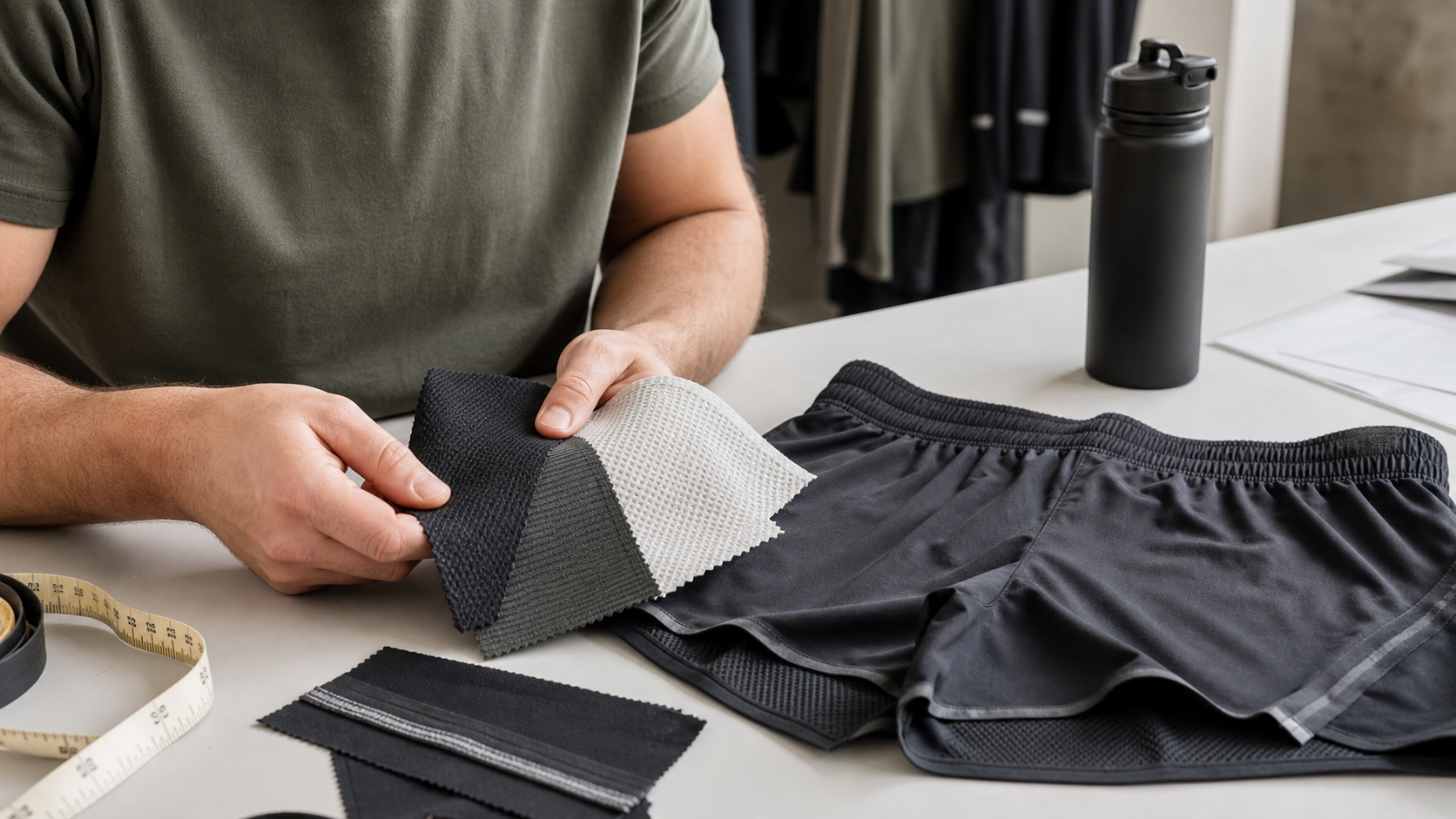
This review image is illustrative and does not identify the pictured fiber content, material code or test outcome.
For a garment review, evaluate more than one moment. Observe fit at first wear, after movement, immediately after doffing, after a defined recovery period and after the stated wash routine. Note waistband return, knee or elbow bagging, seam ripple, surface change and fit perception. The sample should match the proposed size and construction. If the candidate is tested only as a swatch, state that limitation and do not extrapolate to garment comfort or commercial durability.
| Question | Sample or report needed | Record | Do not conclude from it alone |
|---|---|---|---|
| How far does it stretch? | Identified candidate specimen in the intended direction | Method, force or extension, dimensions and conditioning | That it will recover or fit a garment |
| How well does it recover? | Same candidate and current reference under the same procedure | Initial, extended and recovered measurements with time points | That every size or wash condition is approved |
| Does a garment bag after use? | Representative garment with fit and wear observation | Size, duration, movement, recovery time and photos | A full service-life or durability claim |
| Does care change fit? | Sample washed under the intended care instructions | Version, method, cycles, measurements and appearance | Long-term performance beyond the tested procedure |
| Is the product elastane-free? | Supplier documentation and complete BOM review | Exact component and percentage basis | Recyclability, low impact or material availability |
How do garment components change the decision?
Treat each component separately. In leggings, the main body may carry the primary stretch demand while the waistband uses a different construction or elastic. If a pocket bag is added, its extension and seam can affect the pocket opening. A replacement body fabric cannot be approved by inspecting an isolated strip when the waistband, gusset and seams determine the actual fit.
In a sports bra, the front, back, lining, underband and straps can have different roles. A low-stretch outer surface might still rely on elastic in the underband. A high-stretch cup could lack the support or recovery the brand requires. Review each component with the intended wearer and support level; don't assume one elastane-free panel changes the entire garment’s composition or behaviour.
For a two-in-one short, document shell, liner and waistband separately. The shell needs the right drape and coverage during movement. The liner may need secure fit and recovery. The waistband must maintain its position with the actual elastic or material. Pocket integration adds loading. The sample should be reviewed assembled and on body, then compared with the current reference. The YA-03 run-training short set can help buyers identify the layered-short role, but its public image and page do not disclose a verified BOM or elastane-free construction.
For tops and jackets, the body, cuff, collar, pocket, mesh and side panels can behave differently. The garment can include an elastane-free face fabric with elastic trims or thread. A catalogue style helps set silhouette and use context, but any material or pattern change becomes a new sample question. Keep component claims exact.
What do current inPACE styles prove?
Existing inPACE product pages are useful garment references and can show the kind of collection route a buyer wants to discuss. For example, the AW-001 training set and AW-003 zip-neck set are current product directions that can serve as elastane-containing comparison styles only when their product records identify that composition. The published catalogue compositions, when stated, should not be mistaken for fabric codes, mechanical stretch values, recovery data or a guarantee about every size and colour.
A reference garment helps define fit, panel placement, seam type and branding. It does not prove that a replacement candidate exists, that the factory has tested it, or that a price or lead time is available. When the product needs a different fabric, fit, waist construction or garment claim, route it through custom activewear development. Tell the team which parts of the reference are to stay and which should change.
For a broader pre-sampling framework, see the activewear fabric-selection guide. If the project needs comparable wash notes, the activewear wash-sample brief explains how to tie an observation to the correct sample version and care route. These resources support a precise enquiry; actual material supply, technical specification, quotation and schedule require project confirmation.
What should buyers request from a supplier?
Ask for a named candidate and a written scope. The candidate sheet should identify supplier, product code and variant, composition as documented, construction, weight if available, width, colour, stretch direction, care guidance and source date. Ask whether the sample is current and which production route or mill is being proposed. Mark details that are not available as open items. A product name by itself may refer to a family rather than the exact construction.
Ask for test reports only when the report answers a stated question. Check material code, specimen direction, method, conditioning, date, laboratory and result. If a report uses an older or different candidate, ask whether the current sample matches it. Do not accept a result copied from a similar fabric as proof of the candidate at hand. If the supplier offers an internal test, record that it is internal and what procedure was used.
Ask how the development team will compare the candidate with the control. Decide whether the sample is a fabric swatch, a component panel or a finished garment. Identify sizes, fit sessions, wash procedure, branding and review milestones. Set what constitutes revision. A supplier can help make the sample; the brand owns product-positioning and consumer-facing claims.
The fabric and trim review route can be used to frame sourcing questions, while how the development process works explains the general handoff. For a buyer who needs a logo, hangtag, label or packaging on a documented existing style, the private-label service may be relevant. A fabric substitution or new construction is a custom product question, not merely decoration.
How should a brand review a sample?
Use a two-column comment sheet: requirement and observed result. Begin by confirming version, fabric, colour, size and pattern. Then check measurements at rest. Wear the garment and perform the intended movement. Take a second set of measurements or visual notes after recovery. Finally run the agreed care procedure and repeat the same observations. If the team changes size, fit, fabric or wash method between versions, call out the difference so the comparison remains valid.
Keep visual and numeric evidence separate. A close-up can show a seam or pilling observation, but not a recovery rate. A measurement can show a dimension difference under the stated setup, but not whether a product feels supportive to every wearer. A supplier datasheet can explain a material claim, but not whether the finished garment is comfortable. Each evidence type has value within its own boundary.
A successful review means that the sample meets the buyer’s stated requirements for the reviewed version. It does not prove every future production lot or all possible care conditions. Keep the approved physical sample, material source, pattern version, construction notes and claim permissions together. If a later substitute is proposed, compare it to the approved version rather than assuming equivalence based on a similar product name.
What should a sample brief include?
- Target garment, wearer, activity, fit and reference style.
- Exact component being considered for an elastane-free route.
- Candidate supplier, product code, variant and supplied composition record.
- Current reference material and garment as a control.
- Stretch directions, intended movement, fit ease and support requirement.
- Extension and recovery questions with method owner and review interval.
- Size range and sample sizes for on-body approval.
- Seam, lining, elastic, pocket and branding details.
- Intended care instructions and post-wash observations.
- Claim wording under consideration, with the evidence level required.
- Decision owner, acceptance language and revision trigger.
This brief helps a product team choose a low-risk first application and prevents a supplier from interpreting elastane-free as a full garment requirement when the buyer only intended to test one component. The team may decide to retain elastane in the waistband or liner, or it may seek a complete alternate material architecture. Either way, the BOM should reflect the actual decision.
When is an elastane-free trial not yet a useful test?
A material experiment becomes difficult to interpret when the garment brief changes several major variables at once. If the buyer changes the fabric, pattern ease, waistband elastic, size grading and wash instruction in the same sample, a better or worse fit cannot be attributed to the new stretch route. Preserve the current garment as a control, choose one main component to change, and hold the rest of the design as close as practical. When a simultaneous construction change is necessary, state that the sample is a system test rather than a fabric-only comparison.
A trial may also be premature when the source is not identified. A hand-cut swatch with no code, supplier, date or composition can help a designer explain a preferred feel, but it cannot support an order specification or a public content claim. Ask the sourcing partner whether the material can be identified and sampled before investing in pattern or fit changes. If a supplier offers only a family name, request the actual variant and colour intended for development. Keep the sample tag attached and photograph the label in the development record.
Cost and schedule trade-offs should be discussed with the project owner, but they must remain tied to the confirmed brief. An experimental component may require sourcing, testing, pattern adjustments or another review round. Do not assume that a new fiber is available at the same price or delivery timing as the current construction. The buyer can rank fit, material origin, support, care and commercial constraints so the factory knows which question comes first. No comparison table can replace that project-specific decision.
Finally, set a stopping rule. If the candidate misses a must-have recovery or coverage requirement after the agreed sample round, return to the control or revise the product goal. A trial is useful even when it does not pass if it gives a clear, documented reason to stop. The decision should identify the exact candidate and sample version so the team does not mistake an unsuccessful experiment for an approved material route.
Discuss an elastane-free sample route
Send the reference garment, exact component, candidate supplier code, supplied composition, control fabric, movement and recovery requirements, target fit, size range, wash question and claim scope through inPACE’s contact page. If the fabric or garment construction changes, request a custom activewear development review. The project team can confirm the appropriate sample discussion; material availability, price, timing and production conditions depend on the defined scope.
What to review
Questions designers, buyers, and brands should answer
Activewear brand product teams and buyers deciding whether a selected garment component can use an alternate stretch-material route.
Separate mechanical stretch from stretch yarn and polymer behavior, then compare a named candidate with the current reference.
Evaluate shell, liner, waistband and other garment components separately before reviewing the full assembly.
Treat supplier examples as sourcing leads, not as inPACE availability, garment performance or recyclability claims.
Practical next step
Turn the research into a clearer product brief
Share the product reference, component, candidate code, control fabric, fit and recovery requirements, wash question and claim scope.
View the order processProduct directions
Explore relevant activewear products
Use these product pages as practical references for your brief, then confirm materials, fit, customization, and production details through sampling.
AW-001 Training Set Reference
Use the current training set as a fit and product-role reference, then verify the exact comparison composition and sample version.
View product directionAW-003 Zip-Neck Set Reference
Compare this garment direction when describing a body-fit or stretch question; it does not prove an alternate fabric is available.
View product directionCustom Activewear Development
Use the custom route when a new stretch material, pattern or component needs a controlled sample.
View product directionFAQ
Buyer questions
Is elastane-free fabric always stretchable?
No. The phrase indicates the absence of elastane in the specified fabric, not a guaranteed amount of stretch. Construction, yarn and other polymer choices determine movement. Request the exact construction and compare it under a relevant method.
Can mechanical stretch replace elastane in leggings?
Sometimes a particular material and pattern may be developed for a legging use, but the label alone cannot establish fit or recovery. Close-fit garments need a representative sample, comparison with a current control, and a review of extension, bagging, recovery, coverage and care.
Is TPEE the same as elastane?
No. They are different polymer families and material routes. A supplier may use TPEE in a stretch textile, but its behaviour depends on the exact construction and blend. Review the exact product documentation and sample.
Is SINGTEX SCK-4711 an inPACE fabric?
This article cites SINGTEX’s public supplier information as an example of a sourcing direction. It does not confirm that inPACE currently sources, stocks or has tested that exact code. Ask for the current code variant and sample route.
How do I test recovery fairly?
Compare a named candidate with the current reference using the same specimen direction, extension procedure, hold time, recovery interval and conditioning. For a formal result, ask a qualified lab to select a suitable method for the exact textile.
Does elastane-free mean a garment can be recycled?
No. The full garment may include other fibers, elastics, trims, thread, labels, coatings and decoration. A product-level recycling claim needs evidence for the whole construction and an applicable collection and processing pathway.
Can the shell be elastane-free while the liner contains elastane?
Yes, depending on the proposed design. Record shell, liner, waistband and other components separately. Any product description should match the actual BOM and clarify the scope of its composition statement.
Which inPACE product should I use as a comparison?
A buyer may use an identified catalogue garment, such as AW-001, AW-003 or YA-03, to explain the intended fit and product role. Confirm the current composition and construction for the exact sample; the page is a style reference, not a substitute-fabric specification.