
The buying decision
What should a gym wear wholesale supplier help you decide?
The first decision is not the logo. It is whether the products make sense for the people who will wear and buy them. A strength studio may need stable leggings, training tops, and a practical layer. A yoga or Pilates business may give more weight to handfeel, freedom of movement, coverage, and coordinated color. A retailer may need a compact core range that can be explained quickly, merchandised together, and evaluated for repeat sales. Those differences change which references deserve attention and which questions the supplier must answer.
Treat a catalogue as a set of product directions, not proof of permanent inventory. Shortlist the silhouettes that suit the customer, then ask how the product, color, size, branding, and packing choices are reviewed for the enquiry. A business-to-business wholesale route does not mean single-unit retail ordering, live stock, dropshipping, or an automatic delivery schedule. Availability, quantity, artwork, sample needs, and timing remain project-specific.
This route works best when an existing product direction is suitable and the main work is building a coherent branded program around it. That can include a logo or trademark, labels, hangtags, size marks, product bags, stickers, barcodes, and carton presentation. Review the private-label activewear service when those components are central to the brief. If the garment itself must change, stop calling it simple branding and discuss the correct development route.
Decision table
Which questions belong in a wholesale gym wear brief?
Use the following table before requesting products or comparing suppliers. It turns a broad request for “branded gym clothes” into a product-level conversation. On mobile, the table scrolls horizontally so the questions and buyer actions remain readable.
| Decision | What the supplier should review | What the buyer should prepare |
|---|---|---|
| Customer and use | Member uniform, staff kit, studio merchandise, retail basics, or a seasonal capsule | Name the wearer, activity, selling channel, target retail position, and the job each SKU must do. |
| Product starting point | Existing product direction or a garment that needs a new fit, fabric, or construction | Select catalogue references and mark every requested change; do not describe a new garment as simple logo work. |
| Assortment | Core bras, leggings, tops, layers, or coordinated sets | Give every SKU a role and keep the first range narrow enough to explain, sell, and repeat. |
| Colors and sizes | A focused color story and a size curve based on the intended customer | List units by style, color, and size rather than sending one total quantity for the whole order. |
| Branding | Logo or trademark, labels, hangtags, size marks, and packaging | Provide vector artwork where possible, dimensions, placement, color references, and the surfaces being branded. |
| Review sample | A physical reference for product, branding, labels, and presentation | Record what is approved, what needs revision, and which points remain open before bulk preparation. |
| QC and packing | Checks tied to the approved product and warehouse or store receiving needs | Document measurements, workmanship, branding, labels, folding, bagging, ratios, barcodes, and carton marks. |
| Replenishment | Core products that may be reordered without rebuilding the brief | Keep approved references, color and size history, artwork files, packing instructions, and sell-through notes together. |
Send the same information when comparing suppliers. A response based on one color, basic packing, and a single product is not comparable with a program that includes several colors, labels, hangtags, barcodes, size-ratio packing, and multiple receiving locations. Ask each supplier to state the assumptions behind its proposed route rather than comparing one headline number.
Customer and channel
How should studios and retailers define the customer before choosing products?
“People who go to the gym” is too broad to guide an assortment. Write a short customer statement that connects the wearer, the activity, and the buying situation. A member may be buying a studio-branded legging as a community product. An instructor may need a reliable uniform that coordinates across repeated classes. An online shopper may expect a complete outfit and clear product photography. A multi-store retailer may prioritize easy replenishment and presentation consistency.
Then name the practical needs that follow from that statement: coverage, support direction, stretch and recovery, layering, pockets, length, ease, logo visibility, or a specific price position. These are buying inputs, not claims that every catalogue garment already meets every expectation. The supplier needs to review the selected product against its intended use, and the buyer needs to decide which points require a physical sample before approval.
Keep channel requirements separate from garment requirements. Retail-ready barcodes, shelf presentation, folding, size stickers, or store allocation do not change the silhouette, but they change the order record and packing work. A staff uniform may have simpler retail presentation but stronger requirements for repeat color, name or role identification, and distribution by location. Recording both layers avoids a product that looks right but arrives in an unusable receiving format.
Comparable supplier responses
How should buyers evaluate a gym wear wholesale supplier response?
Look for a response that follows the product brief instead of replacing it with broad claims. The supplier should be able to identify the selected product direction, customer use, requested colors and sizes, branding components, packing needs, destination, and unresolved decisions. Useful follow-up questions are specific. They might ask whether a logo sits on a high-stretch area, whether a set is sold as separate top and bottom units, which label file is final, or how store allocations should be packed. Those questions show that the order is being considered as a complete product program.
Separate confirmed facts from conditional points. A catalogue reference may define a silhouette direction, but the response should not present material availability, color, minimums, cost, sample timing, bulk timing, or shipping as universally fixed when those inputs depend on the enquiry. Ask the supplier to mark assumptions and explain what it needs before each one can be confirmed. This makes an early response more useful without asking either side to pretend that all production decisions already exist.
Finally, compare the working method as well as the proposed product. Check whether versioned artwork and comments can be kept together, whether the sample has defined approval points, how production questions will be raised, and which references will be used for QC and packing. A lower-friction order is usually built through clear information control. A vague promise followed by repeated clarification is not necessarily a simpler route, even if the first message appears faster.
Assortment discipline
How can a first gym wear wholesale range stay focused?
A disciplined first range gives every style a job. A core bra or top can support repeat sales; a legging or short can complete the outfit; a layer can add a higher-value option and extend the use beyond a class. A coordinated set can simplify merchandising, but it also creates more size-pairing and stock-balance questions. Choose the roles first, then choose product references. Do not add styles simply because the catalogue contains them.
Color needs the same discipline. Core colors may make replenishment easier to discuss, while one seasonal color can give the range a timely story. Too many colorways spread the order across more combinations and make the size breakdown harder to manage. Instead of asking for “three colors in mixed sizes,” prepare units for every style-color-size cell. That is the level at which production, packing, and receiving questions become clear.
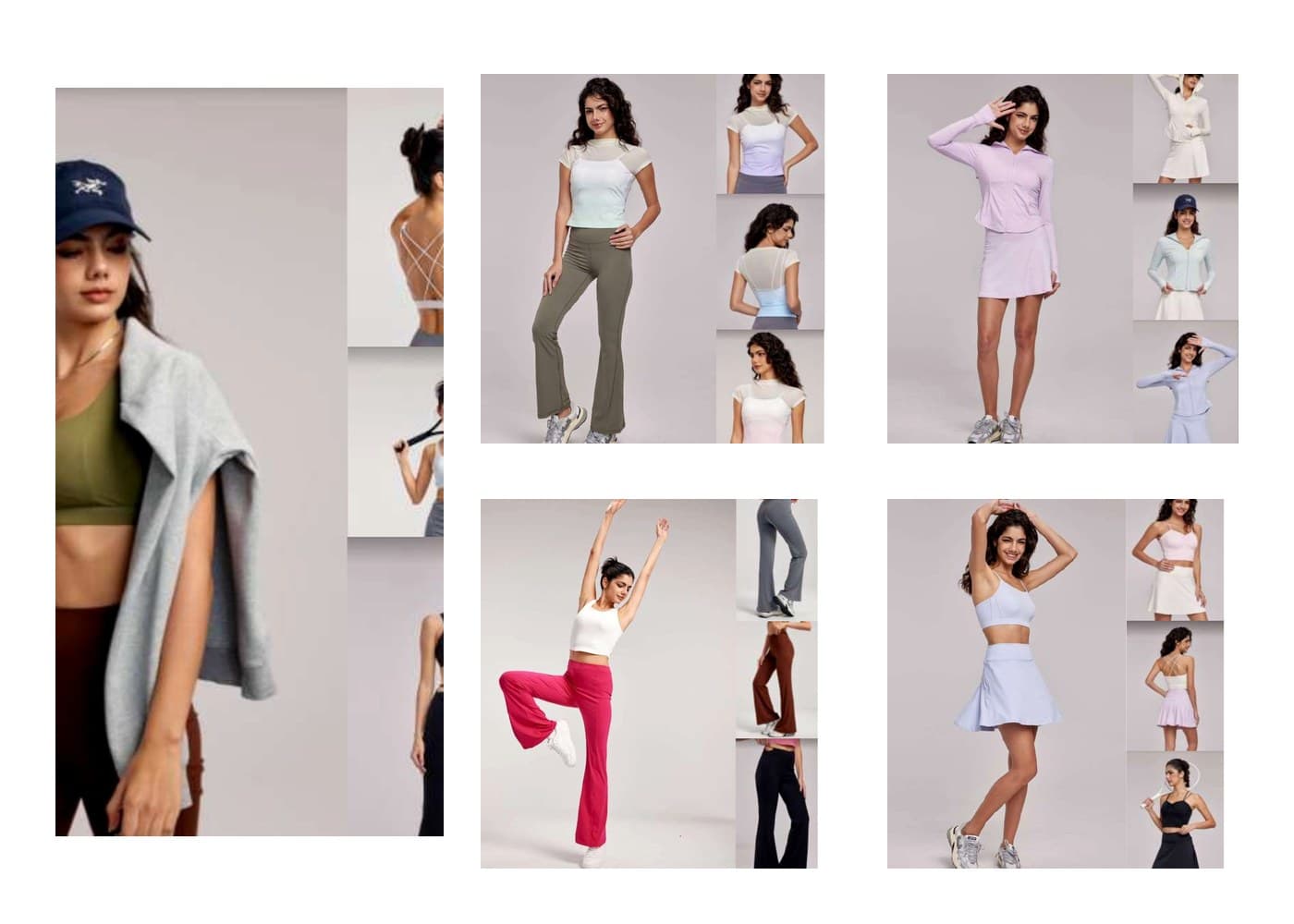
Browse the Activewear Performance Collection to build a shortlist, but keep the final brief tied to the target customer. Catalogue names, displayed colors, and product images are references for discussion. Final material, color, sizing, branding, quantity, availability, and timing should be reviewed on the actual program.
Product starting points
Which gym wear products can anchor a wholesale assortment?
These three starting points illustrate different assortment roles. They are not a claim of live stock or a fixed ordering package. Use them to identify a direction, then confirm the product, material, colors, sizes, branding, quantity, sample, packing, and delivery inputs for your enquiry.

Build the range
Activewear Performance Collection
Use the collection to shortlist silhouettes and decide which products deserve a place in the studio or retail assortment.
Review this product directionLayer and set
Hooded Thumbhole Training Set
A coordinated reference for buyers planning a studio layer, matching set, color direction, branding, and packing presentation.
Review this product directionCore repeat style
Light Support Bra Program
A useful starting point for a compact core-color program in which labels, logo placement, size ratios, and replenishment records matter.
Review this product directionSizes and quantities
What size and color breakdown should a buyer prepare?
Prepare quantities by style, color, and size. One order total cannot show whether a business wants balanced size coverage, heavily weighted core sizes, different ratios by product, or separate allocation for staff and retail. The breakdown also exposes combinations that may be commercially weak. If a statement color receives only a few units across many sizes, the buyer can reconsider the range before asking the supplier to build a plan around it.
Use evidence where it exists. A studio may have member size data from uniforms or preorders; a retailer may have sales history from comparable fits. If no history exists, state that the first order is a learning range and keep assumptions visible. The supplier can review the submitted breakdown, but it cannot know the buyer’s customer mix without inputs. Avoid presenting a generic size curve as a guaranteed commercial answer.
Matching sets need special attention. Customers may wear different top and bottom sizes, so a fixed set ratio can create imbalances. Decide whether products are sold together or separately, how colors coordinate, and how units should be packed. Record this before artwork and packaging are finalized, because a beautifully branded set still fails if the size pairing does not fit the sales channel.
Brand system
Which branding and packing details should be agreed together?
A logo request needs a garment, location, artwork file, target dimensions, colors, and an intended visual effect. The suitable method depends on the product surface and material behavior as well as the artwork. A small mark on a stable area is a different application from a larger graphic across a stretch panel. Ask the supplier to review the actual combination and to identify what a branded sample must show.
Build the rest of the brand system at the same time: main label, care information, size marking, hangtag, barcode or sticker, individual bag, folding method, pack ratio, and carton mark. Each item needs an owner and an approved file or instruction. If the retailer has a warehouse manual, provide the relevant receiving pages early enough for review rather than introducing them after garments are complete.
Read the wholesale activewear with custom logo guide for the adjacent artwork and application decision. It explains why logo method, fabric, placement, sample evidence, labels, and packaging belong in one controlled brief.

Sample evidence
What should a wholesale gym wear sample prove?
Define the sample’s job before it is made or selected. In a light-customization route, the review may need to confirm that the chosen product direction is suitable, the logo is readable and correctly positioned, labels and size marks are usable, and the presentation matches the channel. If the buyer needs to evaluate fit or material behavior, say so. A photograph can help with appearance, but it cannot replace a physical review of movement, handfeel, coverage, dimensions, or packaging.
Consolidate comments. Mark every point as approved, revise, or open, and attach an image or measurement where it reduces ambiguity. A sequence of chat messages such as “move the logo a little” is not a reliable approval record. State the current location, requested new location, dimensions, and visual reference. Use the same discipline for label position, hangtag attachment, folding, and stickers.
Approval should close a defined set of questions; it should not hide unresolved ones. If the color is still under review, the artwork file is not final, or the size breakdown may change, record that openly. The supplier can then explain which later steps depend on those decisions. This protects both sides from treating an early product or logo sample as blanket approval for a complete bulk order.
Route boundary
When should a buyer move from wholesale to custom gym wear development?
Move toward custom development when the requested change affects the garment rather than its brand presentation. A different fit, measurement set, fabric behavior, support level, waistband, strap system, pocket, panel layout, seam construction, or new silhouette requires a product-development discussion. Even a change that sounds small can affect pattern, material, workmanship, sampling, or production planning.
Logo application, labels, hangtags, and packaging on a suitable existing direction are closer to wholesale or light customization. The boundary is useful because it keeps the supplier’s response honest. It avoids a custom request being evaluated as if only artwork were changing, and it avoids a straightforward branding program carrying unnecessary development assumptions.
If your brief includes product changes, review the custom activewear manufacturing route and state what should be retained from the reference, what must change, and what still needs factory guidance. The same customer, channel, quantity, branding, packing, destination, and timing information remains relevant; the sample and approval scope becomes deeper.
Quality and receiving
How should QC and packing follow the approved wholesale brief?
Quality control needs a reference. Ask which approved product, measurement information, artwork, label, packing instruction, and carton detail will be used when the order is checked. The relevant points vary by garment and program, but may include workmanship, measurements, material and trim condition, color identification, logo appearance and placement, labels, size marking, folding, bags, ratios, and carton marks.
Do not expect final inspection to repair unclear product decisions. QC can check against an approved requirement; it cannot invent the intended logo size, decide how a set should be paired, or determine which barcode belongs to a style if the buyer never supplied that record. Build the checkpoints into the brief and sample approval, then ask how questions are raised if production information conflicts.
Packing should lead into the buyer’s real receiving process. Identify whether cartons go to one studio, several stores, a third-party warehouse, or another business location. Provide allocation, ratio, label, barcode, carton-mark, and delivery instructions that are known. The manufacturing and quality overview gives additional context for carrying approved information through production coordination, checking, packing, and export preparation.
Repeat orders
What information makes a gym wear reorder easier to review?
The best time to prepare for a repeat order is during the first one. Keep the final product reference, approved artwork, label and packaging files, color and size breakdown, packing instruction, carton information, and the decisions made during review together. Give the record a version and date. A buyer should be able to explain which product was ordered and how it was presented without reconstructing the program from old messages.
After launch, add commercial evidence: units sold by style, color, and size; stock gaps; customer comments; returns; and requests for another product. That evidence can help the buyer adjust the next breakdown. It does not automatically confirm material, color, price, minimums, or timing for a future order. Ask the supplier to review current inputs again, especially when time has passed or the buyer wants a change.
Separate repetition from development. Reordering an approved direction with the same controlled brand and packing references is different from adding a new fabric, fit, color process, or construction detail. Label changes clearly so the supplier can determine whether the request is a repeat, a light update, or a new custom-development project.
Buyer checklist
Is your gym wear wholesale enquiry ready to send?
Use this checklist as a final gap review. It does not require every detail to be finished. It requires the buyer to state what is known, what is a preference, and what still needs supplier review.
Avoid preventable gaps
Which wholesale ordering mistakes create the most rework?
Choosing too many products
A wide first range spreads attention across more styles, colors, sizes, artwork files, and packing records. Start with products that have a clear customer and assortment role.
Approving through scattered messages
Consolidate product, logo, label, and packing comments. An unclear approval trail makes it harder to know which reference is current and which points remain open.
Treating packing as a late add-on
Barcodes, stickers, folding, ratios, and carton marks connect the product to receiving. Introduce them while the branded sample and order record are still being reviewed.
Supplier context
How does inPACE review a wholesale gym wear enquiry?
inPACE Sports supports B2B activewear discussions using product directions, private-label requirements, sample review, production coordination, QC, packing, and export preparation. The useful starting point is a buyer brief containing the customer and channel, selected products, intended use, units by style, color and size, branding, labels, packing, destination, sample needs, and target arrival window. Product availability, minimums, price, sample route, and timing are reviewed from the actual program rather than promised as fixed catalogue terms.
Wholesale next step
Choose wholesale gym wear products for branding
Share your customer, sales channel, product shortlist, units by style, color and size, logo artwork, label and packaging needs, destination, review-sample requirements, and target arrival window. Mark requested garment changes clearly so the team can distinguish a wholesale/light-customization route from custom development.