
An Italian brand can develop a studio-to-training range more effectively by defining what each garment must do before asking an activewear manufacturer for a price. A useful activewear manufacturer for Italy brief separates existing-style branding from factory-custom development, then documents product roles, movement and fit questions, fabric and seam targets, sample purpose, brand files, packing plan, and Italian-market information owner. That gives each supplier the same decision set rather than a mood board to interpret.
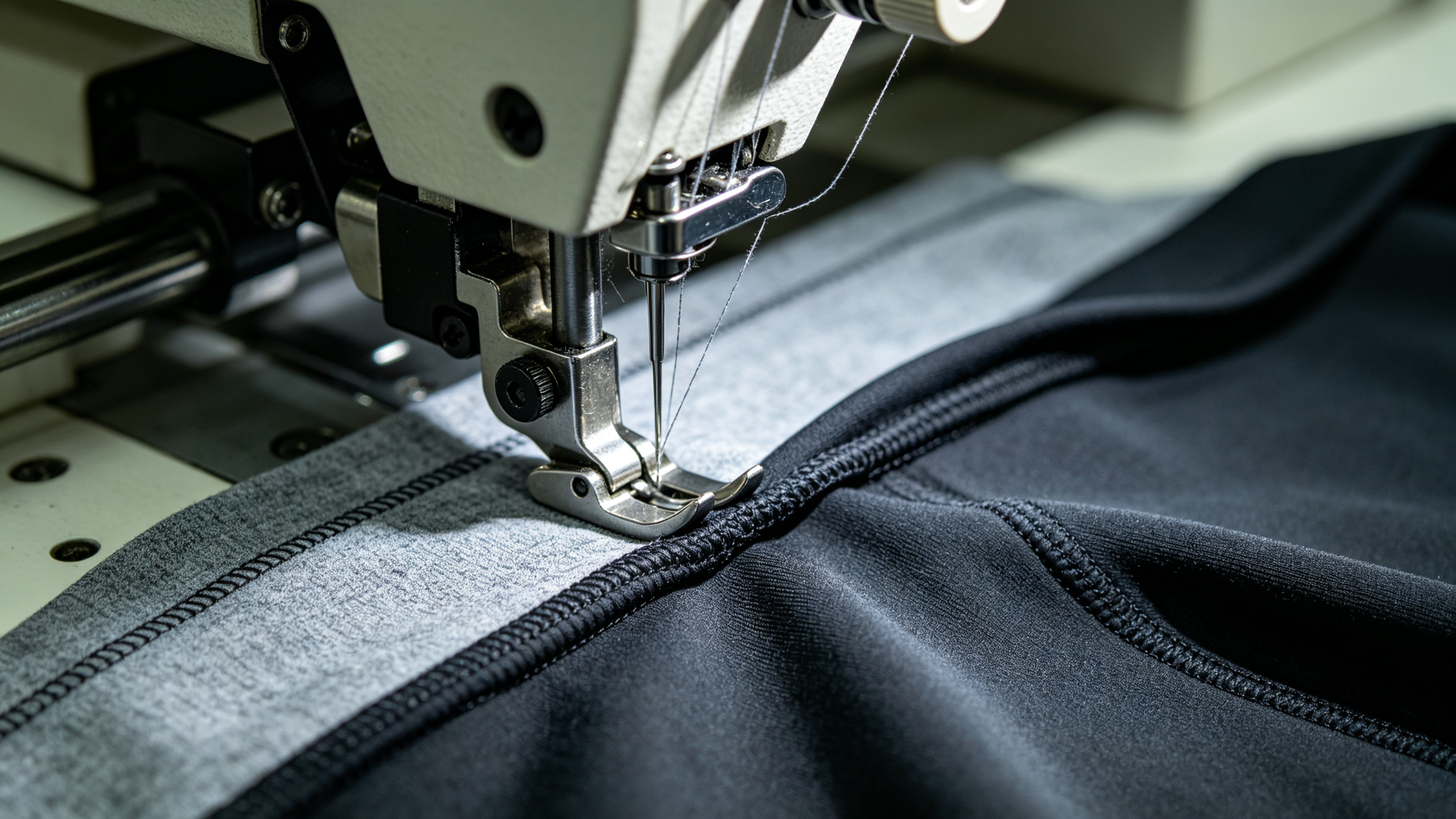
*Factory-context reference: this image illustrates a seam-construction discussion. It does not identify the garment as a particular studio or training product, or prove a selected material, quality level, test result, capacity, or delivery outcome.*
What does a studio-to-training apparel range need to solve?
“Studio-to-training” is not a fabric claim or a ready-made category. It is a practical range-planning question: can the same collection give a customer a credible choice for a low-impact studio session, a commute or warm-up layer, and a more active training context without pretending that one garment performs every job? The answer usually comes from product roles, not from adding more colours or logos.
For example, a first range might need a close-fit legging as its stable base, a bra or fitted top with a defined coverage and support question, a flexible tee or light layer, and a training-oriented top or bottom that introduces a different movement or temperature context. Each role should have one customer use, one visual relationship with the rest of the range, and one question that a sample must answer. That prevents the development team from asking a factory to guess whether “premium studio feel” means fabric hand, compression, surface, construction, finishing, or a brand-story phrase.
The first choice is commercial as well as technical. An existing product direction can be useful when the main work is confirming a suitable reference, logo zone, labels, hangtags, packaging, size-colour assortment, and receiving requirements. A request becomes factory-custom development when it asks for a changed fit, fabric, support direction, coverage, seam map, panel, feature, or construction that needs evidence from a sample. Neither route promises stock, a fixed minimum, price, or calendar. They simply give the buyer and supplier a more truthful starting point.
How should an activewear manufacturer for Italy read the first range brief?
The manufacturer should be able to see which choices the brand has made and which questions remain open. Start with the customer and the product job. A studio-led line might centre on a legging, a low-impact bra or top, a flexible layer, and one coordinated training piece. An ecommerce launch may instead need a defined core set, a size plan, product-page evidence, and a receiving route. The brief does not need to solve every production detail before the first conversation. It should make the reference, preference, and proof point visible.
That distinction protects both sides. A reference image can communicate a silhouette or a colour relationship, but it cannot prove fibre composition, stretch recovery, coverage, construction, grading, lining, logo compatibility, or the buyer's intended consumer wording. A manufacturer can propose a way to investigate a question. The brand still needs to decide which result is acceptable, who approves it, and whether it applies to the selected market and channel. Clear ownership turns a general inquiry into a range-development plan.
Which development route fits each item in the range?
One collection can use more than one route. A brand may retain an established warm-up layer as a branded product direction while developing a new legging because the rise, waistband, fabric hand, coverage, or side-panel construction needs to be different. Treating the collection as a single “private label” request makes both routes less clear.
| Buyer situation | Useful route | First information to share | What remains for approval |
|---|---|---|---|
| An existing silhouette is acceptable and the main work is brand presentation. | Existing-style branding / light customisation. | Product reference, intended channel, logo location, labels, hangtags, packing, size-colour direction, and open questions. | Actual garment, fabric, colour, branding method, quantity direction, and packing components. |
| The garment needs a changed fit, coverage, support direction, fabric, panel, seam, or feature. | Factory-custom development. | Annotated reference, target movements, measurement direction, material questions, change priorities, and sample purpose. | Pattern, material, construction, fit, sample evidence, production files, and market-facing wording. |
| The brand wants to learn from a narrow introduction before widening the range. | Small-batch custom discussion. | Core product roles, learning objective, review method, feedback owners, and a possible next decision. | Scope, materials, quantity, commercial terms, schedule, re-order assumptions, and evidence from the review. |
The Custom Activewear development route is the right conversation when a reference is only the beginning of a product decision. The Private Label service is more relevant when the existing product direction mainly needs controlled brand presentation. In either case, a buyer gains leverage by writing down what is an accepted reference, what is a preference, and what must be validated before production instructions are released.
How should a brand assign the first product roles?
Give each product a job rather than a marketing name alone. A studio legging can be the range anchor if it needs a clear waist height, rise, inseam, gusset, coverage, seam comfort, and recovery review. A bra or fitted top can make neckline, armhole, strap, lining, hem, underband, and support-direction decisions visible. A training tee or light layer can define body length, sleeve movement, opening or collar relationship, layering, and logo placement. The aim is not to claim universal performance. It is to decide what the development team needs to observe.
The Yoga Activewear Catalog can help a team name a product role. A racerback yoga top may be a useful reference for armhole, body length, or logo-zone discussion, while a high-waist yoga bottom can provide common language for the waistband and leg profile. These references are not an instruction to copy a garment or an assertion about future availability, material, colour, fit, price, or quantity. They make a first conversation more specific.
For a training-facing part of the range, a Zip-Neck Sculpt Set can clarify the role of an opening, a closer body relationship, companion bottoms, and a layer transition. The brand should still state which visual features are inspiration, which are product-role cues, and which are actual technical requirements. A screenshot rarely establishes fabric composition, construction, stretch recovery, grading, lining, component performance, or approved claims.
What fabric questions should be visible before a sample is requested?
Fabric conversations work better when they connect a desired feel to a garment area and a movement. Instead of asking for “a premium technical fabric,” state the decision to investigate: a soft hand against the body, a firmer waist, recovery after named movement, coverage in a specified pose, a surface suitable for a logo treatment, a mesh placement question, or a layer that should sit comfortably over a bra or top. Those are sample questions, not proof that every wearer will experience the same result.
For a legging, the brief may name stretch direction, recovery, coverage questions, lining decision, gusset relationship, and seam comfort. For a bra or top, it may name neckline position, underband stability, strap relationship, lining, support direction, armhole comfort, and the interaction between fabric and logo zone. For a layer, it may name handfeel, body length, sleeve movement, collar or zip direction, and how it interacts with the pieces beneath it.
Use the fabrics and trims review to keep composition, surface, stretch, recovery, opacity question, lining, elastic, binding, mesh, zipper, and logo-compatibility discussions in one controlled place. If the selected fabric changes, reopen the related fit, seam, colour, support, care-copy, label, and packaging questions. A silhouette that looks the same in a reference image can behave differently after a material or component change.
How can seam and construction choices bridge studio and training use?
A range that moves between studio and training often places different demands on the same garment area. A seam at an inner leg, side body, armhole, or neckline can change comfort, panel balance, construction sequence, logo placement, and how a product looks when it is layered. The buyer does not need to prescribe an untested construction. The buyer should state the problem to investigate and the evidence expected from a sample.
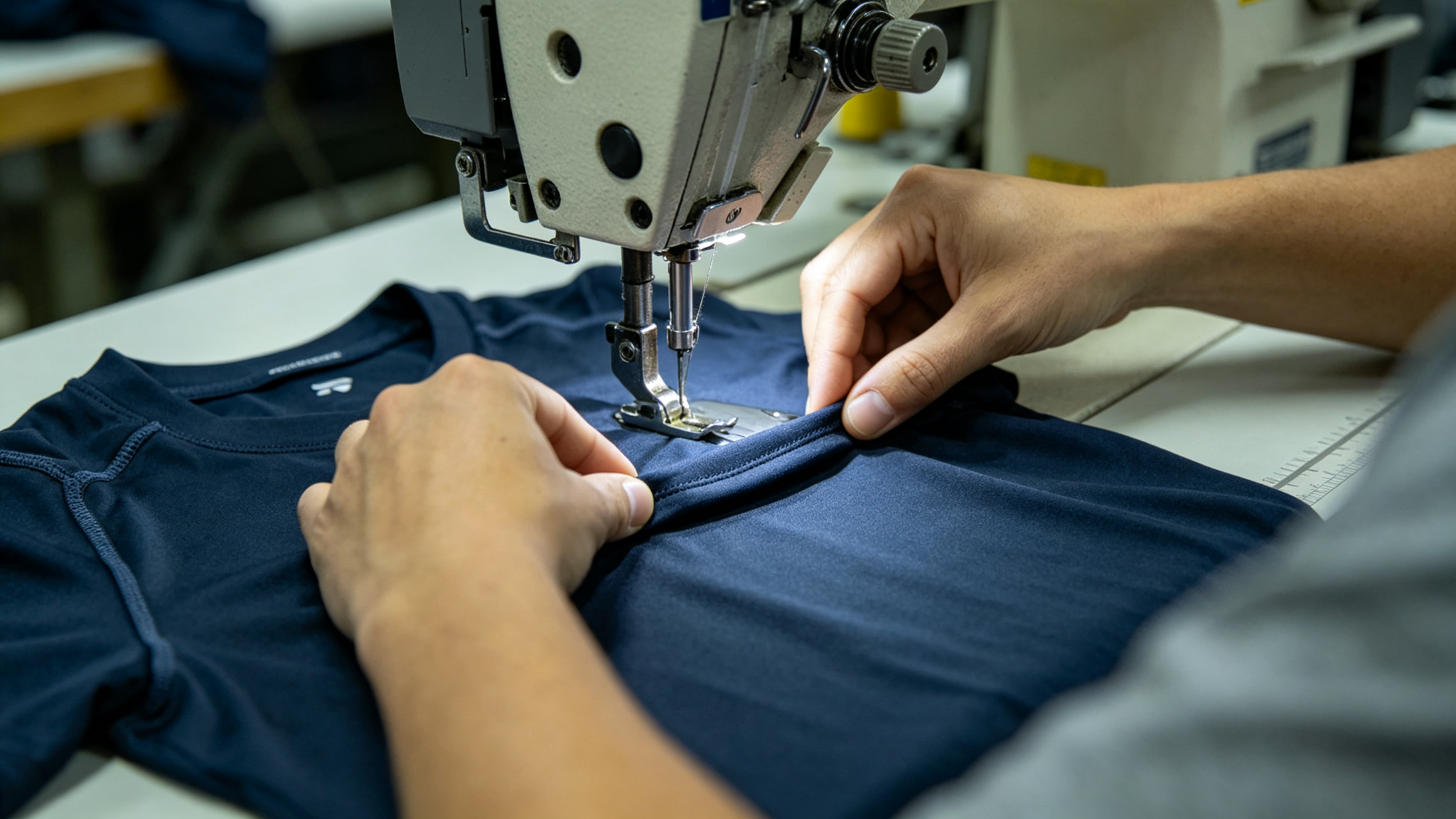
*Factory-context reference: the image supports a discussion of a shoulder-seam review. It does not prove that the pictured garment is a chosen product, or that a specific seam, fabric, production method, or approval applies to an Italian brand programme.*
For example, a team may ask to review whether a shoulder seam sits comfortably beneath a light layer, whether a flat or raised join changes the intended contact area, or whether a panel can accommodate a logo without distorting the garment. For leggings, it may ask to review gusset shape, seam placement, waist construction, and coverage in named movements. The right answer comes from a defined sample and comments from the intended reviewers, not from a claim such as “no-chafe” or “squat-proof” for all customers.
How should a light layer relate to the studio pieces?
A light layer can make a small collection feel coherent, but it should not become a vague “lifestyle” item. Decide whether it is for arriving at a studio, warming up before training, moving between indoor and outdoor spaces, or adding modest coverage over a bra or top. Then record the practical variables: body length, collar or hood choice, opening direction, sleeve movement, pocket question, fabric hand, layer weight, logo zone, and the garment it must sit over.
The Activewear Performance Collection can provide a route for comparing training-layer product roles without assuming a final material or specification. When the layer must change beyond an existing direction, send the change back through the custom brief. When it does not, keep the brand, label, hangtag, and packing decisions attached to the actual reference and not to a generic visual board.
This distinction helps a buyer avoid a common range error: selecting individual “nice” products that have no shared size, colour, material, or layer logic. A small range is more useful when the customer can understand how one top, bra, bottom, and layer work together and the supplier can see which decisions must be consistent across styles.
Who should own Italian-market product information?
This is a sourcing guide, not legal advice. Before label artwork, product pages, packaging, and bulk instructions become final, the brand should name the person responsible for reviewing information that will reach the Italian market. That owner can coordinate the relevant internal and external review of fibre composition, language, product claims, care wording where used, packaging information, and channel-specific obligations. A factory can work from approved product and production files; it should not silently decide what a brand must communicate to a consumer.
Italy's Ministry of Enterprises and Made in Italy explains that textile products are governed by Regulation (EU) No 1007/2011, including rules on textile fibre names and labelling. The Ministry notes that the Regulation addresses fibre composition and that other information may be governed by other EU or Member State rules. The Regulation itself requires fibre-composition labelling or marking to be durable, legible, visible, and accessible, and provides for the official language or languages of the Member State where products are made available to consumers. The brand's responsible reviewer should confirm the applicable Italian-market treatment for the actual product and route.
The practical brief should therefore separate production information from market information. A material specification may tell a factory what has been approved. Fibre wording, a product-page statement, a care claim, or a label layout may still need the market owner's sign-off. This protects the buyer from treating a supplier's material note as a finished consumer communication.
How should packaging enter an Italian launch brief?
Packing joins the finished garment to the warehouse, studio, retailer, ecommerce fulfilment partner, or consumer. Include the receiving point, SKU logic, size-colour plan, barcode question where relevant, fold direction, individual packing direction, carton mark, and the owner of final market-facing files. Keep labels, hangtags, bags, cartons, and online information as separate versioned items so a change is visible rather than hidden inside a single artwork folder.
CONAI states that Italy's Legislative Decree No. 116 of 2020 introduced environmental labelling obligations for packaging, and provides packaging-labelling guidance and tools. The exact obligation, importer or producer role, packaging composition, and sales route must be verified by the responsible brand or its advisers. The manufacturer should receive approved files and instructions, not a request to infer an Italian packaging conclusion from an early range concept.
When a material, sales country, packaging component, or distribution channel changes, reopen the market-information review. That is not unnecessary administration. It tells the team whether an earlier approval still applies to the product actually being supplied.
What should the first sample prove for each role?
Give each sample a named job. A legging sample can answer questions about waist stability, rise, gusset, seam comfort, material hand, coverage in defined movements, and logo-zone position. A bra or top sample can test neckline, underband or hem relationship, strap placement, lining, armhole, and support direction. A layer sample can test sleeve movement, body length, opening, collar, pocket, and how it sits over the studio pieces.
The activewear sample plan is useful for recording a version, material direction, colour reference, base size, reviewers, movements, observations, decisions, and unresolved questions. Keep a sample observation separate from a consumer claim. A sample may reveal a fit or construction change; it does not automatically validate a performance promise, label wording, online product page, packaging symbol, or production quantity.
inPACE can discuss sampling support, including printing, embroidery, and wash effects where the selected fabric, construction, placement, and project scope make them suitable. Usual planning ranges are conditional: samples are commonly discussed at about 5–10 days and production at about 25–50 days after scope and approvals are confirmed. Material availability, components, revision rounds, quantity direction, coordinating-factory schedules, and open decisions change the actual plan.
How should colour and brand presentation remain controlled?
A studio-to-training range may use a shared core colour, a training accent, or a more neutral layer. Treat each as a controlled product decision rather than a colour name copied from a mood board. The activewear colour approval guide can help a team record the source, version, product role, material relationship, logo contrast, and approval owner. That record matters when a colour looks different on a new fabric, a textured panel, a mesh, or a printed surface.
Brand presentation should follow the product route. For existing-style branding, attach approved logo artwork, position, label, hangtag, pack direction, and file versions to the selected reference. For factory-custom development, make those same files part of the sample and production decision chain. Do not let a marketing mock-up become a production instruction without a clear owner, placement, size, material compatibility check, and sample evidence.
How can a buyer compare manufacturer proposals fairly?
Compare assumptions before comparing a headline amount or an indicative schedule. Ask every supplier to state the product route, reference source, material direction, construction questions, branding scope, sample purpose, size-colour plan, packing assumptions, available evidence, and unresolved items. A response based on a different fabric, fewer colours, a different construction, or no packing detail is not a response to the same work.
The activewear manufacturing workflow is useful when a buyer needs to connect approved materials, construction notes, artwork, QC records, and packing instructions. A productive question is: “Which points can you review from this brief, which require a sample, and which Italian-market files remain our responsibility to approve?” The answer should distinguish product development from freight, tax, customs, consumer-law conclusions, and destination-specific obligations.
Which files should be controlled before bulk approval?
Maintain a compact evidence set for every style: product role, versioned reference, measurement direction, material and component notes, colour reference, sample request, artwork, label layout, hangtag, packaging direction, fit comments, receiving instructions, and change log. Give every item a status such as reference only, proposed, approved for sampling, approved for production, or open.
The activewear packaging checklist can structure the pack and receiving discussion. It cannot replace the approved files for the selected product. When a change occurs after sample review, record the prior version, requested change, reason, affected area, requester, approver, and evidence still needed. That enables the factory, merchandiser, and ecommerce team to work from one decision trail rather than comparing contradictory screenshots.
What should be in an Italian studio-to-training inquiry?
Use this checklist before asking an activewear manufacturer to respond:
- Name the Italian sales channel and the product roles in the first range.
- Assign each style to existing-style branding, factory-custom development, or a small-batch learning discussion.
- Classify every reference as fit, material, construction, colour, visual, or branding direction.
- State the wearer, activity, base size, intended size range, and layer relationship.
- List fabric questions for handfeel, stretch, recovery, coverage, lining, surface, and component compatibility.
- Identify seam, panel, neckline, waistband, underband, armhole, or opening questions that the sample should test.
- Supply controlled artwork and name the logo zone, label location, hangtag, packaging, and version status.
- Give every sample a purpose, a reviewer group, and named movements or observations to record.
- Name the owner of fibre information, product-page wording, label approval, packaging review, and Italian-market information.
- State the size-colour and quantity direction without presenting either as a fixed commitment.
- Identify receiving point, carton and barcode questions where relevant, plus the packing owner.
- Ask the manufacturer to record assumptions before any quotation or schedule comparison is used for a decision.
What can inPACE discuss from a well-prepared Italy brief?
inPACE can discuss catalogue-informed product direction, factory-custom development, fabric and fit questions, sampling, branding compatibility, QC and packing records, and coordination across cooperating production factories. That discussion can draw on more than 30 years of garment-production experience in the wider production context without becoming a capacity, certification, price, schedule, or legal claim.
Share the product roles, reference purpose, route for each style, material and fit questions, controlled artwork, sample objective, receiving plan, and the owner of Italian-market information. Send an activewear product brief to inPACE to separate what an existing-style branding programme can confirm from the decisions that need factory-custom development and sample evidence.
Product directions
Explore relevant activewear products
Use these product pages as practical references for your brief, then confirm materials, fit, customization, and production details through sampling.
Yoga Activewear Catalog
Use the catalogue to define studio product roles for an Italian range, while confirming the selected garment, material, fit, colour, branding, quantity, and market-facing information.
View product directionZip-Neck Sculpt Set
Use this training-set reference to discuss a closer body relationship, front opening, companion-bottom role, layer transition, and the sample questions that need evidence.
View product directionCustom Activewear Development
Use factory-custom development when the studio-to-training range needs a changed fit, fabric, coverage, support direction, construction, seam, feature, colour, logo zone, or sample plan.
View product directionFAQ
Buyer questions
Can one Italian activewear range use both private-label and custom development routes?
Yes. A brand can use an existing product direction when logo, labels, hangtags, packaging, and assortment are the central changes, while sending a different style into custom development when its fit, fabric, support, coverage, construction, or feature needs sample evidence. Each style should state its route and its open decisions.
What makes a studio-to-training range different from a generic activewear collection?
It assigns a specific use and sample question to each garment. The range should make the relationship between a studio legging, bra or top, training tee, and light layer visible through fit, material, seam, colour, and layering decisions. It should not assume one garment or fabric works for every activity or wearer.
What should a fabric brief say for studio and training products?
Describe the intended garment area and the observation to review, such as handfeel, stretch direction, recovery, coverage in named movements, lining, surface, seam interaction, or logo compatibility. Confirm the selected material on the relevant sample instead of turning an early fabric preference into a universal performance claim.
Who should approve fibre and market-facing information for Italy?
The brand should assign a responsible owner who can coordinate the appropriate review of fibre information, language, labels, product-page text, packaging, and channel-specific requirements for the actual sales route. A manufacturer can provide agreed production information and work from approved files, but should not substitute for that market review.
How should packaging be handled for an Italian launch?
Keep each product label, hangtag, bag, carton, barcode instruction, and ecommerce information as a separate versioned file. The responsible brand team should verify which Italian packaging and consumer-information requirements apply to its real product and distribution route before approving production instructions.
What should the first sample prove?
Each sample should answer a named product question. A legging can test waist, rise, gusset, seam, material, and coverage observations. A top or bra can test neckline, armhole, lining, straps, hem, and support direction. A layer can test sleeve movement, body length, opening, and how it sits over the range.
When should a brand reopen a decision after sample review?
Reopen it when an input that supported the earlier approval changes. A new fabric, colour, component, logo zone, grade, label statement, packaging item, or market changes the decision context. Record the prior version, requested change, approval owner, and whether a new sample, revised file, or market-information review is needed.