

How should a brand turn activewear print trends into a manufacturable brief?
Printed activewear should begin with a named print role, editable artwork, repeat and scale direction, target garment, coverage boundary, material direction, component notes, and one sample question. Checks, side stripes, typography, tie-dye, geometric graphics, and gradients are design directions, not finished specifications. A printed activewear manufacturer needs the information that makes the intended result reviewable on the actual product.
The first decision is not simply whether a print looks strong on a moodboard. It is whether the print belongs on a core legging, a bra, a bike short, a training layer, a full coordinated set, or a small controlled detail. That choice changes the artwork area, the garment pieces that must align, the number of components involved, the material surface, and what the first sample needs to prove. A full all-over check needs a different review from a narrow side stripe or a small chest graphic.
This guide helps brand teams move from a visual direction to a buyer-ready print brief. It does not promise that a reference image, digital colour, product photo, print method, material, price, MOQ, or production condition is already approved. Those points need project-specific confirmation. The related activewear print placement guide goes deeper on recording the exact artwork position and construction context after the overall print role is clear.
Which print roles work in a B2B activewear collection?
A print should have a job in the range. It can carry the hero visual, identify a limited capsule, link a top and bottom, make a small branded accent visible, or support a coordinated presentation item. Naming that role protects a collection from applying the same artwork everywhere only because it looked effective in one flat layout.
| Print direction | Useful collection role | What the buyer must decide | First proof to request |
|---|---|---|---|
| Checks or houndstooth | Hero bra-and-legging set or a controlled panel | Repeat size, crop point, alignment at seams, and companion solid | Garment-scale print strike-off or sample showing key seams and waistband |
| Side stripe | Directional legging, short, jacket, or sleeve detail | Printed stripe, cut panel, tape, elastic, or another construction route | Stripe width, placement, alignment, stretch behaviour, and component relationship |
| Typography | Small identity signal or a limited graphic capsule | Exact artwork, readable scale, background, position, and ownership of the final file | Artwork proof on the intended fabric and garment area |
| Tie-dye or washed graphic | Seasonal visual field on selected styles | Colour range, coverage, variation boundary, and what should remain controlled | Relevant strike-off or sample with the selected material and colour direction |
| Geometric or abstract graphic | Product-family connection across top, bottom, and layer | Panel map, repeat or placement, contrast areas, and product allocation | Sample evidence showing the graphic beside seams, binding, logo, and components |
| Gradient | Controlled visual transition on a body, panel, or insert | Start and end areas, scale, colour transition, and affected pattern pieces | Full garment review under the agreed material and construction conditions |
The table is a planning tool, not a list of universal technical rules. One direction can be more than one thing: a stripe may be printed on one style and become a separate tape or panel on another. The brief should say which relationship is intended and which alternative would change the product scope.
Why do checks, side stripes, type, tie-dye, geometry, and gradients need different briefs?
Checks and other repeating graphics create an alignment question. A buyer should identify the repeat, intended scale, visible crop, garment pieces, and where a mismatch is acceptable or not. A print that reads evenly on a flat panel can shift at a curved leg, waistband, gusset, seam, pocket, or bra strap. The sample must show the product context, not only a flat swatch.
Side stripes create a route question as well as a visual question. The look may come from a printed line, contrast cut panel, applied tape, elastic, embroidery-look detail, or another construction decision. These routes can change bulk material, seam sequence, stretch, edge finish, and the evidence needed from a first sample. Calling every version a “side stripe” is not enough for a supplier to understand the intended product.
Typography needs an approved final artwork file and a defined relationship with the garment surface. A mark that is legible on a flat dark tee may behave differently on a rib, a high-stretch legging, a mesh panel, a gathered bra area, or a light layer. Tie-dye and gradients need a boundary between intended variation and a revision that the buyer would reject. Geometric graphics need a clear panel map when a line, shape, or contrast block crosses an assembly seam.
Treat these as buyer questions, not as reasons to make broad claims about a particular technique. The right route depends on the garment, material, artwork, coverage, desired handfeel, components, quantity context, and the evidence needed for approval.
What should an activewear print artwork package include?
Start with the editable artwork and the reference that explains its intended use. State the current file version, colour direction, scale, repeat if relevant, target garment, planned coverage, and which product parts carry the graphic. If the artwork is still exploratory, label it as such. A factory should not have to infer whether a social image, screen capture, flat mock-up, or retail photograph is the final instruction.
Separate the visual reference from the production decision. A reference can show the desired energy of a gradient, tie-dye direction, or stripe proportion. It does not automatically approve the exact colours, print method, material, pattern pieces, or logo relationship. Pair the reference with a practical note: which elements must be carried into the sample, what may change, and the single result the buyer wants to review.
Useful artwork-package fields include the following:
- Current editable artwork or clearly labelled working file, plus its version and owner.
- Print family: check, stripe, typography, tie-dye, geometric, gradient, or another defined direction.
- Target products, affected pattern pieces, intended coverage, and any companion solid products.
- Repeat, scale, orientation, placement, colour direction, and the relevant physical or approved references.
- Body fabric direction, lining, mesh, elastic, binding, zipper, label, and logo context.
- The first sample question, reviewer, approval owner, and the action required if the evidence does not match the intended result.
- Required garment views, a physical or agreed colour reference, and the lighting or comparison context for the review.
- A record of which visual relationships are approved for the current style and which still need a revised proof or sample.
- The handoff point at which artwork, garment, component, label, packing, and bulk comments are assembled together.
This preparation makes a quote or sample conversation more useful because it separates known inputs from open questions. It also avoids treating the words “custom print” as a complete technical instruction.
How do repeat, scale, and pattern pieces change a printed garment?
Repeat and scale should be reviewed at garment size, not only on a digital artboard. The buyer should indicate whether a check, houndstooth, geometric line, or type treatment needs to meet at a specific seam; whether the centre front, side seam, waistband, gusset, or pocket is a visual priority; and where normal construction movement may create a different crop. A clear boundary helps the supplier assess the sample without claiming that every visual relationship is already feasible or approved.
The product family matters. A close-fit bra may make neckline, underband, strap, and side-seam crops visible. A legging makes waistband, side panel, inseam, and lower-leg relationships more prominent. A bike short changes the crop at the hem and thigh. A training top or jacket introduces zipper, sleeve, pocket, cuff, and layer relationships. One graphic can appear across all of these items, but each item needs its own product role and sample evidence.
Avoid “make it like the reference” as the only instruction. A better note identifies the largest intended visual area, the areas where a precise relationship is required, the areas where a controlled variation is acceptable, and the person who decides the next action. This turns a trend observation into a manufacturing discussion.
How do fabric, coverage, and components affect printed activewear?
The same visual can read differently on a changed fabric surface, stretch condition, garment size, lighting environment, lining arrangement, or adjacent component. A print brief should therefore connect the artwork to the intended body material and the components that frame it. It should not name a fibre or print method as a universal solution for all activewear projects.
| Review point | Why it matters to the print | Buyer evidence to prepare |
|---|---|---|
| Body material and surface | Stretch, density, texture, sheen, and coverage can change apparent scale and colour | Material direction, use context, physical reference, and the features the sample must demonstrate |
| Print coverage | A full body, panel, stripe, or small graphic carries different risk and review priorities | Marked coverage map, product allocation, and where the print must start and stop |
| Seams and panels | Assembly can shift a repeat, break a line, or change how a graphic is read | Pattern-piece context, visual priorities, and acceptable versus unacceptable changes |
| Lining, mesh, binding, elastic, and zippers | Nearby components can frame, interrupt, conceal, or contrast the print | Component direction, colour relationship, location, and intended level of match |
| Logo, labels, and packing | A brand mark or presentation item can compete with the graphic if not assigned a role | Final artwork ownership, placement, background, label copy, and packing question |
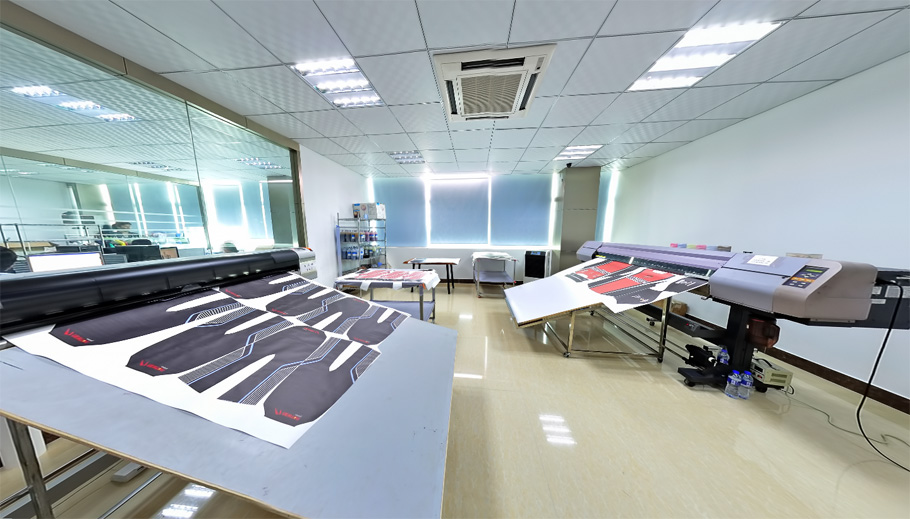
The image above shows why artwork, printed panels, thread, and components benefit from one review conversation. It does not establish a fixed print method, colour result, product availability, or production condition for every project. The fabrics and trims resource can help a buyer organise the material and component questions before a print sample is requested.
How can a brand use printed styles without making every SKU a statement piece?
Give the collection a visual hierarchy. A hero printed set may carry the full check, graphic, or gradient. A supporting legging or bike short can use a smaller panel, stripe, or controlled motif. A companion top or layer may remain solid so the print has room to read. Labels, hangtags, bag inserts, and digital presentation can repeat a colour or element without implying that they are garment approvals.
The Jogging & Printed Activewear Catalog is useful for choosing which silhouette should carry the print conversation. The Houndstooth Statement Set can help a buyer name a coordinated bra-and-legging role, repeat scale, visual coverage, and the sample evidence needed around waistband and seam relationships. It is a product reference, not proof that a pictured artwork, colour, material, or configuration is available for another project.
The Side-Stripe Embroidered Legging Set is useful when the key question is whether a directional detail should be printed, panelled, taped, elasticated, or developed through another controlled construction route. The buyer should state the intended effect and what needs to be seen in the sample before treating any option as approved.
When does a printed project fit private label, and when does it need factory custom development?
A catalogue-informed private-label conversation may suit a selected silhouette that mainly needs a confirmed logo, label, hangtag, packing, and presentation package, with a limited approved graphic or print decision. Actual garment, artwork, material, print route, colour, availability, quantity, and commercial conditions require project-specific confirmation. The private-label activewear route can help a buyer organise the presentation side of that discussion.
Factory-custom development is more appropriate when the brief changes the fit, pattern, panel map, fabric, lining, construction, print coverage, repeat, artwork relationship, stripe route, or controlled sample plan. A graphic that crosses a new panel, a changed waistband structure, a new mesh arrangement, or a new full-coverage print is not merely a presentation choice. It is a physical product-development question. The custom activewear development route and activewear manufacturer service provide the appropriate starting points for this deeper scope.
State the boundary plainly. Name the existing reference, the elements that are still only visual direction, the changes required for the desired product, and the first evidence needed. This helps both sides avoid treating a catalogue image as a replacement for a proper print brief.
What should the first printed-activewear sample prove?
The first sample should answer a written question, such as whether the check scale works across the intended waistband and leg, whether a gradient has the planned visual transition on the selected material, whether a stripe remains aligned through construction, whether the type treatment is readable at product scale, or whether the proposed logo competes with the print. One sample cannot prove every future colourway, product, component, and bulk condition.
inPACE can coordinate sampling support that may include printing, embroidery, wash effects, and other project-appropriate steps. As a usual planning guide, samples often take 5–10 days and production often takes 25–50 days after scope and approvals are confirmed. Actual timing depends on style complexity, material availability, artwork and colour development, decoration, labels, packing, quantities, revisions, and production scheduling, so it must be confirmed for the project.
After a sample review, record the current artwork version, material and component context, visible observations, reviewer, decision owner, required revision, and next action. The sample-to-bulk production guide explains how a confirmed record can move into bulk preparation without implying that a previous photo automatically approves a different material, colour, or product version.
What should buyers check before approving printed activewear for bulk?
Review the print in the actual product context that matters to the range. Place the garment beside its companion style, material direction, lining, mesh, elastic, binding, zipper, logo, label, and packing proof. Check the visible areas at the relevant scale. Then record whether the approved result applies to that specific style and version or whether another product needs a separate decision.
Keep the garment and presentation decisions connected but distinct. A branded hangtag or bag insert does not approve a print on a high-stretch legging. A digital graphic file does not answer a seam, coverage, or material question. The activewear color approval guide can help teams record colour relationships across body fabric, components, logo, labels, and samples; the manufacturing workflow helps place the resulting decisions in the wider sequence from development through production and packing.
How should a team hand off approved print decisions from sample to bulk?
Before a printed activewear style moves forward, gather the current version of every input that affected the sample decision. This normally includes the artwork file and its owner, the target style or styles, the intended pattern pieces and coverage, the relevant physical or agreed colour reference, material direction, lining and component notes, logo artwork, labels, packing, reviewer comments, and the current decision status. The aim is not to create paperwork for its own sake. It is to ensure that a factory, buyer, designer, merchandiser, and quality reviewer are looking at the same controlled instruction.
Name what has been approved and what has not. For example, a buyer may approve the scale of a geometric panel on one legging while leaving the matching bra strap crop open. A stripe may be approved as a printed line but not as an applied tape. A type treatment may be approved on a dark training top while a light-colour version still requires another contrast review. An all-over check may be approved for a specific product and material yet require a separate decision for another pattern, size range, or lining arrangement. Recording the boundary avoids moving a conclusion beyond the evidence that supported it.
The handoff should also distinguish artwork from construction. The same visual direction can need different files, placements, component choices, or print routes across a bra, legging, bike short, tee, and layer. It is useful to state which garment parts contain the artwork, which parts remain solid, which components create deliberate contrast, and whether seams or joins are visual priorities. If a product change requires a new panel, fit, material, or construction relationship, record it as a new factory-custom question rather than hiding it in a late print comment.
Finally, connect the visual record to the operational sequence. Confirm the sample version, reviewer, open point, revision owner, next evidence, label and packing direction, size and quantity context, and delivery question that still requires project confirmation. This gives both sides a traceable path from trend direction to product decision, sample review, and bulk preparation without representing a screen mock-up as a blanket production approval.
How do sample charges and refunds work for a printed style?
As a general guideline, the sample charge is 1.5–3 times the corresponding bulk unit quotation, depending on the product and development scope. For one style, the stated refund schedule is 10% at 100 units, 30% at 300 units, 50% at 500 units, and 100% at 1,000 units. Confirm the quotation, artwork scope, sample plan, and applicable order conditions in writing because material, print development, decoration, components, revisions, and construction can change what is included.
Ready to develop a printed activewear range?
Send inPACE Sports the editable artwork, print family, colours, intended scale and coverage, target products, material and component direction, logo and packing requirements, size and quantity context, and the exact question the first sample should answer. Send a printed-activewear brief to discuss whether a catalogue-informed private-label route or factory-custom development fits the project.
Product directions
Explore relevant activewear products
Use these product pages as practical references for your brief, then confirm materials, fit, customization, and production details through sampling.
Jogging & Printed Activewear Catalog
Use the catalog to identify whether the print belongs on a bra, legging, bike short, top, layer, or coordinated set before artwork, material, and sample evidence are confirmed.
View product directionHoundstooth Statement Set
Use this print-capsule reference to discuss repeat scale, body-to-panel coverage, companion pieces, logo zones, and the print proof required for the first sample.
View product directionSide-Stripe Embroidered Legging Set
Use this set reference to distinguish printed, cut-and-sewn, elastic, tape, and embroidery-look stripe routes before their alignment and sample-review requirements are agreed.
View product directionFAQ
Buyer questions
What should a printed activewear brief include?
It should identify the current editable artwork or working reference, print family, target products, repeat or scale, intended coverage, material and component direction, logo and packing context, the first sample question, reviewer, and next action. A visual reference alone does not approve the finished product.
Can a houndstooth or check print work on activewear?
A check or houndstooth direction can be assigned to a coordinated set, a selected panel, or another defined product role. The buyer should identify repeat size, crop, key seams, waistband relationship, material direction, and the sample evidence needed instead of assuming a flat visual will behave identically on every garment.
Should a side stripe be printed or constructed as a separate detail?
A side stripe can be discussed as a printed line, contrast panel, tape, elastic, embroidery-look detail, or another construction route. The correct choice depends on the garment, material, desired appearance, seam sequence, stretch, components, and sample evidence, so it should be confirmed for the project.
When does printed activewear need factory-custom development?
Use factory-custom development when artwork coverage, pattern pieces, panel layout, fit, fabric, lining, construction, stripe route, logo relationship, or the required sample plan changes the physical product. Share the reference, current artwork, material direction, component notes, sizes, quantity context, and first sample question.
Can a catalogue style be used for a private-label print project?
A catalogue-informed private-label discussion can suit a selected silhouette that mainly needs confirmed branding, labels, hangtags, packing, and a limited approved graphic or print decision. Actual product, artwork, material, print route, colour, availability, quantity, and commercial terms require project-specific confirmation.
How long do printed activewear samples and production take?
As a usual planning guide, samples often take 5–10 days and production often takes 25–50 days after scope and approvals are confirmed. Timing depends on style complexity, material availability, artwork and colour development, decoration, labels, packing, quantities, revisions, and production scheduling, so it must be confirmed for the project.
How are sample charges and refunds handled for one printed style?
The general guideline is a sample charge of 1.5–3 times the corresponding bulk unit quotation, depending on the product and development scope. For one style, the stated refund schedule is 10% at 100 units, 30% at 300 units, 50% at 500 units, and 100% at 1,000 units. Confirm the quotation and applicable order conditions in writing.