
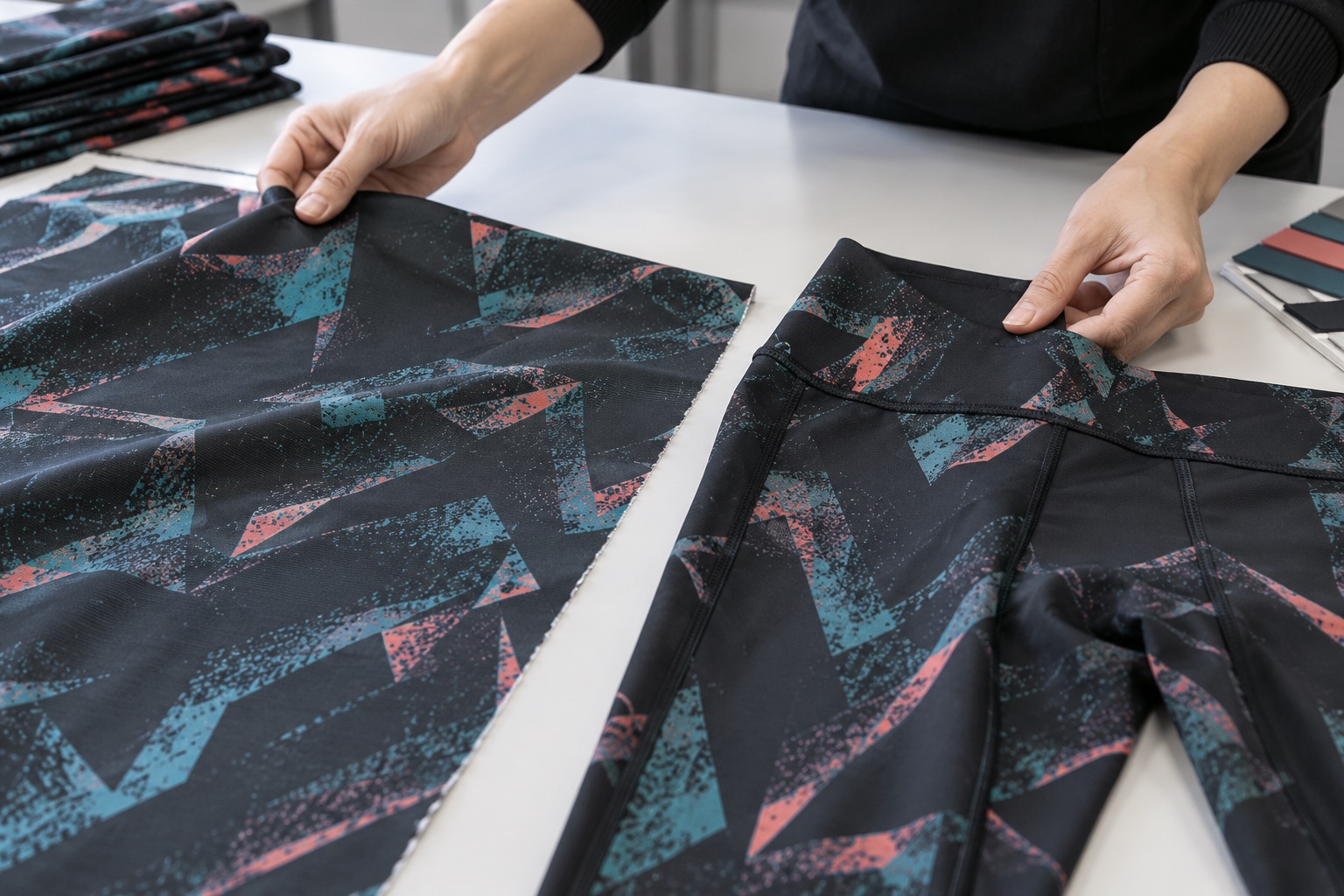
Direct answer: printed activewear quality control starts with the right reference
Printed activewear quality control is a comparison process: identify the approved artwork, garment, material, colourway, print location and sample stage, then record what was observed on the item being reviewed. A useful inspection note names the location and evidence, assigns an owner and disposition, and states whether another sample or agreed test is needed. A defect list alone cannot establish a universal pass result.
This guide focuses on print-specific observations such as colour appearance, registration, coverage, surface marks, edge lift, stretch-zone appearance and artwork-to-panel position. General garment measurements, seams, labels, packing and workmanship remain part of the broader activewear QC checkpoint guide. Those checks can sit on the same inspection plan, but the buyer should keep their references, methods and decisions visible as separate questions.
For a factory-custom or printed-garment project, the buyer and supplier need to agree which item is being reviewed and what decision it can support. A visual review may identify a question for discussion. It does not automatically establish wash durability, colourfastness, adhesion, stretch recovery, compliance or suitability for every size and colourway. Those conclusions require a defined scope and appropriate evidence.
Why does print inspection need its own approval reference?
A garment can meet its measurement and construction brief while the print still raises a buyer question. The reverse can also happen: a graphic may look close to an approved image while the garment’s placement, panel coverage or seam relationship differs from the agreed reference. A single label such as “QC passed” can hide which of these decisions were actually reviewed.
Before an inspection, identify the comparison item. It may be a colour-approved strike-off, a printed fabric swatch, a decorated panel, an assembled sample, a signed visual reference, or a controlled production sample. These objects answer different questions. A strike-off might support a limited discussion of a print impression on a named base; it does not necessarily show how a finished garment’s seams, stretch zones, fit or size grading affect the artwork.
The record should connect the approval to the version that the team can retrieve later. Include the artwork filename or revision, product/style reference, fabric or garment code if available, colourway, print route as described by the supplier, placement or panel map, sample stage, review date and decision owner. If the information is not known, mark it as open. Guessing creates a weak reference that can be repeated through sampling and bulk production.
Record logos, repeats, contrast panels and transfers separately when they use different references or locations.
Use the activewear sample feedback guide to distinguish a strike-off, decoration sample, garment sample, pre-production approval and first bulk reference. The point is to name the purpose of each approval. A later reviewer can then compare like with like rather than treating one attractive sample as evidence for every production question.
Which visual observations should buyers describe by process and location?
A useful observation is specific enough for another person to find the same area and understand the concern. “Print looks bad” offers no location, comparison or next question. “On the front left thigh panel, the blue motif appears closer to the seam than on the approved size-medium sample; please confirm whether the panel map and artwork revision match” identifies a review point without declaring a cause or a result.
For a screen or repeat print, a buyer may need to discuss apparent registration between colours, repeat continuity, edge relationships, banding, pinholes, coverage or a visible mark. For a transfer or film-applied decoration, the relevant visual area could include edge position, surface appearance, wrinkles or visible lifting. For sublimation, the buyer might discuss the artwork’s position across panels, the relationship to the garment ground or an unexpected visible boundary. The names suppliers use can vary, so first ask which proposed route and stage produced the item under review.
Treat these as observation prompts, not a universal defect list. Describe the visible area and its importance to the buyer; do not infer a technical cause from a photo alone.
Use a neutral sequence: identify the location, describe what is visible, point to the approved reference, note the affected quantity or sample count if it is known, and ask what evidence or disposition is required. If the team has not agreed a tolerance, do not invent one during inspection. Ask the responsible quality and product owners to define the acceptance method for the actual programme.
| Observation area | What the reviewer can describe | Reference to retrieve | Question before disposition |
|---|---|---|---|
| Colour appearance | Which area or colour looks different under the stated viewing setup | Approved visual reference and named colourway | Is this a visual comparison request, or does the team need a defined measurement method? |
| Registration or edge | Which colours, edges or repeat features appear offset or interrupted | Artwork revision, separation reference and printed sample stage | Is the visible difference inside an agreed project tolerance? |
| Coverage and surface | Location, size and character of an apparent gap, mark or uneven area | Approved artwork, substrate and sample purpose | Should the item be re-sampled, tested or simply recorded for review? |
| Stretch-zone appearance | Where the visual changes when a named garment area is placed in the agreed review position | Garment size, construction reference and review condition | Is a visual review sufficient, or is an agreed stretch method required? |
| Panel and seam relationship | Which motif, logo or border approaches or crosses a seam or edge | Panel map, placement map and size reference | Does the approved design require alignment, avoidance or a defined crop? |
How should a print observation become a buyer decision?
Start with an evidence packet that ties the observation to the actual sample. Give every review a simple identifier and list the style, colourway, size, sample stage, date, artwork version, material reference and item count or sample quantity when available. Add a photo that shows the whole garment or panel first, then a closer view of the location. Keep the image orientation clear and avoid cropping away the seam, edge, label or other landmark needed to find the area.
Tie each observation to the dated reference and state what it approved. If the sample covered fabric direction only, leave garment, size and colourway approval open.
A disposition should answer what happens next, who owns it and what evidence closes the item. Possible categories can include accept for the stated scope, correct and submit a new sample, hold for technical review, request an agreed test, or document a buyer-authorised concession. The categories are examples for a project record; the business must decide which are appropriate and who can use them. A supplier should not infer that silence, a delivered photo or a sample dispatch equals approval.
Separate an observation from a suspected cause. A visible mark might arise from artwork, surface preparation, transfer application, handling, garment construction or image conditions. The buyer can report the symptom and ask the supplier to investigate. Assigning cause before review can send corrective work in the wrong direction and obscure the evidence needed to prevent recurrence.
If the concern needs a test, define the question first. For example, a team may need an agreed procedure to review a wash-related question, stretch appearance, adhesion or colour change. The selected method, sample identity, conditioning, number of specimens, acceptance basis and responsible laboratory or evaluator must be decided for that project. Do not copy a test method or pass value from an unrelated product and present it as a general inPACE result.
Design the next sample around the open decision: show the named fabric for a material question, the seam for an alignment question, or a full garment for placement review.
What changes when the same print is reviewed on fabric, panels and a garment?
The print reference moves through stages. A digital artwork file shows creative intent. A strike-off or printed swatch adds a substrate and a physical process. A cut panel adds a pattern piece and orientation. An assembled garment adds seams, shaping, size, stretch and construction. Each stage adds information, and each can create new questions. The record should never describe an earlier-stage approval as a full-garment sign-off unless the buyer deliberately agreed that scope.
For an all-over visual, preserve the repeat tile, intended scale, direction and the panel map that shows how the artwork meets cut pieces. A pattern change or size grading can shift the graphic relative to a seam, gusset, waistband or leg opening. Ask which sizes and colourways have been physically reviewed. If only one size has a sample, identify how the remaining size range will be assessed and which points can change through grading.
For a local logo, identify the garment location, dimensions, orientation, distance from a seam or edge, artwork version and application route if known. A proof on a flat image may not show how the garment curves or stretches when worn. If the buyer’s decision depends on the final placement, request a view on the relevant assembled garment and record whether the sample represents the intended size and fit.
The sample plan should name the question, reviewer, source material and decision point. The colour approval guide covers how to identify the colour reference and sample scope. A print sample can raise a colour question without approving every colourway.
| Stage | What it can help the team review | What remains outside that decision unless added |
|---|---|---|
| Artwork file or screen proof | Revision, crop, intended scale, placement idea and composition | Physical colour, fabric surface, seams, wear, wash or garment fit |
| Strike-off or fabric swatch | A print appearance on the named sample base and stated process stage | Assembled garment construction, every size, all colourways and unagreed performance tests |
| Cut panel | Orientation, crop, panel relationship and selected edge or motif questions | Final seam behaviour or placement on every size without garment context |
| Assembled sample | Garment location, seams, shape, selected fit and surface questions | Unreviewed sizes, lots, colours and test claims |
| Controlled bulk reference | The identified production reference used for the agreed bulk comparison | Any altered artwork, material, process or acceptance scope |
How can teams review stretch and seams without overstating a result?
Activewear is designed to move, so a print review can involve a garment area that changes shape during wear. The first task is to define the review position: flat on a table, worn on a fit model, placed on a form, or extended in another agreed way. Different positions can show different views. A casual hand pull is not a controlled test because force, direction, extension, dwell time, recovery period and evaluation method may vary.
A visual review can still be useful. It can help the buyer and supplier notice whether a motif becomes harder to read, whether a seam interrupts an intended line, or whether the print zone appears different in the selected position. Describe exactly what was observed and under what condition. If the commercial decision depends on measured stretch, recovery, adhesion or durability, pause and agree a suitable method and interpretation before making a pass/fail statement.
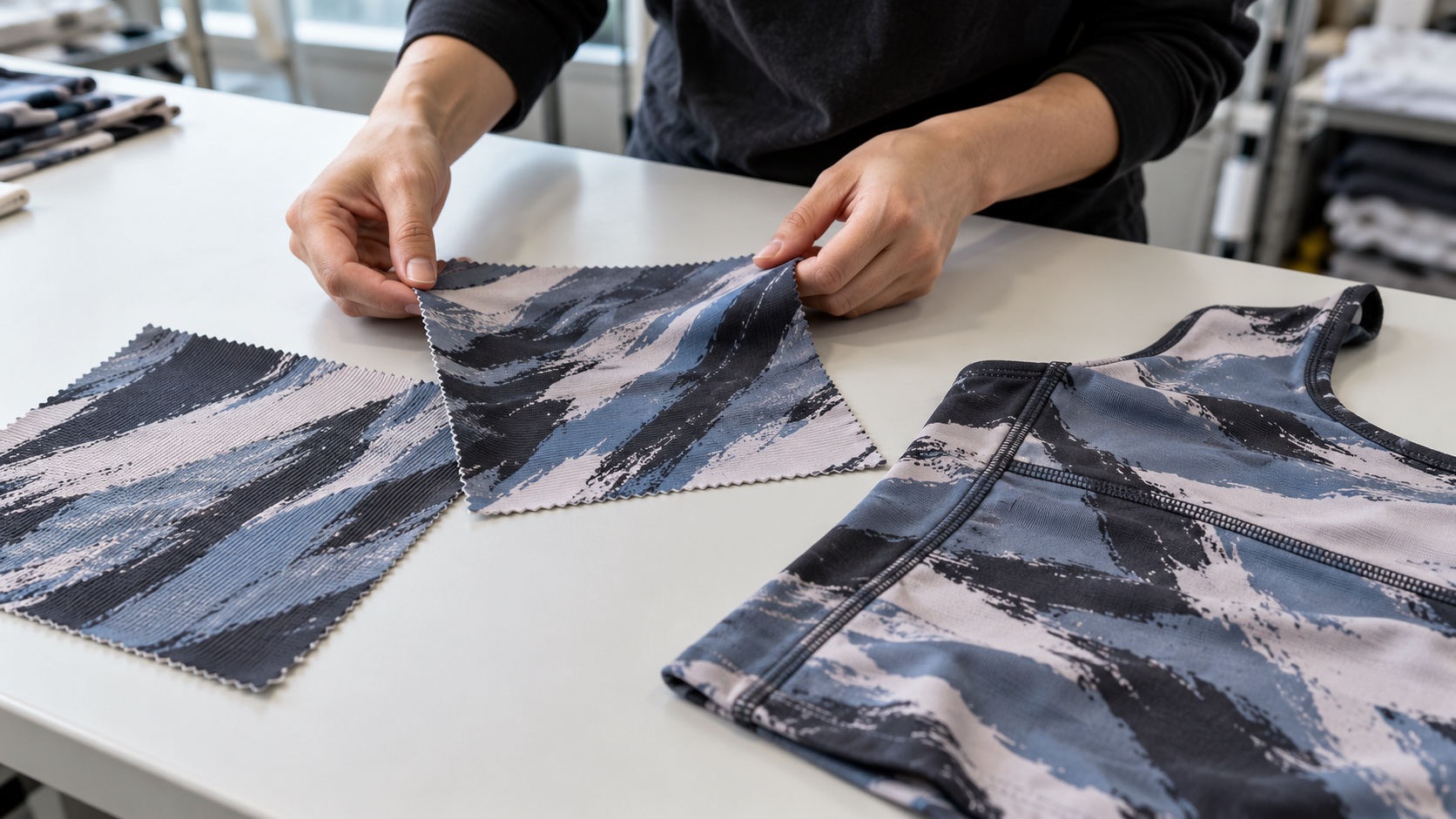
*Illustrative sample-comparison scene only; it is not an actual inspection record or test result.*
The sample also has limits. A printed panel that stretches in one direction does not establish behaviour across the garment. Fabric construction, stretch direction, panel orientation, pattern shape, stitch line and garment fit all influence the context. If a design crosses a gusset or curved seam, the review should identify the exact location and whether alignment or continuity is a design requirement. If the graphic is intentionally disrupted, state that too.
Lighting, viewing angle and camera settings can change how a print appears in a photo. Use photos to locate a concern, and record the agreed physical or instrumental comparison method separately.
For wash-related questions, the team should agree garment care, number of cycles or the applicable test procedure, conditioning, rating method and acceptance basis. For transfer edges or surface adhesion, agree how the sample is prepared, what application route is in scope and who evaluates the result. This guide does not prescribe a test or guarantee that a process will meet one. It asks the parties to define what a meaningful result would look like before using it to approve an order.
What should happen when an observation is not accepted?
A useful process makes the next action traceable. Mark the item as open, assign a responsible person and state whether production or shipment is on hold under the buyer’s agreed process. Identify the affected scope: one garment, one sample, a colourway, an identified lot or the full order. If the scope is unknown, write that it is under review. Do not assume that a single photo represents every garment in a batch.
The owner should choose a correction, re-sample, investigation, agreed test or documented concession, then link that action to the original reference and new version.
Re-approval should be proportional to the change. A small correction to an artwork edge may require a new proof or sample for that visual area. A change to the fabric base, print route, garment panel, finish or construction can affect a broader set of observations. The project owner should decide which evidence must be repeated. The decision belongs in the record, even when the answer is that no additional sample is needed.
Concessions need clarity too. If a buyer accepts a visible variation for a named style, quantity or lot, document who authorised it and the limits of that decision. A concession for one delivery should not silently become an ongoing specification. The production team needs to know whether the accepted item is a one-off resolution or an approved new reference.
When a concern appears in bulk, compare the affected item to the approved reference under the agreed review setup. Preserve a sample and photos if the project process calls for them. Record the date, quantity checked, selection approach, observed location, scope and decision. If the result suggests a systemic issue, the parties should define additional review or containment steps. The article does not establish an inspection sampling plan or acceptance quality limit; those must be agreed for the order and applicable commercial requirements.
Which records protect repeat orders from version drift?
For a repeat order, identify which approved artwork, product, fabric and inspection records carry forward; reassess any substitute or changed scope.
Keep a compact index that connects each garment to its print areas. For every area, record the artwork ID and revision, application location, print method as agreed, colourway, panel or placement map, approved sample ID, review scope, open items and decision owner. For bulk, add the production order or lot reference and any inspection record required by the project. The index makes it possible to trace a comment back to the same item that was reviewed.
Use dated filenames and keep superseded files separate from the active reference. Label a photo as approved only when a documented approval exists.
Review triggers should be explicit. A new artwork scale, colourway, fabric, finish, print route, garment pattern, size range, seam position or supplier may change the earlier evidence. The responsible owner should decide whether to re-review a file, strike-off, panel or assembled garment. A repeat order should use the current approved record, not just a past purchase order number.
This discipline supports a clear handoff between design, sourcing, quality, production and the supplier. If one team approved the visual but another owns the bulk release, record the approval and release roles separately. The sample-to-bulk production guide helps connect the approved sample, change record and production handoff. The manufacturing process page describes the broader inPACE project route; each print-specific scope still needs confirmation for the actual brief.
What should a buyer send before requesting a print-QC review?
A clear request gives the reviewer enough context to compare the garment with the right evidence. Send the current artwork revision and identify the garment style, fabric direction, print locations, colourways, size, sample stage and approval question. Include a panel or placement map if the print’s relationship to seams or edges matters. State whether the review is visual, test-based or both; if test-based, identify the method and acceptance basis the team wants to discuss.
If the project is already in production, add the order or lot reference, item count reviewed, how the items were selected, the observation location, supporting photos and any earlier disposition. If none of that is available, say so. The supplier can then separate a feasibility discussion from a formal inspection and identify what evidence should be created next.
A buyer can use this checklist before sending the brief:
- Identify the style, colourway, size, fabric direction and print locations in scope.
- Attach the current artwork file and state its revision, date and owner.
- Name the approved reference and explain exactly what that approval covered.
- Mark the sample stage: digital proof, strike-off, printed panel, assembled sample, pre-production reference or bulk item.
- Provide a panel map, placement dimensions or seam landmarks when relevant.
- Describe an observation by location and visible condition; separate the observation from a suspected cause.
- State the review setup, including viewing condition or garment position, when it affects the decision.
- Identify any required test method, evaluator and acceptance basis; keep unresolved items open.
- Name the person who can accept, request correction, hold release or approve a concession.
- Record the next action, owner, due point and evidence needed to close the comment.
- For repeats, identify the current fabric, artwork, process, approval and order versions.
How does inPACE fit into a print-quality review?
inPACE works with brands and product teams on B2B activewear development, product sourcing and project-specific sampling. For a printed garment, the useful starting point is a precise question: which artwork, fabric or garment reference should be reviewed, what sample stage is needed, and what evidence will support the buyer’s decision? The team can coordinate a scope discussion and identify information that remains open before a project proceeds.
A print-specific review may sit beside an existing catalogue product direction or part of a custom development brief. If only branding and an existing silhouette are being considered, the Jogging & Printed Activewear collection can help identify a reference direction. If the project changes fit, material, construction, panel architecture or other garment features, use custom activewear development. In either case, the product page is a discussion reference; it does not confirm availability, print capability, material, colour or order terms for a particular project.
The scope should separate visual review from testing. A buyer may want to compare colour appearance, inspect a seam relationship, review a transfer on a named surface, or request a defined durability method. Those are not interchangeable. The relevant supplier or testing party should confirm what can be assessed, what sample is needed and which method applies. Any commercial timing, costs and project conditions must be confirmed for the exact scope.
Share the approved print reference, garment scope, artwork revision, sample stage and inspection priorities through inPACE’s contact page. If the team has a current concern, include a clear photo with a whole-item view and a close-up, plus the decision you need to make. The response can then distinguish known facts, assumptions and the next evidence needed for a project-specific print-QC plan.
Product directions
Explore relevant activewear products
Use these product pages as practical references for your brief, then confirm materials, fit, customization, and production details through sampling.
Jogging & Printed Activewear Direction
Use this catalogue direction to name the garment and panel context for a print review, then confirm the actual material, artwork, and approval scope for the project.
View product directionFabrics & Trims
Use this resource to identify the fabric and component questions that belong beside a print-surface or stretch-zone review.
View product directionCustom Activewear Development
Use the factory-custom route when the project changes fit, fabric, construction, panels, colour programme, or sample-development scope.
View product directionFAQ
Buyer questions
What is printed activewear quality control?
It is a comparison of a named printed garment or sample with the approved artwork, material, colourway, placement and sample reference. The review records visible observations, scope, owner and disposition; it does not create a universal pass standard or prove unagreed performance results.
Which print defects should an activewear buyer inspect?
A buyer can describe questions about colour appearance, registration, coverage, surface marks, transfer edges, stretch-zone appearance, repeat continuity and panel or seam placement. Which observations matter depends on the process, garment location, approved reference and project criteria.
Can a photo approve a printed activewear bulk order?
A photo can help identify a location or document an observation, but it may not show the material, viewing condition, stretch, construction or full garment context. The buyer and supplier should agree which physical reference, review method and approval owner control the release.
Does a visual print inspection prove wash durability or colourfastness?
No. A visual comparison does not establish wash durability, colourfastness, adhesion or another test outcome. The project must define the question, applicable method, sample identity, evaluator and acceptance basis before making a test-based decision.
What should be recorded when a print observation is not accepted?
Record the affected item and scope, artwork and sample versions, location, visible observation, supporting evidence, responsible owner, disposition and next action. State whether correction, another sample, an agreed test or an authorised concession is required.
When should a printed activewear sample be reviewed again?
Re-review when a change could affect the approved evidence, such as artwork revision or scale, colourway, fabric, finish, print route, panel map, garment pattern, size range or seam relationship. The project owner should identify the evidence stage needed for that specific change.
What information should a buyer send for a print-QC review?
Send the style, colourway, size, fabric direction, print locations, artwork revision, approved reference, sample stage, panel or placement map, observation, review conditions and decision owner. For bulk questions, include the order or lot scope and how the inspected items were selected.