
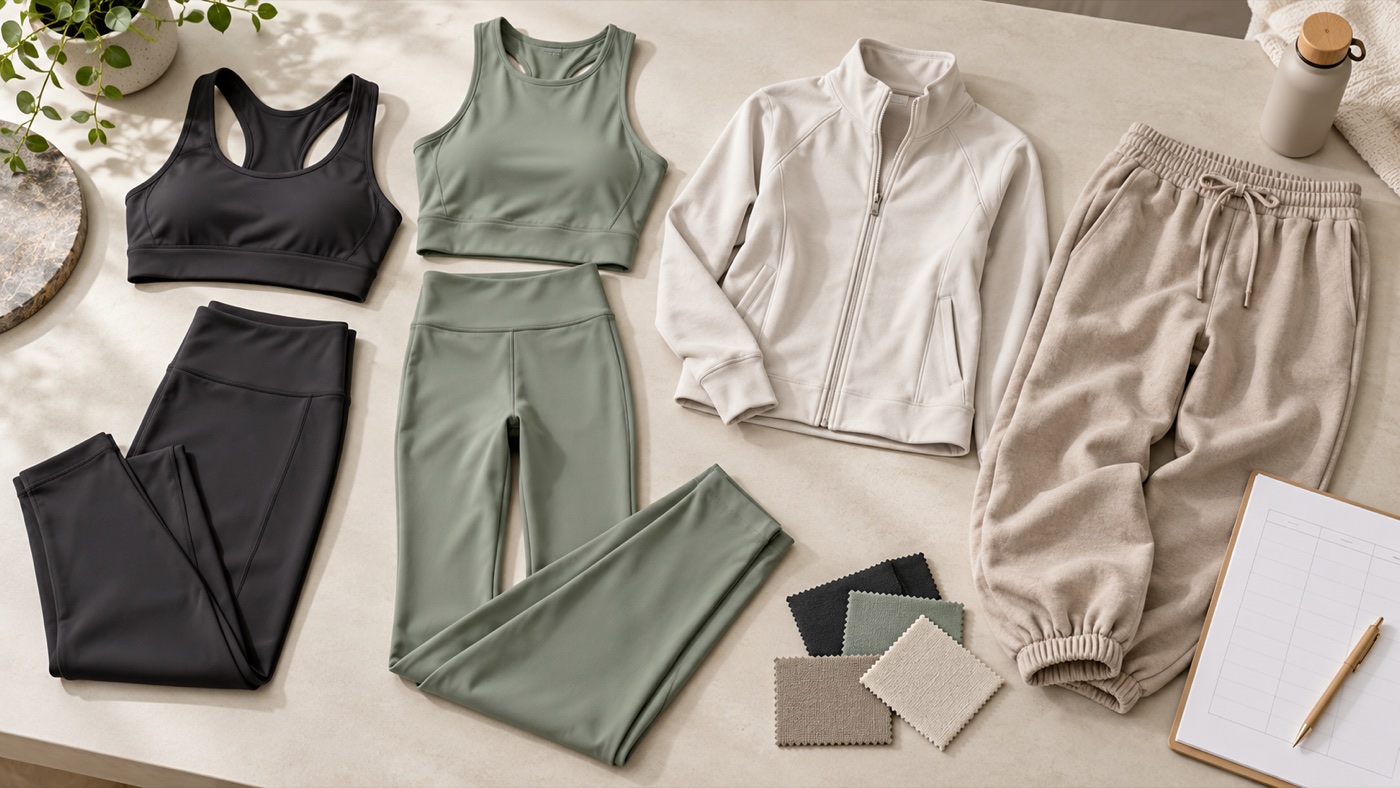
Direct answer. When planning athleisure wholesale for online stores, assign every style a clear job: a training anchor, a studio-to-street option, or an everyday layer. Then check that silhouettes, fabric direction, fit, colours, sizes, product naming and branding make sense together for the buyer’s customer and channel. Start from confirmed catalogue references when existing styles fit; use custom development when a required fit, fabric or construction needs to change.
“Gym-to-street” is a merchandising idea, not proof that every activewear garment is suitable for every setting. A buyer still needs to define how each product is intended to be worn, what the customer should understand from its page, and which product and material details must be verified. A collection can connect training, studio and casual clothing through a thoughtful assortment without claiming that one fabric or fit does everything.
This guide focuses on the range decisions a wholesale online shop needs before it builds product pages, size-colour plans and a supplier brief. It complements a broader activewear product-style selection guide, which helps compare references; this page focuses on how chosen products should work together in a store’s assortment. For launch costs, channel economics or day-to-day fulfilment, use the separate business and ecommerce resources rather than folding those topics into the product mix.
What does “gym-to-street” mean for a wholesale online store?
For a buyer, gym-to-street describes an intended relationship between products selected for training or studio use and pieces that can be styled in a broader daily wardrobe. It is not a universal garment specification or an automatic performance claim. An online shop should show what role each item plays and what evidence supports any descriptions about material, fit, construction or use.
Begin with the customer and the store’s point of view. A shop built around coached studio classes may emphasize coordinated separates and a layer for travel to and from a session. A retailer serving a wider casual audience may include a relaxed pant, a light top and a small number of workout-oriented pieces. These are planning examples, not a statement about what any customer segment is currently buying. Use the store’s own customer feedback, category data and merchandising strategy to decide which scenario matters.
A helpful test is whether a shopper can understand why two neighbouring products belong in the same range. They might share a colour story, a styling direction, a fabric family or a clear transition from training to casual wear. If the relationship is only a vague “lifestyle” label, the buyer should sharpen the garment role or separate the products into more useful categories.
The online store also needs honest boundaries. A crop top selected as a training garment may have a different fit, support construction and care information from a relaxed cotton-blend layer. Do not describe a casual piece as technical activewear simply because it appears beside leggings. Likewise, avoid implying that a yoga pant is designed for all-day wear, running or compression unless the specific product information supports those uses.
How should athleisure wholesale for online stores be structured?
Use a small set of buyer-defined roles to review the range before deciding how many styles, colours or sizes to include. The table below is an organizing tool, not a recommended ratio or sales formula. Every store should choose depth and breadth using its own customer, operational capacity, product evidence and commercial plan.
| Range role | Example product direction | What it contributes to the shop | Buyer check before listing |
|---|---|---|---|
| Training anchor | Sports bra and legging, training set, short or fitted top | Gives the range a clearly active product centre | Confirm fit block, intended activity, construction details, material reference and required size information |
| Studio-to-street bridge | Flared pant, relaxed top, coordinated set or an identified light layer | Connects the active category to the store’s broader styling direction | State where the garment is intended to be worn and which fit or fabric details support that description |
| Everyday casual layer | Relaxed pant, sweatshirt, cover top or simple outer layer | Adds a distinct non-training option or layering piece | Check that material, silhouette, care and product copy match its intended casual role |
| Brand connector | Consistent colour, logo treatment, label, hangtag or coordinated presentation | Helps products feel related across categories | Confirm which approved brand elements apply to each item and how they will be packed |
| Product test or seasonal option | A buyer-selected print, colour or silhouette direction | Lets the team evaluate a specific assortment question | Keep it clearly provisional until references, artwork, sample or commercial scope are approved |
A strong assortment can be narrow and coherent or broader and segmented. The buyer should be able to explain why each style is included, how it differs from its nearest neighbour and which customer question it addresses. If two products serve the same role, compare their silhouette, fit, material, price position and content needs before carrying both into a supplier discussion. If a gap remains—such as a layer between a fitted set and a casual pant—identify the exact product role instead of adding a generic “lifestyle” item.
The Activewear Performance Collection currently presents training sets, bras, one-piece directions and a logo-custom set. The Yoga Activewear catalog groups bras, tops, layers, pants, shorts and skirts, while Jogging & Printed Yoga Activewear presents coordinated sets, training layers and print directions. These pages are starting references for a buyer brief; they do not establish stock, final specifications, material availability, price or which styles belong in a particular store. Confirm the exact product, unit basis, options and quotation with the supplier.
How many styles, colours and sizes should you start with?
There is no universal style count or colour ratio for every online shop. The right assortment depends on the range question the buyer needs to answer, the store’s ability to explain each product, the actual purchase plan, supplier scope and the cost of managing item-level content. Keep those decisions explicit rather than copying a generic “capsule” formula.
Separate breadth from depth. Breadth is how many distinct product roles or silhouettes the store wants to present. Depth is the number of colours and sizes the buyer plans for each style. A range with many related leggings but no top or layer is different from a range with fewer silhouettes and more colour options. Ask which comparison will be most useful: silhouette, use, material, colour or price position. A buyer can then set a scenario for supplier discussion without pretending the scenario is an approved order.
Build the size-colour plan from the store’s intended size range and the supplier’s confirmed product information. A style page, catalog photograph or matching set does not prove that every size, colour or combination is available. Clarify how sizes are named, whether labels map to the store’s chosen system, how colours are distinguished, and which variants need separate photos, descriptions or item identifiers. Keep unknown sizes or colours marked as open instead of silently filling them in.
If two garments use different fit blocks or material systems, treat them as separate products even if the product pages share a visual theme. A bra and a casual layer may need different size notes, material descriptions and care information. The buyer should not assume one sample, size chart or photo approval covers the whole collection.
Consider the work each option creates. More colourways may mean more product images, variant data, fit or shade decisions, and packing details for the buyer to review. Those operational effects can be recorded without asserting a fixed cost or minimum. Confirm what applies to the specific supplier and order before using the plan for a financial forecast.
How can product pages make the range easy to shop?
Give each online listing a precise place in the store’s navigation. Categories might distinguish training sets, bras, leggings, yoga separates, layers and casual bottoms, but the buyer should choose labels that match its own customer vocabulary. Avoid placing very different garment roles under one broad collection name if doing so hides the item’s intended use or relevant fit details.
Use product names and collection copy to distinguish one style from the next. A shopper should be able to tell whether a product is fitted or relaxed, a top or a one-piece, a layer or a standalone garment, and whether the page describes a confirmed feature or an idea under review. Do not rely on trend phrases such as “studio-to-street” to replace material, construction or fit information. A product title should reflect the buyer-approved item rather than repeat a supplier category without context.
Plan photography and product information as a set. Buyers may need front and back views, detail images, a fit reference, fabric close-ups, colour representation and a clear explanation of what is included when an item is sold as a set. Decide which evidence is needed before the listing is finalized. A digital mock-up can support direction, but it does not confirm physical colour, fabric behaviour, size grading, logo durability or garment quality.
If the shop uses coordinated outfits or cross-category links, keep the relationship accurate. Show what can be worn together as a styling suggestion when that is the intent; do not suggest that matching products are automatically sold as a set or share the same material or specification. Confirm the sales unit and pack-out for every listing with the supplier. This prevents a buyer-facing image from creating an assumption that is absent from the order scope.
The range’s content should help customers compare rather than make unsupported claims. Use the same fields across related pages where useful—fit direction, material composition if documented, construction notes, garment measurements, care information and brand details—while allowing each product to have its own specifics. If product data is still pending, mark it for confirmation rather than borrowing information from a visually similar item.
How should fit, fabric and layering decisions stay distinct?
Choose fit and fabric by garment role. A close-fit training piece, a studio pant and a relaxed casual layer can all sit in one online range, but that does not make them the same product or mean a single material should be assumed across them. The buyer should decide which characteristics matter for each item and request evidence appropriate to the claim.
For fitted products, identify the intended silhouette, rise or coverage where relevant, measurement references, size range, and any buyer-required movement or fit review. Avoid claims such as “squat-proof,” “compression,” “sculpting” or “supportive” unless the specific material and construction have been assessed and the brand has evidence for the exact wording. A visual reference cannot prove performance.
For a layer, define the intended use and how it should relate to the garments beneath it. A light cover top, full-zip jacket and sweatshirt serve different functions. State the layer’s shape, closure, length, handfeel and coverage questions; confirm fabric weight, composition and care against the actual product. Do not infer warmth, weather protection or technical performance from a product name alone.
For everyday casual pieces, be clear if the store is building a comfort or styling item rather than an exercise garment. The product may sit within an athleisure brand, yet still need its own material, fit, size, care and use description. That distinction helps the buyer manage the range without blurring the boundary between lifestyle positioning and product evidence.
A simple product-role matrix can keep the development questions apart:
| Product role | Fit and construction questions | Material and proof questions | Styling relationship |
|---|---|---|---|
| Training set | Fit block, waistband, coverage, support details, seams and intended movement review | Actual composition and any substantiated performance claim | Does the top and bottom share a confirmed colour and product story? |
| Studio bottom or top | Close, relaxed or flared direction; measurements and sample size | Handfeel, stretch, recovery and care data the buyer can confirm | Which other approved top or layer can be styled with it? |
| Casual layer | Ease, length, closure, sleeve and layering room | Fabric weight, composition, surface and care instructions | Does it bridge into the shop’s daily-wear category without implying unverified performance? |
Use these questions to review a particular sample or catalog style, not to promise that a garment will meet them before it has been checked. A buyer can keep the visual range connected while allowing each product to have its own approved specification.
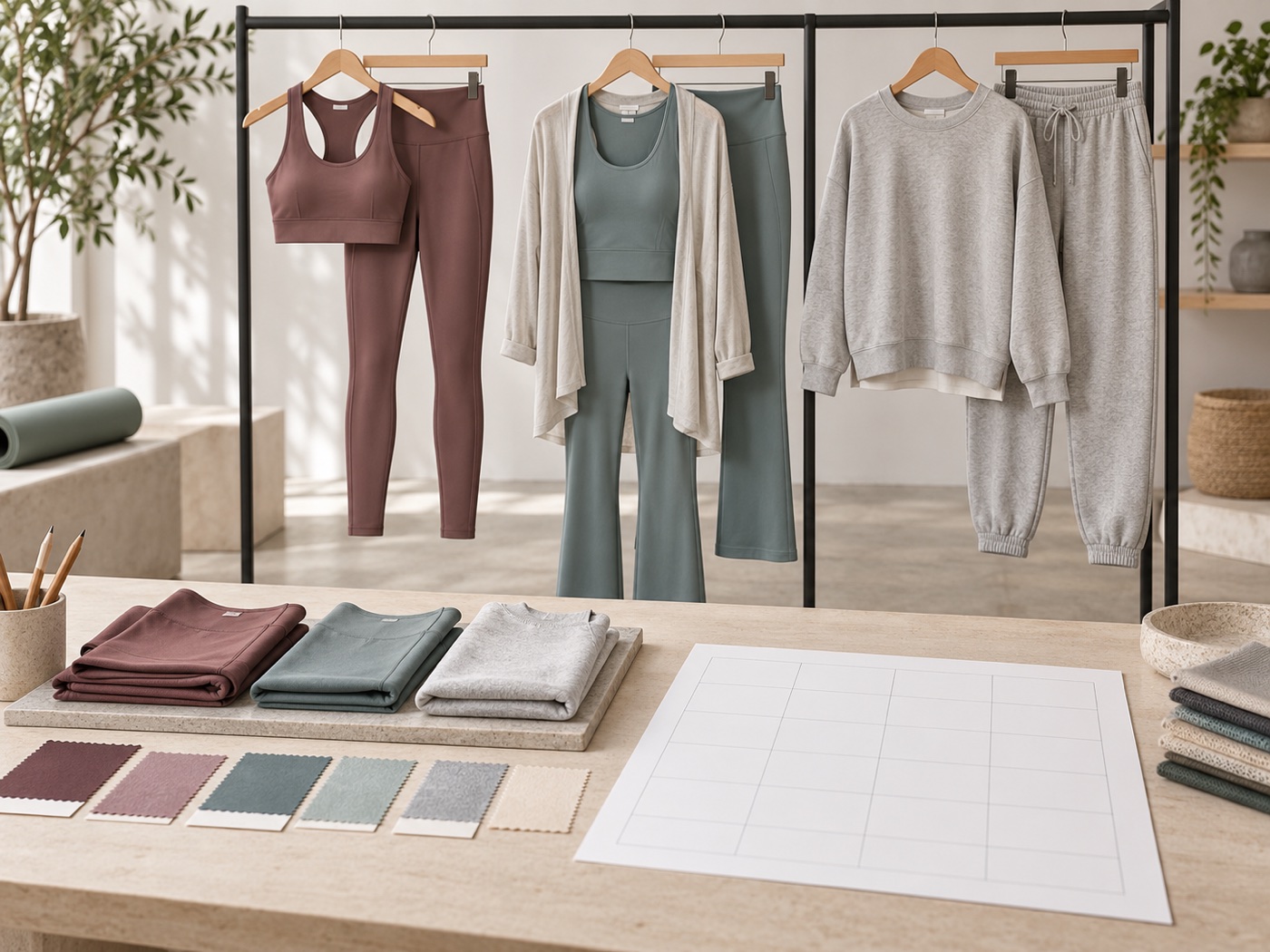
*Illustrative assortment planning scene only; it is not an inPACE catalog image, confirmed product combination or stock representation.*
How do private label details fit into a wholesale assortment?
Once the product roles are clear, decide which items need brand presentation. The private-label activewear route describes logo, woven or heat-transfer labels, care labels, hangtags, barcode and SKU labels, bags, carton marks and packing standards that should be discussed for the actual order. A logo treatment shown on one garment does not automatically apply to every silhouette or material.
Create a brand-component record by style and product version. Note which logo artwork or file is current, where it belongs, who approves the placement, which labels are required, what information is buyer-supplied and which packaging instructions belong to each SKU. If the store wants a consistent presentation across performance and casual items, identify the shared brand elements and the product-specific exceptions. Confirm whether each item is quoted as an individual unit or a coordinated set.
Packing and online catalog data are related but distinct decisions. A listing may need a barcode, variant name or color identifier; the physical packaging may need a label, bag or carton instruction. Keep the identifiers in sync, but do not assume that a product-page choice is included in manufacturing or packing. Ask the supplier to confirm the written scope, responsible party and approved version.
The assortment can stay within a wholesale or light-custom route when the buyer selects an existing product direction and confirms the branding options supported for that project. If a product requires a new fit, fabric, construction, colour placement, performance feature or other product change, review the custom activewear development route. The boundary depends on the requested change and supplier review, not on whether the store calls the range “athleisure.”
How should you test an assortment without inventing demand?
A buyer may need a staged decision: first choose which product roles merit a range review, then confirm what needs sampling or supplier quotation, and later decide which approved options belong in the store’s actual order. Record that sequence so an exploratory assortment board is not mistaken for an approved purchase plan.
Use the store’s own evidence where available. That may include customer interviews, existing category performance, fit feedback, return reasons, search data or merchandising observations. Name the source and time period inside the buyer’s internal decision record. If the shop has no relevant evidence yet, label its assumptions as hypotheses and ask which comparison, sample or smaller business test could help resolve them. Do not describe an item as a “bestseller,” “high-demand” or “proven” based only on a catalog appearance or supplier recommendation.
A useful range review asks specific questions:
- Does each product have an understandable role in the navigation and assortment?
- Does the selected mix connect through a real design, use or brand decision?
- Are training and casual products clearly distinguished in product copy?
- Which materials, fit blocks, colours and sizes are confirmed, and which remain open?
- Can the store support the photos, variant data and product information each item needs?
- Which branding and packaging elements apply to each style or SKU?
- What evidence would make the buyer keep, revise or remove an option?
- What supplier response or sample review is required before the option becomes an order line?
If the buyer needs a wider collection-level process, the activewear capsule sourcing guide covers how a capsule is scoped. This page keeps its emphasis on an online store’s gym-to-street product roles and assortment logic. Use the overlap carefully: the same style may belong in both a capsule plan and an online range, but the buyer’s questions about assortment breadth, listing content and category boundaries are distinct from sourcing and development as a whole.
What should you send an athleisure wholesale supplier?
Send a concise brief that allows the supplier to distinguish catalogue selection from product development. Include links or IDs for the starting styles, what the store intends to retain or change, each item’s role, the target customer and channel, size and colour direction, material questions, branding files and packing needs. List estimated quantities as planning information if they are not yet approved, and identify any assumptions that require a supplier response.
Use this preparation checklist before requesting a review:
- Name the store’s customer, channel and intended assortment point of view.
- Assign each style a role: training, studio-to-street, casual layer or brand connector.
- Link the exact inPACE catalog or product reference and mark requested changes.
- Separate existing product selection from new fit, fabric, construction or feature development.
- List the intended size range, colour plan and any open availability questions.
- Identify the sample or product evidence needed before the buyer can approve a listing.
- Provide approved logo artwork and placement direction by garment.
- State labels, hangtags, barcode identifiers, bag and carton requirements.
- Confirm whether each line refers to a piece, a set or another quoted unit.
- Name the people who consolidate comments and approve the assortment.
- Ask the supplier to identify assumptions, exclusions and scope changes in its response.
For a project-specific review, share the target customer, store channel, selected product references, layering needs, size-colour plan and branding brief through the inPACE contact page. The team can help discuss whether the selected direction is a catalogue-based wholesale request or requires a custom development conversation. A complete brief makes the next discussion more specific; it does not guarantee stock, a minimum quantity, price, delivery date or a confirmed production route before the project is reviewed.
A considered online athleisure assortment gives every product a job and every brand decision a clear owner. It can connect training, studio and casual pieces through a store-specific plan while keeping fit, fabric, packing and evidence attached to the actual item. That is a more useful starting point for a wholesale discussion than a general request for a fashionable gym-to-street collection.
Product directions
Explore relevant activewear products
Use these product pages as practical references for your brief, then confirm materials, fit, customization, and production details through sampling.
Activewear Performance Collection
Compare training set, bra, one-piece and coordinated logo-custom directions as starting references for the store’s range plan.
View product directionYoga Activewear Catalog
Review bra, top, layer, pant and short directions, then confirm the exact style and project scope.
View product directionPrivate Label Activewear
Connect selected product directions with the labels, logos, SKU identification and packing requirements for the brand.
View product directionFAQ
Buyer questions
What should an online store include in an athleisure wholesale range?
Start with buyer-defined roles such as training essentials, studio-to-street pieces and everyday layers. The specific mix depends on the store’s customer, evidence and product plan. Confirm each style, size, colour, material and brand detail with the supplier rather than using a generic assortment ratio.
What does gym-to-street mean for an activewear product?
It describes an intended relationship between active or studio products and broader daily styling. It does not prove that every garment works for every activity or setting. Define the use, fit, construction and product information for each style, and substantiate any performance description separately.
How many styles should a new athleisure shop start with?
There is no universal number. Decide which product roles the store needs to test or support, then set a style and size-colour scenario using its own customer, operational capacity and commercial plan. Mark planning quantities as provisional until approved for an order.
Can I combine yoga, gym and casual clothes in one online collection?
Yes, if the store explains the relationship while keeping each product’s intended use and details accurate. Shared colours or styling can connect items, but a casual layer and fitted training garment may have different materials, fit guidance, care details and evidence.
When is athleisure wholesale different from custom activewear development?
Wholesale or light customization starts from an existing product direction and confirms the supported branding and packing scope. A change to fit, fabric, construction, colour placement or product features may need custom development. The supplier should review the requested change and confirm the route.
What should I confirm before adding a catalog item to my store?
Confirm the exact style, whether it is sold as a piece or set, current material and size information, colour and customization options, packaging, quotation basis and order scope. Catalog images are references; they do not confirm live stock or project-specific availability.
How should I decide which colors and sizes to offer?
Use the store’s own assortment plan and supplier-confirmed product data. Identify the intended size system, color names, variants and any open availability questions. Keep the plan provisional until the supplier confirms the actual style-color-size combinations and the buyer approves them.
What should I send an athleisure wholesale supplier for a range review?
Share the target customer and channel, exact product references, each item’s role, intended changes, size-colour plan, material questions, approved logo files, labels and packing needs. Separate confirmed instructions from assumptions and name who will consolidate comments and approve the range.