
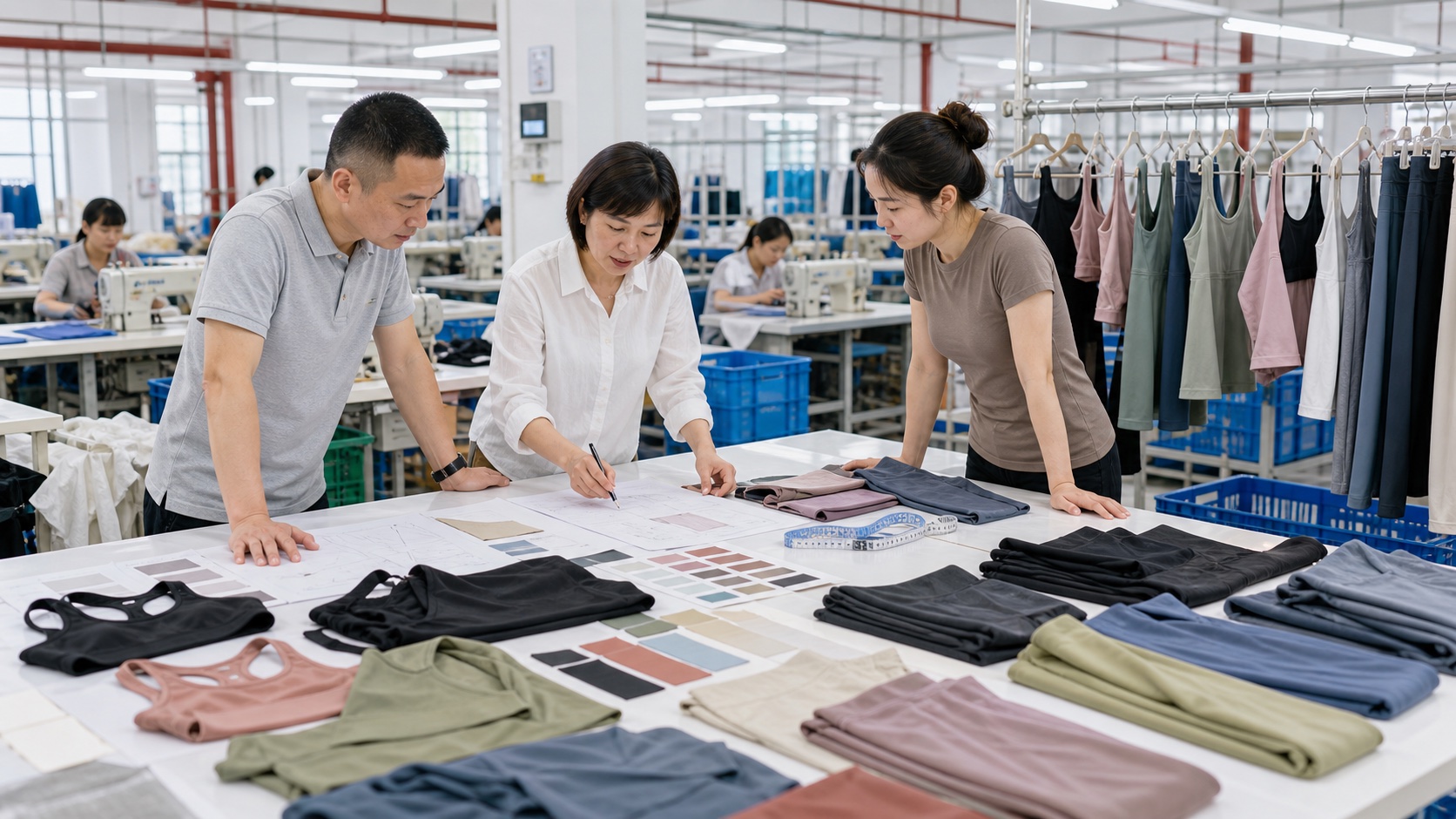
An Australian brand can plan a first yoga and workout apparel range by assigning a clear job to each core style before asking an activewear supplier for pricing. A useful brief separates existing-style branding from factory-custom development, then records the studio, outdoor, and gym use cases; fit and coverage questions; fabric and seam priorities; sample purpose; branding files; packing ownership; and the Australian-market information owner.
*Factory-context reference: this image supports a discussion of pattern, fabric, and sample-planning questions. It does not identify a selected product or establish an Australian-market, performance, capacity, or delivery claim.*
What should the first range prove?
A yoga and workout launch does not need every possible garment. It needs a small set of product roles that work together and create a sensible sample plan. A high-waist legging can be the range anchor, a bra or fitted top can make coverage and support-direction decisions explicit, a tee or light layer can solve the transition between studio and outdoor use, and one workout-facing piece can introduce a more active movement context. The goal is not to make a universal performance promise. It is to decide what the buyer and supplier must observe.
For an Australian brand, describe the channel as well as the activity. A studio membership offer, an online launch, a gym programme, and an outdoor-training community can have different needs for layering, product-page evidence, receiving, labels, packing, and re-order decisions. A reference photo can communicate a silhouette, proportion, or colour relationship, but it cannot establish fabric composition, stretch recovery, coverage, grading, construction, approved claim wording, or market readiness.
Make the range map useful enough that a designer, merchandiser, supplier contact, and receiving owner can read the same version without filling gaps from memory. For each style, identify the intended wearer, primary movement context, companion piece, colour relationship, sample question, and the file that can change the decision. This is especially helpful when an online launch uses only a few core products: the team can separate a product-page preference from a pattern or material instruction, then capture whether the change needs a revised sample, artwork, packing file, or receiving check.
Which development route fits each style?
Start by separating two commercial paths:
| Buyer situation | Appropriate first path | Evidence still needed |
|---|---|---|
| An existing product direction is suitable and the principal work is controlled branding. | Wholesale or light customisation: confirm the reference, logo zone, labels, hangtags, pack direction, and open questions. | Actual garment, material, colour, branding method, quantities, packing components, and the final approval set. |
| The brand needs a changed fit, waistband, coverage direction, support direction, fabric, panel, seam, or feature. | Factory-custom development: use an annotated reference and define which product questions the sample must answer. | Pattern, construction, fabric, fit, sample result, production files, and responsible market information. |
| The team wants a narrow learning release before expanding. | Small-batch custom discussion, with a defined review objective instead of a promise about a retail quantity or re-order. | Scope, materials, commercial terms, timing, quantity direction, review method, and next decision. |
The Custom Activewear development route suits a brief where the reference is only the starting point. The Private Label service is more relevant where the product direction already exists and branding is the primary variable. A collection can legitimately use both paths; calling all styles “private label” hides the different decisions each one needs.
How should product roles cover studio, outdoor, and gym use?
Give each style a use context, a movement question, and an approval question. A Yoga Activewear legging may need the team to examine rise, waistband stability, gusset construction, seam comfort, opacity in agreed movements, and recovery after a defined wear trial. A racerback yoga top can be a reference for armhole, body-length, neckline, and logo-zone discussion. A high-waist yoga bottom can help the team name the waist and leg-profile questions without treating it as a copy instruction or an availability claim.
For a gym or outdoor-training layer, describe what changes: temperature range to validate, layering relationship, sleeve movement, opening, pocket, collar, zip, reflective detail, or logo placement. A Zip-Neck Sculpt Set can be a useful product-direction reference where the buyer needs to discuss the relationship between a fitted layer and a training context. It does not prove a future fabric, testing result, climate performance, price, quantity, or delivery time.
Which fabric and construction questions belong in the brief?
The request should name questions instead of selecting jargon as a substitute for evidence. For a close-fit bottom, include fabric hand, stretch direction, recovery expectation, coverage observations to make during agreed movements, lining or gusset question, panel boundaries, waistband construction, and seam comfort. For a bra or fitted top, include neckline, underband or hem relationship, strap placement, lining, armhole, and support direction. For a layer, include body length, sleeve movement, opening, collar, pocket, and how the garment sits over the core studio pieces.
The fabrics and trims discussion can give a shared vocabulary for material and component questions. It is not a certification, inventory, test, or finished-product claim. Ask the supplier which choices can be discussed from the brief, which require a sample, and which need an approved production file. That creates a more useful comparison than asking several suppliers for a headline number against different assumptions.
What should an Australian importer or brand own?
The product-development team should keep supplier questions separate from Australian regulatory and import decisions. The Australian Border Force's import guidance is a starting point for checking which requirements apply to a particular import. Business.gov.au says imported goods must clear customs, and advises businesses to check permits, clearance requirements, duties, taxes, freight and handling costs. The responsible importer, brand, customs broker, and advisers should determine the specific product, tariff, trade-description, tax, origin, and clearance requirements before goods move; a factory brief cannot settle them.
Business.gov.au likewise notes that some imported goods need a trade description with an accurate description and country of production, while product labels must be truthful, clear, and accurate. These sources help a buyer assign an owner and a review point; they do not create a generic label template for every garment or sales route. Keep fibre, care, origin, consumer-facing copy, online information, carton marks, and packing decisions as separate versioned files, and reopen the review if the material, packing component, country, or channel changes.
What should the first sample prove?
Name the purpose for every sample. A legging sample can test rise, waist stability, seam comfort, material hand, coverage in agreed movements, and logo-zone position. A top sample can test neckline, strap, lining, armhole, and hem or underband relationship. A layer sample can test sleeve movement, collar, opening, pocket, and layering. Record the version, base size, colour reference, reviewers, movements, observations, decisions, and unresolved questions in the activewear sample feedback process.
inPACE can discuss sampling support, including printing, embroidery, and wash effects where the chosen construction, fabric, placement, and project scope make them suitable. Planning ranges are conditional: samples are commonly discussed at around 5–10 days and production at around 25–50 days after scope and approvals are confirmed. Material availability, components, revisions, quantities, factory coordination, and unresolved decisions can change the actual plan.
Working buyer checklist
- Name the studio, outdoor, and gym use contexts that the range must serve.
- Give each core style one product job and one question that the sample must answer.
- Classify each style as existing-style branding, factory custom, or a limited learning discussion.
- State the wearer, base size, intended size direction, coverage concern, and layer relationship.
- List material questions for handfeel, stretch, recovery, coverage, lining, and component compatibility.
- Identify waistband, gusset, neckline, strap, seam, panel, opening, collar, or pocket questions.
- Provide controlled logo, label, hangtag, and packing files with version status.
- Name the sample reviewers and the movements or observations they must record.
- Name the owner for Australian import, tariff, country-of-origin, label, and product-information decisions.
- Ask each supplier to state the assumptions behind its response before comparing scope, price, or timing.
How can a brand compare supplier responses without comparing different work?
Ask each activewear supplier Australia prospect to respond to the same controlled brief. The useful comparison is not a single figure or a promised delivery date. It is whether each supplier has understood the same product route, reference source, material questions, construction changes, colour-size direction, branding scope, sample purpose, packaging assumptions, and approval owner.
For example, two supplier responses may appear to address a yoga legging, while one assumes an existing silhouette with a logo application and the other assumes a new waistband, a changed rise, different material hand, revised panel map, and a fit sample. Those are not comparable scopes. A brand should ask each supplier to list assumptions and open questions before using an indicative quotation or a timing discussion in a decision. This is especially important where a first range combines a catalogue-informed product direction with one or two styles that need factory-custom development.
Use a controlled supplier comparison sheet with separate lines for product role, customer use, route, reference status, material direction, fit and coverage questions, construction changes, logo or label files, sample objective, size-colour direction, packing scope, product information owner, and unanswered questions. The activewear manufacturing workflow can help a team connect approved material and construction notes with later QC and packing records. It cannot turn an early supplier conversation into a commitment about cost, capacity, quantities, testing, import treatment, or a delivery calendar.
How should colour, brand artwork, and packaging be controlled?
Colour selection needs a record that travels with the material and product role. A studio core colour, an outdoor layer colour, and a training accent can all make sense, but each needs an approved source, version, material relationship, logo-contrast decision, and named approval owner. The activewear colour approval guide is useful for treating a colour as a controlled production decision rather than a name copied from a mood board.
For existing-style branding, attach the approved logo artwork, application zone, label layout, hangtag direction, packaging instructions, and file versions to the selected product reference. For factory-custom development, keep the same files in the sample and production decision trail. Do not let a marketing rendering become a production instruction without confirming size, position, material compatibility, application method, and sample evidence.
Packing deserves the same discipline. A brand can define the receiving point, any carton-mark or barcode question, fold or polybag direction, pack ratio, and who owns final market-facing information. The activewear packaging checklist can structure this conversation. It is not a substitute for the approved files, nor does it determine Australian import treatment. If the customer channel, component, product information, or destination changes, reopen the review rather than assuming a prior approval still applies.
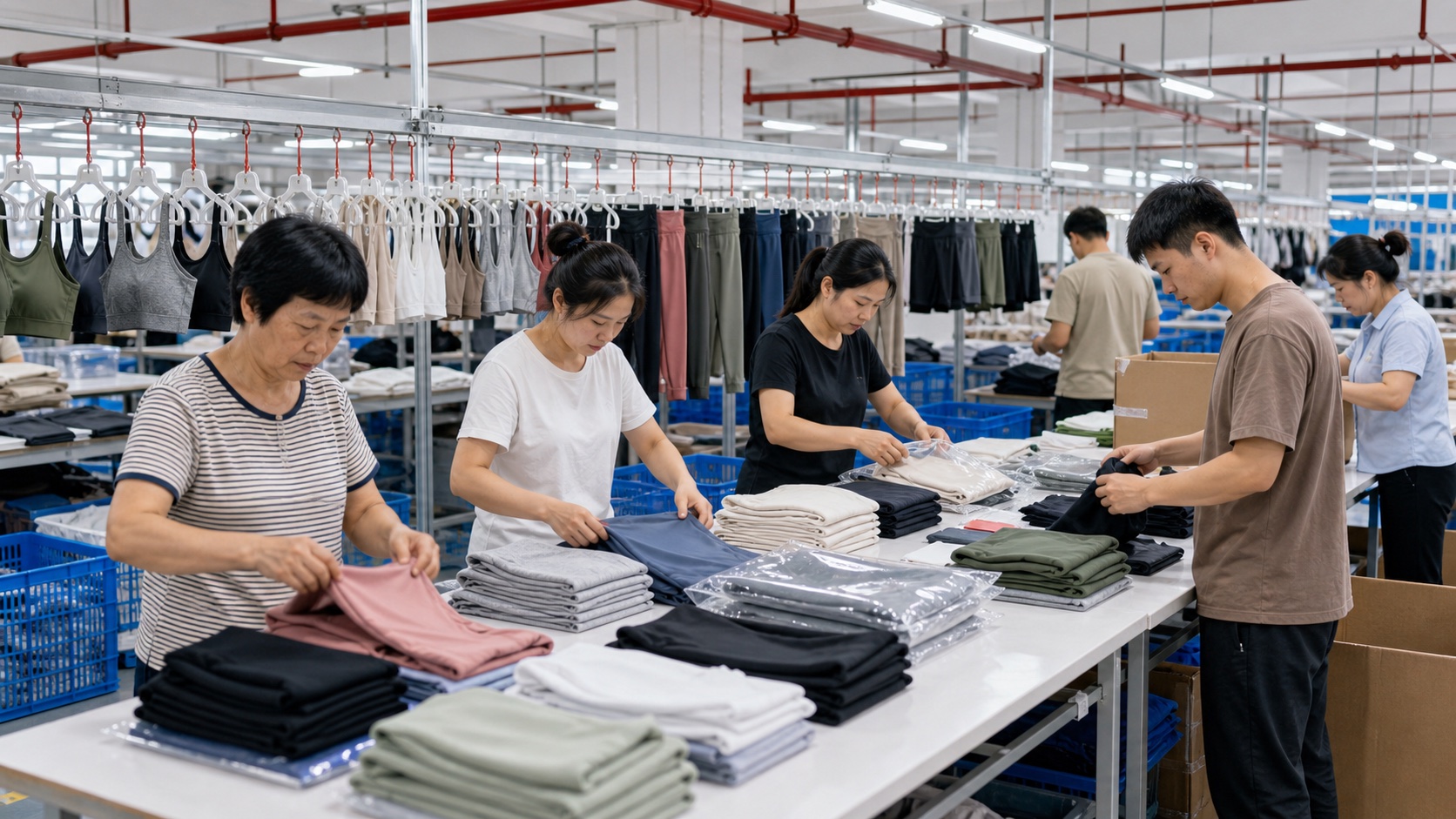
*Factory-context reference: this image illustrates a packing-review discussion. It does not verify any label, packing component, Australian import treatment, finished specification, or customer order.*
What should be approved before bulk production is discussed?
Maintain a concise evidence set for each style. The set can include a versioned reference, product role, measurement direction, material and component notes, colour source, sample request, artwork, label layout, hangtag and packaging instructions, fit comments, receiving information, and a change log. Give each item a status such as reference only, proposed, approved for sampling, approved for production, or open.
The product route controls how much evidence is needed. An existing-style branding programme may need confirmation that the reference, logo location, labels, packing, and product presentation are appropriate before a sample is used to verify actual choices. A factory-custom legging or top needs a more explicit chain: what about the fit, fabric, coverage, panel, seam, neckline, waistband, or support direction changed; what did the sample show; what version now represents the approved direction; and what remains unresolved.
This evidence set is also how a brand coordinates an ecommerce team, designer, merchandiser, supplier, and receiving contact without asking the factory to decide customer claims or import obligations. The Custom Activewear route can start a discussion about these production questions. The brand remains responsible for defining what information it will approve for its selected Australian sales channel.
Which three product directions can start the conversation?
Three route-matched starting points make the brief tangible without pretending they are a ready-made collection. The Yoga Activewear catalog can help establish close-fit studio roles and questions about waist, neckline, coverage, and layer relationships. The Zip-Neck Sculpt Set can inform a training-layer discussion around opening, collar, sleeve, body length, and logo placement. The Custom Activewear development route is the appropriate next step when a brand needs a new fit, fabric, construction, colour, or feature verified by a sample.
These are product directions, not an offer of stock, retail fulfilment, fixed quantities, prices, or timing. A buyer gets a better response by explaining why each reference was selected: perhaps it is useful for a waist profile, a sleeve proportion, a transition layer, or a branding location. That gives the supplier a question to answer rather than an image to interpret silently.
What should an Australian launch brief include before contact?
Before asking for a supplier discussion, summarise the intended customer, channel, range roles, development route for each style, references and their purpose, fit and material questions, branding files, sample objective, product-information owner, packing questions, and change-control process. Add only an honest quantity direction and re-order decision point, not a fixed commitment. This makes room for a supplier to clarify what needs a sample, what can be discussed from a product reference, and what depends on material or component availability.
inPACE can discuss B2B activewear product direction, factory-custom development, fabric and fit questions, sample planning, branding compatibility, QC and packing records, and coordination across cooperating production factories. That conversation can draw on more than 30 years of garment-production experience in the wider production context, without becoming a guarantee of a price, capacity, compliance conclusion, quantity, or delivery outcome. Send an Australian activewear brief to inPACE with the product roles, references, open questions, and approval owners so the first response can separate feasible development work from decisions still owned by the brand.
A practical handoff for the next decision
The strongest first brief is not the longest one. It lets a supplier distinguish a reference from an approved instruction, a product question from a customer claim, and a useful sample from a production release. When an Australian brand gives every style a job, separates catalogue-informed branding from factory-custom development, and names who owns import and market-facing information, it can compare supplier responses on the same basis.
Before the first call, collect the product-role sheet, annotated references, material and fit questions, colour and artwork versions, sample objective, reviewers, packing questions, and a simple change log. Ask the supplier to state what can be explored from the brief, what needs a sample, and what must remain open until the responsible brand team approves a file. That makes the next decision traceable across the studio, outdoor, and gym parts of the range without inventing certainty where evidence is still needed.
The final release decision should return to the same record. If a fabric, construction, artwork, packing component, or selling channel has changed since sample review, mark the change and decide whether the evidence still applies. That small discipline prevents an approval for one version being used accidentally for another.
FAQ
Buyer questions
Should every item in an Australian yoga and workout range be custom?
No. A range can combine existing-style branding and factory-custom development. Existing-style branding is useful when the main decisions are product reference, logo, labels, hangtags, packing, and approval files. Factory custom is appropriate where fit, fabric, coverage, seam map, panel, support direction, or construction needs evidence from a sample. The point is to state which route applies to each item rather than use one label for different work.
What should a first legging sample answer?
Name the questions before the sample is requested: rise, waistband stability, gusset, seam comfort, fabric hand, coverage observations in named movements, recovery, and logo-zone position. Record the base size, material direction, reviewers, movements, observations, decisions, and unresolved points. A sample observation is evidence for a product decision; it is not automatically a consumer-facing performance claim.
Can an activewear supplier determine Australian labelling or import requirements?
A supplier can receive approved production files and clarify the information needed for the selected product. The importer, brand, customs broker, and appropriate advisers should determine product-specific tariff, trade-description, origin, labelling, tax, clearance, and market-information obligations. Keep that responsibility explicit in the brief rather than asking a factory to infer an Australian legal conclusion from a mood board or packaging concept.
How should an outdoor layer differ from a studio core style?
Describe the difference as a product question: layering relationship, sleeve movement, collar or opening, body length, pocket, temperature context to validate, and branding placement. Do not simply call a product “all-weather” or “high performance.” The sample and approved specification should show what the garment must do in the defined use context and which statements remain outside the supplier brief.
Are sample and production timing ranges fixed?
No. inPACE commonly discusses samples at around 5–10 days and production at around 25–50 days only after scope and approvals are confirmed. Material availability, components, revision rounds, quantity direction, coordination across factories, and unresolved decisions can change the plan. Treat a range as a planning reference, not a promise.
What files should be ready before a first supplier conversation?
Prepare product roles, references with a stated purpose, base size and intended size direction, material and fit questions, colour direction, logo artwork, label and packaging files where available, sample purpose, reviewers, channel, receiving questions, and the owner of market-facing information. Mark each file as reference, proposed, approved for sampling, approved for production, or open.
How can a small brand keep the first range manageable?
Choose a narrow role set, define which styles share a material or visual relationship, and give every sample one purpose. Ask suppliers to identify assumptions before comparing responses. A focused first range can produce useful evidence for a later decision without asserting a fixed launch quantity, retail inventory, or re-order plan before the brand has completed its review.