
Direct answer: choose the route after the garment question is clear
The useful way to compare activewear printing methods is to start with the physical job the artwork must do. Is it a small local mark on a stable area? A graphic that crosses a constructed panel? Or a visual that must cover a large part of the garment before it is sewn? Then identify the actual fabric and colourway, the artwork version, the expected stretch or movement around the graphic, the quantity plan, and the evidence the team needs to see on a sample. A method name alone cannot prove that the result will look, feel, or behave as intended on every garment.
For a brand, this is a sourcing decision as much as a design decision. The right route is the one that lets the buyer and manufacturing team describe the same garment, use the same current file, and inspect the same physical evidence. A polished mock-up can begin the conversation. It cannot replace a sample of the identified artwork on the identified material and garment area.
This guide owns the high-level print-route decision. If the project is specifically about a logo on stretch fabric, use the separate activewear logo application guide. If the question is where an artwork should sit in relation to panels, seams, or openings, use the activewear print-placement guide. For collection-level visual direction, read printed activewear trends for brands. Those questions overlap in practice, but they should not be compressed into one line of a purchase brief.
First, name the print task—not the print technology
A buyer who starts with “we need a printed set” may be describing very different work. Separate the task before comparing processes.
1. A local brand mark or limited graphic
This is a logo, wordmark, number, small chest graphic, sleeve mark, or other contained area. The key questions are less about visual coverage and more about the relationship between the artwork, its base material, the local stretch zone, opacity on the chosen ground colour, edge definition, handfeel, and placement. A small graphic on a relatively stable panel may call for a different review than the same graphic across a highly elastic legging zone.
The buyer should say whether the mark is purely visual, whether it must remain flexible, whether a particular texture is part of the design, and which colourways matter. The artwork is not approved simply because it is readable in a digital file. It needs an identified size, a named garment area, and a sample context.
2. A panel graphic or structured colour block
This is a print that occupies a panel, follows the shoulder, leg, side seam, pocket, or another built garment area. Here, the artwork has a construction problem as well as a print problem. A seam can shift the visual. A curved body can change a stripe. A mesh insert, zipper, binding, waistband, or pocket can interrupt the coverage. The brief should identify the relevant pattern or panel reference rather than rely on a front-view mock-up.
3. A large-format or all-over visual
This is a repeat, camouflage, photographic artwork, engineered graphic, or other large visual treatment. It normally requires earlier alignment between artwork and the cut-piece or garment route. The team needs to know whether the visual is intended to run continuously, align at a seam, avoid a named zone, or tolerate variation where a garment is cut and assembled. A detailed digital artwork may look clean on a flat rectangle yet need a different plan once it meets a multi-panel sports garment.
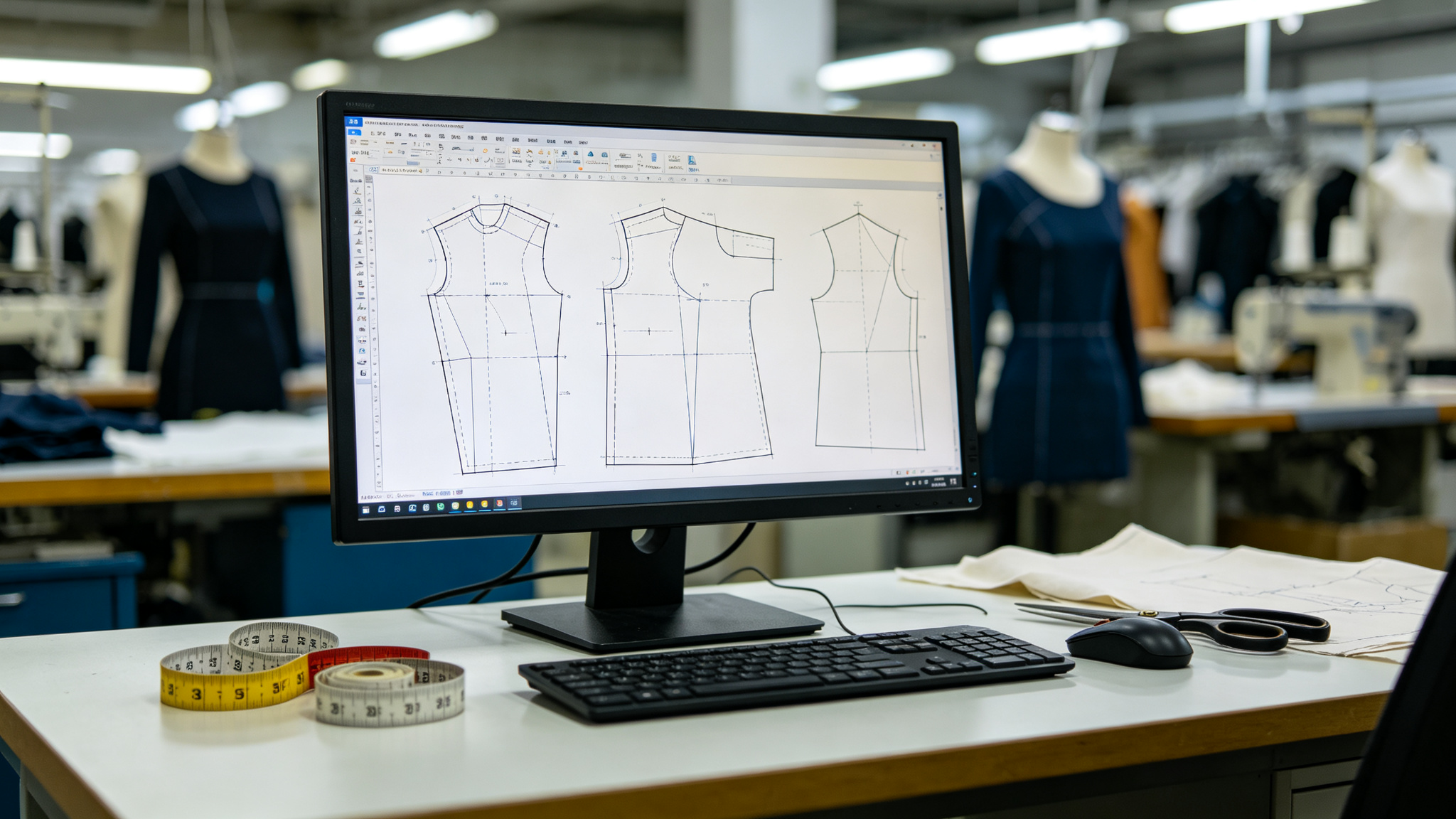
*Artwork direction is easier to review when the garment's panels, construction context, and sample version are named together. The image is a process illustration, not a specification or capability claim.*
A decision matrix for five activewear printing routes
The following routes are common categories for a supplier discussion. They are not a promise that every method is appropriate for every fabric, programme, factory, or quantity. Exact suitability depends on the confirmed garment, material, artwork, colour, commercial scope, and physical trial.
| Route to discuss | Often considered when | Questions that change the answer | Sample evidence to request |
|---|---|---|---|
| Heat-applied or transfer-based decoration | The project has a local mark, defined panel graphic, number, name, or limited artwork area | Substrate, stretch, surface texture, coverage, artwork edge, handfeel, colour, and the exact transfer system | The actual artwork on the named material and area; photos at rest and in relevant stretch; approved dimensions and version |
| Screen or ink-based printing | The graphic is suitable for an ink route and the order plan may justify a process discussion | Fabric construction, colour ground, opacity, detail, number of colours, coverage, order distribution, and cure or finish compatibility | Strike-off or garment sample with documented fabric, colourway, artwork version, and review observations |
| Sublimation-type route | The confirmed fabric and garment construction support the route and the visual needs broad coverage | Fibre composition, fabric face, panel layout, colour, cut-piece strategy, artwork scale, and repeat alignment | Material/cut-piece evidence and a sewn sample for visual continuity, panel relationship, and fit review |
| Direct-to-fabric digital route | The artwork has detail, tonal variation, or short-run exploration needs that warrant discussion | Identified fabric, pretreatment or process conditions, visual depth, penetration/face expectations, colour, coverage, and order plan | Swatch or strike-off plus the intended garment material and a sample where construction affects the image |
| Embroidered, woven, or applied badge alternative | The brief actually needs a dimensional badge or emblem rather than a printed surface | Garment thickness, stretch zone, backing, edge treatment, weight, placement, and wearer comfort | An applied sample on the target area, reviewed for attachment, edge, comfort, and garment distortion |
The matrix is deliberately not a ranking. A local mark may be more successful through a route that is unsuitable for a full panel. A large visual may need construction-led planning before any discussion of a finish. And an order quantity can affect what is commercially practical without determining the technical answer by itself. Ask each supplier to state the assumptions behind its proposal.
Fabric is part of the artwork decision
Activewear fabrics are not blank paper. A fabric can be smooth or textured, dense or open, highly elastic or comparatively stable, light or substantial, pale or dark, brushed or slick. Those traits change how a line, colour, edge, and printed area are perceived. They can also change what must be checked in a physical sample.
Do not describe fabric only as “polyester” or “nylon.” State what is known: composition if confirmed, knit or weave direction, intended garment zone, weight/GSM where available, stretch direction, recovery expectations to be tested, surface texture, and colourway. If any of those items are still open, mark them open. A supplier can then explain what evidence it needs instead of silently filling in gaps.
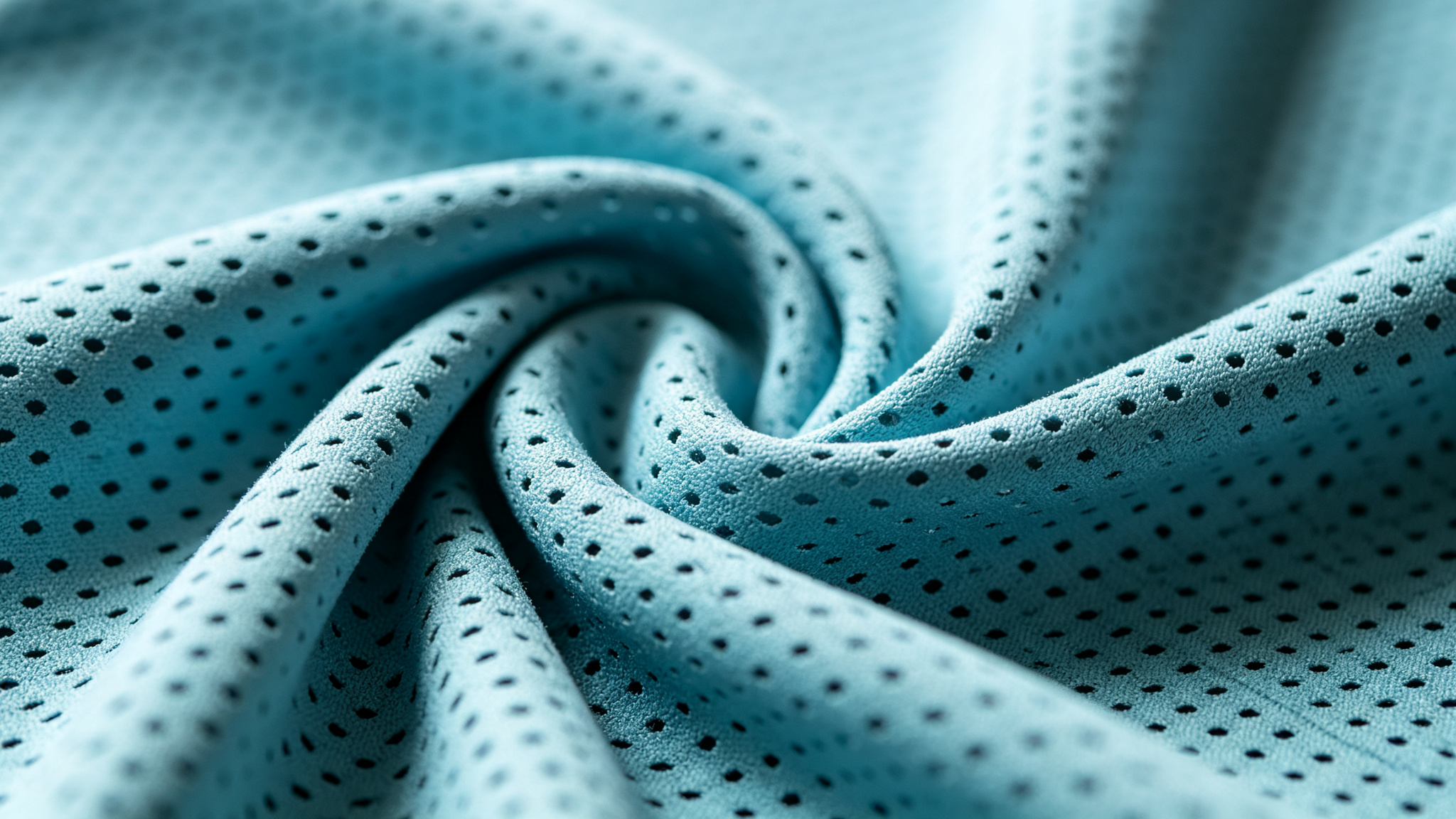
*A fabric face, texture, and openness can affect the visible result. Confirm the actual material and colourway; this illustrative close-up does not establish suitability for a particular process.*
For example, the same small white artwork can look different on a dark, textured, perforated, brushed, or glossy base. A dense chest panel and a highly elastic waistband may need separate samples even if they use the same artwork file. A fabric swatch can give early feedback, but it does not show the interaction of seam, fit, body curvature, and local stretch. Where the garment area matters, include that area in the sample.
The fabrics and trims resource can help frame the information that belongs in a material discussion. It should be used to improve the brief, not to turn a generic material page into proof of a print result.
Compare supplier proposals on one written brief
If two suppliers recommend different activewear printing methods, do not decide that one is stronger merely because its terminology sounds more technical or its quotation is shorter. Send both suppliers the same controlled brief and ask them to answer the same questions: Which material and garment zone are assumed? Which artwork version and coverage are being quoted? What sample or strike-off would they use to validate the route? Which conditions might cause the route, price, or timeline discussion to change? Is the recommendation based on a local decoration, a panel treatment, or a cut-piece/all-over visual?
This makes comparison more honest. One supplier may be responding to a local logo while another assumes broad coverage. One may be describing a swatch only while another assumes a sewn sample. One may have included a colourway matrix or special packing, while another has not. The issue is not that one answer is automatically wrong. The issue is that different scopes cannot be compared like-for-like.
Keep the returned recommendations beside the original brief. Mark each item as confirmed, awaiting physical evidence, commercial assumption, or not offered for the stated project. If a supplier proposes changing the fabric, reducing coverage, moving the artwork, simplifying colours, or splitting the programme into routes, identify that as a proposed change—not as an approved solution. This record is especially helpful when a small brand is balancing a first launch against future expansion, because it preserves what the first sample is actually intended to decide.
The same discipline applies when coordinating several factories or specialist processes. inPACE can help route an approved project discussion to suitable partners; the buyer should still keep one version-controlled source for garment, artwork, material, sample comments, and decision owners. A factory's response is useful evidence for a scoped project, not a transferable guarantee for every future style or colourway.
Common print-brief mistakes to prevent
The first mistake is treating a logo file as the full instruction. A supplier still needs the garment, target panel, material and colourway, desired size, orientation, coverage, and a decision about which version is current. A transparent-background file may be technically usable while the visual brief remains incomplete. The second mistake is treating a rendered garment mock-up as a sample approval. Rendering is helpful for visual hierarchy, but it does not establish what happens at seams, on a textured face, across a stretch zone, or on another colour.
Another frequent error is mixing product-development questions with decoration questions without naming them. If the fabric, neckline, pocket, panel shape, inseam, support structure, or fit is still changing, then the final garment surface may not exist yet. The work can still start: identify the artwork, desired coverage, and open construction decisions, then decide whether a targeted material test or a later garment-context sample answers the next question. A brief is allowed to contain unknowns; it should identify them so that no one mistakes an assumption for an approval.
Finally, do not rely on an approval comment that says only “looks good.” A useful comment names the sample or photograph, artwork version, garment reference, area, colourway, observed condition, decision owner, and next step. It can say that one result is approved while another is still open. This level of traceability protects the brand when the project moves between designer, sourcing team, factory, and quality reviewer. It also makes a revision cheaper to understand because the team can see exactly which input changed.
Artwork, colour, and coverage: convert design language into instructions
An email that says “make the logo bigger” is not an executable artwork instruction. Convert creative direction into fields that can be found and reviewed later:
| Brief field | What to identify | Why it protects the project |
|---|---|---|
| Artwork file | File name, format, version/date, and person who issued it | Prevents a correct print of an old design |
| Intended output | Local mark, panel visual, repeat, engineered artwork, or another named task | Prevents a factory from assuming coverage or process scope |
| Garment reference | Style code or described product, colourway, sample version, and named panel/area | Ties the visual to the actual garment rather than a generic silhouette |
| Scale and orientation | Dimensions or a relationship to landmarks, direction, repeat size, and any no-print zones | Gives the sample reviewer something measurable to inspect |
| Colour instruction | Named references, supplied values, colourway applicability, and what still requires approval | Avoids treating a screen view as final colour evidence |
| Coverage | Approximate area and whether the graphic crosses seams, stretch zones, mesh, pockets, or openings | Reveals physical risks before a bulk discussion |
| Review outcome | Sample ID, photos, reviewer, decision, open points, and next action | Keeps approval distinct from general comments |
For a new brand, the most valuable change is often procedural: use a single current-artwork folder and name one owner for release decisions. This does not make the artwork technically perfect. It makes uncertainty visible. If a design is exploratory, label it exploratory. If colour needs a physical comparison, say that. If the graphic should avoid a seam or opening, put it in the placement instruction rather than assuming the factory can infer it.
How order plan changes the conversation without replacing engineering
Quantity matters, but it is only one input. A supplier needs the style-colour-size matrix, number of graphics or placements, intended destination, and expected order pattern to assess the appropriate commercial and production route. A total unit number without colourway distribution can be misleading; ten units in each of many colourways is a different discussion from the same total concentrated in one option.
Likewise, do not let an early quantity estimate be interpreted as a fixed minimum, a final quote, guaranteed capacity, or a delivery commitment. Those questions depend on the actual article, materials, colours, decoration, packing, production calendar, and approved scope. inPACE can coordinate discussions across suitable partner factories based on the confirmed project; a buyer should request written assumptions for the specific order rather than infer ownership, an all-in-one process, or unconditional availability.
If your programme starts from an existing product, use the private-label activewear route to distinguish product selection plus brand presentation from a new garment-development request. If the garment itself needs a changed fit, fabric, construction, feature, or performance direction, use the custom activewear route and prepare for a more explicit development and sample conversation. The jogging activewear catalogue can help identify a starting product direction, but catalogue imagery does not approve artwork or print method for a new programme.
Build a sample evidence chain before approving anything
The phrase “approved print” is incomplete until it says what is approved. Is it the artwork file, artwork size, colour relationship, position, fabric result, handfeel, appearance at a specified stretch, or an identified before-and-after wash observation? Does the approval apply to one garment, one colour, one material, one size, or a programme? A robust answer records the boundary.
Use a staged evidence chain:
- Brief review. Confirm product route, garment reference, fabric direction, artwork version, coverage, placement, colourways, and quantity plan. Record what is not yet known.
- Method proposal. Ask the supplier to explain why a route is being proposed and list the material, artwork, colour, and commercial assumptions behind it. Treat the proposal as a discussion input, not proof.
- Swatch, strike-off, or targeted decoration sample. Review the relevant visual result on the identified material. If a local mark is the only open question, this may be more efficient than a full garment sample.
- Garment-context sample. When seams, panels, stretch zones, construction, or curved body areas matter, review the artwork on the intended garment area. Take photos with the sample reference and artwork version visible in the record.
- Decision record. State accepted points, changes, open issues, the reviewer, the date, and whether another sample is required. Do not turn “no comment yet” into approval.
- Production handover. Carry the approved reference, file, placement, material, colourway, size scope, and QC points into the production discussion. Reopen the decision if the relevant evidence changes.
If wash appearance is an important requirement, agree what is to be observed, on which material and sample, under what documented condition. Avoid claiming universal wash durability from a single unrecorded test or from a method label. The same principle applies to stretch appearance, colour, opacity, and handfeel: describe what was observed in the actual sample conditions and do not generalise beyond that boundary.
Sample approval is not production QC
Sample approval answers: “Does this identified reference show the intended decision well enough to proceed?” Production QC answers: “Does the manufactured lot conform to the approved record and agreed inspection scope?” The first makes the target visible; the second checks whether production reflects that target. Neither one replaces the other.
Before production planning, a buyer can ask for a handover packet that contains the latest artwork files, garment and panel references, material direction, colourway mapping, approved placement and dimensions, sample photos, change log, packing and label scope, and named open points. The manufacturing overview explains the broader B2B production conversation. The purpose here is narrower: do not allow a print approval to vanish into an untraceable email thread.
A short buyer checklist
- Which garment and colourway is being discussed, and what is the sample version?
- Is the job a local mark, panel visual, or large-format/all-over graphic?
- Which artwork file, version, scale, orientation, and no-print zones apply?
- What are the confirmed fabric details, and what needs a physical trial?
- Which route is proposed, and what assumptions support that proposal?
- What evidence must be seen at rest, in relevant movement or stretch, and in any agreed wash review?
- Does the decision apply to every colour, size, material, and placement, or only the named sample?
- What changed since the last sample, and who has authority to approve the next version?
For more than 30 years of apparel manufacturing experience through Yinshan Fashion, inPACE can help brands turn these questions into a structured factory discussion. That support is conditional on the confirmed product and scope. It is not a substitute for a buyer's own artwork ownership, sample review, or final approval authority.
Send a decision-ready request
Send the garment, fabric direction, artwork, coverage, colourways and quantity matrix for a print-route review. Include the desired product reference, target market if relevant, which decisions are fixed, and which are still exploratory. A clear first pack gives both the brand and supplier a better basis for selecting a route, arranging the right sample, and keeping the eventual production conversation tied to evidence.
Product directions
Explore relevant activewear products
Use these product pages as practical references for your brief, then confirm materials, fit, customization, and production details through sampling.
Jogging Activewear Product Direction
Use the catalogue to identify an existing silhouette before defining artwork, fabric, coverage and sample scope for a printed programme.
View product directionPrivate-Label Activewear Route
Start here when the garment direction is established and the project needs a documented logo, label, packing and print discussion.
View product directionCustom Activewear Development
Use this route when the print brief also requires a new garment fit, fabric, construction, colour, or functional development question.
View product directionFAQ
Buyer questions
Which activewear printing method is best?
There is no universal best method. Choose a route after identifying the garment, actual fabric, artwork, coverage, colourway, stretch or movement context, quantity plan, and sample evidence required. A local logo, panel graphic, and all-over visual are different tasks and may need different reviews.
Can I choose a printing method from a digital mock-up?
A digital mock-up can communicate a visual direction, but it cannot prove the result on the actual material, seam layout, garment area, colourway, or movement context. Use it with an identified artwork version and confirm the proposed route through appropriate physical evidence.
Does fabric composition alone determine the print route?
No. Composition is useful, but the fabric face, texture, construction, colour, stretch, recovery to be tested, garment zone, and intended coverage can all change the discussion. Review the identified material rather than assuming that a fibre name establishes compatibility.
When should a brand ask for a strike-off or a garment sample?
Ask for a targeted strike-off or decoration sample when the open question is the artwork on a known material. Ask for a garment-context sample when seams, panels, stretch zones, fit, curvature, construction, or placement affect what must be reviewed. Record what each sample is intended to prove.
Does sample approval cover every colourway and size?
Not automatically. The approval record should state the exact artwork, garment, material, colourway, size or size scope, placement, and review condition it covers. Reopen the decision when a relevant input changes.
Can a supplier confirm print pricing or MOQ from an artwork image only?
An artwork image alone is not enough for a reliable commercial discussion. The supplier normally needs the garment, fabric direction, coverage, colourway count, artwork files, placements, style-colour-size quantity matrix, packing scope, destination, and requested sample or production route. Commercial terms remain project-specific.
Is print approval the same as production quality control?
No. Print approval establishes the identified target and any open points. Production quality control checks output against the approved record and agreed inspection scope. Both records are needed, and one should not be used as evidence for the other.