
Direct answer. Activewear manufacturing cost by product type changes with the garment’s material area, layers, support structure, pattern pieces, seams, components, branding, size range and approval work. A sports bra, legging, workout top and coordinated set should therefore be quoted from separate controlled specifications—not from one generic activewear unit-price assumption.
For a B2B buyer, the useful question is not which category is universally cheapest. It is which physical and approval decisions make the selected version more or less demanding to develop and produce. A simple-looking sports bra may contain several support and finishing elements. A legging may use a large material area but fewer components. A top can range from an unlined tank to a zip-front layer. A set combines garments and adds colour, size, packing and merchandising relationships.
This guide explains those differences without publishing market price ranges, claiming that a photograph proves construction or replacing a supplier’s project-specific quotation. The route is factory-custom development when fit, material, structure, feature or sample evidence changes. An existing product direction with accepted construction may follow a private-label route focused on confirmed colour, logo, labels and packing.
Why does product type change activewear manufacturing cost?
Each category asks the factory to control a different product system. The bill of materials may include one main fabric or several fabrics, linings, mesh, elastic, cups, bindings, zips, drawcords and labels. The pattern can contain a few large pieces or many shaped pieces. Sewing can involve simple joins, enclosed edges, elastic application, pockets, openings, topstitching or specialist processes. Fit and approval work also differ.
Use four layers when reviewing a category:
- Material scope: fabric, lining, elastic, binding, thread and components.
- Conversion scope: cutting, construction, finishing and any confirmed decoration.
- Development scope: pattern, grading, samples, fit review and other evidence.
- Commercial scope: colour-size quantities, branding, packing and quotation basis.
The activewear cost-engineering guide is useful after a quotation exceeds the target and the team needs controlled alternatives. This article comes earlier: it helps the buyer recognise which drivers belong to each product before requesting or comparing a quote.
What should a cross-category cost-driver map include?
Start with one controlled product role per style. Then compare the same fields:
| Cost-driver area | Sports bra | Legging or biker short | Workout top or layer | Coordinated set |
|---|---|---|---|---|
| Main material | Outer, lining or mesh relationship; support and edge behaviour | Larger body area, waistband layers, gusset and pocket panels | Body, sleeve, collar or hood material; possible rib or mesh | Separate garment consumption plus colour/material matching |
| Support and structure | Straps, underband, lining, cup pocket or selected cup route | Waistband construction, gusset, rise and compression direction | Neckline, armhole, opening, sleeve and body balance | Each garment retains its own fit and construction |
| Components | Elastic, binding, cups, rings/sliders or closures where specified | Pocket, drawcord, zip or hardware where specified | Zip, drawcord, hood, rib, mesh or fastener where specified | Combined components, labels and set presentation |
| Pattern and sewing | Shaped panels, enclosed edges, elastic application and symmetry | Long panels, curved seams, pockets, waistband and hem | Sleeve/armhole, collar/neck, body length and opening | Two or more complete pattern and sewing routes |
| Sample evidence | Fit, coverage, strap/band relationship and internal construction | Rise, waistband, movement, coverage, pocket and length | Shoulder, sleeve, neckline, opening, length and layering | Individual garment approval plus set relationship |
| Commercial planning | Cup/lining options, colours and size range | Colour-size matrix and inseam/length variants | Layer role, seasonal colour and component options | Bundled or separate SKUs, pack ratio and replacement logic |
The table identifies questions, not a cost ranking. A buyer should ask the supplier to show which row drives the quotation for the actual version.
What drives the manufacturing cost of a sports bra?
A sports bra is often small in material area but dense in decisions. The outer shell may work with lining, mesh, a cup pocket, removable cups, fixed cups or another approved internal route. Straps can be cut from the main material, bound, elasticated, adjustable or shaped into a back construction. The lower edge may use an internal elastic, exposed elastic, folded band or separate underband. Each choice changes the pattern, components, operations and sample questions.
Review:
- Neckline and coverage direction.
- Strap width, position, construction and adjustability.
- Armhole and back opening.
- Outer layer, lining and mesh relationship.
- Cup pocket, cup component or no-cup route.
- Underband or lower-edge construction.
- Binding, elastic and edge finish.
- Panel count, shaping and left-right symmetry.
- Logo position and interaction with stretch or seams.
- Base-size fit, intended size range and support question.
The Wide-Strap Longline Sports Bra is a useful visual reference for strap, neckline, longline body and lower-edge questions. It does not disclose the final material, lining, cup route, elastic, pattern, support level, operation sequence or quotation for a new project.
Material area alone can therefore be misleading. A smaller garment can involve several material types, edge lengths and precision points. The supplier should quote the documented construction, while the buyer should keep any support or performance statement tied to physical sample evidence and, where required, an agreed test.
What drives the manufacturing cost of leggings and biker shorts?
Leggings and biker shorts commonly use a larger continuous material area than a bra. Their main drivers often include fabric identity and width, pattern consumption, rise, waistband layers, gusset, pockets, panel seams, inseam or short length, hem and size-colour distribution.
Ask:
- Is the waistband one layer, folded, lined, contoured or built from several pieces?
- Does the style include a front seam, back shaping seam or curved yoke?
- Is there a gusset, and what shape and construction are proposed?
- Are pockets included on one or both sides, and are they integrated or added?
- Does colour blocking create separate panels or material/component purchases?
- Is the leg length fixed, offered in variants or still open?
- Which measurements and movement observations define fit approval?
- Which material and colour version supports the coverage discussion?
The Side-Pocket Biker Shorts can help a buyer mark waistband, rise, pocket, side seam, inseam and hem questions. The photo is a product-direction reference. It cannot prove GSM, fibre, stretch, recovery, opacity, pocket construction, measurements or production time.
Pockets can add pattern pieces, placement control, seam intersections and inspection points. A contoured waistband can change panel count and grading. A colour-blocked legging can add cutting, alignment and material planning. None of those automatically makes one quote high or low; they explain why two leggings with a similar silhouette may not carry the same scope.
What drives the manufacturing cost of workout tops?
“Workout top” covers very different products: a simple tank, fitted T-shirt, long-sleeve base layer, crop top, hooded layer, quarter-zip pullover or fully opening jacket. Sleeve length and body area matter, but neckline, collar, hood, zip, mesh panel, rib, thumbhole, binding and internal structure can change the product route substantially.
For a sleeveless or short-sleeve top, review shoulder, armhole, neckline, body length, hem and any inner layer. For a long-sleeve top, add sleeve shape, cuff, thumbhole and movement relationship. For a zip style, identify zip type, length, teeth, tape, slider, puller, top and bottom finish, guard or facing, and how the selected stretch fabric behaves around the opening.
The Quarter-Zip Long-Sleeve Training Top provides a useful direction for collar, quarter zip, shoulder, long sleeve, thumbhole and cropped-body questions. It does not confirm the actual component specification, material, fit, grading, sewing route, sample work or cost for another programme.
A top’s intended use also changes the brief. A standalone fitted top, a warm-up layer and a studio retail piece may share a photograph but require different fit ease, coverage, material, logo, component and packing decisions.
What changes when the buyer develops an activewear set?
An activewear set is not one product just because it is merchandised together. A bra-and-legging set contains two bills of materials, two patterns, two grading routes and two groups of fit points. A long-sleeve top and legging set can add more material area and components. A three-piece set adds another garment and may create separate selling, replenishment and replacement decisions.
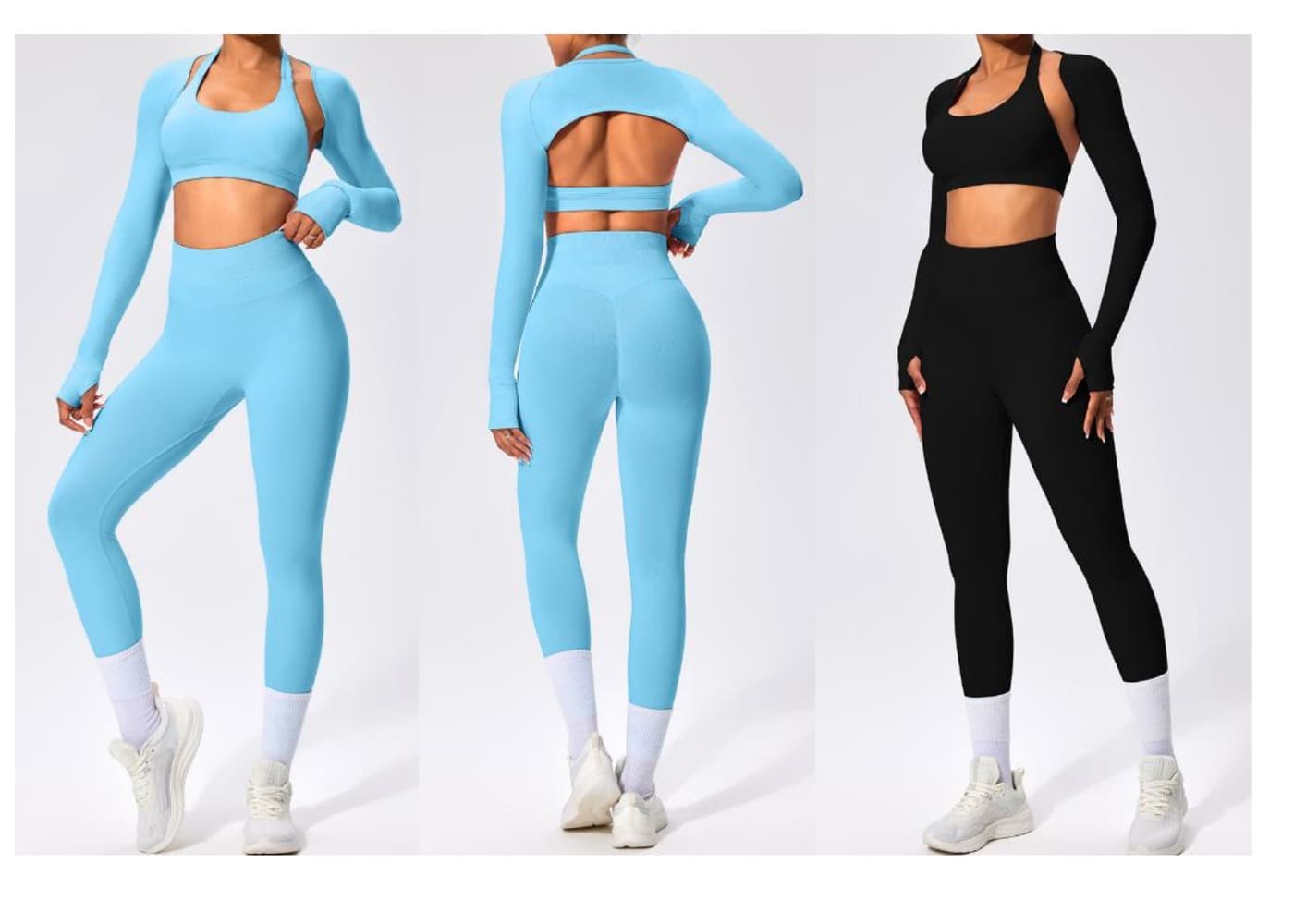
The Open-Back Long Sleeve Set illustrates how a fitted top, open-back feature and legging create connected colour and styling questions. The image does not prove that every garment uses the same fabric, batch, construction or price.
A set needs decisions about:
- Whether products are sold only together or also as separate SKUs.
- Whether sizes can be mixed within a set.
- Whether top and bottom use the same material or only the same colour.
- How shades are approved when materials or components differ.
- Whether the logo system is repeated or garment-specific.
- Whether pieces share labels, hangtags, barcodes and bags.
- How the set is folded, protected and identified.
- How shortages, inspection failures or replacements affect a complete set.
Do not divide a set quotation by the number of pieces and treat the result as a valid single-garment cost. The pack may include shared presentation work, but each garment still has its own material, conversion and approval scope.
How do fabric area, weight and usable width affect the comparison?
Fabric cost direction depends on more than garment category. Buyers should record the material code, construction, weight, usable width or purchasing unit, colour, finish, layers and consumption source for the current pattern. A sports bra with outer and lining materials can have less surface area but more material relationships. A legging may use one main fabric over a larger marker area. A top can add sleeve, hood or collar consumption. A set combines the consumption of each garment.
The fabrics and trims resource can help organise those questions. The supplier or factory should confirm consumption and purchase assumptions for the current pattern, sizes and colour plan. Do not infer exact consumption from a photograph or transfer a figure between products.
Pattern yield can change with long pieces, curved panels, directional surfaces, paired components, large size ranges and engineered artwork. Usable width and marker planning matter, but a buyer should not claim a production marker result without current factory evidence.
How do components and specialist operations change the product scope?
Components can become important even when their physical size is small. Sports bras may use elastic, cups, rings, sliders or closures. Leggings may use drawcords, zips, pocket materials or hardware. Tops may use zips, cords, eyelets, rib or mesh. Sets multiply or coordinate those items.
Printing, embroidery and wash effects should only be included when the confirmed artwork, material, garment zone and process route have been reviewed. Their cost direction can depend on method, colours, placements, dimensions, setup, evidence, handling and partner-factory scope. Do not present one method as universally cheaper.
For every component or specialist process, record:
- Item or method.
- Garment location.
- Product function.
- Colour and material relationship.
- Artwork or technical file.
- Sample or proof required.
- Supplier assumption.
- Buyer approval owner.
This prevents a “sports bra price” or “legging price” from hiding open components that later reappear in sample or bulk discussions.
How do fit, grading and sample work differ by product type?
The approval burden follows the garment’s risk points. A sports bra fit review may focus on neckline, straps, armholes, band, internal construction, coverage and the intended support direction. A legging review may focus on rise, waist, hip, crotch, gusset, inseam, pocket and movement. A top may focus on shoulder, sleeve, armhole, neckline, opening, body length and layering. A set needs every garment approved plus a review of their relationship.

*Real inPACE factory-context image illustrating a product-development review. It does not establish the specification, sample result, consumption, quotation or customer order for any product in this guide.*
The base-size sample does not automatically approve every size. The buyer should define the size range, grading direction, measurement points, tolerances and any size-set review required by the project. A material change can reopen fit because stretch, recovery, thickness and surface affect the finished garment.
Sample cost should be separated from bulk-unit scope and tied to the sample’s purpose. A development sample, fit sample, size set, colour sample, branded sample and pre-production sample do not answer the same question. The actual route and commercial treatment require project confirmation.
How do QC checkpoints differ across the four product types?
Quality-control scope should follow the approved product rather than one generic “activewear inspection” line. A sports bra can require checks around strap symmetry, neckline and armhole finish, lining, cup position, elastic or underband, edge appearance and left-right balance. A legging or biker short can require checks around waistband level, rise, gusset, pocket position, panel alignment, inseam, hem, measurements and the approved coverage direction.
For a workout top, the focus may include shoulder and sleeve balance, neckline, collar, zip or other opening, cuff or thumbhole, body length, hem and layering relationship. A coordinated set needs every garment checked against its own specification plus confirmation of colour relationship, size identification, complete-set packing and the approved SKU logic.
Use a product-specific QC map:
- Approved style, revision, sample and material reference.
- Measurement points and tolerances for the category.
- Material, lining, elastic, cup, zip, drawcord or other component identity.
- Critical seam, edge, pocket, panel and opening positions.
- Artwork, logo, label and care-file version.
- Colour and shade relationship where several materials or garments are combined.
- Packing, size marking, barcode and carton-assortment instruction.
- Defect category, disposition owner and evidence required before release.
This does not mean that more checklist lines automatically make one product more expensive. It means the quoted scope should identify which checks, samples or documents are required for the actual product. Removing an inspection point does not simplify the garment itself, and a lower quotation should not be created by silently dropping evidence that the buyer still needs.
The manufacturing and QC overview helps connect approved specifications to production records. When a product is changed after approval—such as a new legging fabric, bra elastic, top zip or set-packing method—the affected QC points should be reopened with the revised version.
How do colour and quantity plans affect each category?
Use a style-colour-size matrix. A total programme quantity can hide fragmentation across bras, leggings, tops, sets, colours and sizes. Each material, elastic, zip, cup, label or artwork colour may have its own purchasing or setup relationship.
For a coordinated set, the buyer must decide whether quantities are planned by set, garment or both. If pieces are sold separately, the top and bottom size curves may differ. If colours use different materials or components, the supplier should state how that affects the proposal.
Colour planning is a merchandising decision as well as a sourcing decision. The team can concentrate a core colour, phase an accent colour or share suitable confirmed components, but it should not assume that every colour can be combined commercially. Ask the supplier to quote the exact matrix and state its assumptions.
How do logos, labels and packing alter the category comparison?
Branding scope should follow the garment. A bra logo may sit on a small panel or band. A legging logo may sit near a waistband, hip or leg. A top can offer a chest, back or sleeve area. A set may repeat the logo or use one system across pieces. The material, stretch zone, seam position and artwork determine whether the proposed method needs a swatch, strike-off, panel or garment sample.
Labels and packing also differ. A bra, legging and top may need separate size and care records. A set can use one retail presentation while still needing each piece identified correctly. Barcodes, hangtags, fold method, bags, stickers, carton assortment and receiving instructions should be listed rather than assumed.
The private-label activewear route is appropriate when the underlying product is accepted and the project focuses on confirmed branding and presentation. When fit, fabric, construction, components or sample evidence change, use the custom activewear route.
How should buyers compare specifications with the same functional target?
Compare versions that solve the same buyer problem. For example, if the goal is a studio bra with stated coverage and an approved longline silhouette, Option A and Option B should keep those outcomes visible. If one option removes lining or changes the band, it is not equivalent until the buyer approves the new product evidence.
| Comparison field | Baseline version | Alternative version | Decision needed |
|---|---|---|---|
| Product role | Named wearer, use and channel | Same or explicitly changed | Confirm whether comparison remains valid |
| Material | Identified outer, lining and components | Identified alternative | Review fit, coverage, surface and care impact |
| Construction | Pattern, layers, seams and features | Documented changes | Decide sample and QC evidence |
| Branding | Artwork, method, size and placement | Revised branded scope | Approve appearance and material interaction |
| Quantity | Same style-colour-size matrix | Same matrix unless scenario is labelled | Separate product effects from quantity effects |
| Commercial scope | Currency, delivery basis, packing and exclusions | Same basis | Request like-for-like re-quotation |
The manufacturer quotation comparison guide helps align proposals from several suppliers. Keep product-type cost drivers as the input to that comparison; do not use the category label alone as proof that two quotes cover the same work.
What should a category-specific RFQ contain?
Send one brief per product or a clearly separated workbook:
- Product role, target wearer, channel and route.
- Current style ID, revision, reference and open questions.
- Base size, size range, measurements and grading direction.
- Main fabric, lining, mesh, elastic, binding and components.
- Sports-bra support/coverage construction where applicable.
- Legging or short rise, waistband, gusset, pocket and length.
- Top shoulder, sleeve, armhole, neck, opening and body length.
- Set relationship, SKU logic and mixed-size rules.
- Colour-size quantities by garment.
- Artwork, logo, labels, hangtags, barcode and packing.
- Sample purpose, reviewers and approval condition.
- QC points, required documentation and destination context.
Ask the supplier to mark confirmed details, assumptions, alternatives, exclusions and items that still need a sample. That produces a more useful category quotation than a request for “your sports bra price” or “your legging price.”
How can inPACE support a product-specific cost-driver review?
inPACE can review sports bra, legging, short, workout top and set briefs; discuss material, stretch, coverage, support, structure and fit requirements; and identify which category details need physical sample evidence. Where the confirmed scope makes it appropriate, inPACE can coordinate suitable work across multiple partner factories and connect approved specifications with production planning, QC and packing.
That support is informed by more than 30 years of garment-production experience. It is not a universal price list, a promise that one category is cheaper, or a guarantee of timing, capacity, certification or performance. The actual quotation depends on the product version, materials, components, colours, sizes, quantities, branding, evidence and commercial basis.
Use the Activewear Performance collection to identify product directions. When ready, send the product category, construction, material, branding, size-colour plan and target route for a category cost-driver review.
Product directions
Explore relevant activewear products
Use these product pages as practical references for your brief, then confirm materials, fit, customization, and production details through sampling.
Wide-Strap Longline Sports Bra
Use this bra direction to map strap, neckline, longline body, lining, cup-route and underband questions before requesting a category quotation.
View product directionSide-Pocket Biker Shorts
Use this bottom direction to identify waistband, rise, pocket, side-seam, inseam and hem decisions that belong in the cost-driver map.
View product directionQuarter-Zip Long-Sleeve Training Top
Use this top direction to map collar, zip, shoulder, sleeve, thumbhole, body-length and layering decisions before sampling.
View product directionFAQ
Buyer questions
Which activewear product type is cheapest to manufacture?
There is no universal ranking. A sports bra, legging, workout top and set use different material areas, layers, components, operations and approval work. Compare controlled specifications, quantities and commercial scope rather than applying one category price assumption.
Why can a sports bra cost more than its material area suggests?
A sports bra may combine outer fabric, lining, mesh, cups, elastic, binding, shaped panels, straps, edge finishing and precise fit points. The actual construction and sample evidence matter more than garment area alone.
What usually drives a legging or biker-short quotation?
Key drivers can include the identified fabric and consumption, waistband construction, gusset, pockets, panel seams, length, size range, colour-size quantities, branding, sample route and packing. The supplier should confirm the current pattern and scope.
Why do zip workout tops need a separate cost review?
A zip style adds a specified component and construction around the opening, collar or neckline. The tape, teeth, slider, puller, guard or facing, material behaviour, sample evidence and QC points must be reviewed for the actual product.
Should an activewear set be quoted as one product?
The selling presentation may be one set, but each garment has its own BOM, pattern, fit, grading and operations. The quote should show the pieces, shared presentation scope, SKU logic and whether sizes or replacements can be handled separately.
Can a product image prove activewear material or construction cost?
No. An image can show silhouette and visible features, but not the exact material, layers, pattern, seam route, components, consumption, grading, sample work or commercial terms. Use a controlled specification and supplier response.
How should buyers compare two products with the same function?
Keep the product role, required fit, coverage or support, quantity matrix and commercial basis visible. Document material and construction changes, identify their product risks, request the required sample evidence and compare revised quotations on the same scope.
What should a buyer send inPACE for a category cost-driver review?
Send the product category and role, current specification or reference, construction, materials, components, size-colour matrix, branding, packing, sample purpose, QC questions, quotation basis and the decisions that remain open.