
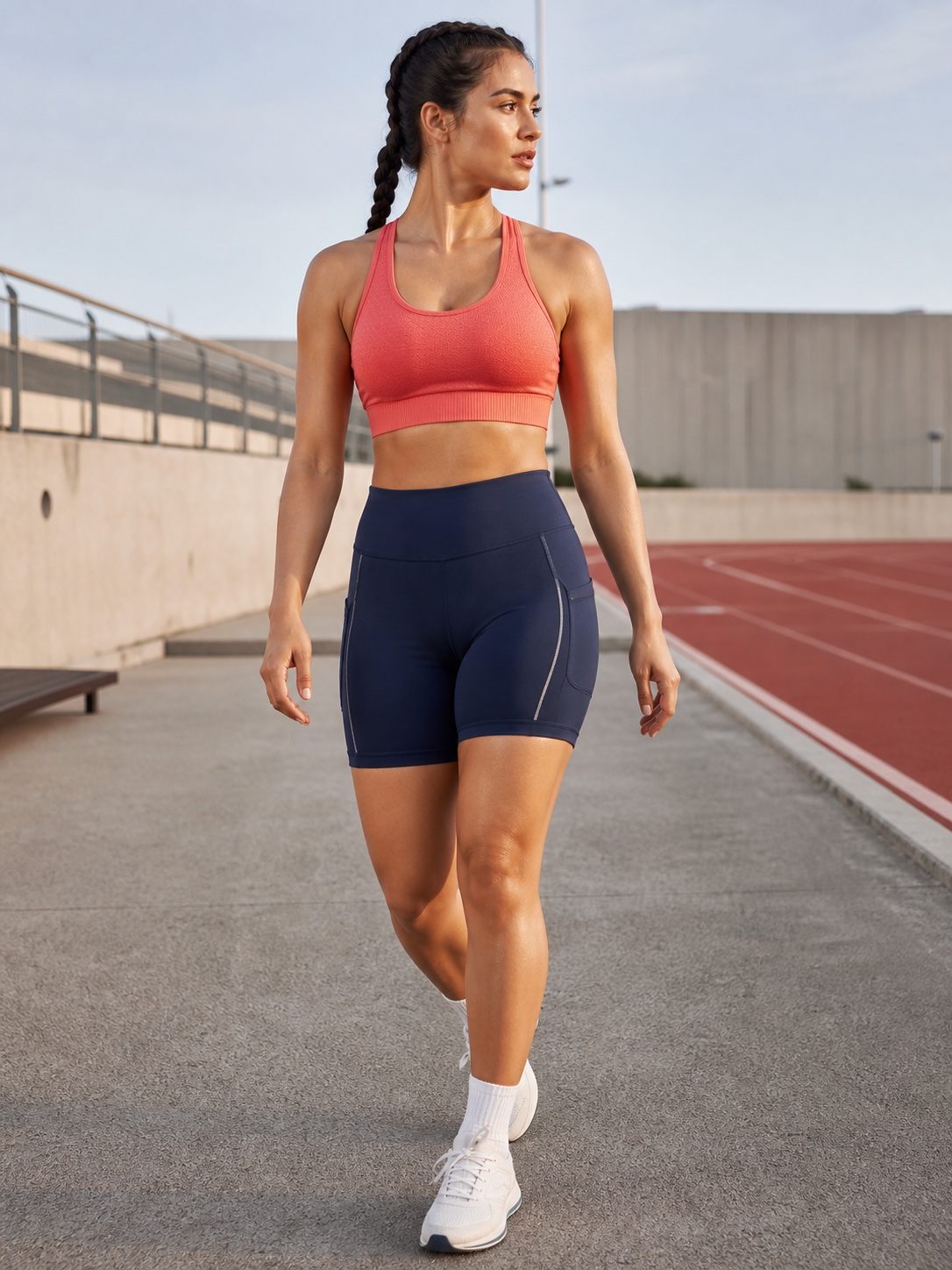
When does a running apparel idea need factory-custom development?
A running collection can start with an existing product direction when the base silhouette, material role, construction, and functional purpose are already close to what the brand needs. A catalogue reference helps a buyer say, for example, that the project begins with a short-and-tank set, a close-fit running layer, or a pocketed bottom. It is a starting point for discussion, not a promise of retail inventory or an instruction to copy every visible detail.
The project becomes factory custom manufacturing when the buyer's core requirement changes how the garment must be developed. Examples include a different short length, a separate inner short, a particular pocket location, a new waistband relationship, a changed leg opening, a revised panel arrangement, a material combination, a reflective detail, or a fit question that an existing reference does not answer. Those choices can affect pattern work, components, construction, sample review, production communication, QC, and packing.
That boundary matters because a running garment usually has more than one job. It must sit correctly while the wearer moves; it may need to carry an item, layer over or under another piece, manage a particular coverage expectation, and present a recognisable brand. A visual reference can reveal a general direction, but it rarely confirms the inside construction, measurement logic, fabric behaviour, component choices, attachment method, or approval evidence needed before production.
For a brand, the useful question is not whether a supplier can make "running wear" in the abstract. The question is what the runner must be able to do in the intended garment and which product decisions must be physically reviewed before the production package is released. The Jogging & Printed Activewear Catalog can help identify a product direction; the factory brief should make the custom requirements visible beside it.
What does a custom running apparel manufacturer need before sampling?
Begin with the commercial and use context. State whether the garment is for road running, trail-oriented training, club kit, a running-and-gym crossover, warm-up layering, or another defined use. Name the intended wearer, climate or layering context where relevant, channel, destination market, and product role in the collection. These inputs do not decide the construction on their own, but they tell the factory which questions should be asked rather than guessed.
Then describe the garment as a set of decisions. A running short is not fully defined by an inseam label or a front photograph. The brief needs to show whether it has an outer shell and inner layer, what coverage and movement relationship the buyer expects, where pockets sit, which edge touches the body, how the waistband is intended to feel, and where artwork, labels, or other branding must be considered. A running top needs its own decisions: body length, sleeve or armhole treatment, neck opening, paneling, ventilation idea, visible logo zones, and the material or layer relationship.
Mark the status of each item. Use labels such as proposed, factory review requested, sample evidence needed, approved for the next sample, or approved for production. This is more useful than sending a polished mood board that conceals which details remain open. It also protects the brand when one change affects several parts of the product: a revised pocket may change the panel, seam route, lining, waistband, artwork zone, and sample review plan together.
Which running-brief decisions change the factory review?
Use one decision matrix for every style. It helps a buyer, product developer, and factory discuss the same version of the garment rather than comparing separate images, emails, and files.
| Brief decision | What the buyer should provide | Why it changes factory review | Evidence to request before release |
|---|---|---|---|
| Runner and product role | Activity, target wearer, use duration, layering context, channel, and the role of the style in the range | It gives purpose to fit, coverage, carrying, material, and branding questions without claiming one construction suits every runner | A brief that names the use context and distinguishes confirmed requirements from open questions |
| Reference direction | Product URL, images, sketch, existing sample, or tech pack with marked parts to keep, change, or investigate | It separates a visual starting point from the actual custom-development scope | Annotated front, back, inside, and detail references tied to the current style version |
| Fit and length | Base size, target size range, body and garment priorities, short length, rise, hem, top length, sleeve or armhole intent | Small dimensional changes can alter balance, coverage, chafing zones, movement, and the need for pattern or grading review | A measured sample and recorded comments for the named size, wearer context, and version |
| Inner layer and coverage | Whether the style has an inner short, brief, liner, compression layer, or no inner layer; contact areas and expected movement | It affects component selection, attachment, seam placement, openings, comfort review, and how the outer layer works in motion | Inside-out photographs plus wear observations on the complete proposed sample |
| Pocket system | Intended carried item, pocket location, opening, closure idea, access direction, and whether the item must remain stable in movement | A pocket can change panel layout, seam load, bulk, access, waistband construction, and sample questions | A sample checked with the stated carried item and movement context, not an empty pocket only |
| Waistband and openings | Desired visual height, adjustment or drawcord idea, elastic or binding relationship, leg opening, and skin-contact priorities | The construction depends on body material, layering, attachment sequence, fit, and the interaction of multiple components | A sample reviewed relaxed and in movement, with any edge or pressure observations recorded |
| Materials and branding | Body and contrast material direction, lining, mesh or trim role, colour direction, logo artwork, placement, labels, and packing information known so far | Materials and brand details influence stretch, opacity, attachment, visual contrast, sample timing, and production documentation | Swatches or references, artwork version, placement mark-up, and sample evidence for the actual garment combination |
| Production record | Quantity direction, size-colour matrix, destination market, QC priorities, packing needs, owner, revision date, and open decisions | It connects the approved sample to the information that has to remain consistent through production, QC, packing, and receipt | A controlled production brief that identifies the latest approved files and any exceptions |
Do not treat this matrix as a request for fixed figures. Cost, quantity planning, sample route, and timing depend on the actual product, materials, colours, components, branding, packing, and order conditions. The useful output is a shared set of assumptions that can be reviewed and changed transparently.
How should a buyer use a catalogue running style without copying it blindly?
Use a catalogue style as a language tool. It gives the factory a concrete point of reference for silhouette, product category, visual balance, and construction questions. The Run-Training Short Set, for example, can help a buyer identify a possible outer-short and inner-layer direction. The brief should then state exactly which features are a starting reference, which need changing, and which parts are only visual inspiration.
Write down the differences in plain language. Instead of saying "make this better," say that the project needs a different outer-short length, a waistband that can be reviewed with a particular inner layer, a pocket for a stated item, a changed hem treatment, a new panel, an alternate material handfeel, or a differently positioned logo. The more specific the decision, the easier it is to choose the right sample evidence and avoid a quote based on an unintended version of the product.
The same approach works for a running layer. The Raglan Training Layer may establish the product family, but it cannot prove the desired sleeve length, neck opening, body length, fabric behaviour, underarm construction, branding zone, or ventilation treatment for another brief. Mark each visible feature as keep, change, investigate, or not applicable. A reference image is valuable when it narrows a question; it becomes risky when it is treated as a complete specification.
If the product can remain close to an existing style and only needs logo, labels, hangtags, or packing, it may fit a wholesale/light-customization discussion. If the brief needs a new fit, fabric, construction, colour relationship, functional feature, or sample route, use the custom activewear development route from the outset. Naming that boundary early is more accurate than calling every branded running item private label.
What must be clear about liners, inner shorts, and skin-contact areas?
An inner short, brief, or liner is not an invisible detail. It changes the garment system. The buyer should explain whether it is intended for coverage, separation, support, carrying, modesty, or another product purpose; where it attaches; which areas touch the body; how it relates to the outer layer; and which motion or comfort questions the sample must answer. Avoid promising that a liner prevents any universal issue. The appropriate construction depends on the fit, material, size, movement, seams, openings, and wearer context.
Describe the product from the inside as well as the outside. Show the attachment points, inside edges, gusset or opening relationship if relevant, label position, pocket access, and locations likely to receive repeated movement or skin contact. Ask for the complete garment sample to be reviewed inside out, relaxed, and in relevant movement. A flat sketch of the outer short alone cannot show whether the inner layer changes the intended experience.
Keep comfort comments specific. "Less rubbing" is a useful concern but not a usable factory instruction by itself. State the location, activity, garment size, sample version, fabric combination, and observation. Then ask what next evidence is needed: a construction adjustment, another material or component review, a revised sample, or a record that the current detail was accepted for the next stage.
How should pockets, waistbands, and access points be briefed?
Start with the carried item and the intended access. A pocket meant for a small key, a phone-sized item, a gel, or nothing at all raises different questions. State the item category without assuming one pocket size or construction will work for every garment. Identify whether the pocket is in the side seam, outer short, inner layer, waistband, back area, or another location; whether it should be open or have a closure; and whether the buyer needs the item to be accessed while moving, before a run, or only for storage.
The factory then needs to review the pocket as part of the garment, not as an isolated rectangle. Its position may change the panel route, seam intersections, material layers, waistband, stretch direction, opening finish, construction order, and visible bulk. The sample should be assessed with the intended item and the named movement context. A pocket that appears tidy when empty may behave differently once an item, a liner, a fabric change, or a new size is involved.
For the waistband, name the visual and functional questions rather than prescribing an unverified result. Describe the desired height, whether an adjustment element is being considered, where branding can sit, which edge touches the body, the relationship to the outer and inner layers, and what the brand wants to inspect during the sample review. A drawcord, elastic, binding, seam, or pocket opening should be evaluated with the intended fabric and size. The fabrics and trims overview is useful for organising material and component questions before the final sample combination is approved.
How should material, panels, and branding be connected in one brief?
List materials by their role in the garment: outer short, inner layer, body panel, contrast panel, waistband, pocket bag, mesh or ventilation area, binding, elastic, lining, label, and logo zone. Attach the current reference for each item and state whether it is approved, proposed, or requires factory review. This prevents a broad phrase such as "quick-dry fabric" from being treated as a complete material specification.
Material decisions should be considered beside pattern and construction decisions. A material can look different at a pocket edge than on the body; a panel can change the relationship between stretch direction and fit; a mesh zone can affect construction, visibility, and logo placement; a lining can add an approval question for the inside of the garment. The buyer does not need to claim test results to make a useful brief. It is enough to name the intended use, the qualities to review, and the evidence needed from the proposed sample.
Branding needs the same discipline. Supply the current artwork file, version name, proposed placement, approximate dimensions or proportion, colour direction, and areas to avoid. State whether the logo is a simple placement request or part of a larger printed panel or brand system. A mock-up cannot demonstrate the finished result on the selected material, stretch zone, seam, or pocket. Record the physical or sample evidence required before it is treated as approved.
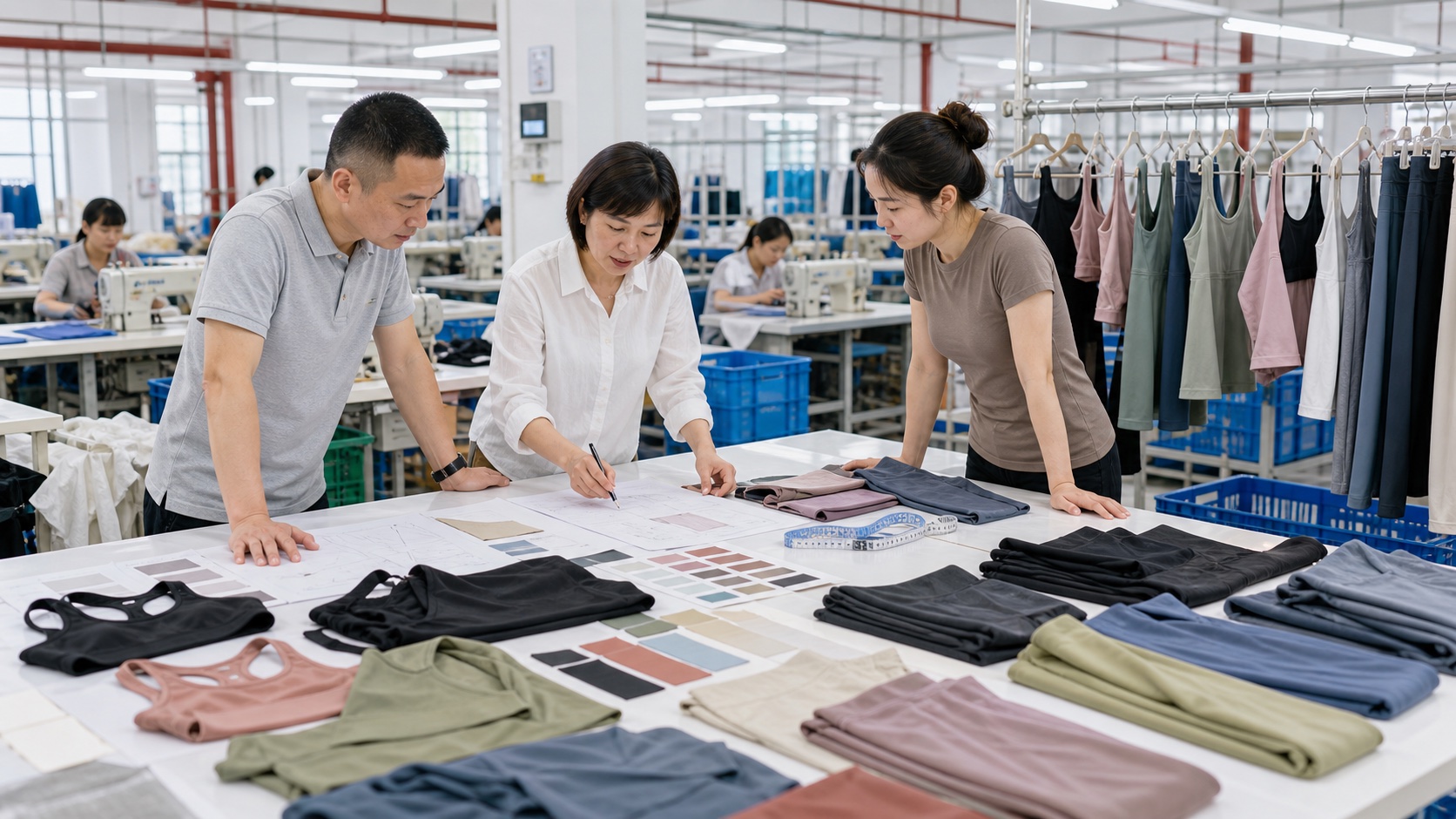
The image above illustrates the working conversation a clear brief should support: product references, materials, garments, and documents are considered together. It does not prove that any visual detail is approved for a specific order. Approval depends on the buyer's actual brief, the proposed sample, and the recorded decision.
How can a running brief turn into a useful sample plan?
A sample plan should answer a small number of specific questions rather than try to settle every decision at once. Begin by identifying the first evidence the brand needs: proportion and fit, a new inner layer, a pocket position, waistband construction, material interaction, an artwork placement, or the relationship between several of these variables. Link that question to the current reference and the sample version so the resulting comments can be evaluated without ambiguity.
For each review, write the garment name, base size, current pattern or reference version, materials and components used, person or team reviewing it, activity context, observed result, requested action, owner, and next decision. A comment such as "pocket looks wrong" should become a traceable instruction: which pocket, on which size and sample, with which item, during what movement, and what needs to change or be investigated. This preserves the evidence when the next sample differs from the first.
It is also useful to separate sample approval from production release. A sample may confirm a design direction while material availability, artwork, labels, packing, size-colour allocation, or another component still requires review. Keep an approval register with discrete statuses rather than turning an early sample into a universal approval. The activewear tech pack checklist explains how to keep product references, measurements, materials, construction, branding, packing, and version control connected as the brief develops.
The production route should remain conditional. The activewear manufacturing workflow can help buyers see where sample approval, production communication, QC, packing, and export preparation fit into the wider project. It does not replace confirmation of the chosen product, material, component, order conditions, or destination requirements.
Which checks should be complete before asking for a factory review?
Before requesting a running-apparel factory review, prepare the following buyer checklist. It does not require every answer to be final; it requires the buyer to label what is known and what must be confirmed.
- Name the style, product role, target runner, use context, sales channel, and destination market.
- Provide the closest product URL, reference images, sketch, existing sample, or tech pack, and mark the parts to keep, change, or investigate.
- State the base size, intended size range, and the fit, coverage, length, and movement priorities that need review.
- Explain whether the garment has an outer layer, inner short, brief, liner, or no inner layer, and describe attachment and skin-contact questions.
- Identify each pocket, the intended carried-item category, location, access direction, closure idea, and movement question.
- Describe the waistband, leg opening, drawcord or adjustment idea, edge treatment, and contact zones that should be reviewed on the sample.
- List body, contrast, lining, mesh, trim, elastic, and pocket materials by their product role, with current references where available.
- Mark panel lines, seam intersections, ventilation ideas, and construction details that affect function or appearance.
- Supply the current logo artwork, placement mark-up, colour direction, size or proportion guidance, and any areas that must remain clear.
- Include labels, hangtags, barcode fields, individual packing, folding, carton-mark, and receiving information that is already known.
- Provide a preliminary style-colour-size quantity matrix and clearly mark assumptions rather than treating estimates as final commitments.
- Identify the destination market and any buyer-supplied labeling, packing, or receipt requirements that must be considered.
- State what the first sample should prove and which open decisions can wait for a later review.
- Record each sample's version, date, base size, material combination, reviewer, observations, required actions, and next approval gate.
- Keep superseded artwork, reference images, and instructions out of the active production file while retaining a revision history.
- Ask the factory to identify missing inputs and to show the assumptions used for any quotation or sample discussion.
How can inPACE Sports support a running-apparel brief?
inPACE Sports can use a buyer's running reference and custom brief to discuss an appropriate factory-custom development path. For Ningbo Yinshan Garments Factory, a productive review connects the intended product, fit, materials, construction, branding, sample questions, QC priorities, packing information, and destination context rather than treating any one image as a finished specification.
The practical next step may be to confirm a catalogue reference, review materials and trims, prepare a clearer tech pack, or plan what the first sample must demonstrate. The final route depends on the actual garment and project conditions. It should not imply a fixed MOQ, price, timeline, capacity, material availability, test result, or certification that has not been confirmed for the brief.
What should a brand send next?
Send a concise running-apparel brief with the activity and target runner, product references, front/back/inside mark-ups, desired fit and length, inner-layer and coverage intent, pocket and waistband requirements, materials, panel and construction questions, branding files, labels and packing information, size-colour-quantity direction, destination market, and the sample questions that remain open.
Keep the request decision-focused. A factory can give a more useful response when it can see what must be preserved, what may change, what needs physical evidence, and who will approve the next version. When the brief is ready, share a custom running apparel product brief with the current files and the one or two questions that matter most for the first review.
Product directions
Explore relevant activewear products
Use these product pages as practical references for your brief, then confirm materials, fit, customization, and production details through sampling.
Run-Training Short Set
Use this layered running reference to identify the outer-short, inner-short, waistband, pocket, and movement questions that a factory brief must resolve.
View product directionRaglan Training Layer
Use this running-layer reference to discuss sleeve length, panel layout, openings, fabric direction, logo zones, and sample evidence before production.
View product directionCustom Activewear Development
Choose the factory-custom route when the running brief requires a new fit, material, liner, pocket system, waistband, construction, or sample plan.
View product directionFAQ
Buyer questions
What should a custom running apparel brief include?
Include the target runner and use context, product reference, fit and length priorities, materials, outer and inner-layer relationship, pockets, waistband, panels, construction questions, logo and label details, packing information, size-colour-quantity direction, destination market, and the sample evidence still needed. Mark what is approved, proposed, and open so the factory does not treat an assumption as a final instruction.
Can a catalogue running style be used as the starting point for a custom project?
Yes. A catalogue style can help identify the garment category, silhouette, visual balance, and initial construction questions. The buyer should mark which features are a starting reference, which must change, and which are only inspiration. A new fit, fabric, liner, pocket, waistband, panel, functional detail, or sample plan should be treated as factory-custom development rather than assumed to be included in the catalogue reference.
How should a brand brief an inner short or liner for running apparel?
State the intended purpose of the inner layer, where it attaches, coverage and skin-contact priorities, relationship to the outer garment, pocket access, material direction, and the movement questions the sample must answer. Review the complete garment inside out and in relevant movement. The appropriate construction depends on the product, fit, materials, size, seam locations, openings, and wearer context.
What pocket details matter in a running apparel factory brief?
Identify the carried-item category, pocket location, opening, closure idea, access direction, and movement context. A pocket may affect panel layout, seam intersections, material layers, waistband construction, stretch direction, bulk, and sample review. Ask for the proposed pocket to be assessed with the intended item and the named activity instead of judging an empty pocket only.
Do custom running apparel projects have a fixed MOQ, price, or lead time?
No universal figure should be assumed. The appropriate order plan, quotation, sample route, and timing depend on the style, materials, colours, components, liner, pockets, logo and label requirements, packing, quantity allocation, and project conditions. Share a current brief and ask the factory to record the assumptions used for the specific discussion.
What should the first running apparel sample prove?
The first sample should answer the most important open decisions, such as fit and proportion, short or top length, inner-layer relationship, pocket placement, waistband construction, material interaction, panel layout, or logo position. Record the sample version, base size, materials, reviewer, movement context, observations, requested actions, and next decision so the following review is traceable.
When should a running apparel project move from light customization to factory-custom development?
Move to factory-custom development when the core requirement changes the product itself: a new fit, material, construction, liner, pocket arrangement, waistband, length, panel, colour relationship, functional feature, or sample plan. If the existing product direction remains suitable and the main work is logo, labels, hangtags, or packing, a light-customization discussion may be more appropriate after the actual project details are reviewed.