

Bio-based activewear claims should name the material, percentage basis and component they describe. A supplier statement about a named fiber cannot automatically describe a fabric or finished garment, and renewable content does not prove recyclability or lower impact. Verify source documents, map the bill of materials and assess the actual garment sample before approving product wording.
What should a bio-based activewear fabric claim prove?
The first task is to stop treating bio-based, renewable, recycled, biodegradable and recyclable as synonyms. They describe different attributes and may require different proof. A renewable feedstock does not by itself prove that the finished textile is recyclable. A bio-based polymer is not necessarily biodegradable in a particular environment. Recycled content has its own chain-of-custody and transaction evidence. This guide focuses on how a buyer can verify bio-based or renewable-content claims at the material level and carry their scope accurately into product development.
A useful public example is The LYCRA Company’s announcement about a renewable LYCRA fiber technology using QIRA-derived BDO. The company announcement states that the renewable input represents 70% of that named fiber’s BDO/PTMEG component. The denominator matters: it is not a statement that an entire fabric or garment is 70% renewable. It also does not establish that inPACE currently sources or uses that technology. Treat it as a supplier example and request current documentation for any project candidate.
What is the difference between fiber, yarn, fabric and garment claims?
Fiber is one material input. Yarn may combine fibers or use a particular construction. Fabric combines yarns in a knit or weave and may include finishes, dyes, coatings or laminations. A garment combines fabric panels with elastic, thread, labels, prints, zippers and other components. A claim made at one level cannot simply be repeated at the next level without a documented calculation and evidence chain.
For example, a supplier may state that a defined portion of a component within a specific fiber comes from a renewable feedstock. That does not state the renewable share of a yarn blended with another fiber, the total fabric, or the garment. To calculate a garment-level percentage, a buyer would need the relevant component weights, exact composition by part and a defined calculation method. If the evidence is missing, the product claim should remain at the supplier’s material level or be left out.
| Claim level | What it describes | Evidence to request | Common overreach |
|---|---|---|---|
| Polymer ingredient | Input used to make a named polymer component | Supplier statement naming ingredient, technology and denominator | Calling the whole fiber renewable |
| Fiber | A defined fiber product and composition claim | Product name, technical statement, date and applicable share | Applying a fiber claim to every fabric using that fiber |
| Yarn | Fibers or polymers combined in a yarn | Yarn code, composition, blend and supplier documentation | Assuming the yarn is a fabric specification |
| Fabric | A specific knit or woven construction and finish | Fabric code, composition, supplier records and relevant certification if claimed | Extending one fabric’s claim to a different colour or finish without evidence |
| Garment component | A panel or BOM line item | Approved BOM, component weight or percentage basis and source record | Omitting elastic, lining, trim or decoration |
| Finished garment | All included components under a named method | Complete BOM, calculation scope, version and claim review | Using one ingredient’s percentage as the garment percentage |
This hierarchy should appear in the buyer’s sourcing notes, not only in the legal review. A product developer chooses the material and component. The factory maps it into a garment. A sustainability or compliance owner checks claim language. If those teams are working from different versions, the final description can accidentally overstate the evidence even when a supplier statement was accurate in its original scope.
How should a buyer verify a supplier statement?
Ask for the original source document from the supplier or trademark owner, not just a sales slide copied into an email. Record the issuer, exact commercial product, code or variant, date, version, claim language, percentage basis, and the component to which it applies. If the document refers to a technology or planned production route, ask whether it applies to the candidate currently offered and whether the source has changed. A company announcement can explain a public claim; it may not serve as transaction-level evidence for a specific purchase.
Check whether the document describes an ingredient, polymer, fiber, yarn, fabric or finished article. Find the denominator in the exact wording. Is the percentage based on a named component, total fiber mass, a molecule, a fabric weight or something else? If it is not clear, ask the supplier to clarify in writing. Never infer a fabric percentage from a fiber percentage without the material composition and calculation method.
Request the supplier’s product data and chain records that connect the claim to the material actually sampled. A lab analysis may be relevant for some composition questions, but a composition test does not necessarily establish renewable feedstock origin. Some attributes rely on sourcing declarations or certification schemes rather than a routine fiber-identification test. The buyer should ask the claim owner which evidence type supports the statement, and have the responsible reviewer decide whether it is sufficient for the intended market.
A website banner, sustainability slogan or award announcement can be a discovery lead. It is not automatically a certificate, transaction record, bill of materials or permission to use a trademark. Preserve a copy of the dated supplier source and the response for the exact candidate. If the only available source names a technology but not a commercial code, record the code as pending and avoid describing the proposed garment as confirmed.
How do you connect the material claim to the BOM?
A bill of materials should identify every garment component relevant to the claim. Depending on the product, that may include body fabric, lining, mesh, waistband, pocket bag, elastic, thread, binding, labels, print, transfer, embroidery, zipper tape and other trims. The BOM should show the component’s exact material code and composition when known, as well as the supplier or source. If the material changes between sample and production, the claim may need to be reviewed again.
A percentage for the garment requires a method. The buyer needs a complete component list, the chosen mass basis, component quantities or weights and a clear scope for what counts as part of the garment. Excluded packaging should not be confused with garment materials; included trim should not disappear just because it is a small portion. If the supplier’s claim covers only one fiber, a consumer-facing phrase should name that fiber or component rather than suggest the complete garment has the same percentage.
Use a blank calculation sheet when data is incomplete. Mark candidate fiber share, fabric share, component mass and finished-garment share as not calculated until the necessary quantities and source documents exist. Do not fill a field with an estimate simply to make the table appear finished. The open question becomes an action for the buyer, supplier and product owner.
| BOM line | Supplier code / composition | Evidence level | Claim share needed? | Open verification |
|---|---|---|---|---|
| Main body | To be confirmed | Supplier record pending | Yes, if claim covers body fabric | Confirm fiber source and percentage basis |
| Lining | To be confirmed | Not supplied | Yes, if included in garment statement | Identify whether lining uses the same material |
| Waistband / elastic | To be confirmed | Not supplied | Yes, if included in finished garment | Record polymer and construction separately |
| Thread / binding | To be confirmed | Not supplied | Include if the chosen method requires it | Ask whether small components are inside the claim boundary |
| Labels / decoration | To be confirmed | Artwork / trim records pending | Depends on public wording | Confirm process, content and scope |
| Packaging | Separately documented | Packaging source | Usually distinct from garment composition | Do not combine with garment denominator unless stated |
When a buyer cannot map all BOM lines, the responsible approach is to narrow the claim. For instance, a material description may state the exact supplier-defined attribute for the named fiber used in a panel. It should not imply that every part of the garment shares the attribute. Specific wording is easier to audit and less likely to mislead a customer.
What does “70% renewable” mean in the LYCRA example?
The LYCRA Company’s public announcement says its renewable LYCRA fiber technology incorporates QIRA-derived BDO and that the renewable content accounts for 70% of the BDO/PTMEG component of the fiber. The claim is about a named fiber technology and a specified component basis. It is not a universal statement about all LYCRA fiber, every stretch fabric, or the total weight of a garment. The supplier’s current product details and documents should be checked for the exact commercial material before a buyer relies on it.
A buyer evaluating this material should ask which product code or program is actually being quoted, whether the offered sample matches the announced technology, what exact denominator appears in current documentation, and what commercial evidence can be supplied for the order. Ask whether the claim is supported by a supplier declaration, a certification or another source, and what language is authorized. If the supplier cannot map the specific yarn or fabric to the claim, keep it at discovery stage.
Do not calculate a garment share by multiplying 70% by a guessed elastane percentage or assumed fabric weight. The 70% figure in the cited statement refers to the supplier-defined component, not the fiber as a whole. Any further calculation requires the exact composition and a documented methodology. A sourcing team should not publish a simplified number that changes the underlying denominator.
A product’s actual BOM might contain a stretch fiber at a certain percentage, but the buyer still needs to know whether that fiber is the named renewable version, how much of it appears in each panel, and what the finished claim intends to describe. A blend, dye route, lining or alternate supplier can change the scope. Keep a clear link between the original supplier statement, the candidate code, the sample, the production BOM and the final copy.
What should be checked in the physical sample?
An environmental attribute does not prove that a material will meet the garment’s fit or performance requirements. The sample review still needs to examine handfeel, opacity, stretch, recovery, seam behaviour, surface, colour, printing or embroidery, wash response and wearer comfort as appropriate. A material may have a promising sourcing profile but need a new pattern or construction. Buyers should evaluate that trade-off through the same product gates used for any new fabric.
Begin with the exact sample identity: supplier, material code, variant, composition record, colour, fabric construction, garment component, date and sample size. If the code is missing, mark it as a development placeholder. Review the material on the intended garment rather than relying only on a lab dip or fabric square. Any coating, dye, print or finishing process should be documented because it may affect the claim, the product behaviour or both.
For stretch garments, compare the candidate and current control in the same direction and under the same agreed extension and recovery procedure. Record bagging and fit after the intended movements. For a close-fit legging or bra, review multiple relevant sizes if the project requires it. The lab should choose a method suitable to the textile structure; not every fabric method applies to every knit or yarn. A supplier report can support a material question only within its own stated scope.
For colour and decoration, review the actual shade, brand artwork, label and care instructions. A transfer or print may cover a surface or change handfeel. A darker or lighter colour may behave differently in production. A material statement for one undyed or unfinished candidate should not be automatically assumed for a different colour or finish. Request written confirmation and tie the claim evidence to the approved version.
A wash review should use the intended care label and garment construction. Record the sample version, procedure, cycles, drying method, measurements, surface observations and any change in claim documentation. One sample wash does not prove a long-term environmental or durability benefit. The organic cotton fabric guide provides a related example of keeping fiber storytelling separate from finished-garment facts, while the activewear wash-sample brief offers a way to capture care review consistently.
How do bio-based, recycled and other claims differ?
A bio-based claim concerns an input’s biological origin under a defined standard or supplier methodology. A recycled-content claim concerns material that has been recovered and reprocessed, and usually requires a separate chain of custody and transaction evidence. A biodegradable or compostable statement concerns behavior under specified conditions; it does not follow from renewable feedstock alone. A recyclable claim concerns an available collection and processing route and the product’s compatibility with that route. Each phrase has a different proof burden.
A mixed fabric can include more than one of these attributes in distinct components. A product might use a recycled polyester shell and a named renewable stretch fiber in a waistband, but the buyer must verify both claims independently. If one claim applies to a fabric and the other to a fiber, keep their denominators and source documents separate. A garment-level statement needs an explicit calculation boundary and complete enough BOM evidence.
Do not use sustainability as a substitute for a measurable material description. Name the attribute, source, scope and evidence. If a supplier says the material is more sustainable but gives no comparison basis, ask: compared with what, for which impact, using which life-cycle boundary, data year and methodology? If those answers are unavailable, report the attribute the evidence supports and leave comparative language out.
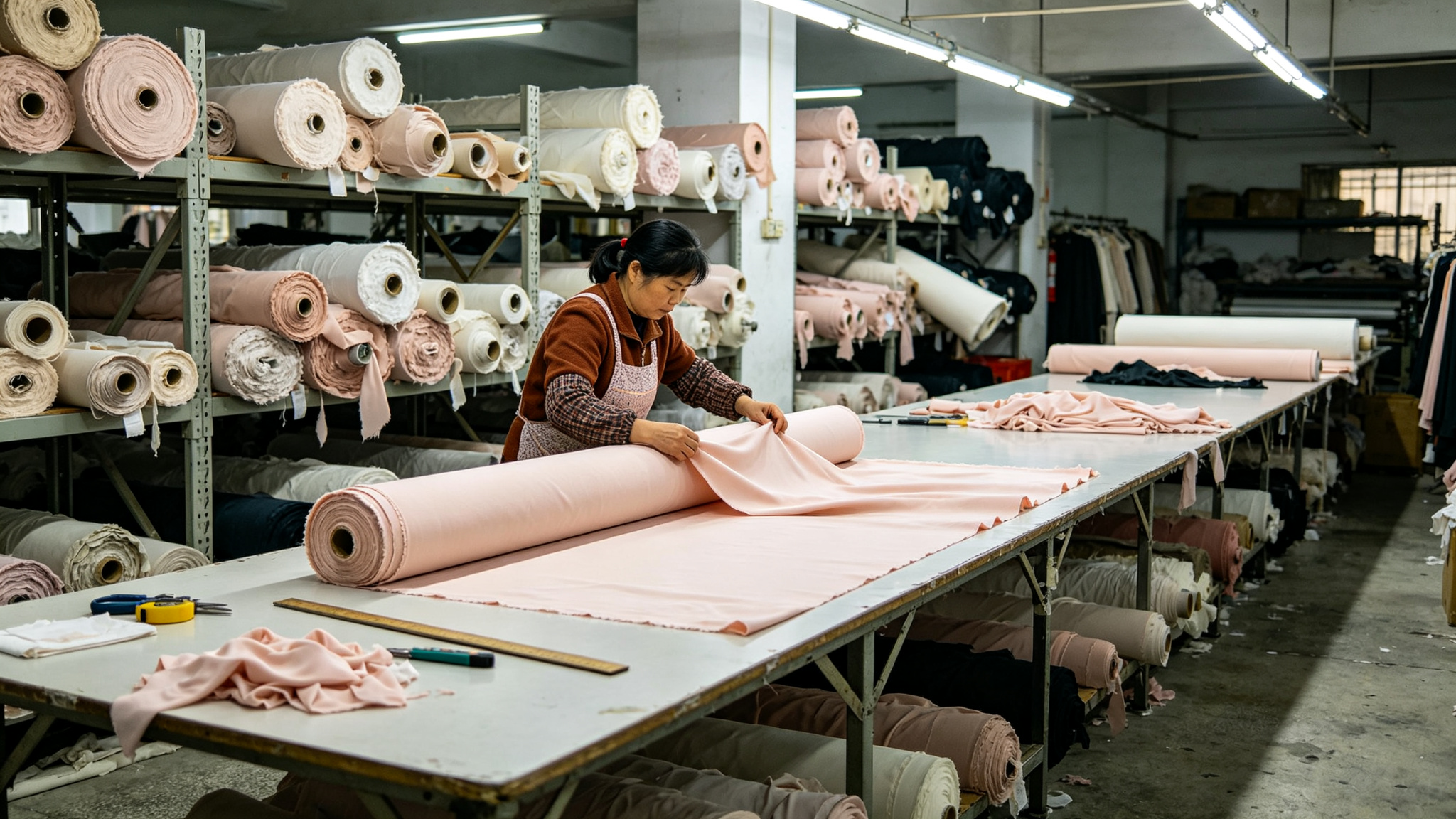
The pictured materials are process references only; they do not establish renewable content or identify the composition of a production candidate.
The buyer should also review claims across markets. Product wording may be subject to different rules and substantiation expectations in the intended sales locations. Have the responsible legal or compliance owner review consumer-facing statements. A manufacturing supplier can provide source and sample information, but the brand remains accountable for the final product representation.
What does a sample and supplier brief need?
A procurement brief should distinguish interest from approval. At the discovery stage, the buyer may ask whether a named technology or route can be explored. Before a sample is commissioned, identify a product role and list the source documents needed. Before a garment claim is approved, the evidence must connect to a named candidate, component and product wording. That phased approach avoids treating a promising article or supplier page as a procurement commitment.
| Brief field | Buyer should specify | Why it matters |
|---|---|---|
| Product and use | Garment type, wearer, activity, market and fit | Defines the technical role and claim context |
| Candidate | Supplier, exact code, variant, construction and colour | Connects source evidence to the actual sample |
| Claim wording | Proposed words and level: fiber, yarn, fabric, component or garment | Prevents denominator drift |
| Source record | Issuer, document date, version, percentage and basis | Makes verification repeatable |
| BOM | Component, composition, weight basis and source | Supports scope and any calculation |
| Sample review | Stretch, recovery, opacity, seams, colour and care | Confirms product fit separately from sourcing attribute |
| Evidence owner | Supplier contact, buyer, product team and legal reviewer | Assigns open questions |
| Approval gate | What is needed before copy, production or launch | Prevents premature public claims |
The brief should include what will happen if the source code changes. A supplier substitution could affect material content, test results, sample appearance or authorized wording. Ask the supplier to notify the buyer before replacing a candidate. The buyer then decides whether the change triggers a new document review, sample review, lab test or claim approval.
How should teams protect traceability after approval?
Store the source statement alongside the purchase and product records. Keep the approved version, document date, material code and component mapping. The production file should show which supplier and fabric were approved. If the order contains multiple colours, size runs or factories, identify which lots and versions are covered. A file in an inbox is not a robust traceability method if product, sourcing and marketing teams cannot find the current evidence.
When a product is revised, compare the changed fields with the evidence. A new colour might use a different dye route or mill. A change in supplier can break the chain between claim and material. A revised pattern can alter component weights. A changed trim can affect the garment-level calculation. The responsible owner should review the evidence scope again and decide whether public wording needs revision.
Avoid attaching a broad claim to a collection if only one style or colorway is supported. If evidence covers a specific style, name that style. If it covers one component, state that component. If the product page is being translated, preserve the same scope and denominator in every language. Translation should not make a careful material statement sound like a whole-garment certification.
Which inPACE product pages are valid references?
A catalogue page can help a buyer point to a product silhouette or use case. The AW-001 training set, AW-003 zip-neck set and DWD115066 yoga activewear reference can be starting points for describing a garment direction. They should not be presented as bio-based products unless a current product-specific BOM and supporting evidence establish that claim. This article does not claim that those catalogue garments use renewable materials.
If the buyer needs a newly sourced fiber, different fabric, altered fit or new component architecture, start from the custom activewear development route. If the existing material and product stay the same and the work centers on logo, label or packing, the private-label page may be a more relevant route. In either case, the buyer should provide the source claim and its exact scope before asking the factory to incorporate it into a product description.
For broader fabric comparison, use the activewear fabric selection guide. For supplier-level recycled-content records, transaction documentation and batch-chain procedures, follow the separate traceability workstream rather than blending it into this bio-based claim guide. The buyer can then keep renewable-origin questions distinct from recycled-content controls.
What mistakes should buyers prevent?
The first mistake is to repeat a percentage without the denominator. The second is to assume a branded fiber technology is present in an unverified fabric. The third is to infer a finished-garment attribute from one component. The fourth is to conflate renewable or bio-based with recycled, biodegradable, recyclable or lower carbon. The fifth is to treat a sample’s handfeel or a supplier brochure as evidence for origin. The sixth is to reuse an old claim after the supplier code, colour, BOM or construction changes.
The remedy is a short claim file. Include the original supplier statement, exact candidate code, component mapping, BOM version, sample record, calculation method if used, final approved wording and an owner responsible for keeping the file current. If any element is missing, state the remaining gap. A clean open item is safer and more useful than a polished but unsupported number.
The manufacturer should be told which details are confirmed and which remain open. For example, the buyer can request a sample using a supplier-identified candidate while the team verifies the percentage basis. The article or internal line plan can call it a candidate direction, but public product wording should wait for approval. This preserves development momentum without representing an unverified claim as a finished fact.
Buyer checklist before sampling
- Identify the exact supplier, commercial material code, variant and intended garment component.
- Request the dated source document and preserve its precise wording and denominator.
- Determine whether the claim is at ingredient, fiber, yarn, fabric, component or garment level.
- Map every relevant BOM line, including lining, elastic, thread, labels, decoration and trims.
- Calculate no percentage until the scope, weights and method are documented.
- Separate renewable or bio-based evidence from recycled-content records.
- Review fit, stretch, recovery, colour, seams, branding, care and wash on the real sample.
- Confirm supplier availability and substitute control for the exact candidate.
- Ask the responsible legal or compliance owner to approve consumer-facing wording.
- Keep the approved claim tied to the correct product, colour, BOM and evidence version.
Share the material record before sampling
Send the intended garment, target component, exact supplier code, dated source statement, percentage basis, available BOM, candidate colour, fit and care requirements, and proposed wording through inPACE’s contact page. For a new sourcing, fabric or construction request, use the custom activewear development route. The project team can discuss a sample scope, while current candidate availability, price, schedule and production details remain subject to project confirmation.
What to review
Questions designers, buyers, and brands should answer
Activewear brands and procurement teams checking renewable or bio-based content claims at fiber, fabric and finished-garment levels.
Keep fiber, yarn, fabric, component and finished-garment percentages distinct and tied to a documented denominator.
Map the supplier statement to the exact candidate code and BOM before approving product wording.
Review fit, stretch, colour, care and sample performance separately from feedstock-origin evidence.
Practical next step
Turn the research into a clearer product brief
Share the supplier document, candidate code, claim denominator, garment component, current BOM and proposed wording for a sourcing and sample review.
View the order processProduct directions
Explore relevant activewear products
Use these product pages as practical references for your brief, then confirm materials, fit, customization, and production details through sampling.
AW-001 Training Set Reference
Use the product page to describe the intended garment role; the current BOM and supplier evidence must support any material claim.
View product directionDWD115066 Yoga Activewear Reference
Use a catalogue style to explain the fit direction, then verify every component and composition against project records.
View product directionCustom Activewear Development
Use factory custom development when a newly sourced material or component architecture is part of the request.
View product directionFAQ
Buyer questions
Is a bio-based fabric automatically biodegradable?
No. Bio-based describes an origin attribute under a defined claim basis. Biodegradation depends on material chemistry and specified environmental conditions, and requires separate evidence. Do not infer one claim from the other.
Is bio-based the same as recycled?
No. Bio-based or renewable content concerns source origin. Recycled content concerns recovered material. Each claim needs its own supplier documents and traceability evidence.
Does 70% renewable LYCRA mean 70% of my fabric is renewable?
No. The cited supplier statement says 70% of a defined BDO/PTMEG component of a named fiber technology is renewable. It is not a percentage for the whole fiber, fabric or garment. Verify the exact commercial product and current denominator.
Can a lab test prove renewable feedstock origin?
Not necessarily. A test may establish some material composition, while feedstock origin may depend on supplier declarations, certification or other chain evidence. Ask the claim owner which evidence supports the exact statement.
Can inPACE catalogue styles be described as bio-based?
Not on the basis of a style page alone. A current garment BOM and source evidence must connect the named material to that exact product. The catalogue references in this article do not confirm bio-based content.
Should the finished garment percentage include trims?
That depends on the defined calculation boundary and the claim language, but the method must be explicit and consistently applied. Document relevant components and do not omit them simply because they are small.
Does renewable content prove lower environmental impact?
No. A renewable-origin statement alone does not establish lower impact. Comparative impact claims need a defined baseline, scope, method and suitable evidence, and should be reviewed by the responsible owner.
What if a supplier changes the material after sample approval?
Recheck whether the changed code, supplier, colour, finish or BOM affects the claim and sample evidence. The buyer may need updated documents, a new sample or revised wording before approving production or publication.