
An effective activewear manufacturer Japan brief gives an overseas manufacturing partner one controlled product record per style: product role, development route, reference purpose, measurements, fit and fabric questions, sample version, branding files, packing instructions, and named approval owners. Existing-style branding and factory-custom development should remain separate, while Japan-facing labels and consumer information stay with the brand’s responsible reviewer.
What should a Japanese yoga or fitness brand decide before contacting a manufacturer?
Begin with the commercial and product decision, not a request for the “best price.” State who the intended customer is, where the range will be sold, what each garment is meant to do, and which information is already controlled. A studio range, a gym retail capsule, a club programme, and an online fitness label can use similar garment names while needing different product evidence, size information, packing, and approval workflows.
The first route boundary matters. Existing-style branding is useful when a suitable product direction already exists and the meaningful work is confirming the garment, colour, logo position, labels, hangtags, assortment, and packing. Factory-custom development is the appropriate discussion when the project changes fit, fabric, coverage, support direction, construction, or another feature that needs sample evidence. A small-batch discussion can support a narrow learning objective, but its scope and terms still require project review.
The yoga wear manufacturer route can help frame a yoga-led product discussion. The Yoga Activewear Catalog can provide product-role vocabulary without becoming a promise of stock, specifications, price, minimum order, or delivery timing. When the product needs a new fit, material, structure, or feature, move the brief into custom activewear development.
Which sourcing route fits each style in the first range?
One collection can use more than one route. A brand may keep an established light layer as a product-direction reference, apply controlled branding to a top, and develop a new legging because its rise, waistband, fabric hand, coverage, or pocket construction must change. Give every style its own route and open-decision list instead of calling the whole range “private label.”
| Buyer situation | Useful route | What to send first | What still needs approval |
|---|---|---|---|
| A suitable existing style is available and identity is the main change. | Existing-style branding / light customization. | Product reference, channel, colour direction, logo zone, labels, hangtags, packing, size-colour plan, and open questions. | Actual garment, material, colour, application method, quantity direction, packing components, and market-facing files. |
| The style needs a new fit, fabric, coverage, support direction, construction, or feature. | Factory-custom development. | Annotated reference, measurement direction, intended movements, material and component questions, change priorities, and sample purpose. | Pattern, material, construction, fit, size set, branding compatibility, sample evidence, and production files. |
| The brand wants to learn from a narrow introduction before extending the range. | Small-batch custom discussion. | Core styles, learning objective, review method, feedback owner, and the decision that follows the test. | Feasible scope, material, quantity, commercial terms, schedule, and evidence required before a repeat or expansion. |
Use the private-label activewear service for a controlled existing-style branding conversation. Use the Activewear Performance Collection to name training and layering roles. Keep the route written beside each internal SKU so that a logo-only item is not accidentally quoted as full development, and a custom-fit item is not treated as a simple catalogue order.
How should a brand assign product roles before discussing details?
A compact first range is easier to brief when every style has one primary job. A yoga-led group might include an anchor legging, a bra or fitted top, a flexible layer, and one training or transition style. The range does not need to make every product perform every activity. It needs a clear relationship between use, fit, material, colour, branding, and the sample question assigned to each item.
For an anchor legging, identify the intended waist position, rise, inseam direction, gusset question, seam placement, pocket need, and the movements in which coverage or stability should be observed. For a bra or fitted top, identify neckline, armhole, strap, lining, underband or hem, coverage, and support direction. For a layer, identify the garment worn underneath, body and sleeve length, opening, collar or hood, pocket, ventilation question, and logo zone. For a training item, explain whether its role differs in movement, temperature, layering, or customer use.
A racerback yoga top reference can give the team shared language for neckline, armhole, back shape, body length, and logo position. A high-waist yoga bottom reference can frame waistband, rise, and leg-profile questions. A Zip-Neck Sculpt Set can frame an opening, close-body relationship, and layer transition. The new project must still confirm its own product decisions.
What reference files make an overseas manufacturing brief easier to interpret?
Give every file a name, version, purpose, and status. A mood board, competitor garment, sketch, measurement sheet, tech pack, logo file, label artwork, packaging drawing, and sample photograph do not carry the same authority. If they sit in one folder without explanation, a manufacturer may not know which item controls a decision or whether two files contradict each other.
Classify a reference as one or more of the following: silhouette direction, fit reference, material-hand reference, construction reference, colour direction, component reference, branding placement, or packing example. State which features should not be copied. If the brand owns a physical garment, record its style, size, condition, and the exact detail being discussed. If the reference is a screenshot, state what can and cannot be inferred from it.
The activewear tech pack checklist can help organise flat drawings, measurement points, construction callouts, components, artwork, and version control. A tech pack is still a controlled instruction set, not evidence that the finished sample meets a claim. Mark entries as confirmed, proposed, open, or reference only. When a measurement, fabric, component, colour, or artwork changes, update the version and identify which connected decisions must be reviewed.
Use unambiguous units and file names. Avoid sending one measurement sheet in centimetres and a later comment in inches without making the conversion explicit. A compact index can list SKU, document, revision, owner, status, and superseded version. That discipline reduces interpretation risk across language, time zone, and team changes.
How should fit and measurement questions be written?
Start with the intended wearer, base size, size range, fit direction, and the garment areas that matter most. The manufacturer does not need a cultural stereotype about Japanese bodies; it needs the brand’s actual size strategy and evidence. If the brand has existing customer data, a fit model, a reference block, or approved product measurements, identify the source and limitations. If it does not, mark the proposed measurements as a starting point rather than presenting them as a proven local-market standard.
Name the measurement points and how they are taken. For bottoms, the brief may cover waist relaxed and stretched, rise, hip, thigh, inseam, outseam, leg opening, gusset, waistband height, and pocket position. For tops and bras, it may cover chest, underbust or hem, body length, shoulder, neckline depth, armhole, strap, sleeve, opening, and layer relationship. Not every style needs every point, but every critical point should be defined consistently.
Fit comments should connect an observation to a sample, size, wearer, and movement. “Sample JPN-LG-02, size M: front waist stayed in position during standing but rolled during repeated forward fold; review waistband height and internal structure” is actionable. “The waist is bad” is not. State whether a comment is a defect, a preference, a new design request, or an unresolved question. That distinction helps the manufacturer decide whether to correct execution, propose a pattern change, or request another decision.
How should fabric, stretch, coverage, support, and structure appear in the brief?
Describe the desired observation, garment area, and use context instead of asking for a generic “high-performance” fabric. For a legging, a useful brief may request a handfeel direction, stretch relationship, recovery question, surface preference, lining decision, coverage review in named movements, waistband interaction, seam compatibility, and logo-zone question. For a top or bra, it may identify neckline and armhole comfort, lining, strap stability, underband or hem relationship, support direction, and how the fabric behaves around an application.
Fibre content alone does not predict the garment result. Knit or woven construction, yarn, weight, finishing, colour, lining, panel layout, seams, elastic, and fit all affect how a product feels and behaves. A swatch can support colour and hand discussion, but it cannot approve a garment. Confirm the selected material on the intended style and relevant sample.
The fabrics and trims review provides a practical place to organise composition, surface, stretch, recovery, coverage questions, lining, elastic, binding, mesh, zipper, and logo compatibility. Keep performance language cautious. “Review recovery after the named movement sequence” is a testable sample question. “Never stretches out” is an unsupported guarantee. “Observe coverage on the selected colour and sample sizes” is a review plan. “Squat-proof for everyone” is not.
Support should be written as a product direction, not an unqualified outcome. A low-impact yoga top, a fitted studio bra, and a training bra can require different neckline, strap, lining, underband, and coverage decisions. If the material, size, construction, or colour changes, reopen the connected review.
How can sample comments stay clear across language and time zones?
One consolidated comment sheet is usually more useful than comments divided across chat messages, annotated screenshots, calls, and email replies. Record the sample ID, garment version, material, colour, review size, reviewer, date, view or movement, observation, requested decision, owner, and status. Attach photographs to the numbered comment rather than using a photograph as the comment itself.
| Comment field | Useful entry | Why it matters |
|---|---|---|
| Sample identity | SKU, revision, sample ID, size, colour, and material reference. | Prevents comments from different versions being combined. |
| Location | Garment area, measurement point, photo number, or drawing callout. | Tells the pattern, material, or production team where to look. |
| Observation | What the reviewer saw or felt in a named position or movement. | Separates evidence from a general preference. |
| Requested action | Keep, revise, investigate, compare, or provide an option. | Avoids treating every comment as the same type of change. |
| Approval owner | Person responsible for fit, design, material, brand, or market information. | Makes conflicting comments easier to resolve. |
| Status | Open, proposed, revised, approved for next sample, or approved for production. | Shows whether the point can enter the next controlled file set. |
The activewear sample plan can support this versioned workflow. Give each sample one primary purpose: development direction, fit, material, branding, size set, colour, or pre-production confirmation. A single garment may answer several connected questions, but the team should still know which decision the sample is expected to unlock.
Ask the supplier to restate the interpreted change before the next sample is made. The brand should close superseded comments and keep the approval boundary visible: one size, selected sizes, one colour, all approved colours, one material, or the intended programme.
Who should own Japan-facing textile and consumer information?
This article is a sourcing guide, not legal advice. The brand should appoint a responsible owner for Japan-facing product information before label artwork, product pages, packaging, and production instructions become final. That person can coordinate the appropriate internal review and, where needed, advice from a qualified local specialist for the actual product and sales route.
Japan’s Consumer Affairs Agency explains that the Household Goods Quality Labeling Act establishes quality-labelling matters and methods for designated household goods, including relevant textile products. Its current Textile Goods Quality Labeling Regulation sets product-specific display matters and rules, including fibre-composition treatment. The responsible reviewer should confirm which provisions, language, care information, responsible-party details, product category, and sales-channel requirements apply to the actual garment.
The operational lesson is about ownership. A factory can provide agreed material and production information and work from approved label files. It should not silently decide the final Japanese consumer wording, legal role, online disclosure, or label format for a brand. Keep production facts, draft market copy, adviser comments, and approved consumer-facing files separate. Mark the version that is authorized for the sample and the version authorized for production.
How should colour, branding, labels, and packing be controlled?
Colour should have a physical or otherwise controlled reference, a version, a material association, and an approval owner. A digital screen image can begin a conversation, but it does not prove an approved shade on the selected material. Record whether the reference applies to the main fabric, mesh, lining, elastic, zipper, thread, transfer, print, embroidery, label, or packaging component. Ask how the brand will compare components when they cannot be produced by the same process.
Artwork should be supplied as a controlled file with scale, colour, position, orientation, and an intended application area. A logo method that works on one material or flat area may not behave the same on a high-stretch, ribbed, curved, lined, or seamed area. Printing, embroidery, and wash effects should be discussed conditionally against the selected fabric, construction, placement, artwork, sample purpose, and production scope. A digital mock-up is not approval of the physical result.
Keep the main label, care label, size identifier, hangtag, bag, barcode field where required by the channel, fold direction, individual packing instruction, and carton mark as separate versioned items. State the receiving point and who owns the final instruction. A studio, own warehouse, retailer, and fulfilment partner may need different receiving information, so the factory must be able to identify which file controls each component and which market-facing items remain open.
What should move from sample approval into production and QC?
Production should begin from a controlled approval package rather than a collection of old messages. For each style, retain the approved product version, material and component references, measurement and grade information, construction notes, artwork, labels, colour approvals, sample evidence, packing instruction, size-colour quantity direction, and open points that must not be treated as approved.
The activewear manufacturing workflow explains why material, construction, branding, QC, and packing records need to travel together. QC should refer back to the approved evidence. A useful check identifies the point reviewed, the reference used, the observation or measurement, the person or stage responsible, and the disposition. “Inspection passed” is less useful than a traceable record showing which sample, measurement table, artwork, label, or pack instruction controlled the decision.

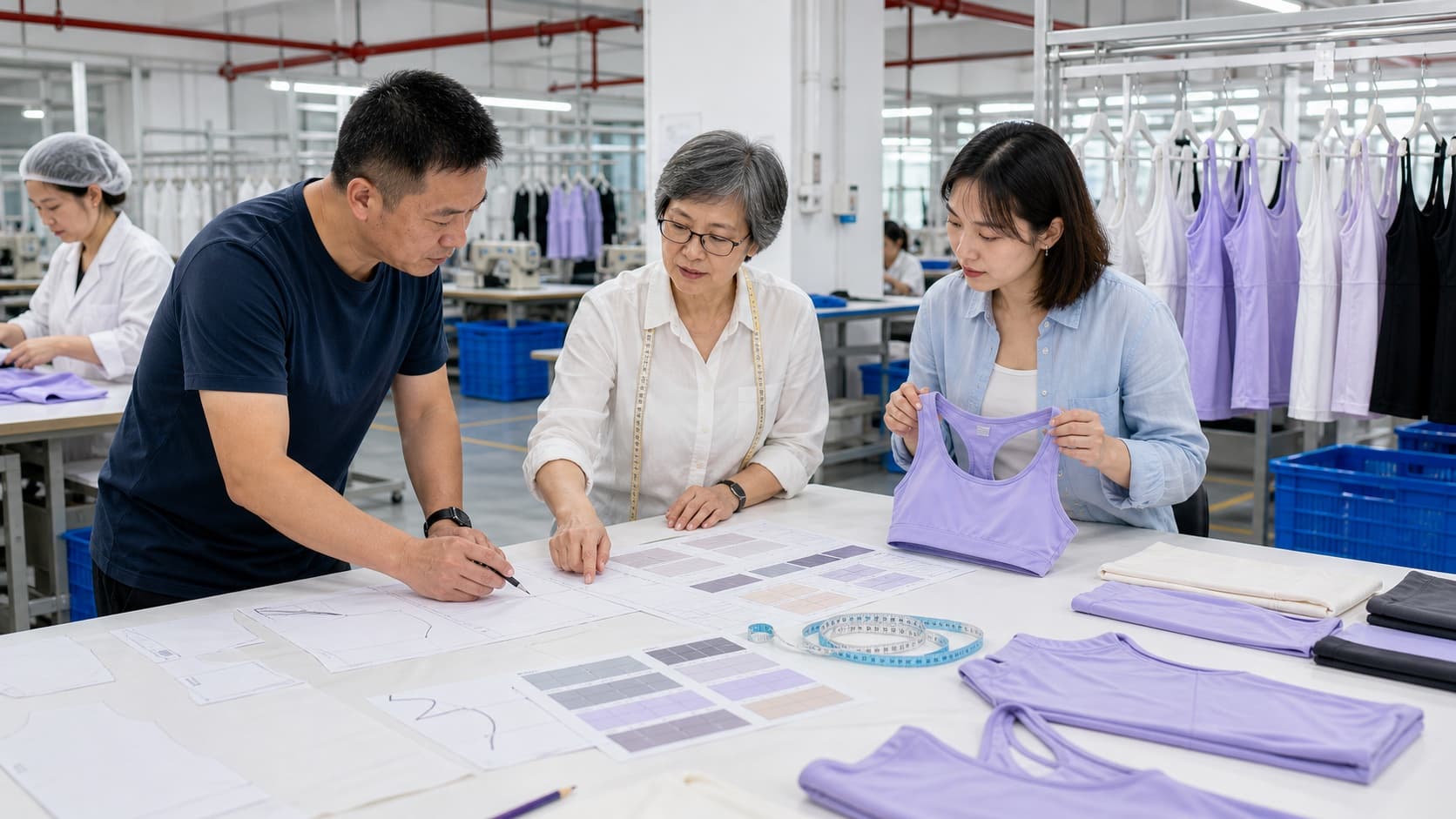
*Factory-context reference: this image illustrates production coordination after product decisions are controlled. It does not prove a Japanese customer order, chosen material, factory assignment, capacity, certification, quality result, or delivery commitment.*
If a project uses more than one cooperating factory or specialist process, keep the same version and approval logic across the handoffs. One partner may handle a selected garment construction while another supports a compatible decoration, wash, or component process. The buyer should see which party owns each step and which approved files move with the work. Coordination does not mean every facility is owned by inPACE, nor does it promise fixed capacity or schedule.
How should a brand compare manufacturer responses?
Compare assumptions before comparing a headline number. Ask every manufacturer to state the route, product reference, material direction, sample purpose, fit and construction questions, branding scope, size-colour direction, packing assumptions, information needed, and open decisions. A proposal based on a different fabric, fewer colours, another logo method, incomplete label files, or no receiving detail is not describing the same project.
Request a short “included, excluded, assumed, and pending” list. Included items show what the response covers. Excluded items prevent a buyer from assuming an undeclared service. Assumptions reveal where incomplete information affected the proposal. Pending items show what must be confirmed before a sample, quotation, or production plan can be treated as current. The how inPACE works page can help structure the transition from inquiry to sample review and production handoff.
What should be in the first activewear manufacturer Japan inquiry?
Use this checklist before sending the same controlled enquiry to potential partners:
- Name the Japanese channel, intended customer, first range purpose, and responsible product owner.
- Give each style an internal SKU, one-sentence product role, and route: existing-style branding, factory custom, or a limited learning discussion.
- Classify every reference as silhouette, fit, material, construction, colour, component, branding, or packing direction.
- State the base size, size range, fit source, measurement units, critical measurement definitions, and grading questions.
- Describe material questions by garment area: handfeel, stretch, recovery, surface, lining, coverage, support direction, structure, and component compatibility.
- Give every sample an ID, purpose, material and colour reference, review size, reviewers, named movements, and approval boundary.
- Supply controlled artwork and record its version, scale, colour, position, application question, label location, and status.
- Name the owner of Japanese fibre, care, responsible-party, product-page, packaging, and channel information.
- State the size-colour and quantity direction without presenting either as a fixed production commitment.
- Describe the receiving point, fold and individual-pack direction, barcode fields where the channel needs them, carton questions, and packing owner.
- Ask the manufacturer to list assumptions, contradictions, missing inputs, sample needs, and decisions that remain with the brand.
- Define what must be reconfirmed when material, fit, grade, colour, branding, market information, or packing changes.
The checklist makes an activewear manufacturer Japan enquiry more comparable without pretending that location alone determines the product. It gives the overseas manufacturing team a controlled basis for discussing the actual garment and gives the Japanese brand a clear place to retain customer, channel, and market responsibility.
What can inPACE discuss from this brief?
inPACE Sports can discuss catalogue-informed product direction, factory-custom activewear development, fit and measurement questions, fabric and trim choices, stretch and coverage observations, support and structure direction, sample planning, branding compatibility, production coordination, QC records, and packing handoff. The work can begin from a brief, reference garment, sketch, sample, or tech pack, provided the purpose and limits of each reference are visible.
The manufacturing judgement behind the discussion draws on wider garment-production experience of more than 30 years through Yinshan Garments. That is experience context, not a claim that the inPACE brand itself has operated for that period. inPACE may coordinate suitable work across multiple cooperating production factories according to the approved product and process needs; it does not imply that every facility is owned, or promise fixed capacity, price, minimum, or delivery timing.
For relevant projects, sampling support can include printing, embroidery, or wash effects when the selected fabric, construction, artwork, placement, and scope make them suitable. Method, cost, sequence, route, and timing remain conditional on the confirmed project and approvals.
Send an activewear product brief to inPACE with the product roles, controlled references, fit and material questions, sample purpose, branding files, packing direction, and approval owners. The first review can identify which items fit an existing-style route, which need factory-custom development, and which information must remain with the brand’s Japanese-market reviewer.
Frequently asked questions
Can a Japanese yoga brand begin with an existing activewear style?
Yes. An existing style can be a practical starting point when the product role is suitable and the main work is confirming colour, logo, labels, hangtags, assortment, and packing. The actual garment, material, fit, application method, quantity direction, and market-facing files still need review. A changed fit, fabric, coverage, support direction, structure, or function needs factory-custom development and sample evidence.
What should be translated in an overseas manufacturing brief?
Translate or clarify every item whose meaning controls the product: measurement names, construction callouts, material and component terms, sample comments, artwork notes, label status, packing instructions, and approval decisions. Keep original and translated versions connected by the same SKU and revision. A bilingual summary is helpful, but it should not create a second uncontrolled specification.
Does a reference image count as a production specification?
No. A reference image can show a silhouette, colour relationship, construction direction, or logo position, but it usually cannot prove fibre composition, measurements, inside construction, stretch recovery, coverage, grading, or approved claims. Mark exactly what the image is intended to communicate and provide controlled files for the decisions that affect sampling and production.
Who should approve labels and consumer information for Japan?
The brand should appoint a responsible owner who can confirm the applicable Japanese requirements for the actual product, seller, channel, and route, with qualified local advice where needed. The manufacturer can provide agreed material and production information and work from approved files, but it should not replace the brand’s market review or decide final consumer-facing wording.
What should the first fit sample prove?
It should answer named questions for a stated style, material, colour, size, wearer, and movement. Examples include waist position, rise, coverage observation, neckline, armhole, strap relationship, support direction, sleeve movement, or logo-zone behaviour. Record the sample ID, reviewer, observation, decision, and remaining open point instead of treating one fitting as approval of every size and colour.
How should Japanese and overseas teams handle sample changes?
Use one consolidated comment record tied to the sample ID and product revision. Number each comment, identify the garment area and evidence, state the requested action, name the approval owner, and close or supersede old comments. Ask the manufacturer to confirm its interpretation before the next sample so a preference is not mistaken for a production instruction.
Can inPACE coordinate printing, embroidery, or wash-effect samples?
inPACE can discuss sampling support that may include printing, embroidery, or wash effects when the selected fabric, construction, artwork, placement, and project scope make them appropriate. The actual method, sample need, production sequence, cost, and timing depend on confirmed materials, components, revision rounds, quantity direction, cooperating-factory schedules, and approvals.
Product directions
Explore relevant activewear products
Use these product pages as practical references for your brief, then confirm materials, fit, customization, and production details through sampling.
Yoga Activewear Catalog
Use the catalog to define product roles and controlled references for a Japanese yoga or fitness brief, while confirming the actual garment, material, fit, colour, branding, and scope.
View product directionZip-Neck Sculpt Set
Use this reference to discuss an opening, close-body relationship, companion-bottom role, layer transition, and the sample questions that need project-specific evidence.
View product directionCustom Activewear Development
Use factory-custom development when the range needs a changed fit, fabric, coverage, support direction, structure, feature, branding area, or controlled sample plan.
View product directionFAQ
Buyer questions
Can a Japanese yoga brand begin with an existing activewear style?
Yes. An existing style can be a practical starting point when the product role is suitable and the main work is confirming colour, logo, labels, hangtags, assortment, and packing. The actual garment, material, fit, application method, quantity direction, and market-facing files still need review. A changed fit, fabric, coverage, support direction, structure, or function needs factory-custom development and sample evidence.
What should be translated in an overseas manufacturing brief?
Translate or clarify every item whose meaning controls the product: measurement names, construction callouts, material and component terms, sample comments, artwork notes, label status, packing instructions, and approval decisions. Keep original and translated versions connected by the same SKU and revision. A bilingual summary is helpful, but it should not create a second uncontrolled specification.
Does a reference image count as a production specification?
No. A reference image can show a silhouette, colour relationship, construction direction, or logo position, but it usually cannot prove fibre composition, measurements, inside construction, stretch recovery, coverage, grading, or approved claims. Mark exactly what the image is intended to communicate and provide controlled files for the decisions that affect sampling and production.
Who should approve labels and consumer information for Japan?
The brand should appoint a responsible owner who can confirm the applicable Japanese requirements for the actual product, seller, channel, and route, with qualified local advice where needed. The manufacturer can provide agreed material and production information and work from approved files, but it should not replace the brand’s market review or decide final consumer-facing wording.
What should the first fit sample prove?
It should answer named questions for a stated style, material, colour, size, wearer, and movement. Examples include waist position, rise, coverage observation, neckline, armhole, strap relationship, support direction, sleeve movement, or logo-zone behaviour. Record the sample ID, reviewer, observation, decision, and remaining open point instead of treating one fitting as approval of every size and colour.
How should Japanese and overseas teams handle sample changes?
Use one consolidated comment record tied to the sample ID and product revision. Number each comment, identify the garment area and evidence, state the requested action, name the approval owner, and close or supersede old comments. Ask the manufacturer to confirm its interpretation before the next sample so a preference is not mistaken for a production instruction.
Can inPACE coordinate printing, embroidery, or wash-effect samples?
inPACE can discuss sampling support that may include printing, embroidery, or wash effects when the selected fabric, construction, artwork, placement, and project scope make them appropriate. The actual method, sample need, production sequence, cost, and timing depend on confirmed materials, components, revision rounds, quantity direction, cooperating-factory schedules, and approvals.